Explained
Wood Routers, Explained
After reading, you'll know whether a compact router will ever do what you need, and why you cannot upgrade your way past a quarter inch collet.
In this guide
Routers are sold on horsepower and speed. The specification that decides what the tool can ever do is the collet, and it cannot be changed later.
The 30-second version
- The collet fixes your bit catalogue, because large-diameter cutters are generally made in half inch shank, and no adapter converts a quarter inch router upward.
- Half inch shanks deflect less, with roughly four times the cross-sectional area, which shows as less chatter even on profiles sold in both sizes.
- Big bits need slow speeds, since rim speed is RPM times cutter circumference, and a large cutter at full speed can burn timber and become dangerous.
- Router horsepower is a peak figure, quoted as maximum or peak on tools drawing six or seven amps, which is the practice that drew a class action in the compressor market.
- Many routers ship fixed-base, so plunge work, meaning mortises and stopped grooves, means budgeting for a second base.
The products this guide is about
Our verdict on each, with the full reasoning on the companion review.
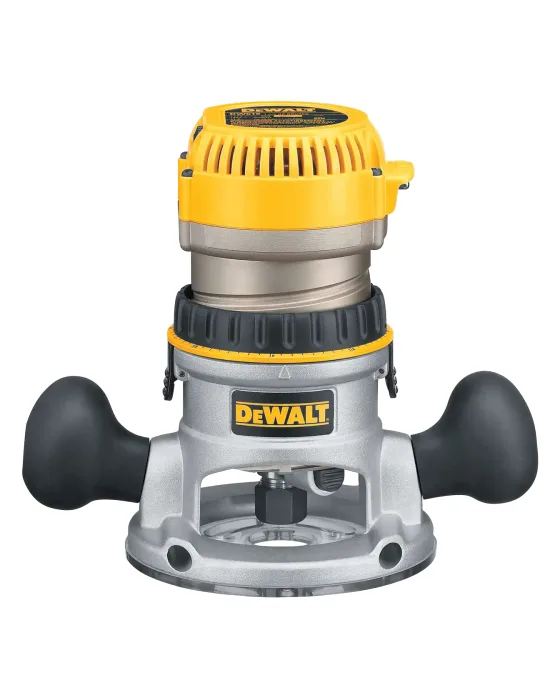
- Buy DEWALT DW618 2-1/4 HP Electronic Variable Speed Fixed Base Router The only router here that takes half inch shanks, which is the difference between some of the bit catalogue and all of it. Amazon
- Buy Makita RT0701C Compact Router The best of the compact routers here on speed range and weight, and one that labels its horsepower figure as a maximum. Amazon
- It depends DEWALT DWP611 1.25 HP Compact Router A well-built compact with the same quarter inch ceiling and a narrower speed range than the Makita it competes with. Amazon
- Skip Makita XTR01Z 18V LXT Brushless Cordless Compact Router Cordless convenience on a tool that usually lives at a bench, with the same quarter inch limit and a battery to buy. Amazon
What actually matters
- Collet size - 1/4 in. on compacts, 1/4 and 1/2 in. on mid-size and larger. Decides which bits fit, permanently, and cannot be upgraded because the collet seats in the motor shaft.
- Speed range - commonly 8,000 to 30,000 RPM. The high end suits small bits, the low end exists for large-diameter cutters that must be slowed to control rim speed.
- Amps - the honest power figure, since horsepower on routers is usually quoted as a peak or maximum. Six to seven amps is typical for compacts, twelve for mid-size.
- Base type - fixed for edge work and tables, plunge for starting cuts in the middle of a workpiece. Many routers ship fixed and sell the plunge base separately.
- Base flatness and concentricity - governs how faithfully the router follows a bearing or a template. Rarely published and worth researching by reputation.
- Soft start - ramps the motor up rather than jolting, which matters more as the tool and the bit get larger.
The specs, in plain English
Green flags vs red flags
Green flags
- Collet sizes are listed explicitly, and both are named if both are supplied.
- The speed range is given as two numbers so the low end is visible.
- Amps are published alongside any horsepower figure.
- Which base is supplied is stated, and available bases are listed.
- Plunge capacity is published for plunge-capable models.
Red flags
- Horsepower leads the listing and is labelled peak or maximum.
- Only a top speed is given, with no floor.
- The collet size is not stated anywhere in the specification.
- Accepts most bits appears with no shank size named.
- Router table ready is claimed on a tool with a quarter inch collet only.
Who's who: the brands
- DEWALT - Publishes both collet sizes on mid-size routers and runs a coherent two-base compact system. The DWP611 compact tops out at a lower speed than the Makita RT0701C.
- Makita - Its RT0701C compact has a 10,000 to 30,000 RPM range and many aftermarket bases are available for it. Labels its horsepower figure as a maximum.
- Bosch - Makes plunge routers and the Colt compact, which competes with the Makita.
- Festool - Router systems built around guide rails and dust extraction, priced accordingly and sold as part of an ecosystem.
- Porter-Cable - Known for the 690 series of mid-size fixed base routers, which many jigs and bases are built around.
How to read a listing without getting fooled
Read the collet size first and treat it as a permanent decision about which bits you can own. Then read the speed range from the bottom, because a low floor signals a router meant for large cutters. Take amps as the power figure and ignore any horsepower quoted as peak or maximum. Check which base is included, since many are fixed, and price the plunge base before deciding the tool is cheap.
How much should you spend?
Budget and mid-range both buy compact quarter inch routers, and the difference between them is speed range, base flatness and how many jigs fit. Premium buys a mid-size router with both collets, which is the only way to reach large-diameter bits and a sensible choice for a router table. Cordless carries a premium for mobility that most routing does not need.
Questions, answered
Is a compact router enough for a beginner?
For most of what beginners do, yes. Edge profiling, roundovers, chamfers, trimming laminate and cutting hinge mortises with a jig are all quarter inch work and all easier with a light one-handed tool. The limitation appears the first time you want a raised panel cutter or a large rail-and-stile set, which are generally half inch shank, and at that point you are buying a second router rather than an accessory.
Why does my router burn the wood?
Usually feeding too slowly, or running a large bit at too high a speed. Both leave the cutter rubbing rather than slicing, which generates heat instead of chips. Slow the router down as bit diameter goes up, keep the feed steady rather than hesitant, and take shallower passes so the cutter is always removing material rather than polishing it.
Which direction should I feed a router?
Against the rotation of the bit, so the cutter pushes back against your feed rather than pulling the tool along. On an outside edge that means moving left to right as you face the work; inside a frame it reverses. Feeding with the rotation is a climb cut, which is faster and grabs, and freehand it can pull the router out of your hands.
Do I need a router table?
Not to start, and it changes what the tool can do. A table turns the router into a small shaper, which is safer and far more accurate for narrow stock, edge profiles and anything repeated. It also makes large bits practical, which is where the collet question returns: most table work worth doing wants half inch shanks, so a table and a quarter inch router is a limiting combination.
Or jump to the head-to-head: DEWALT DW618 2-1/4 HP Electronic Variable Speed Fixed Base Router vs Makita RT0701C Compact Router.