

Tools & DIY
The Best Wood Routers: 4 Compared (and One to Skip)
Four routers compared on the collet size that permanently decides which bits you can ever fit, and on a horsepower figure the industry was supposed to have retired.
The short version
Buy the DEWALT DW618. It is the only router here that ships with both quarter inch and half inch collets, which means large-diameter bits are open to it, and its 2-1/4 HP 12 amp motor runs 8,000 to 24,000 RPM with soft start. That collet is the whole argument and it is not one you can add later. Buy the Makita RT0701C if you want a compact trim router and accept the limit: it runs 10,000 to 30,000 RPM, the widest speed range here, weighs 3.9 pounds and is a common choice for edge work, hinge mortises and laminate. The DEWALT DWP611 is the it-depends, a compact router with a narrower speed range topping out at 27,000 RPM and the same quarter inch ceiling, worth choosing over the Makita mainly if you want the matching plunge base. Skip the Makita XTR01Z unless cordless is the point: it is the same quarter inch compact class, with a plunge capacity of 1-9/16 inches and a battery to buy, for a tool that usually works at a bench next to a socket. Best for: anyone about to buy a compact router without realising the collet decides which bits they can ever own.
Our picks at a glance
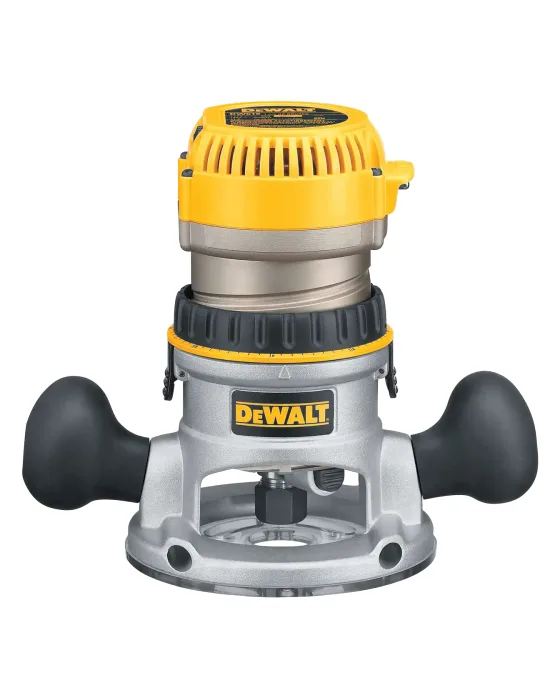
- DEWALT DW618 2-1/4 HP Electronic Variable Speed Fixed Base Router - Buy. The only router here that takes half inch shanks, which is the difference between some of the bit catalogue and all of it.
- Makita RT0701C Compact Router - Buy. The best of the compact routers here on speed range and weight, and one that labels its horsepower figure as a maximum.
- DEWALT DWP611 1.25 HP Compact Router - It depends. A well-built compact with the same quarter inch ceiling and a narrower speed range than the Makita it competes with.
- Makita XTR01Z 18V LXT Brushless Cordless Compact Router - Skip. Cordless convenience on a tool that usually lives at a bench, with the same quarter inch limit and a battery to buy.
The verdict in 30 seconds
What mattered most
- Collet sizes
- Speed range
- Power
- Weight
- Base as supplied
- Plunge capacity published
A router's collet is the one specification you cannot upgrade your way out of. Three of the four tools here take quarter inch shanks only, and that is not a small limitation: the large-diameter bits, raised panel cutters, big roundovers, anything that removes a lot of material in one pass, are made in half inch shank because a quarter inch shank would flex and snap. A half inch shank also grips over a far larger surface area, so it deflects less and chatters less even on bits available in both. Buy a quarter inch router and you have chosen your bit catalogue for the life of the tool. The second thing worth noticing is the horsepower. Makita lists the RT0701C at Maximum Horsepower 1-1/4 HP on a 6.5 amp motor, which is the same peak-figure practice that drew a class action in the air compressor market.
The only router here that takes half inch shanks, which is the difference between some of the bit catalogue and all of it.
Best for: Anyone who will ever want a raised panel cutter, a large roundover or a router table, where half inch shanks are not optional.
- Ships with both 1/4 in. and 1/2 in. collets, so large-diameter bits made only in half inch shank will fit.
- A half inch shank grips over a much larger area, so it deflects and chatters less than the same profile in quarter inch.
- 2-1/4 HP (DEWALT labels it maximum motor HP) from a 12 amp motor with electronic variable speed from 8,000 to 24,000 RPM and soft start.
- The low 8,000 RPM end is what large bits need, since big cutters must be run slower to keep rim speed sane.
- Considerably larger and heavier than the compact routers here, and awkward for one-handed edge work.
- The fixed base version needs a separate plunge base for mortising, which is a further purchase.
- DEWALT quotes 2-1/4 HP as maximum motor HP rather than a continuous output figure.
- Overkill for laminate trimming and hinge mortises, which is what most people actually use a router for.
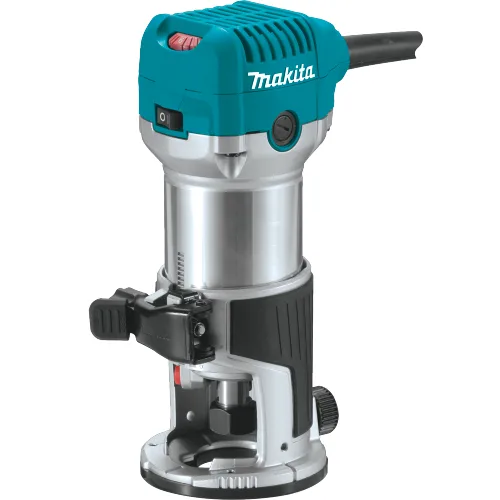
The best of the compact routers here on speed range and weight, and one that labels its horsepower figure as a maximum.
Best for: Edge profiling, laminate trimming, hinge mortises and jig work, which is the large majority of what routers are used for.
- A 10,000 to 30,000 RPM variable range, the widest here, so small bits get the speed they need and larger ones can be slowed.
- At 3.9 lb it is the lightest tool in this comparison, which matters for one-handed edge work.
- Makita publishes the collet size, speed range, amps and weight plainly in one spec table.
- Owners report a range of aftermarket bases and jigs are available for it.
- 1/4 in. collet only, so large-diameter bits are permanently out of reach.
- Makita lists Maximum Horsepower 1-1/4 HP on a 6.5 amp motor, which is a peak figure rather than continuous output.
- Fixed base as supplied, so plunge work needs a separate base.
- 6.5 amps is the least power here, which shows in hardwood if you take too deep a pass.
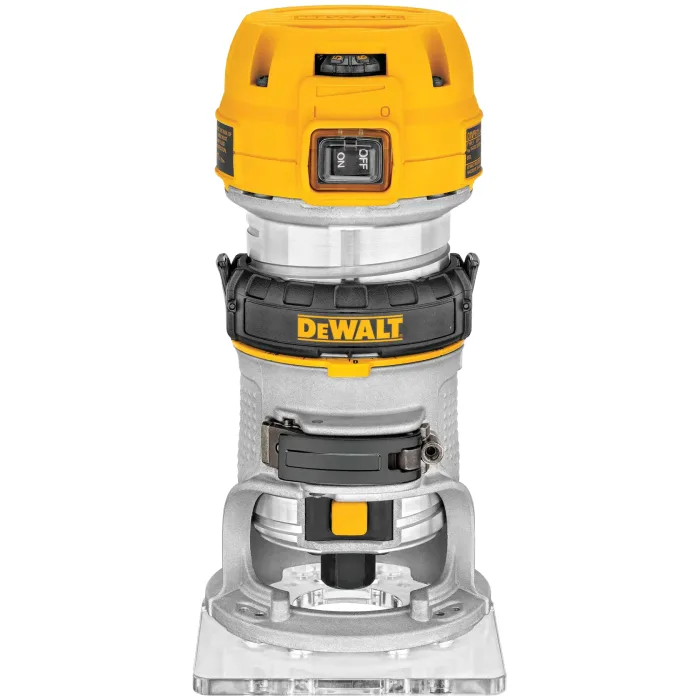
A well-built compact with the same quarter inch ceiling and a narrower speed range than the Makita it competes with.
Best for: Someone building a two-base compact system who values the plunge base and the lighting over the Makita's wider speed range.
- Variable speed to 27,000 RPM from a 7 amp motor, slightly more power than the Makita compact.
- Dual LED lights around the base, which is genuinely useful when following a line on dark timber.
- A matching plunge base is available, making it a straightforward two-base system.
- Owner reports are generally favorable on base flatness and concentricity, which decides how accurately it follows a bearing.
- 1/4 in. collet only, the same permanent limitation as the other compacts.
- A narrower speed range than the Makita, which cannot be slowed as far for the largest bits a compact will take.
- Horsepower is quoted as a peak figure on a 7 amp motor.
- Fixed base as supplied, so plunge capability is another purchase.
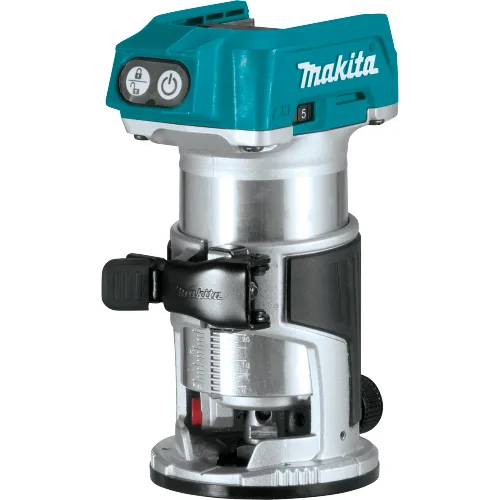
Cordless convenience on a tool that usually lives at a bench, with the same quarter inch limit and a battery to buy.
Best for: Site trimming and edge banding away from power, where the cord is genuinely the obstacle.
- Brushless motor with the same 10,000 to 30,000 RPM range as the corded Makita compact.
- Makita publishes a 1-9/16 in. plunge capacity and a 5-1/4 in. overall length, so the working envelope is stated.
- Genuinely useful for trimming laminate or edge banding away from power, and on site work.
- Constant speed control and an LED, with the same accessory ecosystem as the corded model.
- 1/4 in. collet only, so it carries the compact class limitation at a premium price.
- A router is usually used at a bench next to a socket, so the cordless advantage applies to a narrow slice of the work.
- At 4.6 lb with a battery it is heavier than the corded Makita compact it otherwise matches.
- Bare tool, so batteries and a charger are on top of an already higher price.
| Criteria | DW618 2-1/4 HP Electronic Variable Speed Fixed Base Router Top pick Buy it Buy | RT0701C Compact Router Buy it Buy | DWP611 1.25 HP Compact Router It depends Buy | XTR01Z 18V LXT Brushless Cordless Compact Router Skip it Buy |
|---|---|---|---|---|
| Best for | Anyone who will ever want a raised panel cutter, a large roundover or a router table, where half inch shanks are not optional. | Edge profiling, laminate trimming, hinge mortises and jig work, which is the large majority of what routers are used for. | Someone building a two-base compact system who values the plunge base and the lighting over the Makita's wider speed range. | Site trimming and edge banding away from power, where the cord is genuinely the obstacle. |
| Price tier | $$$ · premium | $$ · mid-range | $$ · mid-range | $$$ · premium |
| Collet sizes | 1/4 in. and 1/2 in. | 1/4 in. only | 1/4 in. only | 1/4 in. only |
| Speed range | 8,000 to 24,000 RPM | 10,000 to 30,000 RPM | To 27,000 RPM | 10,000 to 30,000 RPM |
| Power | 12 amp, 2-1/4 HP | 6.5 amp, 1-1/4 HP maximum | 7 amp, 1.25 HP peak | 18V brushless |
| Weight | Full size | 3.9 lb | Compact | 4.6 lb with battery |
| Base as supplied | Fixed | Fixed | Fixed | Fixed |
| Plunge capacity published | Not for fixed base | Not published | Not published | 1-9/16 in. |
| Horsepower figure type | Labelled maximum motor HP | Labelled maximum | Peak | Not quoted |
Which one is right for you?
- Anyone who will ever want a raised panel cutter, a large roundover or a router table, where half inch shanks are not optional. Buy it DEWALT DW618 2-1/4 HP Electronic Variable Speed Fixed Base Router
- Edge profiling, laminate trimming, hinge mortises and jig work, which is the large majority of what routers are used for. Buy it Makita RT0701C Compact Router
- Someone building a two-base compact system who values the plunge base and the lighting over the Makita's wider speed range. It depends DEWALT DWP611 1.25 HP Compact Router
- Site trimming and edge banding away from power, where the cord is genuinely the obstacle. Skip it Makita XTR01Z 18V LXT Brushless Cordless Compact Router
How we judged the field
Collet size first, because it is the only specification in this comparison that cannot be changed after purchase and it decides which bits will ever fit. Three of the four here are quarter inch only, which is the normal state of the compact router class, and the consequence is that large-diameter cutters are permanently unavailable. Speed range second, read from the bottom up, because the low end is what large bits require and it is the end that separates a full-size router from a compact. Then power, in amps rather than horsepower, since horsepower on these tools is quoted as a maximum or peak figure that describes a moment rather than sustained output. Then the base supplied and what a second base costs, since every router here ships fixed and every one of them needs a plunge base for mortising.
DEWALT DW618 2-1/4 HP Electronic Variable Speed Fixed Base Router
Buy itThe DEWALT DW618 is the pick on a single specification that outranks everything else. It ships with both quarter inch and half inch collets, which means large-diameter bits are available to it, including the raised panel cutters and large roundovers that simply are not made in quarter inch shank because the shank would flex and break. Even on profiles sold in both sizes, the half inch shank grips over roughly four times the cross section, so it deflects less and leaves a cleaner cut. The 2-1/4 HP 12 amp motor runs 8,000 to 24,000 RPM with soft start, and the 8,000 RPM floor is not a throwaway figure: large cutters have to be run slower because rim speed scales with diameter, and the compacts here cannot go that low because they cannot fit the bits that need it. The costs are size and specialisation. It is heavy and awkward for one-handed edge work, it needs a separate plunge base for mortising, and for laminate trimming it is far more router than the job wants.
Makita RT0701C Compact Router
Buy itThe Makita RT0701C is the second buy and the compact most people should own. Its 10,000 to 30,000 RPM range is the widest here, which matters because small-diameter bits need high rim speed to cut cleanly rather than burnish, and at 3.9 pounds it is the lightest tool in this comparison, which is what makes one-handed edge work controllable. Makita publishes collet, speed, amps and weight plainly in one table, and owners report that many aftermarket bases and jigs are built around it, which is a practical advantage that does not appear on any spec sheet. Two things to be clear about. The collet is quarter inch only, which is the permanent limitation of this class rather than a fault of this tool. And Makita lists it at Maximum Horsepower 1-1/4 HP on a 6.5 amp motor, which is a peak figure of the sort that drew a class action in the compressor market; the amps are the honest number and they are the lowest here.
DEWALT DWP611 1.25 HP Compact Router
It dependsThe DEWALT DWP611 is the it-depends, competing directly with the Makita compact and losing narrowly on the specification that matters within the class. It has slightly more motor at 7 amps against 6.5, and owner reports are generally favorable on base flatness and concentricity, which is what decides whether the router follows a bearing accurately rather than wandering. The dual LEDs around the base are genuinely useful on dark timber. Where it falls behind is the speed range: it tops out at 27,000 RPM against the Makita’s 30,000 and does not reach as low at the bottom, which narrows the band of bit sizes it handles well. It carries the same quarter inch collet ceiling and the same peak horsepower quotation, and like the Makita it is supplied fixed-base. The reason to choose it over the Makita is the matching plunge base and the two-base system, which is a real argument if you know you want plunge capability.
Makita XTR01Z 18V LXT Brushless Cordless Compact Router
Skip itThe Makita XTR01Z is the skip, and not because it is a poor tool. It is the corded Makita compact with a brushless motor and a battery, sharing the same 10,000 to 30,000 RPM range, and Makita publishes a 1-9/16 inch plunge capacity and a 5-1/4 inch length so the working envelope is stated. The problem is what cordless buys on this particular tool. A router is overwhelmingly a bench tool or a table tool, used within a metre of a socket, and the jobs where the cord is genuinely the obstacle, trimming edge banding or laminate on site, are a narrow slice of routing. For that slice you pay a premium, add a battery and charger, and carry 4.6 pounds instead of 3.9, all while keeping the same quarter inch collet limitation as its cheaper corded twin. If site trimming is most of your work it is the right tool; for most people it is paying for mobility that routing does not need.
Sources
Specs in this review come from these pages.
- Makita USA, RT0701C compact router specifications (makitatools.com)
- Makita USA, XTR01Z 18V LXT brushless cordless compact router (makitatools.com)
- DEWALT DW618 2-1/4 HP electronic variable speed fixed base router (dewalt.com)
- DEWALT DWP611 1.25 HP compact router (dewalt.com)
- On router bit shank sizes and why half inch shanks deflect less (toolguyd.com)
DEWALT DW618 2-1/4 HP Electronic Variable Speed Fixed Base Router vs Makita RT0701C Compact Router: which should you buy?
The DEWALT DW618 against the Makita RT0701C is not really a contest between two routers, it is a choice between two classes, and the collet is the line between them. The Makita is lighter, faster at the top end, cheaper and better suited to the work most people actually do with a router: profiling edges, trimming laminate, cutting hinge mortises with a jig. For all of that a quarter inch collet is sufficient and the compact body is an advantage rather than a compromise. The DEWALT is heavier, more expensive and clumsy on an edge, and it is the only one of the two that can ever fit a raised panel cutter or a large roundover, or run slowly enough to use one safely. If you know your work stays small, the compact is the better tool and the money saved is real. If there is any chance of a router table or panel work, the collet decides it and nothing else in the comparison matters.
What to look for
- Collet size, before anything else: quarter inch only is a permanent ceiling on which bits will ever fit, and no adapter lifts it.
- The bottom of the speed range: large-diameter bits need low RPM because rim speed scales with cutter diameter, and a floor of 8,000 exists for bits a compact cannot hold.
- Amps rather than horsepower: horsepower here is routinely quoted as a maximum or peak, which describes a moment, while amps describe continuous draw.
- Which base is supplied: all four here ship fixed, and plunge work needs a second base that is a separate purchase.
- Base flatness and concentricity: what decides whether the router tracks a bearing accurately, and rarely published, so reputation has to stand in.
- Whether the model is a common jig fitting: aftermarket bases and jigs are built around a handful of compact routers, which is worth more than a small spec advantage.
Our final take
The collet is the decision. Everything else in a router listing can be worked around, upgraded or lived with, and the shank size cannot. Decide whether large-diameter bits are ever in your future, buy accordingly, and then treat any horsepower figure on the box as decoration and read the amps instead.
Questions, answered
Why does collet size matter so much?
Because it decides which bits physically fit, permanently. Large-diameter cutters, raised panel bits, big roundovers and anything that hogs material are generally made in half inch shank, since a quarter inch shank of that length would flex and eventually snap. Even for profiles sold in both sizes, the half inch shank has roughly four times the cross-sectional area, so it deflects less and chatters less. A quarter inch router is not a router you grow into, it is a router with a fixed catalogue.
Can I fit a half inch collet to a compact router?
No, and the reason is the motor shaft rather than the collet. The collet seats into a taper machined into the end of the armature shaft, and on a compact router that shaft is simply not large enough to accept a half inch bore. Adapters that claim to do it are sleeves that reduce a half inch collet to grip a quarter inch shank, which is the opposite of what you want. If you need half inch bits, you need a bigger router.
Why do big bits need a slower speed?
Because what matters at the cutting edge is rim speed, not shaft speed, and rim speed is the RPM multiplied by the cutter's circumference. A three inch panel cutter at 24,000 RPM is moving its edge several times faster than a half inch roundover at the same setting, fast enough to burn the timber and, on a large cutter, to be dangerous. This is why the full-size router here runs down to 8,000 RPM while the compacts start at 10,000: the low end exists for the bits the compacts cannot fit.
Is horsepower on a router a real number?
Often not. Makita lists the RT0701C at Maximum Horsepower 1-1/4 HP on a 6.5 amp motor, and a maximum or peak figure describes a brief moment rather than sustained output, which is the same peak-figure practice that drew a class action in the air compressor market. The comparable figure is amps, which at least describes what the tool draws continuously, and the practical figure is whether the router bogs down in a cut, which no published number tells you.
Fixed base or plunge?
Fixed base for edge work, profiling and anything in a router table, which is most routing. Plunge for starting a cut in the middle of a workpiece, which means mortises, inlays and stopped grooves. All four routers here are supplied with fixed bases, and plunge bases are available separately for the models we checked, so the practical question is whether you buy the second base now or discover you need it later.
Deciding between the top two? See our head-to-head: DEWALT DW618 2-1/4 HP Electronic Variable Speed Fixed Base Router vs Makita RT0701C Compact Router.
More in Tools & DIY
Wood Routers, Explained Plain-English guide → DEWALT DW618 2-1/4 HP Electronic Variable Speed Fixed Base Router vs Makita RT0701C Compact Router Head-to-head →  The Best Work Gloves: 4 Compared (and One to Skip)
  The Best Work Lights: 4 Compared (and One to Skip)
  The Best Adjustable Wrenches: 4 Compared (and One to Skip)
  The Best Air Compressors: 4 Compared (and One to Skip)