

Tools & DIY
The Best Adjustable Wrenches: 4 Compared (and One to Skip)
We compared four adjustable wrenches against the numbers in the live international standard: how much jaw play is allowed, how thick the head may be, and how much torque the tool has to survive.
The short version
The Channellock 8WCB is the pick, an 8 inch wrench that publishes a 1.54 in jaw capacity at 0.76 lb with a 0.55 in joint thickness, which is genuinely the reach of a 12 inch wrench in a tool you can get into a cabinet. The Crescent ATWJ210VS is the value choice and the better documented one: Crescent prints a jaw thickness for every size, marks the spec block ANSI Meets or Exceeds, and states that each wide jaw wrench meets the ASME performance requirements for the next size up, which its own catalog confirms at 39 mm against 38 mm for its plain 12 inch. The KNIPEX 86 03 250 Pliers Wrench suits anyone working on plated fittings and soft fasteners, because its parallel smooth jaws close with what KNIPEX calls zero backlash and it is the only tool here whose maker addresses jaw play as a design goal rather than a slogan. It is the wrong answer if you want one hand, one setting and a scale. Skip the Milwaukee 48-22-7412: its specification table lists height, length, width, colour, material, weight, pieces and warranty, gives the material as Metal, has no jaw capacity row at all, and publishes no jaw thickness, no head thickness and no standard. Best for: anyone who would rather buy a wrench from a maker who prints the numbers the standard cares about.
Our picks at a glance
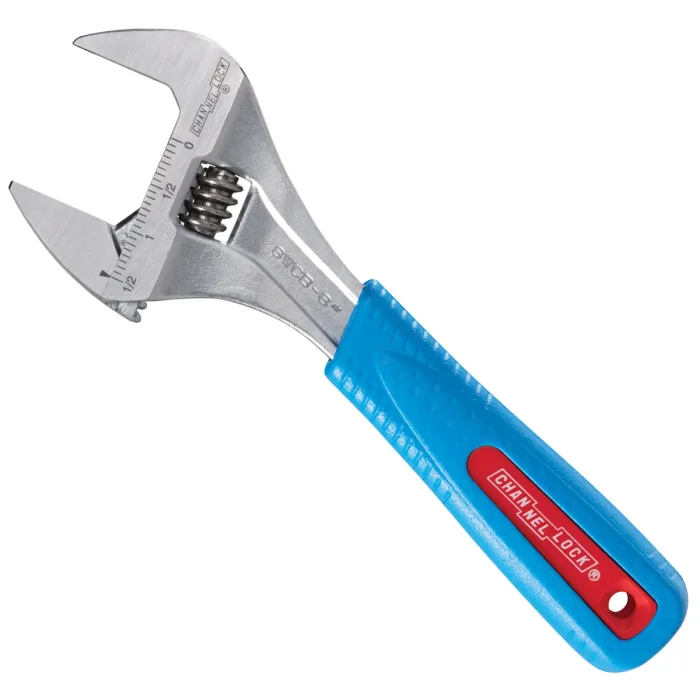
- Channellock 8WCB 8-inch CODE BLUE WideAzz Adjustable Wrench - Buy. An 8 inch wrench that really does open as far as a 12 inch one, at under half the weight, with the head dimension printed.
- Crescent ATWJ210VS 10-inch Wide Jaw Adjustable Wrench - Buy. The only adjustable wrench here whose maker prints a jaw thickness at every size and ties the tool to a named standards body.
- KNIPEX 86 03 250 Pliers Wrench, 250 mm - It depends. The alternative answer to the whole category, and the only tool here whose maker treats jaw play as a design target rather than a marketing line.
- Milwaukee Tool 48-22-7412 12-inch Adjustable Wrench - Skip. Probably a decent wrench, but Milwaukee's page publishes almost nothing you can check, including the jaw capacity.
The verdict in 30 seconds
What mattered most
- Nominal size and published length
- Maximum jaw opening
- Published weight
- Jaw or head thickness published
- Material the maker states
- Standard cited on the product page
Almost everything people say about adjustable wrenches is folklore, and the odd part is that it does not have to be. There is a current international standard for these tools, ISO 6787:2018, and it puts hard numbers on the two things that actually decide whether a wrench rounds a fastener or turns it: how much the movable jaw is allowed to wobble, and how much torque the wrench has to take without bending. Almost no manufacturer prints either number. So we compared four current wrenches on what their makers do publish, and then checked those figures against the standard's own tables.
An 8 inch wrench that really does open as far as a 12 inch one, at under half the weight, with the head dimension printed.
Best for: Someone who wants one wrench in a tool bag and cares more about reach in tight spaces than about paperwork.
- Channellock publishes 1.54 in (39.12 mm) of jaw capacity at 0.76 lb (344.73 g), where its own claim of matching a 12 inch wrench checks out against Crescent's 12 inch at 1.5 in.
- Joint thickness is published at 0.55 in (13.97 mm), inside the 15 mm ceiling ISO 6787 sets on head thickness for a 200 mm wrench.
- Measurement scales are laser engraved with inches on the front and millimetres on the reverse, and the material and origin are both stated: chrome vanadium steel, made in Spain.
- The page names no standard at all, so there is nothing to check the head or the strength against beyond Channellock's own figures.
- Joint thickness is published but jaw tip thickness is not, and the tip is the dimension that decides whether the jaws reach into a recess.
- No jaw play figure and no torque rating appear anywhere on the page, which is true of every wrench here.
- The wide jaw comes with a wide head: joint width is published at 2.87 in on an 8 inch tool, so it needs more swing room around the fastener than a plain 8 inch.
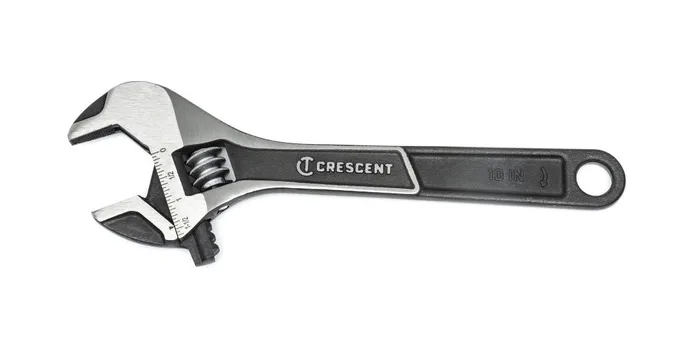
The only adjustable wrench here whose maker prints a jaw thickness at every size and ties the tool to a named standards body.
Best for: Anyone who wants the most published specification per unit of money and does not mind a phosphate finish.
- Crescent publishes a 0.3 in jaw thickness against 0.4 in on its own plain 10 inch, and 1.5 in (39 mm) of opening against 1.312 in (34 mm), so the wide jaw is both thinner and wider.
- The spec block carries an ANSI Specification field reading Meets or Exceeds, and the feature list states that each wide jaw wrench meets the ASME performance requirements for the next size up.
- That claim is checkable inside Crescent's own catalog: the 10 inch wide jaw opens to 1.5 in, exactly what the plain 12 inch opens to, and it carries a Full Lifetime warranty.
- At 1.26 lb it is heavier than Crescent's own plain 10 inch at 1.06 lb, so the extra opening costs you about a fifth of the weight.
- Black phosphate and lacquer is a less durable finish than the chrome on Crescent's standard line, and the page says so by omission rather than by comparison.
- The ASME claim names no edition of the standard, and Crescent publishes no torque figure of its own to go with it.
- The micro-serrations that Crescent credits for grip will mark a plated or soft fastener where a smooth jaw would not.
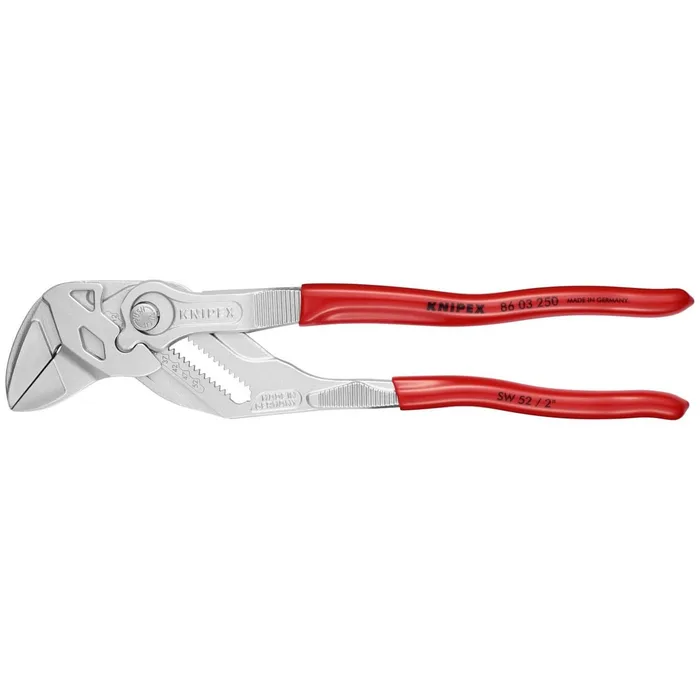
The alternative answer to the whole category, and the only tool here whose maker treats jaw play as a design target rather than a marketing line.
Best for: Anyone who works on chrome traps, brake unions, bike parts or plated fittings, where marking the fastener is the failure that matters.
- KNIPEX publishes parallel, smooth jaws that close with what it calls zero backlash jaw pressure, and states that the mechanism multiplies the applied hand force by ten.
- The dimensions are unusually complete for a gripping tool: 52 mm (2 in) maximum capacity, 19 adjustment positions, jaw thickness 8.0 mm, joint thickness 14.0 mm, tip thickness 8.0 mm, 465 g.
- Smooth jaws are the published reason to buy it, for damage free work on plated fittings and chrome, which is exactly where a serrated adjustable jaw leaves marks.
- It is a plier, not an adjustable wrench, so the ISO 6787 clearance and torque tables that describe the rest of this field do not describe it.
- There is no handle scale to preset a size from: you set it on the fastener with 19 detents rather than dialling in 19 mm.
- The joint measures 14.0 mm thick, so this is not the tool for a fastener sunk in a recess, whatever its jaw tips measure.
- You hold the handles closed while you turn, which is a two handed motion in places where a wrench is a one handed one.
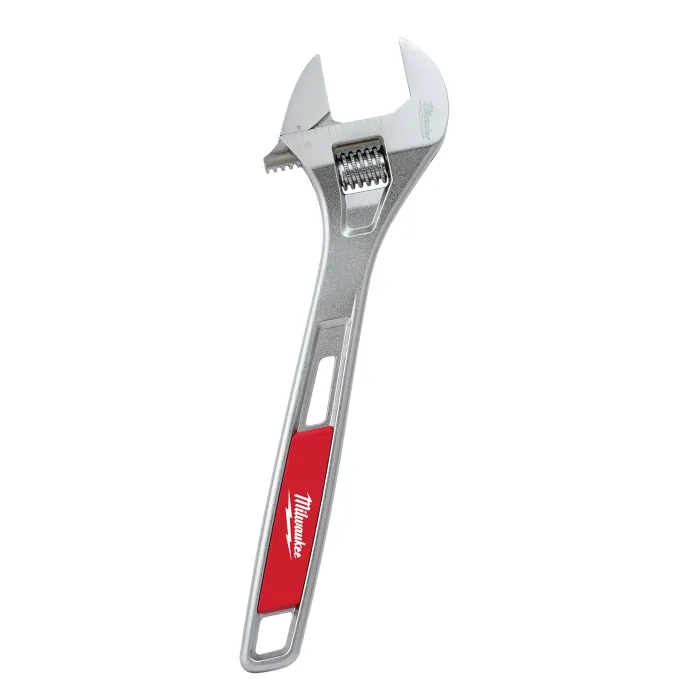
Probably a decent wrench, but Milwaukee's page publishes almost nothing you can check, including the jaw capacity.
Best for: Someone already committed to one brand's hand tool line who is buying on the warranty rather than on the specification.
- Published net weight is 1.715 lb, lighter than Crescent's chrome 12 inch at 1.81 lb, and it carries a Limited Lifetime Warranty.
- The feature list goes straight at the right failure mode: a proprietary adjustment screw so the jaws will not back off, and a parallel jaw design described as not slipping or damaging finished surfaces.
- The tether ready handle loop is a real feature for anyone working above ground, and the other wrenches here do not list one.
- The specification table lists height, length, width, colour, material, weight, number of pieces and warranty. There is no jaw capacity row, so the tool's headline number is not in its own specification.
- No maximum opening appears in the written specification table; it shows up only in product imagery.
- Material is given as Metal. Channellock names chrome vanadium, Crescent names heat treated forged alloy steel.
- No jaw thickness, no head thickness and no standard are cited, so there is no way to tell whether it fits where a thin head fits or what it is built to survive.
| Criteria | 8WCB 8-inch CODE BLUE WideAzz Adjustable Wrench Top pick | ATWJ210VS 10-inch Wide Jaw Adjustable Wrench | 86 03 250 Pliers Wrench, 250 mm | 48-22-7412 12-inch Adjustable Wrench |
|---|---|---|---|---|
| Verdict | Buy it | Buy it | It depends | Skip it |
| Best for | Someone who wants one wrench in a tool bag and cares more about reach in tight spaces than about paperwork. | Anyone who wants the most published specification per unit of money and does not mind a phosphate finish. | Anyone who works on chrome traps, brake unions, bike parts or plated fittings, where marking the fastener is the failure that matters. | Someone already committed to one brand's hand tool line who is buying on the warranty rather than on the specification. |
| Price tier | $$ · mid-range | $ · budget | $$$ · premium | $$ · mid-range |
| Nominal size and published length | 8 in (203.2 mm) | 10 in | 250 mm (about 10 in) | 12 in, though the spec table lists length as 14.2 in |
| Maximum jaw opening | 1.54 in (39.12 mm) | 1.5 in (39 mm) | 52 mm (2 in) gripping capacity | Not in the spec table |
| Published weight | 0.76 lb (344.73 g) | 1.26 lb catalog weight | 465 g | 1.715 lb net weight |
| Jaw or head thickness published | Joint thickness 0.55 in (13.97 mm) | Jaw thickness 0.3 in | Jaw 8.0 mm, joint 14.0 mm, tips 8.0 mm | Neither published |
| Material the maker states | Chrome vanadium steel, made in Spain | Heat treated forged alloy steel, black phosphate | Chrome plated, plastic coated handles | Metal |
| Standard cited on the product page | None | ANSI Specification: Meets or Exceeds, plus ASME performance of the next size up | None, and ISO 6787 covers adjustable wrenches rather than pliers | None |
| What the maker says about jaw play | Precise 4-thread knurl improves adjustment accuracy | Tension spring stabilises the jaw, larger knurl for a tighter fit | Zero backlash jaw pressure, no figure given | Proprietary adjustment screw, jaws will not back off |
| Setting a size | Laser engraved scale, inches one face and millimetres the other | Laser etched scale in SAE and metric | 19 detented positions rather than a scale | Laser etched ruler, described as accurate, no tolerance given |
Which one is right for you?
- Someone who wants one wrench in a tool bag and cares more about reach in tight spaces than about paperwork. Buy it Channellock 8WCB 8-inch CODE BLUE WideAzz Adjustable Wrench
- Anyone who wants the most published specification per unit of money and does not mind a phosphate finish. Buy it Crescent ATWJ210VS 10-inch Wide Jaw Adjustable Wrench
- Anyone who works on chrome traps, brake unions, bike parts or plated fittings, where marking the fastener is the failure that matters. It depends KNIPEX 86 03 250 Pliers Wrench, 250 mm
- Someone already committed to one brand's hand tool line who is buying on the warranty rather than on the specification. Skip it Milwaukee Tool 48-22-7412 12-inch Adjustable Wrench
How we judged the field
Five things decide whether an adjustable wrench is worth owning, and the international standard puts a number on three of them. The first is jaw clearance, the slack between the movable jaw and the fixed one, because that slack is what lets a wrench rock on a fastener and start shaving corners. ISO 6787:2018 allows 0.28 mm on a 200 mm wrench and 0.50 mm on a 600 mm one, and no maker prints its own figure. The second is head thickness, which decides where the tool physically fits; the same table caps it at 15 mm for a 200 mm wrench, 17 mm at 250 mm and 20 mm at 300 mm. The third is jaw tip thickness, capped at 8.5 mm, 11 mm and 13.5 mm at those same lengths, because the tip is what reaches into a recess. The fourth is strength, which the standard tests rather than rates: 230 N.m for a 200 mm wrench, 319 N.m at 250 mm, 609 N.m at 300 mm, applied both ways on a mandrel hardened to at least 55 HRC, with at least 40 HRC required across the whole head. The fifth is opening, where the standard sets a floor rather than a ceiling, which is exactly the gap the wide jaw designs exploit.
The field splits on how much of that a maker is willing to print. Crescent sits at one end: its spec blocks carry a jaw thickness at every size and an ANSI field reading Meets or Exceeds, and the wide jaw line makes a specific, checkable performance claim about the next size up. Channellock sits close behind, publishing joint thickness, capacity and weight to two decimal places but naming no standard. KNIPEX is playing a different game entirely, and is the only maker here that names jaw backlash as a design goal, though its tool is a plier and the adjustable wrench standard does not describe it. Milwaukee sits at the other end, with a specification table that has no jaw capacity row and gives the material as Metal. We picked those four because between them they cover the whole real decision: plain or wide jaw, wrench or pliers, and a maker who publishes against one who does not.
Channellock 8WCB 8-inch CODE BLUE WideAzz Adjustable Wrench
Buy itThe Channellock 8WCB is the tool that made the most sense of all the numbers we gathered. Channellock publishes 1.54 in of jaw capacity, 39.12 mm, in an 8 inch wrench weighing 0.76 lb, and claims that gives you the capacity of a 12 inch wrench in a compact tool. That claim survives checking: Crescent’s plain 12 inch publishes 1.5 in of opening and 1.81 lb, so the Channellock opens slightly further at 42 percent of the weight. The joint is published at 0.55 in, 13.97 mm, which sits inside the 15 mm ceiling ISO 6787 puts on head thickness for a 200 mm wrench, and the scale is laser engraved with inches on one face and millimetres on the other. The material and the origin are both stated, chrome vanadium steel made in Spain, which is more than two of the other three manage. What you do not get is a standard, a jaw tip thickness or a torque figure, and the wide jaw brings a 2.87 in joint width that needs room to swing. For one wrench in a bag, this is the one.
Crescent ATWJ210VS 10-inch Wide Jaw Adjustable Wrench
Buy itThe Crescent ATWJ210VS is the tool to buy if you would rather pay for published specification than for reach. Crescent is the only adjustable wrench maker in this comparison that prints a jaw thickness at every size, and the wide jaw 10 inch comes in at 0.3 in against 0.4 in on its own plain 10 inch, while opening to 1.5 in against 1.312 in. That is thinner and wider at the same time, which is the trade you actually want. The spec block carries an ANSI Specification field reading Meets or Exceeds, and the feature list makes a claim you can test inside Crescent’s own catalog: each wide jaw wrench meets the ASME performance requirements for the next size up. The 10 inch opens to exactly what the plain 12 inch opens to, so the claim holds. The costs are real. It is 1.26 lb against 1.06 lb for the plain 10 inch, the finish is black phosphate rather than chrome, no edition of the ASME standard is named, and the micro-serrations that Crescent credits for grip will mark a plated fastener.
KNIPEX 86 03 250 Pliers Wrench, 250 mm
It dependsThe KNIPEX 86 03 250 Pliers Wrench is the answer to a question the rest of this category cannot answer. Every adjustable wrench here is allowed a fraction of a millimetre of slack between the jaws by the standard that governs it, and none of the makers says what theirs is. KNIPEX designed the slack out instead: parallel jaws that close with what it calls zero backlash jaw pressure, a mechanism it states multiplies applied hand force by ten, and smooth jaw faces meant for damage free work on plated fittings and chrome. The published dimensions are unusually full for a gripping tool: 52 mm maximum capacity, 19 adjustment positions, 8.0 mm jaw thickness, 14.0 mm joint thickness, 8.0 mm tips, 465 g. The catches are real ones. It is a plier, so ISO 6787’s clearance and torque tables do not describe it. There is no scale to preset from, you set it on the fastener. The joint is 14.0 mm thick, so a sunken fastener still beats it. And you squeeze the handles while you turn, which is two hands.
Milwaukee Tool 48-22-7412 12-inch Adjustable Wrench
Skip itThe Milwaukee 48-22-7412 is very likely a fine 12 inch wrench, and that is the problem: there is almost no way to tell from Milwaukee’s own page. The specification table lists height, length, width, colour, material, weight, number of pieces and warranty. It does not list a jaw capacity, which is the one number an adjustable wrench exists to have; the maximum opening is not in the written specification table. Material is given as Metal, where Channellock names chrome vanadium and Crescent names heat treated forged alloy steel. There is no jaw thickness, no head thickness and no standard cited, so nothing about fit or strength can be checked. Milwaukee’s feature list actually points at the right things, a proprietary adjustment screw so the jaws will not back off and a parallel jaw design, plus a tether ready handle loop that none of the other pages list. The published weight of 1.715 lb also undercuts Crescent’s chrome 12 inch at 1.81 lb. It is the documentation, not the tool, that is the reason to buy something else.
Sources
Specs in this review come from these pages.
- ISO 6787:2018 - Assembly tools for screws and nuts, Adjustable wrenches (scope, jaw clearance, hardness, torque test) (iso.org)
- ASME B107.100 - Flat Wrenches (current 2023 edition, 66 pages) (asme.org)
- ASME B107.100-2010 - Revision and Incorporation of ASME B107.6, B107.8, B107.9, B107.21, B107.39, B107.40 and B107.66 (files.asme.org)
- Channellock - 8WCB 8-inch CODE BLUE WideAzz Adjustable Wrench (channellock.com)
- Crescent Tools - ATWJ210VS 10 inch Wide Jaw Adjustable Wrench (crescenttool.com)
- KNIPEX - 86 03 250 Pliers Wrench (knipex.com)
- Milwaukee Tool - 48-22-7412 12 inch Adjustable Wrench (milwaukeetool.com)
- IREGA - adjustable wrench catalogue (jaw thickness, standards cited, left turning models) (angloamericantools.com)
- Unior - Guide, safety tips and proper use of Unior hand tools (adjustable wrench section) (uniortools.com)
Channellock 8WCB 8-inch CODE BLUE WideAzz Adjustable Wrench vs Crescent ATWJ210VS 10-inch Wide Jaw Adjustable Wrench: which should you buy?
Both buys are wide jaw designs, so the choice is not about whether you want extra opening. The Channellock 8WCB is the better tool in the hand: 1.54 in of capacity at 0.76 lb in an 8 inch length, which puts it inside a cabinet or under a sink where the Crescent’s 10 inches of handle will not go, and it publishes the joint thickness that decides whether the head clears. It also tells you what it is made of and where, chrome vanadium steel from Spain, and its scale carries both unit systems on opposite faces. If you are buying one wrench and the constraint is space, that is the one.
The Crescent ATWJ210VS wins on everything you can audit. It is the only adjustable wrench here with a jaw thickness in the spec block, 0.3 in against 0.4 in on Crescent’s own plain 10 inch, and the only one that names a standards body at all, with an ANSI field reading Meets or Exceeds and a stated ASME performance equivalence to the next size up that its own catalog confirms. The trade is weight and finish: 1.26 lb against 1.06 lb for the plain 10 inch, and black phosphate instead of chrome. Buy the Channellock if you want the most jaw for the least tool, the Crescent if you want the maker to have written down what it built.
What to look for
- A published head or joint thickness: ISO 6787 caps head thickness at 15 mm on a 200 mm wrench, 17 mm at 250 mm and 20 mm at 300 mm, so a maker who prints its own figure is telling you where the tool will physically fit.
- A jaw tip thickness, not just a jaw thickness: the same table caps the tip at 8.5 mm, 11 mm and 13.5 mm at those lengths, and the tip is what actually reaches into a recessed fastener while the rest of the head sits outside it.
- Any named standard at all: Crescent’s spec blocks carry an ANSI field, and Channellock’s and Milwaukee’s cite nothing, which tells you how much of the page is checkable.
- A stated alloy, not a stated metal: chrome vanadium and heat treated forged alloy steel are answers, and Metal is not, because ISO 6787 requires at least 40 HRC across the whole head and hardness comes from the steel and the heat treatment.
- Weight against capacity, at the same length: a wide jaw 8 inch at 0.76 lb reaching 1.54 in beats a plain 12 inch at 1.81 lb reaching 1.5 in, and both numbers are printed, so this is the one comparison you can always make.
- How the maker talks about the jaw backing off: nobody publishes a clearance figure, so the language is all you get, and a four thread knurl, a tension spring or a locking adjustment screw are at least the maker acknowledging the actual failure mode.
Our final take
Adjustable wrenches are the rare category where a live standard exists, sets real numbers, and almost nobody quotes it. ISO 6787:2018 will tell you how much jaw slack is allowed, how thick the head may be and how much torque the tool must survive, and it also quietly tells you that an adjustable is tested at four fifths of the fixed wrench of the same size. That is the plain version of the folklore. Buy the Channellock 8WCB if you want the most opening in the smallest head, the Crescent ATWJ210VS if you would rather have a maker that prints a jaw thickness and names a standards body, and the KNIPEX Pliers Wrench if what you touch is plated and marking it is the failure that matters.
Questions, answered
Is there actually a standard for adjustable wrenches, or is this like pipe wrenches?
There is one, and it is current, which is the opposite of what we found when we looked at [pipe wrenches](/best-pipe-wrenches/). ISO 6787:2018, Assembly tools for screws and nuts, Adjustable wrenches, is the third edition, published in March 2018, and it cancelled and replaced ISO 6787:2001. It sets the dimensions of the wrench, the admissible clearance of the adjustable jaw, a hardness floor and a torque test. On the American side, ASME B107.8 covered adjustable wrenches on its own until ASME B107.100-2010 was published as a revision and incorporation of B107.6, B107.8, B107.9, B107.21, B107.39, B107.40 and B107.66. The current edition is ASME B107.100-2023, Flat Wrenches, at 66 pages. So B107.8 is not dead, it is inside B107.100, which is a real difference from a specification that was cancelled outright.
How much jaw wobble is actually allowed?
ISO 6787:2018 gives a number for every size in one table, measured between the adjustable jaw and the fixed jaw under a light force at the jaw, on either side. A 100 mm or 150 mm wrench may have up to 0.25 mm of clearance. A 200 mm or 250 mm wrench may have up to 0.28 mm. A 300 mm or 375 mm wrench may have up to 0.30 mm, a 450 mm up to 0.36 mm and a 600 mm up to 0.50 mm. The standard also requires the jaw to travel through its whole range without binding or wedging. Not one of the four makers here publishes what its own wrenches measure, so the figure exists but you cannot buy on it.
Does any manufacturer publish a torque rating?
None of the four does, and that is the single most useful thing to know about this category. The standard does: ISO 6787:2018 requires a 200 mm wrench to survive 230 N.m on a hexagon mandrel hardened to at least 55 HRC, a 250 mm wrench 319 N.m and a 300 mm wrench 609 N.m, applied in both directions with no permanent deformation afterwards. It also requires at least 40 HRC over the whole head. The closest any maker gets is relative: Crescent states its wide jaw wrenches meet the ASME performance requirements for the next size up, and credits micro-serrations with four times the torque of a traditional adjustable. KNIPEX states its Pliers Wrench multiplies applied hand force by ten. Those are comparisons, not ratings, and none of them tells you the number you would work to.
Do adjustable wrenches really round bolts, or is that a myth?
It is real but it is not mysterious, and the standard quietly admits it. ISO 6787:2018 notes that its own test torques are the values for equivalent fixed wrenches from ISO 1711-1:2016, Table 3, Series C, multiplied by 0.8. In other words, an adjustable wrench is required to take four fifths of what the fixed wrench of the same size takes, and it is allowed up to half a millimetre of jaw clearance where an open end wrench has none. Add those together and you get a tool that grips on two faces with a little slack rather than two faces with none. The makers' own advice is consistent: Unior's hand tool safety guide says to adjust the wrench tightly to the nut and pull so the force is on the side of the fixed jaw, never to pull on a loose fitting wrench, and not to use an adjustable to free a rusted nut or to give the final tightening. So it is slop plus a strength derating, not a curse, and the pull direction matters because the fixed jaw is the strong one.
Is the scale on the handle accurate enough to preset a size?
Treat it as a guide, not a gauge. All four makers put a scale on the tool and none of them publishes a tolerance for it. Channellock laser engraves inches on one face and millimetres on the other and calls it handy for sizing nuts, pipe and tube diameters. Crescent laser etches SAE and metric and says it allows easy fastener size identification. Milwaukee is the boldest, calling its laser etched ruler accurate for size adjustment, again with no number attached. ISO 6787:2018 requires an adjustable wrench to be marked permanently and legibly with just two things, the nominal length in millimetres and the maker's name or trademark, so the scale is not a regulated feature at all. Use it to get close, then close the jaw on the fastener until there is no rock in it.
Deciding between the top two? See our head-to-head: Channellock 8WCB 8-inch CODE BLUE WideAzz Adjustable Wrench vs Crescent ATWJ210VS 10-inch Wide Jaw Adjustable Wrench.
More Tools & DIY reviews
 The Best Air Compressors: 4 Compared (and One to Skip)
  The Best Angle Grinders: 4 Compared (and One to Skip)
  The Best Bar Clamps: 4 Compared (and One to Skip)
  The Best Belt Sanders: 4 Compared (and One to Skip)
  The Best Bench Vises: 4 Compared (and One to Skip)
  The Best Benchtop Planers: 4 Compared (and One to Skip)