

Tools & DIY
The Best Angle Grinders: 4 Compared (and One to Skip)
Four angle grinders compared on the things the makers actually put in writing: switch type and whether it latches on, published restart protection after a power cut, published brake behaviour, and whether anyone prints a vibration or noise figure at all.
The short version
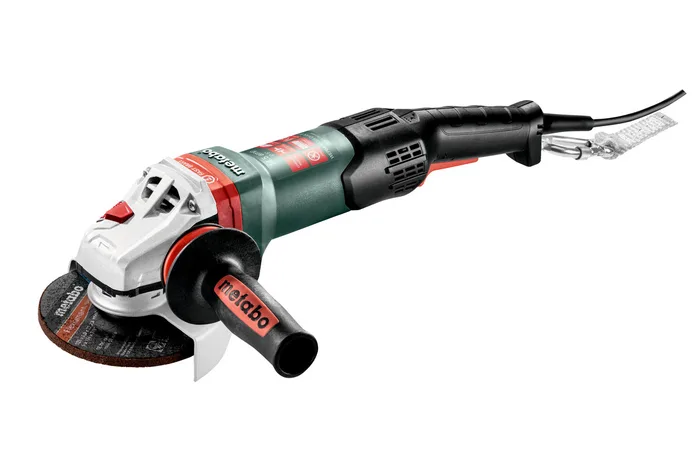
Buy the Metabo WEPBA 17-125 Quick RT DS. It is the only one of the four that publishes hand-arm vibration and noise numbers for the US market, at 6.1 m/s2 for surface grinding and 95 dB(A) sound pressure, and Metabo's own feature list names a mechanical disc brake that stops the disc in 2 seconds after release even during a power failure, plus a deadman switch, restart protection and the S-automatic torque limiting clutch. The Makita GA5053R is the value pick and the most interesting one for anyone who has watched a guard get thrown in a truck: Makita states the guard is non-removable and designed to stay permanently attached, the switch has no lock-on and needs a two-stage lock-off to start, and the manual documents an unintentional restart proof function. The Bosch GWX18V-50PCN suits someone already on 18V who wants the electronics, since Bosch publishes KickBack Control, restart protection, drop control and an X-Brake, but it takes X-LOCK wheels only, so an existing drawer of threaded and 7/8 inch bore discs will not fit it. Skip the DEWALT DWE402: DEWALT's own manual names a lock-on button on the DWE402 that the otherwise identical DWE402N does not have, and DEWALT publishes no restart protection, no brake, and no vibration or noise figures for either. A latching paddle plus no published restart protection is the combination worth avoiding. Best for: anyone cutting rebar, dressing welds, removing rust or notching tile who wants the safety behaviour written down before they buy.
Our picks at a glance
- Metabo WEPBA 17-125 Quick RT DS Angle Grinder - Buy. The only one of the four whose US spec sheet prints a vibration figure and a noise figure you can plan a workday around.
- Makita GA5053R 4-1/2 in. / 5 in. Paddle Switch Angle Grinder with Non-Removable Guard - Buy. Makita states the guard is designed to stay permanently attached, which removes the single most common shortcut people take with these tools.
- Bosch GWX18V-50PCN 18V X-LOCK Angle Grinder with No Lock-On Paddle Switch - It depends. The most electronics of the four and the fastest wheel changes, but it will only take X-LOCK wheels.
- DEWALT DWE402 4-1/2 in. (115mm) Small Angle Grinder - Skip. A capable grinder sold in two versions, and this is the one with the button that latches the paddle on.
The verdict in 30 seconds
What mattered most
- Power
- No-load speed
- Wheel size
- Switch
- Restart protection published
- Brake published
An angle grinder spins a bonded abrasive wheel fast enough that the wheel's own strength is the safety margin, and almost every buying decision that matters is about what happens when something goes wrong. Three of the four tools here publish restart protection, meaning the motor will not spin up on its own when power comes back after an outage; one does not, and that one is also sold with a button that latches the paddle switch on. Only one of the four publishes a vibration figure in metres per second squared or a noise figure in decibels for the US market. We read the manuals and the spec tables rather than the box copy, because the switch behaviour, the brake and the guard are all documented there and nowhere else.
The only one of the four whose US spec sheet prints a vibration figure and a noise figure you can plan a workday around.
Best for: Someone who grinds for a living and wants the maker's own vibration, noise and brake numbers on paper before they commit.
- Publishes 6.1 m/s2 vibration for surface grinding and 4.4 m/s2 for sanding, each with a stated uncertainty of 1.5 m/s2.
- Metabo describes the disc brake as mechanical and patented, stopping the disc in 2 seconds after release even during a power failure.
- Feature list names electronic soft start and restart protection, plus the S-automatic torque limiting clutch for when a disc jams.
- The published 6.1 m/s2 is high enough that trigger time, not battery or cord, becomes the limit on a long day.
- Sound pressure is listed at 95 dB(A) and sound power at 103 dB(A), so hearing protection is not optional with this one.
- Corded only, and at 6 lbs without the cable it is among the heaviest of the four.
- Sits at the top of the category, and the M-Quick nut is a Metabo system rather than a universal one.
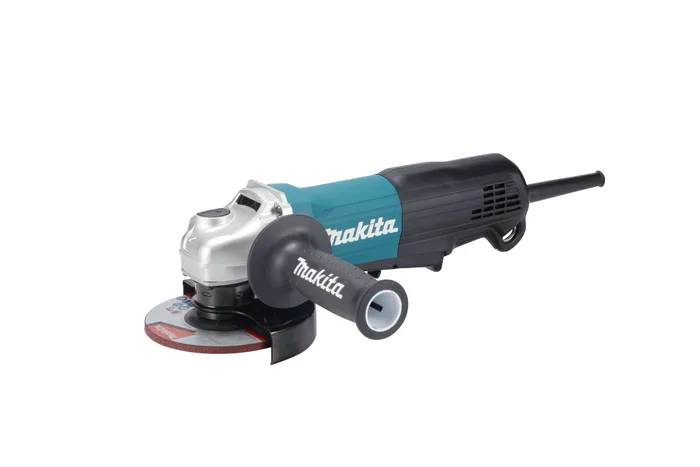
Makita states the guard is designed to stay permanently attached, which removes the single most common shortcut people take with these tools.
Best for: A working buyer who wants the guard question settled at the factory rather than left to a moment of impatience on site.
- Non-removable guard that still rotates tool-free, so there is no trade between adjusting it and keeping it on.
- No lock-on switch at all, and Makita's spec table lists a two-stage lock-off you have to work to start the tool.
- The instruction manual documents an unintentional restart proof function, with a note to wait more than one second before restarting.
- Makita publishes no vibration or noise figures for this model in the US documentation.
- The spec table lists Bind-Up Control as No, so there is no electronic kickback cut-out.
- No brake is listed, so the wheel coasts after you release the paddle.
- The non-removable guard is a hard limit if a job genuinely calls for a different guard type.
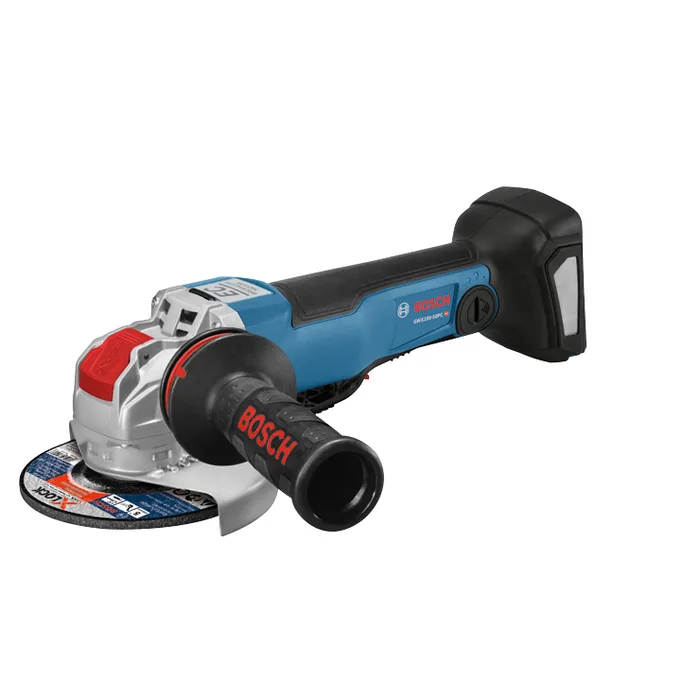
The most electronics of the four and the fastest wheel changes, but it will only take X-LOCK wheels.
Best for: Someone already on an 18V platform who changes wheels constantly and is willing to rebuild their abrasive stock around one mount.
- Bosch publishes KickBack Control, restart protection, drop control and an X-Brake for rapid stopping when the switch is released.
- The X-LOCK mount snaps a wheel on and releases it with a lever, with no spanner, flange nut or loose parts to drop.
- No lock-on paddle switch and a Vibration Control auxiliary handle, at a listed 4.5 lb as a bare tool.
- X-LOCK accessories only, so standard threaded and 7/8 inch bore wheels you already own will not mount.
- Bosch publishes no vibration or noise figures for it on the US product page.
- Sold here as a bare tool, so it only makes sense if you already hold 18V batteries and a charger.
- No-load speed is listed at 9,000 RPM, the slowest of the four.
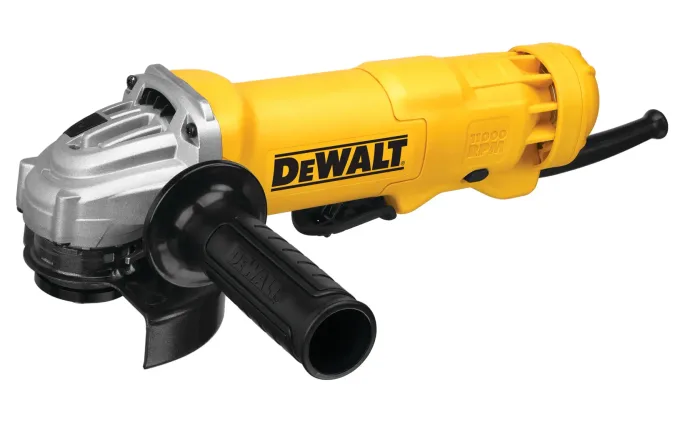
A capable grinder sold in two versions, and this is the one with the button that latches the paddle on.
Best for: Nobody who has the choice, since DEWALT sells the DWE402N with the same motor and no lock-on button.
- 11 amp AC/DC motor at 11,000 RPM, and the manual documents the correct Type 27 and Type 1 guard pairings clearly.
- One-Touch guard rotates through 360 degrees with a single action, and the wheel releases without a wrench.
- Auto-off brushes shut the tool down when the brushes need replacing, which is a real durability feature.
- DEWALT's manual lists a lock-on button for the DWE402 that the otherwise identical DWE402N does not have.
- The published feature list names no restart protection, so a latched-on tool has nothing documented to stop it restarting when power returns.
- No brake of any kind is listed, so the wheel keeps spinning after you let go.
- Neither the US product page nor the manual publishes a vibration figure in m/s2 or a noise figure in dB(A).
| Criteria | WEPBA 17-125 Quick RT DS Angle Grinder Top pick | GA5053R 4-1/2 in. / 5 in. Paddle Switch Angle Grinder with Non-Removable Guard | GWX18V-50PCN 18V X-LOCK Angle Grinder with No Lock-On Paddle Switch | DWE402 4-1/2 in. (115mm) Small Angle Grinder |
|---|---|---|---|---|
| Verdict | Buy it | Buy it | It depends | Skip it |
| Best for | Someone who grinds for a living and wants the maker's own vibration, noise and brake numbers on paper before they commit. | A working buyer who wants the guard question settled at the factory rather than left to a moment of impatience on site. | Someone already on an 18V platform who changes wheels constantly and is willing to rebuild their abrasive stock around one mount. | Nobody who has the choice, since DEWALT sells the DWE402N with the same motor and no lock-on button. |
| Price tier | $$$ · premium | $$ · mid-range | $$$ · premium | $$ · mid-range |
| Power | Corded, 14.5 amps, 1000 W output | Corded, 11 amps | 18V cordless, bare tool | Corded, 11 amps AC/DC |
| No-load speed | 10,000 RPM | 11,000 RPM | 9,000 RPM | 11,000 RPM |
| Wheel size | 5 in (125 mm) | 4-1/2 in and 5 in (115 and 125 mm) | 4-1/2 in to 5 in | 4-1/2 in (115 mm) |
| Switch | Deadman paddle | Paddle, no lock-on, two-stage lock-off | No lock-on paddle | Paddle with lock-on button |
| Restart protection published | Yes, restart protection | Yes, unintentional restart proof | Yes, restart protection | Not published |
| Brake published | Mechanical disc brake, 2 seconds, works during power failure | Not published | X-Brake on switch release | Not published |
| Kickback response published | S-automatic torque limiting clutch | Bind-Up Control listed as No | KickBack Control plus drop control | Not published |
| Vibration and noise published (US) | 6.1 m/s2 grinding, 95 dB(A) sound pressure | Not published | Not published | Not published |
Which one is right for you?
- Someone who grinds for a living and wants the maker's own vibration, noise and brake numbers on paper before they commit. Buy it Metabo WEPBA 17-125 Quick RT DS Angle Grinder
- A working buyer who wants the guard question settled at the factory rather than left to a moment of impatience on site. Buy it Makita GA5053R 4-1/2 in. / 5 in. Paddle Switch Angle Grinder with Non-Removable Guard
- Someone already on an 18V platform who changes wheels constantly and is willing to rebuild their abrasive stock around one mount. It depends Bosch GWX18V-50PCN 18V X-LOCK Angle Grinder with No Lock-On Paddle Switch
- Nobody who has the choice, since DEWALT sells the DWE402N with the same motor and no lock-on button. Skip it DEWALT DWE402 4-1/2 in. (115mm) Small Angle Grinder
How we judged the field
Five things decide whether an angle grinder is a good buy, and none of them is the amp rating. First, the switch: a deadman paddle stops the tool when you let go, a lock-on button defeats that, and the makers state which one you are getting. Second, restart protection, which stops the motor spinning up by itself when power returns after an outage or a tripped breaker. Third, the brake, and specifically whether it is described as mechanical, since a mechanical brake still works when the power has gone. Fourth, the guard: whether it adjusts without tools, and in one case here, whether it comes off at all. Fifth, whether the maker publishes a hand-arm vibration figure in m/s2 and a noise figure in dB(A), because those are the numbers that govern how long you can safely hold the thing.
The field splits neatly along documentation. Metabo publishes a full technical values block with vibration, uncertainty of measurement, sound pressure and sound power, and describes its brake as mechanical and patented. Bosch publishes a long list of named electronic behaviours, including KickBack Control and drop control, but no vibration or noise numbers on the US page. Makita publishes neither, but does something no one else here does and makes the guard non-removable by design. DEWALT publishes the least of the four and is the only one that sells a lock-on variant alongside a no-lock one, which makes the choice between them the entire story. We picked four tools that are all currently listed by their makers, and judged them only on what those makers put in writing.
Metabo WEPBA 17-125 Quick RT DS Angle Grinder
Buy itThe Metabo WEPBA 17-125 Quick RT DS is the only grinder here that tells you what your hands and ears are actually taking. Metabo’s technical values list 6.1 m/s2 for surface grinding and 4.4 m/s2 for grinding with sandpaper, each carrying an uncertainty of measurement of 1.5 m/s2, alongside 95 dB(A) sound pressure and 103 dB(A) sound power. That transparency cuts both ways. The European daily exposure action value for hand-arm vibration is 2.5 m/s2 averaged over eight hours and the limit value is 5 m/s2, so on the directive’s own arithmetic 6.1 m/s2 reaches the action value in roughly an hour and twenty minutes of trigger time. Those thresholds are European rather than American, but the number is real and no rival will even tell you theirs. The rest is unusually well specified: a deadman switch, electronic soft start and restart protection, a patented mechanical disc brake that Metabo says stops the disc in 2 seconds after release even during a power failure, the S-automatic torque limiting clutch for a jammed disc, an autobalancer, and a steel ring for a carabiner. At 14.5 amps and 10,000 RPM on a 5 inch wheel, it is a full day tool. For anyone who grinds for a living, this is the one.
Makita GA5053R 4-1/2 in. / 5 in. Paddle Switch Angle Grinder with Non-Removable Guard
Buy itThe Makita GA5053R answers the question nobody else on this list answers, which is what happens when someone decides the guard is in the way. Makita states the guard is designed to remain permanently attached to the tool, while still rotating tool-free for adjustment. The switch story is just as deliberate: the spec table lists Lock-On Switch as No and Lock-Off Switch as Yes, Makita describes a two-stage power lock-off you must work through to start the tool, and the instruction manual documents an unintentional restart proof function, with a note telling you to wait more than one second before restarting when it engages. The manual gives a rated speed of 11,000 per minute, 115 mm and 125 mm wheel diameters across the two model numbers, a maximum wheel thickness of 7.2 mm and a net weight of 5.5 to 6.0 lbs. What you give up is measurement and stopping: no published vibration or noise figures, no brake, and Bind-Up Control listed flatly as No. There is also an integrated tether loop for work at height. For most buyers this is the sensible one.
Bosch GWX18V-50PCN 18V X-LOCK Angle Grinder with No Lock-On Paddle Switch
It dependsThe Bosch GWX18V-50PCN is the one with the most going on electronically and the biggest string attached. Bosch publishes an unusually specific list of behaviours: KickBack Control that helps shut the tool off if the wheel binds, restart protection that helps prevent accidental startup if the supply of power is interrupted, drop control that shuts the grinder off after it is dropped, an X-Brake for a rapid stop when the switch is released, and soft start. The switch is a no-lock-on paddle, and the auxiliary handle is a Vibration Control unit, though Bosch publishes no vibration number to go with it. The tool is listed at 4.5 lb bare, 9,000 no-load RPM, 5/8-11 UNC spindle, sized for 4-1/2 to 5 inch wheels, and connected-ready through an optional module. The catch is X-LOCK. Wheels snap on and release with a lever, up to five times faster than a threaded nut, but only X-LOCK wheels fit, so a drawer of ordinary 7/8 inch bore discs becomes useless with it. Right for someone on 18V rebuilding their abrasive stock anyway, wrong for anyone who is not.
DEWALT DWE402 4-1/2 in. (115mm) Small Angle Grinder
Skip itThe DEWALT DWE402 is a perfectly competent 11 amp, 11,000 RPM grinder that DEWALT undermines with one component. Look at DEWALT’s own instruction manual, which covers several variants at once: item K is the lock-on button, and it is listed for the DWE402 and DWE402G but not for the DWE402N. Push the lock-off lever back, squeeze the paddle, press the button, and the tool keeps running with your hand off it. Against that, DEWALT’s published feature list for this model names no restart protection and no brake, and neither the US product page nor the manual carries a vibration figure in m/s2 or a noise figure in dB(A). The manual itself is good, with clear guidance that a Type 1 guard must be used for any wheel where surface grinding is forbidden and a warning that side forces on a cut-off wheel may cause it to shatter. The tool is not the problem; the version is. DEWALT already sells the DWE402N with the same motor and no latch, which makes this one hard to recommend to anyone.
Sources
Specs in this review come from these pages.
- OSHA 29 CFR 1910.243, Guarding of portable powered tools (osha.gov)
- OSHA 29 CFR 1926.303, Abrasive wheels and tools (osha.gov)
- oSa, Product marking requirements for bonded abrasives (EN 12413:2019) (osa-abrasives.org)
- FEPA, Safety recommendations for the use of cutting and grinding wheels for angle grinders (fepa-abrasives.org)
- Metabo, WEPBA 17-125 Quick RT DS technical values (metabo.com)
- OSHA 29 CFR 1910.95, Occupational noise exposure (osha.gov)
Metabo WEPBA 17-125 Quick RT DS Angle Grinder vs Makita GA5053R 4-1/2 in. / 5 in. Paddle Switch Angle Grinder with Non-Removable Guard: which should you buy?
The Metabo and the Makita are both built around the idea that the tool should protect you when you stop paying attention, but they spend their money in opposite places. Metabo spends it on measurement and stopping. You get vibration and noise figures on the spec sheet, a mechanical brake described as stopping the disc in 2 seconds even during a power failure, a torque limiting clutch for a jammed disc and an autobalancer, all wrapped around a 14.5 amp motor. Makita spends it on prevention. There is no brake and no published measurement, but the guard is designed not to come off, the switch has no lock-on and needs a two-stage lock-off to start, and the manual documents restart protection. One tool assumes something will go wrong and shortens the consequences; the other assumes people take shortcuts and removes the shortcut.
Choose on how you work rather than on the spec count. If you grind or cut for hours at a stretch, take the Metabo, because a published 6.1 m/s2 lets you reason about trigger time and an unpublished figure does not, and because a wheel that keeps spinning after you release the paddle is a hazard every single time you set the tool down. If the grinder gets shared, lives in a truck, or gets handed to someone less experienced, take the Makita, because the guard cannot be left behind on the last job and the switch cannot be latched on. Either way, pair it with proper eye protection, see our safety glasses and hearing protection picks, and something on your hands from the work gloves comparison.
What to look for
- Read the switch line, not the amp rating: the maker’s spec table will say whether there is a lock-on button, and the lock-on version is usually a different model number from the same maker.
- Look for restart protection by name: Metabo, Bosch and Makita all publish it under their own terms, and a tool that does not name it should be assumed not to have it.
- Check whether the brake is mechanical: Metabo says its disc brake stops the disc in 2 seconds after release even during a power failure, which an electronic brake that needs power cannot promise.
- Compare the tool’s no-load speed to the wheel’s marked speed: a 115 mm wheel is typically marked 13,300 rpm and a 125 mm wheel 12,200 rpm at the usual 80 m/s, so a 12,000 RPM tool leaves very little margin.
- Budget for the cutting guard separately: the open guard in the box is a Type 27 grinding guard, and the closed two-sided Type 1 guard needed for cutting wheels is usually a separate part number.
- Treat a published vibration figure as a feature, not a warning: almost nobody prints one for the US market, and the number you cannot see is not smaller than the number you can.
Our final take
Buy the Metabo WEPBA 17-125 Quick RT DS if you use a grinder seriously. It is the only one of these four that publishes the numbers governing how long you can hold it, and the only one whose brake is described as working through a power cut. Buy the Makita GA5053R if you want the same care applied to prevention instead: a guard that stays on, a switch that cannot be latched, and restart protection documented in the manual. Take the Bosch GWX18V-50PCN only if you are already on 18V and are willing to standardise on X-LOCK wheels. Skip the DEWALT DWE402, not because the motor is poor but because DEWALT sells the identical DWE402N without the lock-on button, and with no published restart protection the latch is the wrong side of a real hazard.
Questions, answered
How do I know a wheel is safe to put on my grinder?
Compare two numbers before anything else. The DEWALT manual states the rule plainly: the rated speed of the accessory must be at least equal to the maximum speed marked on the power tool, because accessories running faster than their rated speed can break and fly apart. The wheel carries both a maximum operating speed in metres per second and a maximum permissible speed of rotation in revolutions per minute, and under EN 12413 both must be marked on the product. In practice a 115 mm wheel at the usual 80 m/s peripheral speed is marked 13,300 rpm and a 125 mm wheel is marked 12,200 rpm, so a 5 inch grinder running 12,000 RPM has very little headroom. OSHA also requires that the spindle speed of the machine be checked before mounting the wheel to be certain it does not exceed the maximum operating speed marked on the wheel.
Do grinding wheels really expire?
Resinoid bonded ones do, and it is a standard requirement rather than a manufacturer's preference. The Organization for the Safety of Abrasives, which administers the oSa mark, states that abrasive products for hand-held machines with bond type B and BF must carry a date of expiry, and that the date of expiry shall at the longest be within 3 years from the date of manufacture, expressed as month and year. Magnesite bonded products get one year. FEPA's own safety leaflet for angle grinder wheels puts it at the top of the do's list: ensure the blade bears the EN 12413 mark and displays an expiry date, and do not use a blade without the EN 12413 mark. This is one of the least known checks in the whole category, and it costs nothing to look.
What does the guard actually have to cover?
For portable grinders, OSHA 1910.243(c)(4) states that the maximum angular exposure of the grinding wheel periphery and sides shall not exceed 180 degrees and the top half of the wheel shall be enclosed at all times. For right angle head or vertical portable grinders, 1910.243(c)(3) sets the same 180 degree maximum and adds that the guard shall be located so as to be between the operator and the wheel during use. The tighter 90 and 125 degree figures people sometimes quote come from 1926.303(c)(1), which applies to floor stand and bench mounted wheels, not to the tool in your hands. On construction sites 1926.303(b)(2) also requires the guard to cover the spindle end, nut and flange projections.
Why do thin cutting wheels shatter?
Because they are only built to take load on their rim. DEWALT's manual says it directly: wheels must be used only for recommended applications, and gives the example that you should not grind with the side of a cut-off wheel, because abrasive cut-off wheels are intended for peripheral grinding and side forces applied to these wheels may cause them to shatter. A Type 27 depressed centre wheel is the one designed for surface grinding, and the thicker 1/4 inch versions are made for it, while thinner Type 27 wheels need their own label checked to see whether they are cleared for surface grinding or edge and cutting work only. That is also why twisting in the cut is on FEPA's don'ts list, and why a Type 1 cutting wheel needs a closed, two-sided Type 1 guard rather than the open Type 27 guard the tool ships with.
Does a grinder restart on its own when the power comes back?
It can, and that is exactly what restart protection is for. Metabo lists electronic soft start and restart protection on the WEPBA 17-125 Quick RT DS, Bosch lists restart protection on the GWX18V-50PCN as helping prevent accidental tool startup if the supply of power is interrupted, and Makita's manual for the GA5053R describes an unintentional restart proof function where the tool will not start while the switch lever is held even when plugged in. DEWALT publishes no equivalent feature for the DWE402, and the DWE402 is also the variant with a lock-on button that keeps the tool running after the paddle is released. A latched switch plus no published restart protection is the combination that turns a tripped breaker into a live tool on the floor. If you have to buy a grinder without restart protection, at least buy the version without the latch.
Deciding between the top two? See our head-to-head: Metabo WEPBA 17-125 Quick RT DS Angle Grinder vs Makita GA5053R 4-1/2 in. / 5 in. Paddle Switch Angle Grinder with Non-Removable Guard.
More Tools & DIY reviews
 The Best Bar Clamps: 4 Compared (and One to Skip)
  The Best Belt Sanders: 4 Compared (and One to Skip)
  The Best Bench Vises: 4 Compared (and One to Skip)
  The Best Benchtop Planers: 4 Compared (and One to Skip)
  The Best Block Planes: 4 Compared for Fine Woodworking
  The Best Brad Nailers: 4 Compared (and One to Skip)