

Tools & DIY
The Best Brad Nailers: 4 Compared (and One to Skip)
Four 18 gauge brad nailers compared on the one specification with a published injury statistic behind it: whether the trigger fires sequentially or on contact.
The short version
Buy the DEWALT DCN680B. It has a tool-free selectable trigger, so sequential mode is one switch away rather than buried, and it drives 18 gauge brads from 5/8 to 2-1/8 inches, the longest range here, from a brushless motor with no compressor, hose or oil anywhere. Buy the Makita XNB01Z if an explicit selector and depth control matter more: it holds up to 100 nails and pairs a two-mode selector switch for contact or sequential with a tool-less depth dial. The CRAFTSMAN CMPBN18K is the it-depends and it is the safest actuation in this comparison, because it is described as a sequential drive mechanism rather than a selectable one, which removes the choice in the right direction. At 4.91 pounds it is also the lightest listed here and the cheapest, provided you already own a compressor. Skip the DEWALT DWFP12231 unless you are committed to air: it drives to 2 inches rather than 2-1/8, and once you add a compressor, hose and fittings it costs more than a cordless nailer that does the same work. Best for: anyone buying a nailer on magazine size who has not read what the trigger selector actually does.
Our picks at a glance
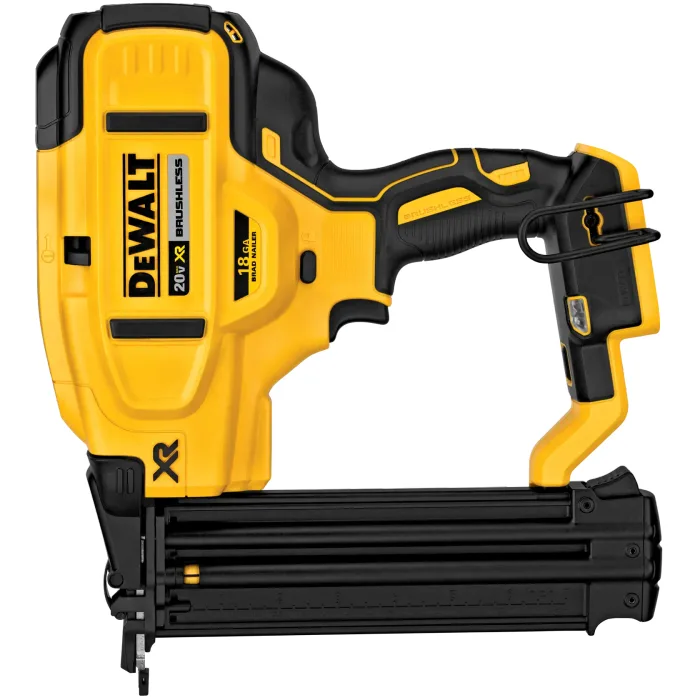
- DEWALT DCN680B 20V MAX XR 18 Gauge Cordless Brad Nailer - Buy. The longest nail range here with a tool-free trigger selector, so the safer sequential mode is a switch rather than a service operation.
- Makita XNB01Z 18V LXT Lithium-Ion Cordless 18 Gauge Brad Nailer - Buy. A 100-nail magazine, with the trigger mode on an explicit two-position selector switch.
- CRAFTSMAN CMPBN18K 18 Gauge Pneumatic Brad Nailer - It depends. Ships with a sequential trigger rather than a selector, which removes the trigger choice in the safer direction.
- DEWALT DWFP12231 18 Gauge Pneumatic Brad Nailer Kit - Skip. A capable air nailer whose real price includes a compressor, on a job a cordless tool now does without one.
The verdict in 30 seconds
What mattered most
- Trigger actuation
- Nail range
- Power source
- Magazine capacity
- Weight
- Depth adjustment
Almost every specification on a nail gun is a convenience. One is not. Research on residential carpentry found the risk of a nail gun injury roughly twice as high with a multi-shot contact trigger as with a single-shot sequential one, and that more than half the injuries from contact-trip tools would have been prevented by sequential firing. The mechanism is simple and nasty: a contact trip gun reloads automatically after firing, so if your finger is still on the trigger when the nose bumps anything, it fires again. Most modern nailers offer both modes on a selector, which means the safety decision is not made in the shop when you buy the tool, it is made every time you pick it up. That is the specification worth reading first, and the one that listings mention in passing between magazine capacity and weight.
The longest nail range here with a tool-free trigger selector, so the safer sequential mode is a switch rather than a service operation.
Best for: Trim and moulding work away from a compressor, where the nail range and switchable actuation matter more than weight.
- A tool-free selectable trigger for sequential or contact actuation, which puts the mode with half the injury rate within reach at any moment.
- Drives 18 gauge brads from 5/8 in. to 2-1/8 in., the longest range in this comparison.
- Brushless motor and no compressor, hose, oil or fittings to buy, maintain or drag around.
- Integrated tool-free stall release lever to reset the driver blade when the tool jams, which on a nailer is a routine event.
- At 6.34 lb bare it is heavier than both pneumatic tools here, and a nailer is held at odd angles for long stretches.
- Bare tool, so batteries and a charger are a substantial separate cost.
- Cordless nailers can have a short delay between trigger and drive compared with pneumatic, which takes adjusting to.
- Check which trigger mode the tool is set to before the first nail.
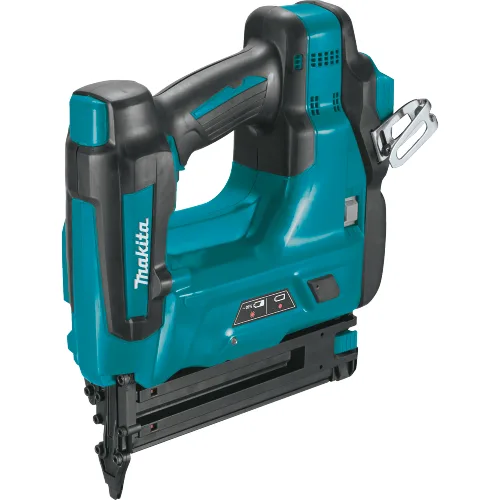
A 100-nail magazine, with the trigger mode on an explicit two-position selector switch.
Best for: Long runs of trim and moulding where reloading interrupts the rhythm and depth needs frequent adjustment.
- A two-mode selector switch for contact or sequential nailing, stated plainly in the specification rather than implied.
- Magazine capacity of up to 100 nails, which matters on long runs of trim.
- Tool-less depth dial, so nail depth can be corrected on the spot rather than with a wrench.
- Cordless on the LXT platform, so no compressor and no hose across the floor.
- Drives to 2 in. rather than the DEWALT's 2-1/8, which occasionally matters on thicker casing.
- Bare tool, so the platform cost applies unless you already own LXT batteries.
- Brushed motor, so run time per charge is shorter than a brushless equivalent.
- The default trigger mode out of the box is not stated on the product page.
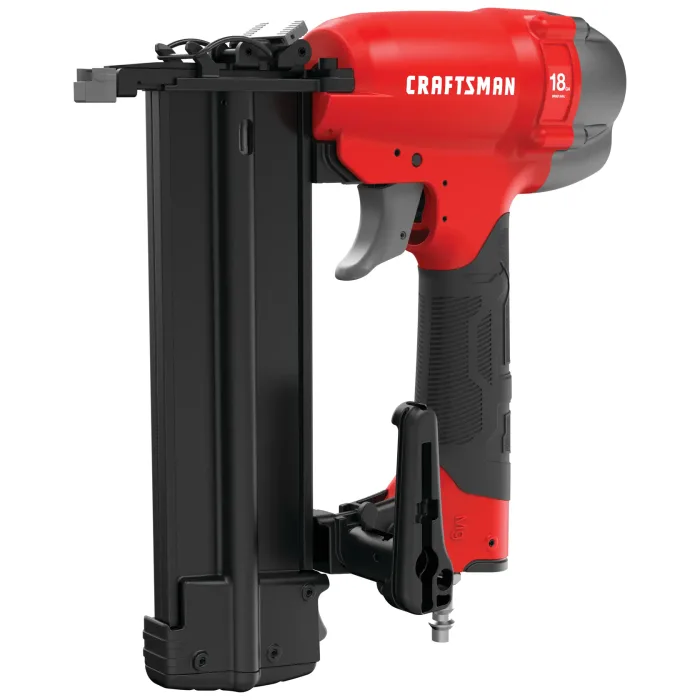
Ships with a sequential trigger rather than a selector, which removes the trigger choice in the safer direction.
Best for: Anyone who already owns a compressor and would rather the tool make the safe choice for them.
- Assembled with a sequential action trigger per the manual, the actuation mode with roughly half the injury rate.
- At 4.91 lb as listed it is the lightest tool here, which is what you feel after an hour overhead.
- Operates on 70 to 120 PSI, a range any small compressor will deliver.
- The cheapest nailer in this comparison by a large margin if a compressor is already in the shop.
- Pneumatic, so it needs a compressor and a hose, none of which is included in the price you compare.
- Drives to 2 in., matching the Makita and short of the DEWALT cordless.
- 100-nail magazine, slightly behind the cordless DEWALT's 110.
- Ships with a sequential trigger only, which is a genuine speed cost on large production runs even though it is the safer arrangement.
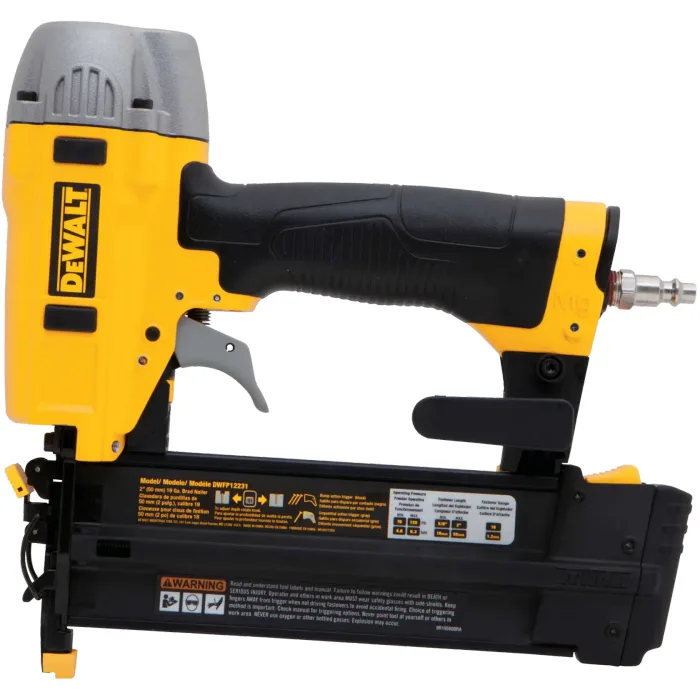
A capable air nailer whose real price includes a compressor, on a job a cordless tool now does without one.
Best for: A shop that already runs air for other tools and wants the instant, weightless feel that pneumatic still does best.
- Tool-free depth-of-drive adjustment with detents, so nail set depth repeats rather than being dialled by feel.
- Tool-free jam release mechanism, which matters because clearing a jam is a frequent job on any nailer.
- Pneumatic tools fire instantly with no spin-up delay, which cordless nailers still cannot match.
- Light in the hand compared with any cordless nailer, because the power source is at the other end of a hose.
- Drives to 2 in., where the cordless DEWALT reaches 2-1/8 for the same gauge.
- Needs a compressor, hose and fittings, which is the actual cost of ownership and is not in the sticker price.
- A hose across a finished floor is the practical objection to air nailers for trim work.
- Needs compressor moisture management that battery tools do not.
| Criteria | DCN680B 20V MAX XR 18 Gauge Cordless Brad Nailer Top pick Buy it Buy | XNB01Z 18V LXT Lithium-Ion Cordless 18 Gauge Brad Nailer Buy it Buy | CMPBN18K 18 Gauge Pneumatic Brad Nailer It depends Buy | DWFP12231 18 Gauge Pneumatic Brad Nailer Kit Skip it Buy |
|---|---|---|---|---|
| Best for | Trim and moulding work away from a compressor, where the nail range and switchable actuation matter more than weight. | Long runs of trim and moulding where reloading interrupts the rhythm and depth needs frequent adjustment. | Anyone who already owns a compressor and would rather the tool make the safe choice for them. | A shop that already runs air for other tools and wants the instant, weightless feel that pneumatic still does best. |
| Price tier | $$$ · premium | $$$ · premium | $ · budget | $$ · mid-range |
| Trigger actuation | Tool-free selectable sequential or contact | Two-mode selector, contact or sequential | Sequential drive mechanism | Sequential style trigger |
| Nail range | 5/8 to 2-1/8 in. | 5/8 to 2 in. | 5/8 to 2 in. | 5/8 to 2 in. |
| Power source | 20V cordless brushless | 18V cordless brushed | Pneumatic, 70 to 120 PSI | Pneumatic |
| Magazine capacity | 110 nails | Up to 100 nails | 100 nails | 100 nails |
| Weight | 6.34 lb bare | 7.7 lb with battery | 4.91 lb | 5.15 lb |
| Depth adjustment | Tool-free | Tool-less dial | Adjustable | Tool-free with detents |
| Jam or stall release | Tool-free stall release | Not published here | Not published here | Tool-free jam release |
Which one is right for you?
- Trim and moulding work away from a compressor, where the nail range and switchable actuation matter more than weight. Buy it DEWALT DCN680B 20V MAX XR 18 Gauge Cordless Brad Nailer
- Long runs of trim and moulding where reloading interrupts the rhythm and depth needs frequent adjustment. Buy it Makita XNB01Z 18V LXT Lithium-Ion Cordless 18 Gauge Brad Nailer
- Anyone who already owns a compressor and would rather the tool make the safe choice for them. It depends CRAFTSMAN CMPBN18K 18 Gauge Pneumatic Brad Nailer
- A shop that already runs air for other tools and wants the instant, weightless feel that pneumatic still does best. Skip it DEWALT DWFP12231 18 Gauge Pneumatic Brad Nailer Kit
How we judged the field
Trigger actuation first, because it is the only specification in this category with a measured injury statistic attached to it and because it is usually mentioned in passing. Contact triggers carry roughly double the injury rate of sequential ones in residential carpentry research, and more than half of those injuries are estimated to be preventable by sequential firing, so whether a tool offers the safer mode, and how easy it is to reach, is the first question. Then nail range, since the difference between 2 and 2-1/8 inches decides whether thicker casing can be fastened in one go. Then magazine capacity and depth adjustment, which decide the rhythm of the work. Then the real cost, which for a pneumatic tool includes a compressor, a hose and fittings that never appear in the price comparison.
DEWALT DCN680B 20V MAX XR 18 Gauge Cordless Brad Nailer
Buy itThe DEWALT DCN680B is the pick because it handles the safety question well and the practical ones better than anything else here. Its trigger selector is tool-free, which matters more than it sounds: a mode switch that needs a hex key gets set once and forgotten, while one you can flick means sequential mode is genuinely available for the fiddly parts of a job and contact mode for the repetitive parts. It drives brads from 5/8 to 2-1/8 inches, the longest range in this comparison, and the extra eighth is occasionally the difference on thicker casing. There is no compressor, hose, oil or moisture trap anywhere in the picture, and the tool-free stall release deals with the jams that every nailer produces. The costs are honest ones. At 6.34 pounds bare it is heavier than either pneumatic tool here and you feel it working overhead; it is a bare tool, so batteries and a charger land on top; and cordless nailers can have a short delay between trigger and drive that pneumatic users notice.
Makita XNB01Z 18V LXT Lithium-Ion Cordless 18 Gauge Brad Nailer
Buy itThe Makita XNB01Z is the second buy and the better choice for long runs. Its magazine holds up to 100 nails, which sounds trivial until you are working along a room’s worth of shoe moulding and every reload breaks the rhythm. It states its two-mode selector plainly in the specification rather than leaving it to the manual, and the tool-less depth dial means correcting a proud or overdriven nail is a two-second adjustment rather than a hunt for a wrench. Being cordless, it removes the hose from a finished floor. The limitations are modest: it drives to 2 inches rather than 2-1/8, so the thickest casing is out; it is a bare tool on the LXT platform; and it is a brushed motor, which costs run time per charge against a brushless equivalent. The product page does not say which mode the tool arrives in.
CRAFTSMAN CMPBN18K 18 Gauge Pneumatic Brad Nailer
It dependsThe CRAFTSMAN CMPBN18K is the it-depends, and it is genuinely the safest tool in this comparison, which is not how a budget option usually earns its place. It is specified as a sequential drive mechanism rather than a selectable one, meaning the actuation mode with roughly half the injury rate is the only mode available. Removing the choice removes the possibility of leaving it on the fast setting and forgetting. At 4.91 pounds it is lighter than the cordless DEWALT, which is a comfort difference in this group, and it runs on 70 to 120 PSI, which any small compressor delivers. The catch is the compressor itself, plus hose and fittings, none of which is in the price you compare on a shelf. And shipping with a sequential trigger only is a real speed cost on production runs, even though for trim work it barely registers.
DEWALT DWFP12231 18 Gauge Pneumatic Brad Nailer Kit
Skip itThe DEWALT DWFP12231 is the skip, and not because it is a poor tool. It has tool-free depth adjustment with detents, so depth settings repeat rather than being re-found by feel, and a tool-free jam release, both of which are genuinely well executed. Pneumatic tools also fire instantly with no spin-up, which no cordless nailer matches, and they are light in the hand because the motor is at the other end of a hose. The problem is that it drives to 2 inches where its own cordless sibling reaches 2-1/8, and that its real price includes a compressor, a hose and fittings. Once those are counted it costs more than the cordless DEWALT that does the same job without dragging a line across a finished floor. If you already run air for other tools, buy it. If this nailer would be the reason to buy a compressor, it is the wrong end of the decision.
Sources
Specs in this review come from these pages.
- CPWR, understanding the risk, on contact trip triggers carrying double the injury rate (cpwr.com)
- OSHA and NIOSH, Nail Gun Safety: A Guide for Construction Contractors (osha.gov)
- DEWALT DCN680B 20V MAX XR 18 gauge cordless brad nailer (dewalt.com)
- Makita USA, XNB01Z 18V LXT cordless brad nailer (makitatools.com)
- CRAFTSMAN CMPBN18K 18 gauge pneumatic brad nailer (craftsman.com)
DEWALT DCN680B 20V MAX XR 18 Gauge Cordless Brad Nailer vs Makita XNB01Z 18V LXT Lithium-Ion Cordless 18 Gauge Brad Nailer: which should you buy?
The two DEWALTs make the cordless-against-air comparison cleanly, since they share a maker and a gauge. The pneumatic DWFP12231 fires instantly, weighs less in the hand, and costs much less on the shelf. The cordless DCN680B drives an eighth of an inch longer, has a brushless motor and a tool-free stall release, and needs nothing else to work. The decision is really about what you already own. A shop with air already plumbed should buy the pneumatic without hesitation, because the marginal cost is the tool alone and the instant response is a genuine advantage on precise placement. Someone buying their first nailer for trim should look at the total: a compressor, a hose and fittings against a battery and a charger, at which point the cordless is cheaper, quieter and does not put a hose across a finished floor.
What to look for
- Which trigger modes the tool offers and how the mode is changed: contact triggers carry roughly double the injury rate, and a tool-free selector is what makes the safer mode actually get used.
- Whether a sequential-only tool suits you: removing the choice removes the risk of leaving it on the fast setting, which for trim work costs almost no time.
- Nail length range: the spread here is 2 to 2-1/8 in., and the extra eighth decides whether thicker casing fastens in one pass.
- Magazine capacity: 100 to 110 nails in this group, which sets how often a long run of moulding is interrupted.
- Tool-free depth adjustment and jam release: both are frequent operations, and doing either with a wrench is how nailers end up set wrong.
- The real cost of pneumatic: a compressor, hose and fittings are part of the purchase and never part of the shelf price.
Our final take
Nailer listings compete on magazine size and weight, and the specification that carries a measured injury statistic is the trigger. Decide the actuation question first, either by buying a sequential-only tool or by buying one whose selector is easy enough that you will actually use it. Then read the nail range, and then work out what a pneumatic tool really costs once the air is included.
Questions, answered
What is the difference between a sequential and a contact trigger?
On a sequential trigger you must press the nose against the work first and then pull the trigger, and the tool fires one nail per trigger pull. On a contact or bump trigger you can hold the trigger down and fire simply by bumping the nose against the work, which is much faster. The safety difference is measured rather than theoretical: research in residential carpentry found roughly double the injury rate with contact triggers, and that more than half of those injuries would have been prevented by sequential firing. The gun reloads automatically after each shot, so with the trigger held down anything the nose touches becomes a shot.
If contact mode is riskier, why does anyone use it?
Speed, and it is a real difference rather than a marginal one on production work like sheathing or subfloor. The trade is that the speed advantage shrinks the more precision the job needs, and trim work with an 18 gauge brad nailer is precision work. For most people fitting moulding and casing in a house, sequential mode costs almost nothing in time and removes the failure mode where a stumble or a recoil bounce puts a second nail somewhere unplanned.
What is 18 gauge good for, and when do I need 16 or 15?
Gauge is wire thickness and the numbering runs backwards, so 18 gauge is thinner than 16. An 18 gauge brad leaves a very small hole that often needs no filling and holds light trim, shoe moulding, casing and small assemblies without splitting thin stock. Sixteen and fifteen gauge finish nails are thicker, hold considerably more, and leave a hole you will fill. If you are attaching baseboard to studs or hanging doors, you want a finish nailer; for decorative trim and small work, 18 gauge is the right tool.
Do I still need a compressor?
Not for this class of tool. Cordless 18 gauge nailers now drive the same fasteners without a compressor, hose, fittings or oil, and for trim work in a finished house the absence of a hose dragging across the floor is worth real money. Pneumatic still wins on instant response, since cordless nailers have a short delay while the mechanism readies, and on weight in the hand, because the power source is at the far end of the hose. If you already run air, the pneumatic tools are much cheaper.
Why does my nailer leave nails proud of the surface?
Usually depth of drive, and on a pneumatic tool it can also be air pressure. Every nailer here has a depth adjustment, and on the tool-free versions it is a dial rather than a wrench job. Set it on a scrap of the same material rather than on the workpiece. If depth is set correctly and nails still sit proud on a pneumatic, check that the compressor is holding pressure in the working range, which for the CRAFTSMAN here is 70 to 120 PSI.
Deciding between the top two? See our head-to-head: DEWALT DCN680B 20V MAX XR 18 Gauge Cordless Brad Nailer vs Makita XNB01Z 18V LXT Lithium-Ion Cordless 18 Gauge Brad Nailer.
More in Tools & DIY
Brad Nailers, Explained Plain-English guide → DEWALT DCN680B 20V MAX XR 18 Gauge Cordless Brad Nailer vs Makita XNB01Z 18V LXT Lithium-Ion Cordless 18 Gauge Brad Nailer Head-to-head →  The Best Caulk Guns: 4 Compared (and One to Skip)
  The Best Circuit Breaker Finders: 4 Compared (and One to Skip)
  The Best Circular Saws: 4 Compared (and One to Skip)
  The Best Clamp Meters: 4 Compared (and One to Skip)