Explained
Brad Nailers, Explained
After reading, you'll know which trigger setting to use and when, and whether a cordless or pneumatic nailer is actually cheaper for you.
In this guide
Nailer listings lead with magazine capacity and weight. The specification with a published injury statistic behind it is the trigger, and it is usually one line down.
The 30-second version
- Contact triggers double the injury rate, according to residential carpentry research, and over half of those injuries are estimated to be preventable by sequential firing.
- The gun reloads itself after every shot, so with a contact trigger held down, anything the nose touches becomes another nail.
- Gauge numbers run backwards, so 18 gauge is thinner than 16, leaves a smaller hole, holds less and is far less likely to split thin trim.
- A tool-free selector is what gets used, because a mode switch needing a hex key gets set once and forgotten, usually on the faster setting.
- Pneumatic prices exclude the air, since a compressor, hose and fittings are all part of owning the tool and none of it is on the shelf tag.
The products this guide is about
Our verdict on each, with the full reasoning on the companion review.
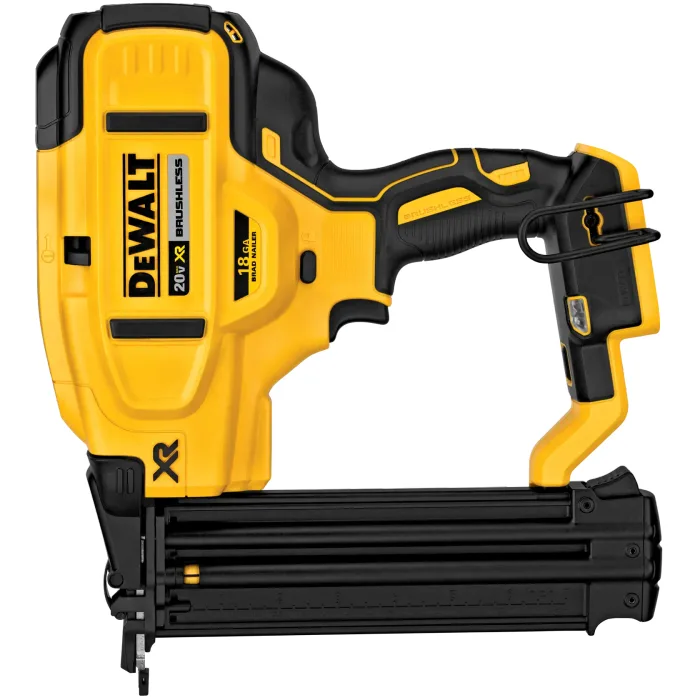
- Buy DEWALT DCN680B 20V MAX XR 18 Gauge Cordless Brad Nailer The longest nail range here with a tool-free trigger selector, so the safer sequential mode is a switch rather than a service operation. Amazon
- Buy Makita XNB01Z 18V LXT Lithium-Ion Cordless 18 Gauge Brad Nailer A 100-nail magazine, with the trigger mode on an explicit two-position selector switch. Amazon
- It depends CRAFTSMAN CMPBN18K 18 Gauge Pneumatic Brad Nailer Ships with a sequential trigger rather than a selector, which removes the trigger choice in the safer direction. Amazon
- Skip DEWALT DWFP12231 18 Gauge Pneumatic Brad Nailer Kit A capable air nailer whose real price includes a compressor, on a job a cordless tool now does without one. Amazon
What actually matters
- Trigger actuation - sequential fires one nail per trigger pull after the nose is pressed; contact fires whenever the nose bumps with the trigger held. The safety difference is measured, roughly double the injury rate for contact.
- Gauge - wire thickness, numbered inversely. 18 gauge for trim and small work, 16 and 15 gauge for baseboard and structural trim where holding power matters more than hole size.
- Nail length range - typically 5/8 in. up to 2 or 2-1/8 in. for 18 gauge. The top of the range decides what thickness you can fasten in one pass.
- Magazine capacity - around 100 nails on this class of tool. It sets how often a long run is interrupted rather than anything about quality.
- Depth of drive adjustment - a dial or wheel setting how far the nail is driven. Tool-free versions get adjusted; wrench-operated ones get left alone.
- Power source - pneumatic fires instantly and weighs less in the hand but needs a compressor. Cordless needs nothing else but is heavier and can have a slight firing delay.
The specs, in plain English
Green flags vs red flags
Green flags
- The trigger modes are named explicitly and the tool says how the mode is changed.
- Nail length range is given as a span rather than a maximum.
- Magazine capacity is stated as a number of nails.
- Depth adjustment is described as tool-free or as a dial.
- A jam or stall release is named as a feature.
Red flags
- The trigger is described only as an easy-actuation or pro trigger with no mode named.
- Magazine capacity and weight lead the listing and actuation is absent.
- Only a maximum nail length is given with no minimum.
- A pneumatic tool's price is compared with cordless without mentioning the compressor.
- Depth of drive is adjusted by changing air pressure rather than on the tool.
Who's who: the brands
- DEWALT - Runs parallel pneumatic and cordless lines using the same fasteners, which makes the cost of going cordless easy to see. The cordless brad nailer reviewed here has a tool-free trigger selector and stall release.
- Makita - States trigger modes and magazine capacity plainly in the specification, with a tool-less depth dial on its cordless brad nailer.
- CRAFTSMAN - Budget pneumatic tools, some specified as sequential-only, which is a safety advantage rather than a limitation for trim work.
- Bostitch - Long-standing pneumatic nailer maker, common on sites and generally competing on durability and price rather than features.
- Milwaukee - Cordless-first nailers on the M18 platform, competing hard on firing speed and the absence of a spin-up delay.
How to read a listing without getting fooled
Find the trigger actuation first and check both which modes exist and how the mode is changed, because a selector that needs a tool will be set once and left. Then read the nail length range as a span. Then magazine capacity, then whether depth and jam clearing are tool-free. If the tool is pneumatic, add a compressor, hose and fittings to the price before comparing it with anything cordless.
How much should you spend?
Budget buys a pneumatic nailer that is light, fast and sometimes sequential-only, and which assumes you already own air. Mid-range buys a better pneumatic with tool-free depth and jam release. Premium buys cordless, where the money goes on removing the compressor entirely rather than on driving nails any better, and where the tool is heavier for it.
Questions, answered
Which trigger mode should I use for trim?
Sequential, in almost every case. Trim work is precise placement rather than volume, so the speed advantage of contact mode is small, while the risk it adds is measured at roughly double. Save contact mode for repetitive flat work where you are firing many nails in a row and the nose stays on the workpiece.
Will an 18 gauge brad hold baseboard?
Not on its own, in most cases. Eighteen gauge holds light trim, shoe moulding and small assemblies well, but baseboard being pulled by a wall that is not flat wants the thicker shank of a 16 or 15 gauge finish nail. Many people use both: brads to tack and hold while adjusting, finish nails to fasten.
Why does my nailer keep jamming?
Usually the wrong fasteners, a nearly empty magazine, or driving into something harder than the nail can take. Check that the brads match the tool's gauge and length range, keep the magazine loaded rather than running it to empty, and back the depth off if you are hitting hardwood or a hidden fastener. Check for a jam release; three of the four tools in the review list a tool-free one.
Do cordless nailers fire as fast as pneumatic?
Not quite. Cordless mechanisms need a brief moment to ready themselves, which pneumatic tools do not, and experienced users notice it immediately. The gap has narrowed considerably and for trim work it is irrelevant, but for high-volume repetitive nailing pneumatic still feels instant in a way battery tools do not.
Or jump to the head-to-head: DEWALT DCN680B 20V MAX XR 18 Gauge Cordless Brad Nailer vs Makita XNB01Z 18V LXT Lithium-Ion Cordless 18 Gauge Brad Nailer.