Explained
Circuit Breaker Finders, Explained
After reading, you'll understand what a breaker finder is physically doing, why adjacent breakers respond, and which published specs actually predict whether a unit will give you a clean answer.
In this guide
Almost everyone buys a breaker finder expecting a tool that says yes or no, and almost everyone is surprised the first time two breakers respond. That is not a defect and it is not a bad unit, it is how signal injection behaves in a panel full of parallel conductors. The specs that predict a clean answer are not the ones on the front of the box. They are whether the receiver shows a number, whether the gain can be changed, and whether the manual admits the problem exists.
The 30-second version
- It is a two-part radio, a transmitter that injects a tone onto the circuit and a receiver tuned to that tone, not a device that senses electricity in general.
- The neighbouring breaker is the failure mode, because the injected signal couples into adjacent conductors, and the fix in the manuals we read is a procedure rather than a specification.
- The makers we read publish no accuracy figure, so treat words like quickly and accurately as marketing and judge the tool by whether it gives you something to compare.
- Plug-in finders need a live outlet, since their transmitters draw power from the circuit, and only a battery powered tracer will follow a run you have already switched off.
- Finding a breaker is not proving a wire dead, which is a separate instrument and a separate step that a finder is not built to replace.
The products this guide is about
Our verdict on each, with the full reasoning on the companion review.
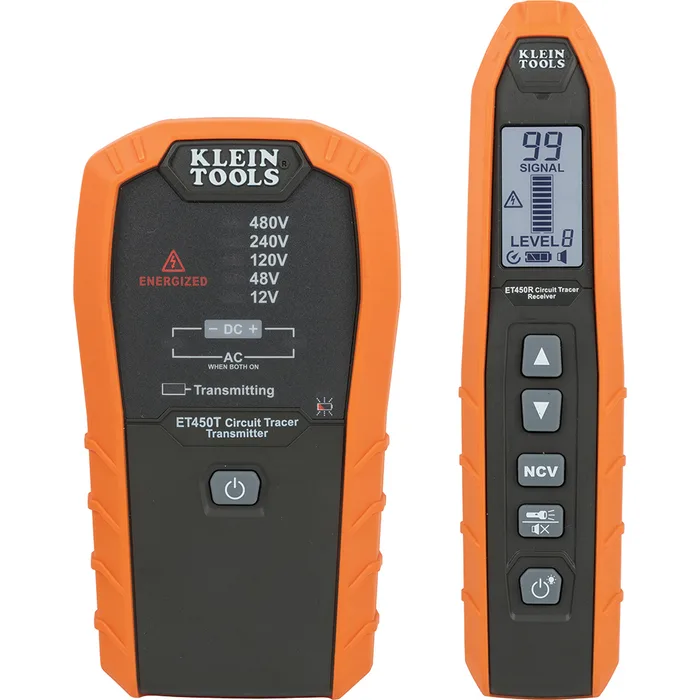
- Buy Klein Tools ET450 Advanced Circuit Tracer Kit The one here that replaces a beep with a number, and the only one that will follow a circuit you have already switched off. Amazon
- Buy Fluke BK120 SmartTrace Breaker Finder The plug-in finder whose maker actually writes down what to do when the receiver picks two breakers instead of one. Amazon
- It depends Klein Tools ET310 Digital Circuit Breaker Finder with GFCI Outlet Tester A breaker finder whose transmitter is also a full receptacle tester, which is either exactly what you wanted or a feature you already own. Amazon
- Skip Extech CB10 AC Circuit Breaker Finder and GFCI Receptacle Tester A competent little receptacle tester bolted to a receiver whose entire answer to a false hit is a knob you turn down by feel. Amazon
What actually matters
- Signal strength readout - a numeric value or bar graph turns two suspicious breakers into two comparable readings. Without one, all you have is the presence or absence of a beep, which is the same information for the right breaker and its neighbour.
- Sensitivity levels - reducing gain and rescanning is the standard way to eliminate candidates, because the true breaker keeps responding at settings where the coupled neighbours drop out. A unit with a single fixed threshold gives you nothing to turn down.
- Energised versus de-energised capability - a plug-in transmitter is powered by the outlet, so it cannot signal a circuit you have already killed. Battery powered tracers clip onto conductors and work either way, though the signal on an open circuit is much weaker.
- Measurement category rating - CAT II covers utilisation points like receptacles, CAT III covers the distribution part of the installation, which is what a panel is. You are holding this tool inside an open enclosure, so look for the rating and the voltage together.
- Two-pass or learning routines - some receivers sweep once to calibrate against the panel's background and once to decide, and the manual will tell you to ignore everything the first pass says. Skipping the first pass defeats the learning routine.
- Receptacle wiring indications - many transmitters double as outlet testers, which is useful if you do not already own one and redundant if you do. The conditions they cannot detect are the same set covered in our [outlet tester comparison](/best-outlet-testers).
- A confirmation step - a free verification is to trip the breaker you found and watch the transmitter in the outlet go dark. A maker that puts this in the instructions is telling you how much weight to put on the indication alone.
The specs, in plain English
Green flags vs red flags
Green flags
- The receiver shows a numeric signal strength, not just a light and a beep.
- Sensitivity is adjustable across several named levels or a continuous control.
- The manual states what to do when two breakers give the same reading.
- A measurement category rating and the 61010 standard parts are named in the specifications.
- The instructions include a step to confirm the result by tripping the breaker.
Red flags
- The only accuracy claim anywhere is the word accurately in a marketing bullet.
- No measurement category rating appears in the specification table at all.
- The manual never mentions adjacent breakers, false hits or what to do about them.
- A single fixed sensitivity with no control and no learning pass.
- Claims that it works through a closed panel door without the breaker faces exposed.
Who's who: the brands
- Klein Tools - Covers both ends, from a plug-in finder with a receptacle tester built into the transmitter to a full tracer kit with numeric signal strength and eight sensitivity levels.
- Fluke - Compact plug-in unit that publishes both the adjacent-breaker procedure and a full specification sheet including CAT rating and standards.
- IDEAL Electrical - Long-running SureTrace line of tracers aimed at commercial and industrial panels, with sensitivity modes and a manual that explains the underlying physics unusually well.
- Extech - Budget end under Teledyne FLIR, typically pairing a receptacle tester transmitter with a simple variable-sensitivity receiver and a short specification.
- Amprobe - Sells a combined breaker finder and cable tracer aimed at the same buyer as the plug-in units, alongside a separate line of advanced wire tracers.
How to read a listing without getting fooled
Start at the receiver, not the transmitter. Look for a signal strength readout and count how many sensitivity levels are listed, because those two lines predict more about your afternoon than anything else on the page. Then find the operating voltage of the transmitter: a range like 110 to 125 V AC means it is line powered and cannot touch a dead circuit, while a tracer will list voltage indicators and its own batteries instead. Check for a measurement category and the 61010 standard parts, and be suspicious of a listing that shows only a certification logo with no CAT number, since that is a tool you take inside a panel. Finally, download the manual before you buy and search it for the word adjacent. If the maker has written down what to do when two breakers respond, you are buying from someone who has actually used the thing.
How much should you spend?
The budget tier gets you a working transmitter and receiver pair, usually with a receptacle tester built into the plug, a single sensitivity control at best, and a specification sheet thin enough to read in a minute. Mid-range is where the documentation improves rather than the physics: the same plug-in architecture, but with a published measurement category, a named standard, a non-contact function in the receiver and a manual that tells you what to do when the answer is ambiguous. That is the sweet spot for a homeowner or anyone carrying one tool. The premium tier is a different product rather than a better one, a tracer kit with test leads, its own batteries, a numeric signal display, multiple gain steps and the ability to follow a de-energised run, and it is worth the jump only if mapping panels or chasing wires is a regular part of the job rather than an annual chore.
Questions, answered
Do I need a breaker finder if my panel is already labelled?
Probably not for the labelled circuits, but panel labels age badly. Outlets get added, circuits get split, and a label written when the house was built rarely survives two renovations. A finder is most useful when you are the one creating the labels, or when you need to kill exactly one circuit in an occupied building without shutting anything else down. If your panel is accurate and you only work on your own house, the tool is a convenience rather than a necessity.
What is the difference between a breaker finder and a circuit tracer?
A breaker finder is the narrow version: plug the transmitter into a live outlet, sweep the panel, get an indication. A circuit tracer does that and more, because its transmitter carries batteries and clips directly onto conductors, so it also traces wires behind walls, sorts a single wire out of a bundle, finds opens and shorts, and works whether the circuit is energised or not. Tracers cost considerably more and come as a case of leads and adapters. If the only question you ever ask is which breaker, a finder is enough.
Why do the instructions tell me to unplug everything on the circuit?
Because connected loads change what the transmitter's signal does. Klein warns that other equipment or devices attached to the circuit could interfere with the tester and asks you to clear the circuit before testing, and Fluke's safety sheet says the same thing in its own words. It costs you two minutes and removes a whole class of confusing results, so it is worth doing every time.
Can a breaker finder work on a fuse panel?
Yes, and manufacturers say so directly. The receiver is looking for a radiated signal from a conductor, and a fuse holder carries the same conductor a breaker would. Klein's ET450 manual and IDEAL's manual both describe locating fuses alongside breakers. What does change is the geometry: fuse panels tend to be more cramped and the conductors sit differently, so expect to spend more time on receiver orientation and to lean harder on sensitivity adjustment if the unit has it.
Or jump to the head-to-head: Klein Tools ET450 Advanced Circuit Tracer Kit vs Fluke BK120 SmartTrace Breaker Finder.