Explained
Cut-Resistant Gloves, Explained
After reading, you'll understand exactly what a cut level means under each standard, how to convert between them, and which of the other ratings on the label are worth anything.
In this guide
Almost everyone buying their first pair of cut-resistant gloves buys on a single number, and almost everyone gets caught by the same trap: there are two competing rating systems and they both use small integers. A glove can be honestly described as level 5 under the European standard and sit near the bottom of the American one. On top of that, the puncture rating most gloves quote is measured with a blunt probe that behaves nothing like a needle, and the word gauge, which is what actually decides how the glove feels on your hand, rarely appears in consumer listings at all.
The 30-second version
- Two standards, two scales, so a cut number is meaningless until you know whether it came from ANSI/ISEA 105 or EN 388.
- The EN letter converts cleanly, because ISO 13997 newtons and ANSI grams come off the same machine and one newton is about 102 grams.
- The EN 1 to 5 index does not convert, since the coup test measures cycles against a reference fabric rather than force to cut through.
- Gauge decides dexterity, and modern engineered yarns mean a very high cut level no longer forces you into a thick glove.
- Puncture is not needlestick, so if needles are your hazard, look for an ASTM F2878 level and ignore the probe number.
The products this guide is about
Our verdict on each, with the full reasoning on the companion review.
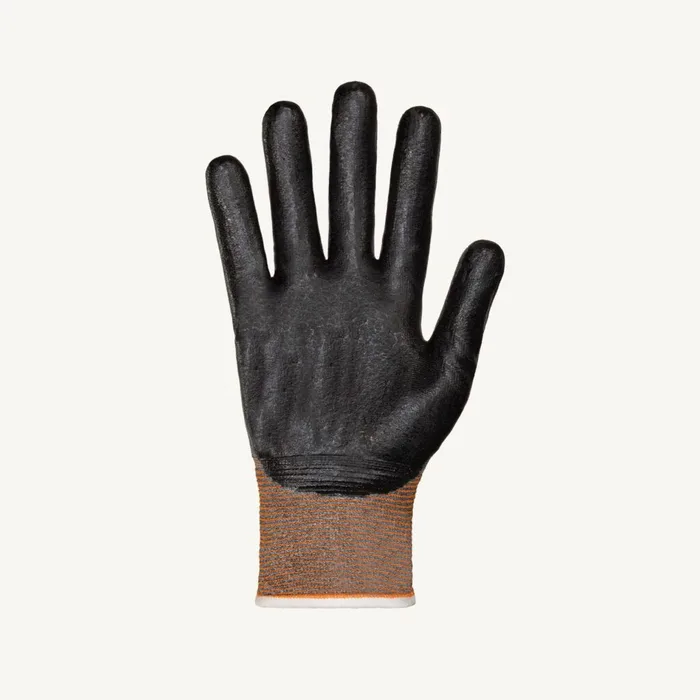
- Buy Superior Glove Dexterity Pro S21TXUFN A 21-gauge knit that Superior rates ANSI A9 for cut, which is the top of the American scale in a glove thin enough to pick up a washer.
- Buy DEWALT DPG578 Foam Nitrile A6 Cut Resistant Glove The same 21-gauge idea three cut levels down, and one of the few consumer gloves that prints both its ANSI and EN 388 ratings where you can read them. Amazon
- It depends HexArmor PointGuard Ultra 9032 One of the few gloves carrying a real needlestick rating, which matters enormously to a small group of buyers and not at all to everyone else. Amazon
- Skip NoCry CutGuard Pro Stainless Steel Cut Resistant Gloves Sold on a headline of "Certified Level 5 cut resistance" when the certificate list underneath it says ANSI 105-2016 A2 and the only Level 5 belongs to a dexterity test.
What actually matters
- Which standard the number came from - ANSI/ISEA 105 and EN 388 both produce small integers that look interchangeable and are not. Always establish the standard before you compare two gloves.
- Cut level headroom - the ANSI scale runs A1 at 200 grams to A9 at 6,000 grams, so the difference between neighbouring levels near the top is larger in absolute terms than near the bottom. Choose the level for the sharpness of your material, not for the biggest number available.
- Gauge - the number of knitting needles per inch, and the single best predictor of how thin and tactile the glove will feel. A 21-gauge glove has a bare-hand feel, a 13-gauge glove is the general-handling default and a 7-gauge glove is bulky.
- Coating type and coverage - foam nitrile, polyurethane, sandy nitrile and silicone dots grip differently and wear differently, and most coatings cover only the palm. If the back of your hand is exposed to the hazard, look for a rating described as 360 degrees.
- Probe puncture versus needlestick - the ordinary puncture level comes from a blunt stylus and models tearing or bursting. A hypodermic needle is a completely different hazard tested under ASTM F2878, and very few gloves carry that rating.
- Abrasion level - this decides how long the glove survives, and it is independent of cut level. A cheaper glove with a higher abrasion rating can genuinely outlast a more expensive one on scraping work.
- Food contact - a separate regulatory claim about the materials, not a performance rating. If the maker does not state it on the product page, do not assume it.
The specs, in plain English
Green flags vs red flags
Green flags
- The listing names the standard and its edition year, for example ANSI/ISEA 105-2024 or EN 388:2016 plus A1:2018, rather than just a level.
- Both an ANSI level and a full EN 388 code appear, and converting the EN letter into grams lands in the same band as the ANSI level.
- The gauge is stated, so you can predict how thin the glove will feel before it arrives.
- Abrasion and puncture levels are published alongside cut, including honest low numbers rather than only the flattering one.
- Sizing runs across a real range with a measurement chart, because a cut glove that slips is a cut glove that fails.
Red flags
- A bare "Level 5" or "cut level 5" with no standard named anywhere on the page.
- An ANSI level and an EN cut letter that cannot both be true, such as A2 alongside Level E.
- The word certified attached to a number that turns out to belong to a dexterity or comfort test rather than a cut test.
- Comparative claims such as being several times better than leather or steel, with no test cited.
- Kitchen and food marketing with no explicit food-contact statement in the product's own specifications.
Who's who: the brands
- Superior Glove - A Canadian maker known for very fine engineered-yarn knits and for publishing detailed per-product rating tables, including separate probe and hypodermic puncture entries.
- HexArmor - Specialises in layered palm armour and publishes ANSI needlestick levels for its needle-resistant gloves.
- Ansell - A long-established industrial glove maker whose HyFlex range is a common default in factory and assembly settings.
- Mechanix Wear - Built its name on mechanics' gloves and also sells cut-resistant styles; check each listing for the standard it cites.
- DEWALT and Milwaukee - Tool brands that sell cut gloves as numbered systems at home centres, convenient to shop but easy to confuse with the European scale.
How to read a listing without getting fooled
Start at the bottom of the listing, not the top. Find the block that names standards and edition years, and ignore any level quoted in the headline or the bullet points until you have matched it to something in that block. If you see an EN 388 code, read it left to right as abrasion, coup cut, tear, puncture, then the ISO 13997 letter, with an optional P for impact at the end; an X anywhere means that test was not reported. Convert the letter into grams by multiplying the newton value by about 102, then check whether it agrees with any ANSI level on the same page. If it does, the maker is being straight with you and either number is usable. If it does not, or if only one system appears while the marketing quotes the other, treat the headline number as advertising. Then look for gauge, coating and abrasion, which between them tell you how the glove will actually feel and how long it will last.
How much should you spend?
Budget cut gloves are genuinely usable now, and a well-documented budget pair from a tool brand can carry a mid-to-high ANSI level on a fine knit. What you give up at that tier is usually abrasion life, coating quality and consistency between batches, and sometimes any EN data at all. The mid-range is where you find the widest choice of gauges and coatings for specific tasks, and where the ratings blocks tend to be complete. Premium pricing buys three things worth paying for: the top cut levels on the finest knits, ratings that are third-party verified, and specialist protection such as needlestick resistance that simply does not exist further down. Because cut gloves are consumables that wear out, the honest way to think about cost is per week of use rather than per pair, which often flatters a slightly more expensive glove with a higher abrasion rating.
Questions, answered
How do I convert an EN 388 letter into an ANSI level?
Multiply the newton value by roughly 102 to get grams, then read off the ANSI band. A at 2 newtons is about 204 grams, so roughly A1; B at 5 is about 510 grams, so A2; C at 10 is about 1,020, so A3; D at 15 is about 1,530, so A4; E at 22 is about 2,244, so A5; and F at 30 is about 3,060, so A6. The conversion works because both figures come from the same straight-blade machine at the same 20mm reference distance, just reported in different units. What does not convert is the EN 1 to 5 coup index.
Can a stainless steel mesh glove have an ANSI cut level?
Generally no, and one mesh maker says so plainly. The TDM machine detects cut-through using a low-level electrical current, and stainless steel mesh is conductive, so the test cannot register a result. NiroflexUSA states on its own product page that an ANSI/ISEA 105 cut level cannot be determined for its steel gloves and invites buyers to ask any mesh maker claiming a cut level to produce the test report. Mesh gloves are instead certified to EN 1082-1 and ISO 13999-1, the standards written for hand protection against hand knives, which is a different and more appropriate benchmark.
Can I wash cut-resistant gloves, and when should I replace them?
Most knit cut gloves can be laundered and the maker will say how. Superior Glove specifies wash and tumble dry on low heat for its TenActiv knits, while NoCry recommends hand washing and air drying for its coated stainless blend. Follow the stated method, because heat can damage the coating and some engineered fibres. Replace a glove as soon as the shell is nicked, thinned or showing the coating worn through, since the rating describes intact material and nothing else. Treat gloves as consumables and buy them in quantity rather than nursing a worn pair along.
Will a cut-resistant glove protect me from a saw or a powered blade?
No, and makers say so directly. Niroflex warns that its steel mesh gloves may not withstand the force of power-driven blades, saws and tools and tells users to avoid that hazard entirely. Bob Dale Gloves states plainly that its products are not cut and puncture proof and should not be used with moving blades, tools or serrated blades. Every cut rating in both standards is generated by a single controlled pass of a blade under a measured load, which bears no relation to a spinning blade with a motor behind it. For powered tools the answer is guarding, push sticks and keeping hands out of the cut path.
Or jump to the head-to-head: Superior Glove Dexterity Pro S21TXUFN vs DEWALT DPG578 Foam Nitrile A6 Cut Resistant Glove.