Explained
Drill and Driver Bit Sets, Explained
After reading this you will know the difference between drilling bits and driving bits, why a huge piece count is filler, and how to spot bits that grip fasteners and hold an edge instead of stripping and dulling.
In this guide
Almost every mixed set on the shelf is sold on one number: the piece count. That is exactly the wrong thing to judge it by. A bit set does two completely different jobs, drilling holes and driving screws, and a good buy comes down to a dozen or so bits made of the right steel, not a sprawling case of sizes you will never touch.
The 30-second version
- Drill bits and driver bits are two different tools. One bores holes and the other turns screws, and a mixed set is really two small kits sharing a case, so judge each half on its own merits.
- The piece count is a marketing trap. A 200-piece set is mostly exotic filler sizes; what decides satisfaction is the quality of the roughly twelve bits you actually reach for.
- If you own an impact driver, insist on impact-rated bits. Standard bits shatter or cam out under the hammering blows of an impact driver, while impact-rated bits have a flex zone that lets the tip survive.
- Tip steel and fit are what stop stripping. Hardened, properly tempered alloy that fits the screw recess snugly bites in and resists rounding, whereas soft or sloppy tips chew up screw heads.
- A case that grips bits is part of the value. If tips rattle loose you spend your time hunting for a PH2 in the bottom of the box, so retention matters more than the size of the case.
The products this guide is about
Our verdict on each, with the full reasoning on the companion review.
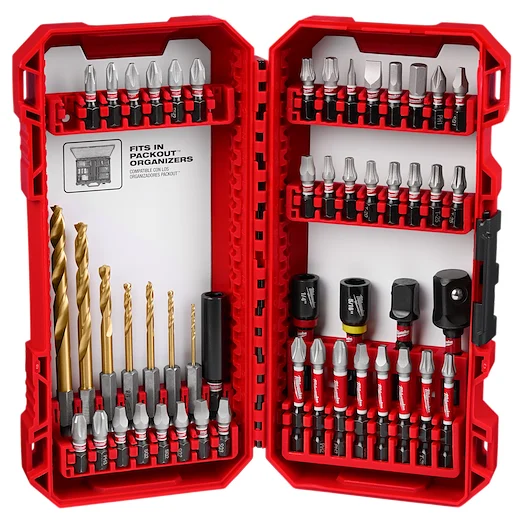
- Buy Milwaukee SHOCKWAVE Impact Duty Drill and Drive Set (50-Piece) Nails the fundamentals: genuinely impact-rated driving bits, titanium drill bits, and almost no wasted count.
- Buy DeWalt Screwdriving and Drilling Set (100-Piece) The strongest all-rounder — impact-ready FlexTorq driving bits and titanium drill bits in four grab-and-go cases.
- It depends Ryobi 120-Piece Drill and Impact Rated Drive Kit Impact-rated bits at a budget price — fine for weekend jobs, but the steel is softer and the count is padded.
- Skip Craftsman Drill/Drive Bit Set (140-Piece) A classic count trap: 140 pieces that look like value, but the driving bits cam out and the twist bits dull fast.
What actually matters
- Drill bits vs driver bits - a mixed set combines twist bits that bore holes with driver bits that turn screws; they are not interchangeable, and a set can be strong on one half and weak on the other.
- Impact rating - whether the driving bits are built to survive a cordless impact driver's hammering; without a torsion or flex zone, standard bits snap or cam out.
- Tip steel and hardness - the alloy and heat-treat of the driving tips (S2 tool steel or impact-specific alloys) is the single biggest predictor of whether a bit grips or strips.
- Twist-bit coating and material - black-oxide, titanium-coated, or true cobalt decides how cleanly the drilling bits cut and how long they stay sharp, especially in metal.
- Everyday sizes - PH2, T25, and square (Robertson) in useful numbers matter far more than a handful of exotic sizes you will rarely fit to a fastener.
- Shank and quick-change - a standard 1/4-inch hex shank drops into any impact driver or quick-change chuck, so bits swap in a second without a keyed chuck.
- Case and bit retention - a case that holds each bit tightly keeps the set usable for years; a loose tray leaves you digging for the one bit you need.
The specs, in plain English
Green flags vs red flags
Green flags
- Driving bits explicitly described as impact-rated with a torsion or flex zone, not just 'compatible' with an impact driver
- Driving tips in hardened S2 or an impact-specific alloy, with owner reports of the tips gripping rather than rounding off
- Titanium-coated or cobalt twist bits rather than plain black-oxide when you drill anything harder than softwood
- Generous counts of the sizes you actually use, especially PH2, T25, and square, plus a magnetic bit holder
- A case that holds each bit tightly with no rattle, so nothing works loose or goes missing
- A 1/4-inch hex shank on the driving bits for quick, keyless changes across your impact driver and drill
Red flags
- A headline piece count in the hundreds used to imply value while the listing says nothing about steel or impact rating
- Driving bits that are not impact-rated if you own an impact driver, since they will cam out and strip
- Only plain black-oxide twist bits when you plan to drill metal, as they dull within a few holes
- No-name mega-kits with vague 'premium steel' claims and a pattern of owner reports about stripped screws and dulled bits
- A bulky case where bits rattle loose or the everyday sizes are buried among exotic filler
- Marketing that leans entirely on the number of pieces and never names the tip shapes or the steel
Who's who: the brands
- Milwaukee - Known for SHOCKWAVE impact-duty bits with a shock-absorbing zone and hardened tips that top independent strip-resistance rankings.
- DeWalt - Makes impact-ready FlexTorq driving bits and titanium twist bits, usually packed in stackable ToughCase modules for broad one-box coverage.
- Bosch - Long-respected for accurate, durable drill bits and solid impact-rated driving bits aimed at trades and serious DIYers.
- Makita - Offers well-regarded impact-rated bit sets, often bought to stay within the Makita cordless ecosystem.
- Ryobi - Budget kits that unusually include impact-rated driving bits, though the steel is softer and the count tends to be padded.
- Craftsman - Familiar big-count sets that look like value but often skip impact rating, so the driving bits cam out under a modern impact driver.
How to read a listing without getting fooled
Start by separating the two halves of the set: find what the driving bits are (the tip shapes and, crucially, whether they are impact-rated) and separately what the drill bits are made of (black-oxide, titanium, or cobalt). Treat any big number on the front of the box as noise and go looking for the steel instead; a listing that names S2 tool steel or an impact alloy and calls out a torsion or flex zone is telling you something real, while one that only shouts a piece count is hiding the fact that most of those pieces are filler. Confirm the driving bits carry a 1/4-inch hex shank so they work in your impact driver, count how many of the everyday sizes you actually get (PH2, T25, square) rather than how many exotic ones pad the total, and check that the drill-bit grade matches your material, titanium for general wood and light metal, cobalt if you regularly drill hardened steel. Finally, read owner reports for the words 'strip', 'cam out', and 'dull', and weigh the case: one that grips bits tightly is worth more than a larger case that lets them rattle loose.
How much should you spend?
Spend based on how hard you will actually use the set, not on the size of the case. The value sweet spot is a curated mid-range kit with genuinely impact-rated driving bits, hardened tips, and titanium twist bits, because that combination grips and lasts where budget mega-kits fail. Paying up past that buys marginally harder steel and tighter fit that mainly rewards someone driving fasteners all day; a homeowner who reaches for the drill occasionally will not notice the difference. At the bottom, a huge no-name count for very little money is the false economy to avoid, since the driving bits strip and the drill bits dull within weeks, and you end up buying twice. If you are on a tight budget, a smaller set of impact-rated bits from a known maker beats a giant bargain box every time, and adding cobalt drill bits later only makes sense once you regularly drill hardened metal. Judge the price against the dozen bits you will actually use, and treat everything past those as filler you are also paying to store.
Questions, answered
What is the difference between a drill bit and a driver bit?
They do opposite jobs. A drill bit, usually a spiral 'twist' bit, bores a hole; you judge it by its material and coating (black-oxide, titanium, or cobalt). A driver bit turns a screw and is tipped in a shape like Phillips, Torx, or square; you judge it by its steel, its fit in the recess, and whether it is impact-rated. A mixed set is really two small kits in one case, and it can be strong on one and weak on the other, so look at each half separately.
Does the number of pieces in a set matter?
Not much, and a high count is often a trap. A 200-piece set is mostly sizes you will never fit to a fastener. What decides satisfaction is the quality of the dozen or so bits you actually use, PH2, T25, square, and a few common drill sizes, plus whether the steel is hard enough to grip screws and hold a drilling edge. A curated set of good bits will out-serve a bloated mega-kit almost every time.
What does 'impact rated' mean, and do I need it?
Impact-rated driving bits have a built-in torsion or flex zone that absorbs the rapid hammering of a cordless impact driver, so the bit flexes instead of snapping or shattering. If you use an impact driver, as most people now do, you want impact-rated driving bits. Standard bits used in an impact driver tend to break at the tip or cam out and strip screw heads.
Titanium, cobalt, or black-oxide drill bits, what's the difference?
Black-oxide is the cheapest coating and dulls fastest; it is fine for softwood but struggles in metal. Titanium-coated bits stay sharp longer and drill cleaner holes in wood and light metal, which covers most home use. Cobalt bits are actually alloyed with cobalt rather than just coated, and are the choice for regularly drilling hardened steel. For a general-purpose set, titanium is the sweet spot.
Why do my driving bits keep stripping screws?
It is usually a mix of soft or worn bit steel and a poor fit in the screw recess. Cheap, non-impact bits round off under an impact driver and then cam out, chewing the fastener. Using the correct size and type (a true PH2 in a PH2 screw, not a worn one), keeping steady inward pressure, and switching to hardened, impact-rated bits fixes the great majority of stripping problems.
Can I use the same bits in both a drill and an impact driver?
The 1/4-inch hex driving bits in these sets fit both tools, but only impact-rated bits should see regular use in an impact driver. Twist drill bits go in your drill's chuck for making holes. If a set's driving bits are not impact-rated, keep them for the drill or hand tools and reserve impact-rated bits for the impact driver.
Or jump to the head-to-head: Milwaukee SHOCKWAVE Impact Duty Drill and Drive Set (50-Piece) vs DeWalt Screwdriving and Drilling Set (100-Piece).