Explained
Fall Protection Harnesses, Explained
After reading, you'll understand what a harness is certified to do, what else you have to buy for it to work, and how to read the numbers on a harness label without being misled.
In this guide
First time buyers reliably make one of three mistakes. They buy a harness and stop, not realising that OSHA defines a fall arrest system as an anchorage plus a connector plus the harness. They buy on capacity, comparing a 400 pound figure against a 310 pound figure without knowing the two numbers come from different documents. Or they buy a positioning belt or a rope access harness because it was cheaper or looked more serious, and end up with equipment that is not certified for the job they need done. All three are avoidable by reading two things: the standards on the label and the maker's own instruction manual.
The 30-second version
- A harness is one third of a system, and the other two thirds, the anchorage and the connecting device, are what actually limit the force that reaches your body.
- OSHA sets the numbers everything follows from, 1,800 pounds maximum arresting force with a body harness, 6 feet maximum free fall, and 3.5 feet maximum deceleration distance.
- The dorsal D-ring is the fall arrest point, and hip, rear waist, shoulder and seat attachments are for positioning, restraint or rescue and explicitly not for arresting a fall.
- Rescue is a requirement, not a courtesy, because OSHA mandates prompt rescue and its own bulletin cites research showing suspension can be fatal in under 30 minutes.
- Retirement rules differ by brand, with some makers tying life entirely to inspection and others setting a service life in their technical notices, so read yours.
The products this guide is about
Our verdict on each, with the full reasoning on the companion review.
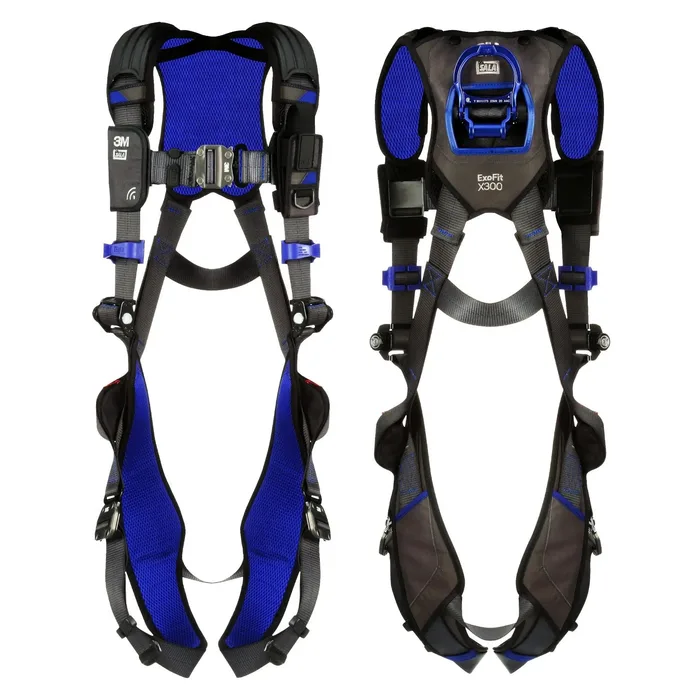
- Buy 3M DBI-SALA ExoFit X300 Comfort Vest Safety Harness The best documented harness in the category, with padding and hardware that hold up and instructions that tell you the truth about capacity. Amazon
- Buy MSA Safety V-FORM Full Body Harness (Back D-Ring, Qwik-Fit Leg Straps) A plain fall arrest harness with published approvals and an RFID tag for logging inspections. Amazon
- It depends Petzl AVAO FAST International Version A rope access and suspension harness that happens to do fall arrest, and the wrong answer if all you do is stand on a roof.
- Skip 3M DBI-SALA Tongue Buckle Positioning Belt with Hip Pad A perfectly good positioning and restraint belt that is not fall arrest equipment and is bought by people who think it is.
What actually matters
- Standards on the label - ANSI/ASSP Z359.11 is the American full body harness standard and CSA Z259.10 is its Canadian counterpart. A harness that also carries EN 358, EN 813 or ANSI Z459.1 is certified for work positioning, suspension or rope access on top of fall arrest.
- Attachment points - the number and location of D-rings decides what the harness can legally do. A single dorsal D-ring is a pure fall arrest harness; hip, ventral and rear waist points add positioning and restraint functions that are not fall arrest.
- Capacity range - Z359.11 covers users from 130 to 310 pounds including clothing and tools. Anything above 310 pounds on a label comes from OSHA or CSA test allowances, not from ANSI.
- Fall indicator - the standard requires a visual indicator that deploys when the dorsal attachment takes a fall. An intact indicator is not proof the harness is still good, so keep inspecting.
- Inspection interval - every maker requires a pre use check by the wearer plus a documented inspection by a competent person other than the user. The ANSI baseline for that formal inspection is no more than one year, and a maker can set a shorter one.
- Published life - some manufacturers set no expiry and retire on inspection findings alone, while others set a maximum service life, which can mean storage time counts against the harness.
- Fit and sizing - the ANSI guidance in these manuals stresses that correct fit is essential to performance, with chest straps in the middle chest area and leg straps snug enough to avoid contact with the genitalia in a fall.
The specs, in plain English
Green flags vs red flags
Green flags
- The listing names a specific standard and edition, such as ANSI/ASSP Z359.11, rather than saying OSHA approved.
- The maker publishes both the ANSI capacity range and the OSHA capacity separately instead of quoting only the bigger number.
- The instruction manual is available to download before you buy and states the inspection interval and the retirement criteria.
- Component figures are given, such as D-ring proof test load, D-ring breaking strength and webbing width and breaking strength.
- The product has a visual fall indicator and a label area or RFID tag for recording inspections.
Red flags
- The listing says OSHA approved or OSHA certified, which is not a thing OSHA does for equipment.
- The seller markets a positioning belt, tool belt or seat harness as fall protection without naming a fall arrest standard.
- A single capacity number well above 310 pounds is quoted with no mention of which document it comes from.
- No downloadable instruction manual, no named standard edition and no manufacturer product page you can find.
- The bundle is sold as complete but includes no anchorage or no energy absorbing connecting device.
Who's who: the brands
- 3M DBI-SALA - A major fall protection line with published instruction manuals and separate ANSI and OSHA capacity figures on its harnesses.
- MSA Safety - An industrial safety maker whose V-FORM harness lists its approvals, capacity and D-ring count on its product page.
- Petzl - A French maker rooted in climbing and caving whose professional harnesses carry rope access and suspension certifications alongside fall arrest.
How to read a listing without getting fooled
Start at the bottom of the listing, not the top. Find the standards line and check whether it names ANSI/ASSP Z359.11, and whether it also names EN 358, EN 813 or ANSI Z459.1, which tell you the harness is built for positioning or suspension too. Then find the capacity and see whether the seller has split it into an ANSI figure and an OSHA figure; if there is only one big number, assume it is the OSHA one. Next, count and locate the D-rings, and translate them: dorsal and sternal are fall arrest, hip and ventral are work positioning, rear waist is restraint only, shoulder pairs are rescue and retrieval. Finally, download the instruction manual before you buy. It is the only place you will find the inspection interval, the retirement rules and the component strength figures, and it is the document that tells you what the harness will not do.
How much should you spend?
Budget harnesses are usually a single dorsal D-ring, pass through or tongue buckle legs, minimal padding and steel hardware, and they meet the same standard as anything else in this list. Mid-range buys you quick connect buckles, some padding, aluminium hardware, an RFID tag and often a torso adjuster, which matters if you wear the harness for hours rather than minutes. Premium buys fuller padding, weight distribution systems, more configuration choices including positioning models, and in the rope access category the additional EN 813 and ANSI Z459.1 certifications that let you hang in the harness and work. Be careful about where you economise: spending less on the harness to afford a properly rated anchorage connector and an energy absorbing lanyard or self retracting lifeline is usually the better trade, because those are the components that limit the force reaching your body.
Questions, answered
Does a harness have an expiry date?
It depends entirely on the maker, and this is one of the few places where brands genuinely disagree. 3M states that functional life is determined by work conditions and maintenance and that the harness may remain in service as long as it passes inspection. Other makers set a service life in their technical notices, which can mean time sitting in a warehouse counts against the harness, so check the notice for the one you buy.
What is the difference between a fall arrest harness and a rope access harness?
A fall arrest harness is designed to catch you once and distribute the shock through the shoulder straps, thighs and sub pelvic strap. A rope access or suspension harness is designed to hold you comfortably for hours, which needs a rigid waist belt, a ventral attachment point and certification to EN 813 or ANSI Z459.1. Most rope access harnesses also carry fall arrest certification, so they can do both, but they are heavier and more expensive. 3M is explicit that a full body harness should not be used for extended suspension and recommends a seat board or work seat if you will be hanging for a long time.
Can I use the side D-rings on my harness to clip in a lanyard?
Not for fall arrest. The ANSI Z359 guidance reproduced in manufacturer manuals says hip attachment elements are used as a pair and solely for work positioning, and shall not be used for fall arrest. They exist so that arborists, utility workers on poles and people tying rebar can lean back into a positioning lanyard and use both hands. The same guidance says the rear waist attachment is solely for travel restraint and must never be used to support your full weight, and that shoulder D-rings are for rescue and retrieval rather than fall arrest.
What actually changed in the 2021 revision of the harness standard?
ANSI/ASSP Z359.11 was approved on March 18, 2021 with an effective date of May 1, 2022 for manufacturers. The fall arrest indicator was redefined as a visual indicator, and every harness now has to have one, located where it can be visually inspected. Head first dynamic test language was clarified, with the test torso remaining at 220 pounds and a peak impact load requirement of not less than 3,600 pounds. New pictogram labelling was added to show approved uses for each attachment, and a warning is now required on integrated D-ring extenders that increased free fall should be considered.
Or jump to the head-to-head: 3M DBI-SALA ExoFit X300 Comfort Vest Safety Harness vs MSA Safety V-FORM Full Body Harness (Back D-Ring, Qwik-Fit Leg Straps).