Explained
Helping Hands, Explained
After reading, you'll understand why a helping hands tool tips, marks boards or drifts, and which published numbers predict each of those.
In this guide
Most people buy their first helping hands tool on a photograph, and most people then discover the same three things: the arms sag, the clips leave marks on the board edge, and the whole thing skates across the bench when a cable pulls on it. None of that is bad luck. Each one is a mechanical consequence of a number the listing either printed or quietly left out. This guide covers the handful of terms you need to read the listing properly, and the difference between a claim that can be checked and one that cannot.
The 30-second version
- Mass beats marketing, because a long arm is a lever and only base weight resists it.
- Bare metal clips concentrate force, so the jaw lining or cover decides whether your board picks up bite marks.
- Goosenecks creep and ball joints shift, so pick the failure mode you can live with rather than expecting neither.
- ESD safe without an ohms figure is a description, and none of the third hand makers reviewed here publishes a measured surface resistance.
- For bare boards a vise beats a third hand, and many benches sensibly end up with one of each.
The products this guide is about
Our verdict on each, with the full reasoning on the companion review.
- Buy Omnifixo OF-M4.4 Makers Third Hand Four independently magnetised clips with parallel silicone lined jaws and a ball joint the maker specifically claims does not kick back when you tighten it.
- Buy QuadHands Deluxe Magnetic WorkBench The classic gooseneck idea with the numbers published: an 8.5 by 11 inch steel base at over 6.4 pounds, five arms in three lengths, and silicone clamp covers in the box. Amazon
- It depends Hakko C1390C Omnivise PCB Holder A 1.2 kg block that clamps one edge of a board and holds it dead level, with rubber padded jaws Hakko describes as static dissipative. Amazon
- Skip Aven 17012 Third Hand with Tweezers The listing sells it on a heavy base that prevents movement, then publishes a total weight of one pound and nothing else at all. Amazon
What actually matters
- Base mass - This is the only thing stopping the tool tipping when an arm is extended and loaded. A maker who publishes it has thought about the physics, and one who writes heavy base instead has usually not.
- Arm reach - Reach is what makes a third hand useful and it is also what makes it unstable. Judge reach only in combination with the base weight that has to counterbalance it.
- Jaw or clip face - Bare sprung metal puts all its force on two hard edges, which is how boards get marked. Silicone tubing, a removable cover or a rubber pad spreads that load across a face.
- Joint type - A flexible gooseneck holds by friction along its length, a ball joint holds by clamping a sphere, and a segmented arm holds at each pivot. They differ in stiffness, in how easily they reposition, and in how they let go.
- Heat tolerance - An iron tip will touch the tool. Metal arms shrug it off, plastic arms do not, and silicone linings sit in between, but only a temperature figure tells you where the limit really is.
- Static handling - A holder is in contact with a board you are trying not to zap. Some makers pad the jaws with dissipative rubber, some provide a deliberate ground path, and most say nothing at all.
- Board versus everything else - A vise holds a board level and is useless for a wire in mid air. A third hand does the opposite. Deciding which problem you actually have saves you buying the wrong tool twice.
The specs, in plain English
Green flags vs red flags
Green flags
- The base or unit weight is published as a figure rather than described as heavy.
- Arm lengths are listed individually, so you can pair reach against that weight.
- The jaw opening is given in millimetres or inches.
- The jaw lining, cover or pad is named as a material and included in the box.
- Any heat or static claim comes with a number or a named test method.
Red flags
- Heavy base or sturdy base with no mass anywhere on the page.
- ESD safe with no resistance value and no test standard named.
- Heat resistant with no temperature figure.
- Bare metal clips with no mention of covers, sleeves or pads.
- A bundled magnifier and LED doing the work that a specification should be doing.
Who's who: the brands
- QuadHands - US made magnetic base systems built around flexible metal arms, and unusually willing to publish base weights and arm lengths.
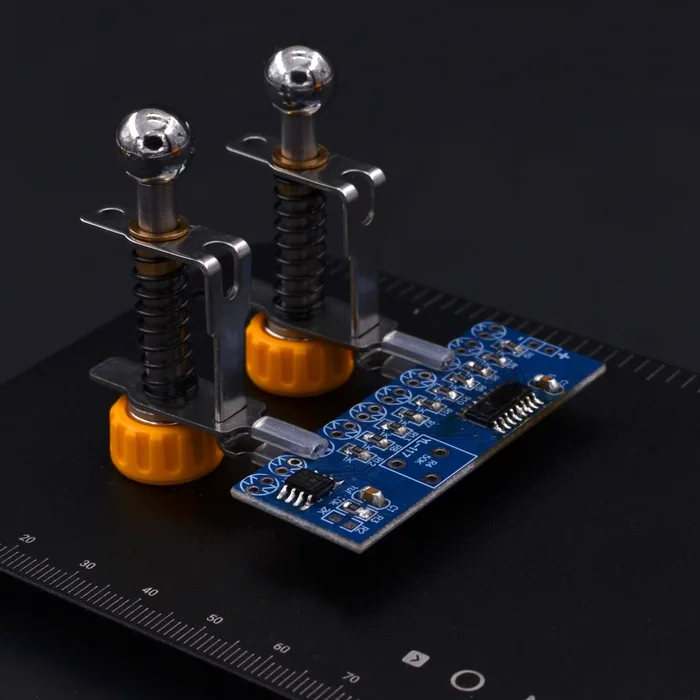
- Omnifixo - Modular magnetic clips with parallel silicone lined jaws and locking ball joints, aimed squarely at the drift and marking complaints.
- Hakko - Soldering equipment maker whose Omnivise board holders are the workshop standard for keeping a board level during rework.
- PanaVise - Long established maker of tilting, rotating vise heads and circuit board holder heads.
- Stickvise - Makes low profile PCB vises designed to keep the board close to the bench.
How to read a listing without getting fooled
Read the listing looking for numbers, and notice where they stop. A good page will tell you the base mass, the arm lengths, the jaw opening and what the jaw faces are made of, in that order of usefulness. A weaker page will describe the base as heavy, call the arms flexible and show a photo of a circuit board held at a jaunty angle. When you hit a claim that sounds technical, ask what would prove it: heat resistant should come with a temperature, ESD safe should come with a resistance and a test method, and heavy should come with a weight. It is also worth reading the maker's own manual where one exists, because manuals are written by engineers and tend to admit things the marketing page does not, such as needing two units for a larger board or not putting the magnetic feet anywhere hot.
How much should you spend?
The budget tier is dominated by unbranded cast base units, often bundled with a magnifier and a light, and they publish almost nothing you can check. They will hold a wire, and plenty of people start there quite reasonably. The mid tier is where documented tools begin: heavier published base masses, several arms in named lengths, stainless clamps with covers included, and single purpose board holders from established soldering brands. That tier is where the value sits for anyone soldering regularly. The premium tier buys you modular clips with parallel jaws, locking ball joints and grounded bases, plus the kind of published detail that lets you decide before you buy rather than after. Across all three tiers, the useful question is not what a tool costs but how many of its claims come with a number attached.
Questions, answered
Can I rest a hot iron on the base between joints?
Do not make a habit of it, whatever the base is made of. A steel plate will survive the contact but it will conduct heat into whatever is bolted or magnetised to it, and on tools with plastic feet or magnets the damage is permanent, which is why Omnifixo tells you not to heat its feet or magnets at all. Use the iron's own stand, which is designed to hold the tip clear of everything. If you want a surface you can put hot things on, that is a job for a rated bench mat rather than for a holder.
Will the magnets in a magnetic base tool harm a circuit board?
For ordinary boards, no. Neodymium magnets affect ferrous metal and magnetic storage media, not the semiconductors, passives and copper on a typical assembly. The things to keep away are mechanical hard drives, magnetic stripe cards and some sensors and speakers. The practical nuisance is different and more common: a strong magnetic foot will happily grab loose screws and cut offs from your bench, so brush the plate before you set a board down on it.
Do I need to bolt the tool to the bench?
Most people never do, and a published base mass is the reason why. A heavy plate on rubber feet resists both sliding and tipping for the loads a soldering job puts on it. Bolting down becomes worth it when you are pushing hard against the work, which is more of a vise situation than a third hand one, and it is why makers of vise heads publish bolt patterns. If your tool skates, the honest fix is usually more mass rather than more clamping.
Can I add clip protection to a tool I already own?
Yes, and it is the cheapest upgrade in this category. Short lengths of silicone tubing slipped over the jaws of an alligator clip spread the clamping force across a face instead of two toothed lines, which is exactly what the covers supplied with better tools do. Heat resistant silicone is the right material because it will meet an iron tip sooner or later. If a clip is too coarse even sleeved, a strip of thin card or a scrap of dissipative foam between the teeth and the board works for a one off job.
Or jump to the head-to-head: Omnifixo OF-M4.4 Makers Third Hand vs QuadHands Deluxe Magnetic WorkBench.