Explained
Hole Saws, Explained
After reading, you'll understand which arbor you need, what each cutting edge is genuinely rated for, and how to read a depth and speed spec before you buy.
In this guide
Almost everybody's first hole saw mistake is the same one. You buy a cup, you buy an arbor, and the two do not screw together, because the industry uses one thread for small saws and a different thread for large ones. The second mistake is running the thing at full drill speed, which cooks the teeth on a big saw in a couple of holes. Neither is a secret: the thread sizes and the recommended speeds are published. They are just published somewhere nobody looks until the third hole.
The 30-second version
- There are two threads, not one, 1/2 in. x 20 for saws from 9/16 in. to 1-3/16 in. and 5/8 in. x 18 for 1-1/4 in. and larger, and a kit with one arbor only covers one of them.
- The thread is standard, the quick-change is not, so cups and plain arbors mix across brands while proprietary mandrels and pin systems may need an adapter or may not accept the cup at all.
- Depth of cut is usually about 1-5/8 in., which clears a single nominal two-by at 1-1/2 in. but not a doubled plate, and deep-cut and carbide ranges publish 2 in. or more.
- Speed matters more than pressure, and both Milwaukee and LENOX publish recommended RPM by diameter and material, dropping well under 100 RPM for large saws in stainless.
- Warranties in this category are thin, with Milwaukee's tooth break cover on HOLE DOZER the exception and several makers stating no warranty at all on their own pages.
The products this guide is about
Our verdict on each, with the full reasoning on the companion review.
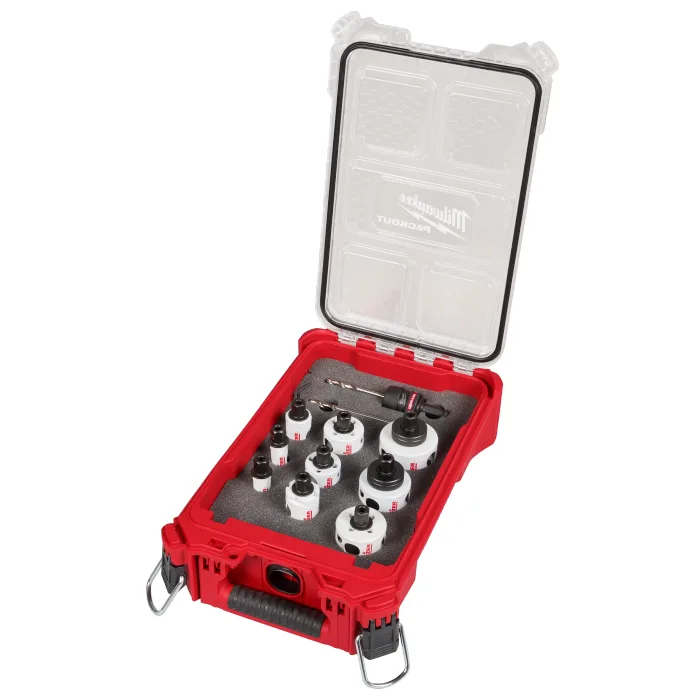
- Buy Milwaukee 12PC QUIK-LOK HOLE DOZER Bi-Metal Hole Saw Kit (49-22-4702) The only kit here whose maker publishes a depth of cut, an RPM figure per material and a warranty, on an arbor documented to drive other brands' saws.
- Buy LENOX 7PC Contractor's Hole Saw Kit (1815140) Four saws and both arbors you actually need, from the maker that publishes the most complete public speed chart in the category.
- It depends Diablo 13 pc Carbide Teeth Hole Saw Set (DHS13SPLCT) The deepest published cut here by a wide margin, on a mandrel that other brands' saws can join but Diablo's cups cannot leave. Amazon
- Skip Milwaukee SHOCKWAVE Impact Duty Thin Wall Hole Saw, 1-1/2 in. (49-56-9835) A good sheet-metal tool sold in the same aisle as real hole saws, and rated by its own maker for a fraction of the work.
What actually matters
- Arbor thread size - the single spec that decides whether your saw and your arbor will meet. The market runs on 1/2 in. x 20 for saws up to 1-3/16 in. and 5/8 in. x 18 from 1-1/4 in. up, and Milwaukee, LENOX and Diablo all publish those same two numbers.
- Quick-change system - the layer bolted on top of the thread, and the only place real lock-in happens. Milwaukee's QUIK-LOK and LENOX's SNAP-BACK are described as accepting threaded hole saws generally, while Diablo lists its own cups' shank as Diablo Mandrel.
- Cutting edge material - bi-metal, carbide-tipped, carbide grit and diamond are rated for different work rather than being good, better and best. LENOX's published selection guide puts carbide-tipped top for stainless and cast iron and diamond top for tile and granite.
- Depth of cut - the published figure for how thick a material the cup will pass in one go. A standard bi-metal saw is around 1-5/8 in., a deep-cut bi-metal around 2 in., and Diablo's carbide cups are published at 60 mm (2-3/8 in.).
- Tooth pitch - how many teeth sit in an inch of cutting edge, and whether the spacing is constant or variable. Milwaukee's bi-metal HOLE DOZER is 3.5 TPI constant, Starrett's Fast Cut is 5.5 TPI constant, and Starrett's Deep Cut uses a variable pitch instead.
- Plug ejection - how the disc of waste comes out of the cup, which you will do on every hole. Slots need a screwdriver, mandrel-based ejection is tool-free, and thin wall saws often include a spring that does it automatically.
- Pilot bit length - the drill in the middle has to reach the work before the teeth do, and stay ahead of them. Milwaukee ships a 1/4 in. by 4 in. pilot with its arbor set, and LENOX sells pilot drills at 3-7/16 in. and 4-1/4 in. for its deeper cups.
The specs, in plain English
Green flags vs red flags
Green flags
- The listing states a depth of cut in inches or millimetres rather than just a diameter.
- The kit includes arbors or adapters for both the 1/2 in. x 20 and 5/8 in. x 18 thread ranges.
- The maker publishes a recommended RPM by diameter and material, not just a single speed.
- The tooth pitch is stated, and ideally whether it is constant or variable.
- Plug removal is described as a specific mechanism, such as slots low on the cup, mandrel ejection or a spring.
Red flags
- A quick-change system whose page only claims compatibility with the same brand's own saws.
- A kit with a single arbor and saws that span both thread ranges.
- No depth of cut anywhere in the listing, only diameters and a piece count.
- Life claims given as a multiplier with no stated test material or comparison.
- A saw sold with an integral hex shank and no thread, which cannot join any arbor system later.
Who's who: the brands
- Milwaukee - Publishes per-size data, including depth of cut and RPM by material, and backs HOLE DOZER with a limited lifetime tooth break warranty.
- LENOX - The long-running bi-metal name, whose catalogue carries the fullest public speed charts, though several of its kit pages state no warranty applies.
- Diablo - Carbide-focused, with the deepest published cut of the sets here and a Snap-Lock mandrel system that its own cups are built around.
- Starrett - Splits its bi-metal range into a constant-pitch Fast Cut at 1-5/8 in. depth and a variable-pitch Deep Cut at 2 in., and states the material thickness each is for.
- Bosch - Sells hole saws around its keyless Power Change Plus arbor, with screw-in adapters offered to fit other brands' saws to the system.
How to read a listing without getting fooled
Start at the bottom of the listing, not the top. Find the diameter, then look for a depth of cut; if the seller gives you one without the other, the listing is incomplete and you should go to the manufacturer's own page for the number. Next find the thread or the arbor reference, because that tells you whether this cup joins what you already own. Then read the cutting edge description literally: multi-material, carbide grit and carbide-tipped are three different things sold under overlapping words, and the maker's selection guide will tell you which one it puts top for your material. Finally check whether the maker publishes a recommended speed at all. A brand that will not tell you how fast to run a 4 in. saw in stainless is a brand that has left the most important variable to you.
How much should you spend?
Budget kits buy you saws and a conventional arbor, which is genuinely enough if you drill a few holes a month; the compromise is usually that the maker publishes less about them and offers no warranty. Mid-range is where you start getting a quick-change arbor with adapters for both thread ranges, published per-size data and a case that survives a van. Premium buys carbide teeth, a deeper cup and tool-free plug ejection, and it is worth it when you are cutting nail-embedded wood, cast iron or stainless regularly rather than occasionally. Spend the extra on the arbor before you spend it on the saws, because the arbor is the part you keep.
Questions, answered
Do I need a different arbor for large and small hole saws?
Usually yes. The industry uses 1/2 in. x 20 threads on saws from roughly 9/16 in. to 1-3/16 in. and 5/8 in. x 18 on saws from 1-1/4 in. upwards, and LENOX for instance lists separate arbor references for each range. Some quick-change systems get around this with adapters: Milwaukee's QUIK-LOK arbor set ships a small thread adapter, a large thread adapter and a large thread pin adapter on one shank. If your kit contains only one arbor, check which range it covers before you assume it covers both.
Is carbide always better than bi-metal?
No, it is different rather than strictly better. LENOX's own published selection guide rates carbide-tipped at the top for stainless steel and cast iron and multi-material carbide at the top for nail-embedded wood and masonry, while listing bi-metal as the good general option across ordinary wood and metal. Carbide also runs at different speeds: LENOX's carbide-tipped chart lists 1000 RPM for a 1-1/4 in. saw in aluminium where its bi-metal chart lists 410. For occasional holes in clean wood and mild steel, bi-metal is the sensible buy.
Why do big hole saws burn out so fast?
Almost always speed. Cutting speed at the rim rises with diameter, so the same drill setting that is fine on a 3/4 in. saw is far too fast on a 4 in. one. LENOX's published bi-metal chart drops from 460 RPM at 3/4 in. in mild steel to 85 RPM at 4 in., and to 40 RPM at 4 in. in stainless. Use the drill's low gear, keep steady pressure rather than heavy pressure, and back out often to clear chips.
Can I use a hole saw in an impact driver?
Only the ones sold for it, and they are a narrower tool than they look. Milwaukee's SHOCKWAVE thin wall hole saws use a 1/4 in. quick change hex shank and are rated for plastics and thin gauge metals up to 1/8 in. thick, with sizes stopping at 1-1/2 in. A conventional threaded hole saw on a standard arbor wants a drill with a chuck, low gear and preferably a side handle, because a large saw that binds will try to twist the tool out of your hands.
Or jump to the head-to-head: Milwaukee 12PC QUIK-LOK HOLE DOZER Bi-Metal Hole Saw Kit (49-22-4702) vs LENOX 7PC Contractor's Hole Saw Kit (1815140).