Explained
Infrared Thermometers, Explained
After reading, you'll understand why two guns with the same headline accuracy can disagree by tens of degrees, and which spec lines predict which one is telling the truth.
In this guide
First-time buyers usually compare temperature range and price, then wonder why the tool reads a hot copper pipe as barely warm. Infrared thermometers do not measure temperature directly; they measure radiated energy and convert it, and that conversion depends on the surface, the distance and the room around it. The two specs that govern all of that, emissivity and distance-to-spot, are the two most often skipped in listings. The good news is that both are easy to understand once someone explains them without the physics.
The 30-second version
- It reads surfaces only, so air, liquid and internal temperatures need a contact probe, not a better infrared gun.
- Emissivity is the whole ballgame, and a tool with a fixed 0.95 setting cannot be corrected for shiny metal no matter how careful you are.
- Distance-to-spot is a ratio, not a range, so the spot grows as you back away and your target has to stay bigger than it.
- The laser only aims, and on several tools you can switch it off entirely and keep measuring.
- How accuracy is written matters more than the number, because bands, ambient conditions and stated caveats are what make the figure checkable.
The products this guide is about
Our verdict on each, with the full reasoning on the companion review.
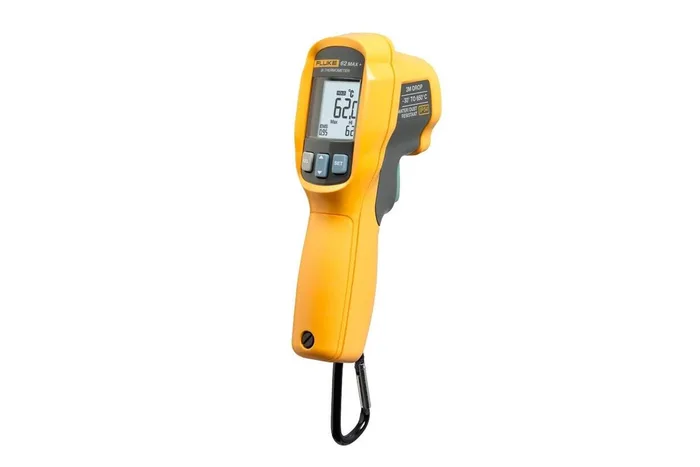
- Buy Fluke 62 MAX+ The one that tells you what its distance-to-spot ratio actually means.
- Buy Klein Tools IR10 Dual-Laser Infrared Thermometer Tightest optic here, plus the contact probe that covers what infrared cannot. Amazon
- It depends ThermoWorks Industrial IR Gun (IR-GUN-S) Paperwork and banded accuracy, in exchange for a low temperature ceiling.
- Skip Etekcity Lasergrip 774 Upgrade Infrared Thermometer Emissivity locked at 0.95, which quietly breaks every reading on shiny metal. Amazon
What actually matters
- Emissivity adjustment - every material radiates infrared with a different efficiency, and the gun has to be told which one it is looking at. Klein's own chart puts commercial sheet aluminum at 0.09 and black paint at 0.96, which is the difference between a useless reading and a good one.
- Distance-to-spot ratio - this sets how large an area the reading averages over at any given distance. At 20:1 you get roughly a 1 inch spot at 20 inches; at 12:1 you get a 1 inch target at 12 inches, so you have to stand closer for the same precision.
- How the ratio is qualified - Fluke publishes its optic as calculated at 90 percent energy while others give a bare number, so a bigger ratio from a brand that will not state its method is not automatically better.
- Banded accuracy - a maker that splits accuracy into target ranges, and states a separate figure below freezing, is describing real behavior rather than quoting a best case.
- Stated operating ambient - accuracy figures assume the tool itself is at a stable temperature, which is why ThermoWorks publishes a 0 to 50 C operating range and warns about rapid ambient change.
- Contact probe input - a K-type jack turns a surface-only instrument into one that can also read air, gas and liquid, which is a genuine capability difference rather than a feature bullet.
- Build ratings - a published IP rating and drop height, like the IP54 and 3 meter figures on the Fluke and Klein, is a specific commitment; silence on both is not the same as being tough.
The specs, in plain English
Green flags vs red flags
Green flags
- Emissivity published as a range, such as 0.10 to 1.00, rather than as a single value.
- A distance-to-spot ratio that says how it was derived, for example calculated at 90 percent energy.
- Accuracy quoted in bands, with a separate and looser figure for sub-zero targets.
- A stated operating ambient range plus an explicit note on what degrades accuracy.
- A published ingress protection rating and drop height, and a full manual you can download before buying.
Red flags
- Emissivity listed as a bare 0.95 with no range, which means it is fixed.
- A single accuracy figure covering the entire temperature range with no conditions attached.
- A very large distance-to-spot ratio quoted with no explanation and no spot diameter chart.
- Marketing that implies body temperature use on a tool that is meant for inanimate objects.
- No downloadable manual, no ingress or drop rating, and specifications that appear only in a retail listing.
Who's who: the brands
- Fluke - Test and measurement specialist whose datasheets qualify their own numbers, including stating the energy fraction behind the distance-to-spot ratio.
- Klein Tools - Electrical trade brand that bundles a K-type probe with the IR10 and prints an emissivity chart in the paper manual.
- ThermoWorks - Thermometry house that publishes banded accuracy and ships a certificate of conformance with traceable calibration.
- Etekcity - Budget consumer brand with a wide Lasergrip line where emissivity is fixed at 0.95 on the Lasergrip 774 Upgrade.
- Extech - Long-running instrument brand with a broad ladder of infrared models aimed at building and industrial diagnostics.
How to read a listing without getting fooled
Start at the emissivity line, not the temperature range. If it shows a range with a low and a high value, the setting is adjustable and the tool can be corrected for metals; if it shows one number, it is locked and you should assume every reading on a shiny surface is low. Next find the distance-to-spot ratio and read whether the maker qualified it, because an unqualified 20:1 and a 12:1 stated at 90 percent energy are not measuring the same thing. Then check whether accuracy is a single figure or several, and whether the sheet names an operating ambient and any conditions that degrade it. Finally look for the things that are absent: no probe jack means surfaces only, no ingress or drop rating means no claim was made, and no downloadable manual usually means the specification you are reading was written by a retailer rather than by the manufacturer.
How much should you spend?
Budget infrared guns are genuinely usable on matte, dark, non-metallic surfaces, and they are where fixed emissivity shows up most often, so read that line before anything else. The mid-range is where the category gets interesting: adjustable emissivity, tighter optics, contact probe inputs and published build ratings all appear here, and the step up from budget buys real capability rather than badge value. Premium tools rarely add range or a bigger number; they add disclosure, tighter accuracy specs, longer warranties and qualified optics, which is worth paying for only if your readings have to be defensible to somebody else. One thing worth knowing is that adjustable emissivity is not a premium-tier feature at all, since Fluke's entry 62 MAX has it and some budget models do not, so it is a brand and model choice rather than a spending threshold.
Questions, answered
Can it read temperature through glass or a window?
No. Common infrared thermometers work in the 8 to 14 micron band, and ordinary glass is effectively opaque there. Point one at a window and you will measure the temperature of the glass itself, not what is behind it. The same limitation applies to plastic sheeting and to looking through a clear inspection panel.
What is the trick for measuring shiny metal accurately?
Give the metal a surface with known emissivity. The standard method is to stick a patch of matte tape or apply a dab of flat black paint to the target, let it reach the same temperature as the metal underneath, then measure the patch with emissivity set near 0.95. On a tool with adjustable emissivity you can instead dial in a value for the material, though real surfaces vary with finish, oxidation and angle, so the tape method is usually more reliable.
Does the reading change if I hold the gun at an angle?
Yes, and it gets worse the further off perpendicular you go. An angled view stretches the measured spot into an ellipse covering more area than the ratio predicts, and reflective surfaces bounce more of the surroundings into the sensor. Measure square to the surface where you can. It also helps to take several readings and compare rather than trusting a single number.
Do these need recalibrating, and how would I check?
Manufacturers generally treat annual calibration as good practice, and Klein states the IR10 is accurate for one year. Formal recalibration uses a blackbody source, which is laboratory equipment. As a field sanity check, Klein's own manual advises verifying correct operation by measuring a known temperature value on a comparable object before you rely on the tool to judge whether something is safe.
Or jump to the head-to-head: Fluke 62 MAX+ vs Klein Tools IR10 Dual-Laser Infrared Thermometer.