Explained
Locking Pliers, Explained
After reading, you'll understand which locking plier specifications are real, which are marketing, and which the maker has quietly left blank.
In this guide
Almost everyone buys their first locking plier by size, picks a 10 inch because it sounds versatile, and never looks at anything else. Then it slips on round stock, or the screw walks out of adjustment halfway through a job, or the jaw will not open far enough for the pipe. The specifications that would have predicted all three are short, and the frustrating part is how often they are missing. Knowing which fields to look for, and what it means when they are blank, is most of the work.
The 30-second version
- The jaw is the tool, and curved, straight, long nose, C-clamp, welding and sheet metal versions are separate catalog items with separate part numbers, not styling.
- Jaw capacity is the number to find, and some makers publish one figure, some publish three for round, square and hex, and some publish none at all.
- Hardness is rarely published, so treat forged, hardened and heat treated as material descriptions rather than as figures you can compare.
- The adjusting screw is the weak point, so look for a lock nut that retains the setting or a published replacement adjusting bolt part number.
- Lever and trigger releases both break the same toggle, so the difference is ergonomics and how much force the linkage was designed around, not safety.
The products this guide is about
Our verdict on each, with the full reasoning on the companion review.
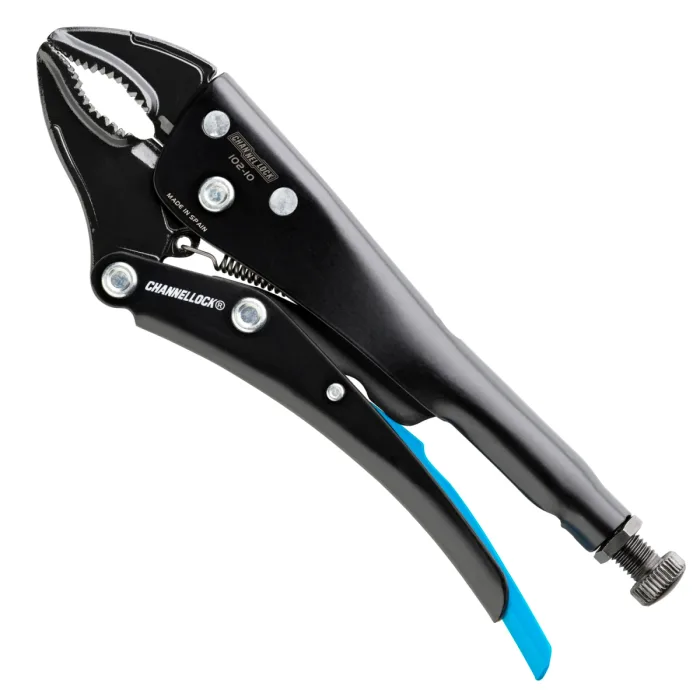
- Buy Channellock 102-10 10-inch Curved Jaw Locking Pliers w/ Cutter The only one of the four whose maker page lists a lock nut to retain the jaw adjustment, backed by the fullest dimensional table in the group.
- Buy Knipex 41 14 250 Grip Pliers with Universal Jaws, 10 in. Publishes three separate jaw openings, names the steel the jaws are forged from, and states the country of origin. Amazon
- It depends Milwaukee 48-22-3410 10 in. TORQUE LOCK Curved Jaw Locking Pliers with Grip The only one here with published part numbers for the two things that wear out, but the product page gives no jaw capacity. Amazon
- Skip Irwin IRHT82573 New Fast Release Curved Jaw Locking Pliers CR, 10 in. Irwin's own page carries no specifications section for it, and Irwin keeps the maximum locking force line for its trigger release models instead. Amazon
What actually matters
- Jaw capacity - the widest thing the jaws will close around, and the single most useful number on the page. Two of the four tools in our review do not publish it at all, which means you are sizing by eye.
- Jaw style - curved, straight, long nose, C-clamp, welding clamp and sheet metal are genuinely different tools. Makers list them as distinct catalog numbers with their own spare parts, which is the clearest proof they are not variations on a theme.
- Over-centre toggle - the linkage that makes a locking plier lock. Knipex describes it as toggle lever action giving high clamping pressure, and it is what holds the jaws closed after you let go of the handles.
- Adjusting screw - the knurled screw in the handle end that sets how tight the jaws close. It is the setting you will fight with, and only some makers publish anything that stops it moving.
- Lock nut - a nut on the adjusting screw that keeps it where you set it. Channellock publishes one; it is the direct answer to a plier that will not hold an adjustment through repeated cycles.
- Release mechanism - the lever or trigger that breaks the toggle and opens the jaws. Lever designs sit in the handle, trigger designs hang below it, and one maker sells a triggerless version marketed on being easier to open.
- Service parts - a published spring kit or adjusting bolt kit, tied to your catalog number. The spring and the bolt are the two parts that fail, so a maker that lists them is telling you the tool is repairable.
The specs, in plain English
Green flags vs red flags
Green flags
- A jaw capacity printed in the specification table, ideally with separate figures for round, square and hex material.
- A lock nut or equivalent named as retaining the jaw adjustment.
- A jaw material given as a grade, such as forged chrome vanadium electric steel, rather than as an adjective.
- A published service parts document with a spring and adjusting bolt number against your catalog number.
- A country of origin stated in the technical table rather than left blank.
Red flags
- A product page with no specifications section at all, only feature bullets.
- Quantified claims such as 3X gripping power carrying footnote markers whose text is not shown anywhere on the page.
- A specification block whose numbers contradict the product name, such as a length shorter than the tool or four dimensions listed as the same value.
- A cited standard with no year, or a reference to a specification you cannot find a current record for.
- Hardness described as hardened, heat treated or induction hardened with no figure attached.
Who's who: the brands
- Channellock - A Pennsylvania maker best known for tongue and groove pliers, which publishes full dimensional tables and states plainly which of its lines are made in the USA and which are not.
- Knipex - A German pliers specialist whose technical tables break out jaw material, body material, finish, weight and country of origin for each catalog number.
- Milwaukee - A jobsite tool brand whose locking range is unusual for publishing a service parts bulletin with spring and adjusting bolt kits for every catalog number.
- Irwin - The brand behind the VISE-GRIP name, selling both a classic trigger release Original line and a newer triggerless Fast Release line.
How to read a listing without getting fooled
Start at the specification table, not the feature bullets, and look for one number: jaw capacity. If it is there, check whether it is a single figure or broken out by material shape, because a universal jaw with three published openings tells you far more than one headline measurement. Then read the material line and ask whether it names a steel grade or just an adjective; forged chrome vanadium electric steel is checkable, maximum toughness is not. Look for anything about holding the adjusting screw, since that is the failure most owners actually hit. Finally, look for a manual or parts list link, because a published spring and adjusting bolt number is the strongest signal that the maker expects you to keep the tool. Treat any quantified marketing claim with a superscript footnote marker as unverified until you can read the footnote.
How much should you spend?
Budget locking pliers are widely available and often carry a lifetime guarantee, but the pages behind them tend to be the thinnest, with feature bullets and no dimensions. Mid range is where the useful documentation starts: full dimensional tables, a named jaw material, a lock nut on the adjusting screw, or a published service parts bulletin. Premium buys you a specialist maker's technical table, with separate jaw openings for different material shapes, an explicit steel grade and a stated country of origin, usually on a bare handled tool aimed at trades rather than at a shelf. The honest read is that spending more in this category buys better information and better finish rather than a documented jump in gripping force, because none of the makers in our review publishes a clamping force figure.
Questions, answered
How big a locking plier should I buy first?
A 10 inch curved jaw is the usual first tool because the curved profile handles round, hex and flat material adequately and the length gives enough handle leverage for most jobs. Check the published jaw capacity rather than the nominal size, since the two are not related in any fixed way. If most of your work is small and fiddly, a 5 to 7 inch is easier to place one handed. Add a second size only after you know which way the first one falls short.
Will locking pliers damage what I clamp?
Expect it to, and that is the mechanism rather than a defect. The jaws carry hardened serrations that bite into the workpiece, and the bite is what stops the slipping that a plain plier suffers. Expect visible tooth marks on anything softer than the jaws, including plated fasteners, tube and finished surfaces. If you need to hold something without marking it, use a clamp with pads, a soft jaw insert or a strap instead.
Are these an alternative to a wrench or a socket?
Only as a last resort, even though makers do market them for nuts and bolts. A socket or a box wrench spreads load across the flats and leaves the head intact, which is what you want on a fastener you will see again. Locking pliers earn their place when the head is already rounded, the stud has no head left, or nothing else will reach. Keeping them for that job also keeps the teeth sharp for it.
How do I stop the jaws slipping?
Most slipping is a setting problem rather than a tool problem. Close the jaws on the workpiece first, then turn the adjusting screw in until the handles take real effort to snap over, so the toggle is working near the top of its range. Choose the jaw that matches the shape, since a straight jaw on round stock tends to give only a two point grip. If it slips again after a few cycles, check whether the adjusting screw has backed off, which is the argument for a tool that publishes a lock nut.
Or jump to the head-to-head: Channellock 102-10 10-inch Curved Jaw Locking Pliers w/ Cutter vs Knipex 41 14 250 Grip Pliers with Universal Jaws, 10 in..