Explained
Digital Multimeters, Explained
After reading, you'll understand what CAT I through CAT IV actually mean, why a CAT III 600 V meter is built for a harsher environment than a CAT II 1000 V meter, how to check that a safety claim was tested by someone other than the seller, and which measurement specs are worth paying for.
In this guide
First-time buyers almost always shop on functions and counts, because those are the numbers the listing shouts. The specification that decides whether the meter survives a fault is the measurement category, and it is quietly printed near the input jacks in small type. Making it worse, the two numbers in that marking work in opposite directions from what intuition suggests, and the marking itself is easy for anyone to silkscreen onto a case. This guide untangles the category system, the listing marks and the handful of specs that actually change how a meter behaves.
The 30-second version
- The CAT number matters more than the voltage number, because it describes how much fault energy is available where the meter is connected.
- A printed rating is a claim, not a test, so look for a listing from UL, CSA, TUV or ETL/Intertek in the manual or datasheet.
- The lowest rated part sets the rating, which means CAT II leads turn a CAT IV meter into a CAT II measurement system.
- Fuses are safety hardware, not consumables, and a high interrupt capacity ceramic fuse is what stands between a wrong-jack mistake and an arc.
- True RMS is not a luxury on modern circuits, since drives, ballasts and switch-mode supplies draw pulsed current that averaging meters misread badly.
The products this guide is about
Our verdict on each, with the full reasoning on the companion review.
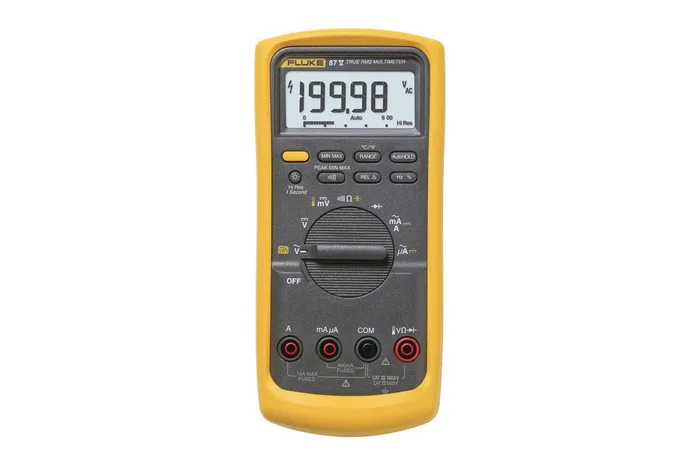
- Buy Fluke 87V Industrial Multimeter The industrial reference: CAT III 1000 V and CAT IV 600 V, UL listed and TUV licensed, with the tightest DC accuracy in this group. Amazon
- Buy Klein Tools MM720 CAT IV 600 V / CAT III 1000 V, true RMS, 6000 counts and a low impedance mode, at a price a working electrician will actually pay. Amazon
- It depends Fluke 117 Electrician's Multimeter A tightly focused electrician's meter with a low impedance mode and a built-in non-contact detector, but it stops at CAT III 600 V. Amazon
- Skip AstroAI DM6000AR Digital Multimeter A capable-looking 6000 count meter whose maker publishes no measurement category, no accuracy figures and no independent safety listing. Amazon
What actually matters
- Measurement category (CAT) - IEC 61010 sorts circuits by how much energy is available behind them, and the meter has to be built for the worst one you will touch. Fluke puts CAT II circuits under 10 kA of available short circuit current, CAT III under 50 kA and CAT IV above that, limited only by the utility transformer.
- Independent listing - a category marking means nothing unless a recognised laboratory tested the meter to the standard. Fluke works with nationally recognised test labs including CSA, UL, TUV and ETL/Intertek and states that any test instrument should be labelled to show certification by at least one independent testing agency.
- Fusing on the current inputs - the classic accident is probing a live circuit with the leads still in the amps jacks, which creates a short through the meter. Fluke notes that modern digital multimeters use a special high-energy fuse designed to contain the fault current available from a CAT IV installation.
- True RMS versus averaging - averaging meters are calibrated for pure sine waves and misread distorted ones. Fluke states an averaging meter can read up to 40 % low or 10 % high on the non-sinusoidal waveforms produced by variable-speed drives, electronic ballasts, computers and HVAC equipment.
- Input impedance and LoZ - a normal meter presents around 10 megohms, which is high enough that capacitively coupled voltage from a neighbouring conductor shows up as a real reading. A low impedance mode of roughly 3 kilohms loads that phantom voltage away so you see the truth.
- Counts and accuracy - counts set resolution, accuracy sets how close the number is to reality, and they are not the same thing. A 6000 count meter with plus or minus (0.05 % + 1) DC accuracy is far more trustworthy than a 20,000 count meter with no published accuracy table at all.
- Test leads and probe tips - leads carry their own category rating, and Fluke instructs users not to exceed the rating of the lowest rated component of the meter, probe or accessory. Protective caps that reduce exposed probe metal to under 4 mm are what let many leads be used in CAT III and CAT IV environments.
The specs, in plain English
Green flags vs red flags
Green flags
- The manual or datasheet names a standard and a route, such as UL listed to UL 61010-1, certified to CSA C22.2 No. 61010-1, or licensed by TUV to EN 61010-1.
- A full accuracy table is published for every function and range, not just a single headline percentage.
- Fuse type, current and voltage are specified, and better still an interrupt rating in kA is quoted.
- The supplied leads have their own category rating, or ship with protective caps that keep exposed probe metal under 4 mm.
- Input impedance is published, and a low impedance mode is described with an actual figure rather than a marketing name.
Red flags
- A category is printed on the case but the maker publishes no standard, no laboratory and no test reference anywhere.
- The only mark shown is CE, which is a manufacturer self-declaration rather than third-party certification.
- The listing leads with counts and function count while the accuracy, impedance and fuse specifications are simply absent.
- Marketing photographs show the meter being used in a distribution panel while its stated category is CAT II or CAT III 300 V.
- Test leads are shown with long bare probe tips and no category marking or safety caps.
Who's who: the brands
- Fluke - The industrial default, and the maker whose published safety documentation and independent laboratory listings the rest of the category tends to be judged against.
- Klein Tools - An American hand-tool maker whose test and measurement line is aimed squarely at electricians, with CAT IV rated meters and manuals that name UL and CSA standards.
- Amprobe - One of the brands under the Fluke umbrella, generally positioned below Fluke-branded instruments while covering similar electrical and HVAC work.
- Brymen - A Taiwanese test and measurement manufacturer that designs its own meters, often sold through regional distributors rather than under a single global brand.
- AstroAI - A budget online brand selling inexpensive multimeters and clamp meters, with product pages that generally omit category ratings, accuracy tables and safety listings.
How to read a listing without getting fooled
Start at the bottom of the meter rather than the top of the listing. Find the marking near the input jacks, note both the category and the voltage, and remember that they are two separate claims: the category tells you where you may connect it, the voltage tells you what steady potential it is built for. Then leave the retail listing entirely and open the manufacturer's own manual or datasheet. You are looking for three things: a standards line that names a laboratory or a specific standard number, an accuracy table with a row for every function, and a fuse specification with a size, a current and a voltage. If a maker publishes a full accuracy table, it usually publishes the safety data too, and the reverse is just as reliable a signal. Finally check what leads come in the box and what they are rated to, because that is the number that will actually cap your measurement system.
How much should you spend?
Budget meters buy you functions rather than confidence: high counts, temperature, capacitance and a carry case, with the safety and accuracy data mostly missing. They are genuinely fine for batteries, automotive circuits and hobby electronics, and they are the wrong tool the moment real fault current is available. The mid-range tier is where the category stops being decorative, and it is the level most people should buy at: a true RMS meter with a CAT III 1000 V or CAT IV 600 V rating, published fuse specifications, a low impedance mode and leads that ship with proper safety caps. The premium tier does not buy you a higher category so much as measurement quality and durability: tighter accuracy, high resolution modes, filtering for motor drives, better sealing and longer warranties. If you are choosing between more functions at a lower tier and fewer functions with a verifiable listing, take the listing every time.
Questions, answered
What does CAT I mean, and why do so few handheld meters carry it alone?
Fluke describes CAT I as protected electronic equipment, meaning circuits that are not directly connected to mains supply. Very little fault energy is available there, so a CAT I rating on its own tells you the meter should stay away from building wiring entirely. Most handheld meters are marked with a higher category because buyers expect to use them on mains, and a meter marked only CAT I is not a mains troubleshooting tool.
Can I just use CAT IV leads on a CAT II meter to make it safer?
No. The rating of a measurement system is set by its lowest rated component, so better leads on a lesser meter still leave you with the meter's category. Upgrading leads is worth doing when the meter is the better-rated part and the leads are the weak link, which is a common situation. It does not work in the other direction.
Is a higher count meter more accurate?
No, counts and accuracy are separate specifications. Counts describe how finely the display can divide a range, while accuracy describes how close the reading is to the true value and is quoted as a percentage of reading plus a fixed number of counts. A 20,000 count display on a meter with no published accuracy figure is showing you extra digits of an unknown error.
Why does my meter show voltage on a wire I know is disconnected?
That is ghost voltage, and it is a consequence of high input impedance. A meter presenting around 10 megohms will happily display a voltage that is only capacitively coupled from a neighbouring energised conductor running alongside it. A low impedance mode of roughly 3 kilohms loads that tiny coupled charge away so the reading drops to near zero, which tells you the conductor is genuinely dead.
Or jump to the head-to-head: Fluke 87V Industrial Multimeter vs Klein Tools MM720.