

Tools & DIY
The Best Digital Multimeters: 4 Compared (and One to Skip)
We compared four digital multimeters on the things that decide whether a meter is safe and useful: measurement category rating, independent safety listing, fusing, true RMS behaviour, input impedance and published accuracy.
The short version
The Fluke 87V is the meter to buy if you work on real distribution systems: it is rated CAT III 1000 V and CAT IV 600 V, its manual states it is UL listed to UL 61010-1 and licensed by TUV to EN 61010-1, and its DC accuracy of plus or minus (0.05 % + 1) is far tighter than anything else here. The Klein Tools MM720 is the value pick and the one most electricians should actually buy: same CAT IV 600 V / CAT III 1000 V rating, true RMS, 6000 counts, a low impedance mode for ghost voltage, and a manual that states conformity to UL 61010-1 and certification to CSA C22.2 No. 61010-1. The Fluke 117 is a depends: superb for branch and feeder work in commercial buildings, but it stops at CAT III 600 V and 600 V maximum input, so it is the wrong tool at a service entrance. The AstroAI DM6000AR is the skip, not because it is cheap but because AstroAI publishes no measurement category, no accuracy figures and no independent safety listing for it, while the case in their own photograph carries only a CE self-declaration. Nothing on the listing lets you verify the printed category claim. Best for: buy the MM720 if you work on building electrical systems, the 87V if you also need bench-grade accuracy, and keep anything unlisted for batteries and hobby electronics.
Our picks at a glance
- Fluke 87V Industrial Multimeter - Buy. The industrial reference: CAT III 1000 V and CAT IV 600 V, UL listed and TUV licensed, with the tightest DC accuracy in this group.
- Klein Tools MM720 - Buy. CAT IV 600 V / CAT III 1000 V, true RMS, 6000 counts and a low impedance mode, at a price a working electrician will actually pay.
- Fluke 117 Electrician's Multimeter - It depends. A tightly focused electrician's meter with a low impedance mode and a built-in non-contact detector, but it stops at CAT III 600 V.
- AstroAI DM6000AR Digital Multimeter - Skip. A capable-looking 6000 count meter whose maker publishes no measurement category, no accuracy figures and no independent safety listing.
The verdict in 30 seconds
What mattered most
- Measurement category
- Independent safety listing
- True RMS
- Display counts
- DC volts accuracy
- Input impedance and LoZ
A multimeter is the rare tool where the most important specification is not on the front of the box. The number that decides whether a meter survives a fault is its IEC 61010 measurement category, and that number is widely printed on cases that no independent laboratory has ever tested. We picked four meters that sit at very different points on that scale: two that suit a working toolbag, one that suits a specific kind of electrician and nobody else, and one that is fine for batteries and wrong for a breaker panel.
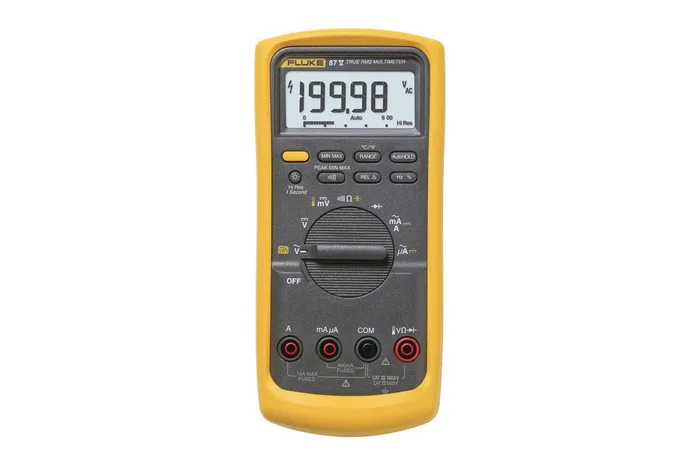
The industrial reference: CAT III 1000 V and CAT IV 600 V, UL listed and TUV licensed, with the tightest DC accuracy in this group.
Best for: Industrial and commercial technicians who need CAT IV capability, a low pass filter for motor drives and near bench-grade DC accuracy in one instrument.
- Rated CAT III 1000 V and CAT IV 600 V, and the manual states it is UL listed to UL 61010-1 and licensed by TUV to EN 61010-1.
- DC volts accuracy of plus or minus (0.05 % + 1), with a 19,999 count high resolution mode on top of the standard 6000 counts.
- Both current inputs are fused at 1000 V (11 A and 440 mA fast-blow) and an input alert warns audibly when a lead is in a current jack on the wrong function.
- No low impedance mode, so ghost voltage on long unloaded conductors has to be dealt with another way.
- The supplied TL75 leads are rated CAT II 1000 V on their own and only reach CAT III 1000 V / CAT IV 600 V with the protective caps fitted.
- IP30 ingress rating, so it is not a meter for wet or heavily contaminated environments.
- Large and heavy at about 355 g bare, with no backlit keypad, and priced at the top of the category.
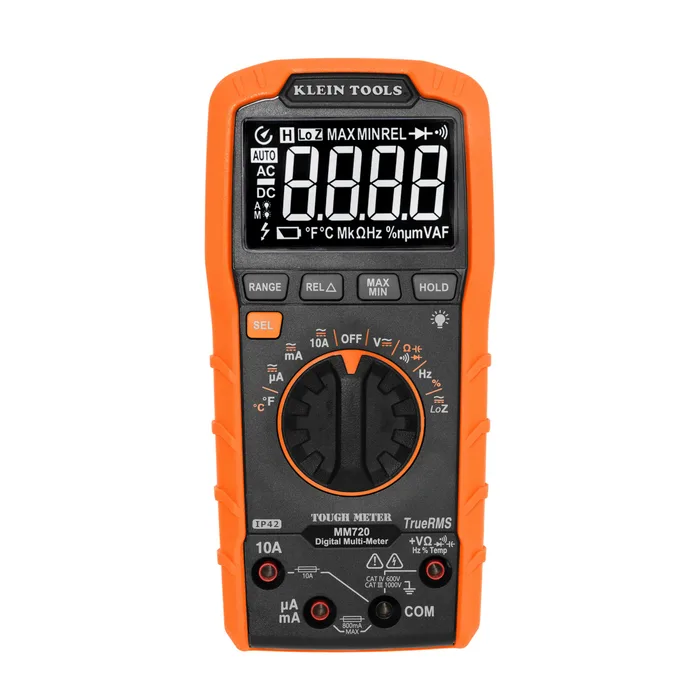
CAT IV 600 V / CAT III 1000 V, true RMS, 6000 counts and a low impedance mode, at a price a working electrician will actually pay.
Best for: Electricians and maintenance technicians who want a CAT IV rated, independently certified true RMS meter with ghost voltage handling and no premium price.
- Carries a CAT IV 600 V / CAT III 1000 V rating, and the manual states it conforms to UL 61010-1, 61010-2-030 and 61010-2-033 and is certified to CSA C22.2 No. 61010-1.
- LoZ mode drops input impedance to above about 3 kilohms, which collapses ghost voltage instead of displaying it as a live reading.
- Both current inputs use fast-blow 1000 V fuses (10 A and 800 mA) and the supplied leads come with CAT III / CAT IV safety caps.
- DC accuracy of plus or minus (0.5 % + 5) on the 6 V range is field-grade, not bench-grade.
- Klein does not publish an interrupt rating in kA for the fuses, so you cannot compare that figure against meters that do publish it.
- Resistance at plus or minus (1.2 % + 5) and capacitance at plus or minus (3.0 % + 5) are ordinary, so this is a power meter rather than an electronics meter.
- IP42 and a 2 m drop rating are solid but it is not a sealed instrument.
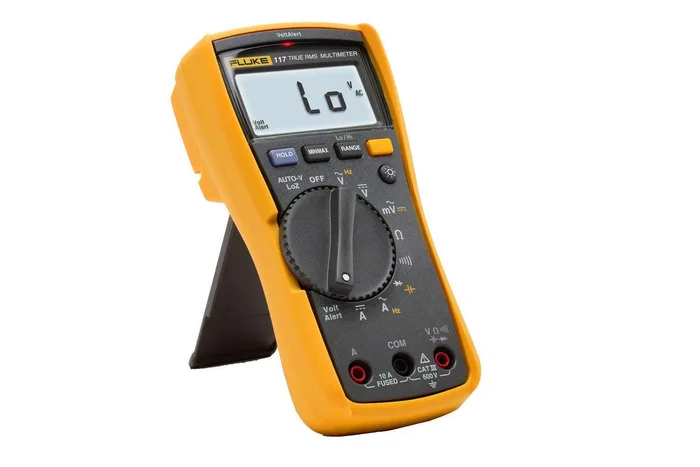
A tightly focused electrician's meter with a low impedance mode and a built-in non-contact detector, but it stops at CAT III 600 V.
Best for: Commercial and residential electricians working on branch circuits and feeders inside a building, where ghost voltage is a daily nuisance and CAT IV is not needed.
- Auto-V LoZ at roughly 3 kilohms input impedance removes ghost voltage automatically, and VoltAlert gives a non-contact check without reaching for a second tool.
- The 11 A, 1000 V amps fuse has a published 17 kA interrupt rating, which is the number that actually matters when a fault current arrives.
- The detailed specification sheet lists CE, CSA and RCM, so the safety claim is backed by third-party certification.
- Rated CAT III 600 V with a 600 V maximum between any terminal and earth ground, so it is the wrong meter for a service entrance or a 1000 V system.
- The specification sheet lists temperature and microamps for the sibling 116, not for the 117, so it is not the HVAC or flame-sensor choice.
- The product page lists a 4 mm silicone test lead set without publishing a category rating for the leads themselves.
- DC accuracy of plus or minus (0.5 % + 2) is unremarkable for what it costs.
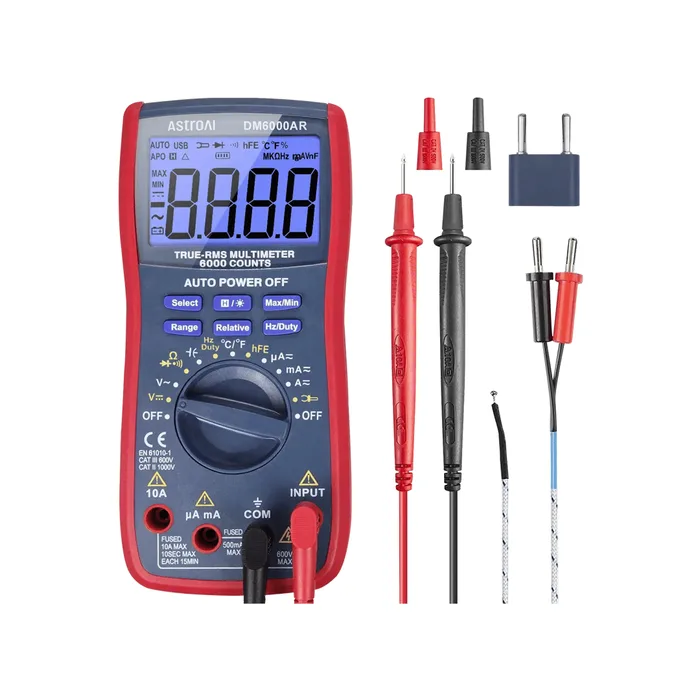
A capable-looking 6000 count meter whose maker publishes no measurement category, no accuracy figures and no independent safety listing.
Best for: Low energy work only: batteries, automotive 12 V systems and bench electronics, well away from a distribution panel or a service entrance.
- 6000 counts with both auto and manual ranging, plus capacitance, frequency, duty cycle and temperature, is a lot of function for very little money.
- Genuinely useful for low energy work such as battery packs, 12 V automotive circuits and hobby electronics.
- Sold as a kit with leads, clips and a pouch, so a first-time buyer has everything needed to start measuring.
- AstroAI's own product page states no measurement category, no accuracy specification, no input impedance and no fuse ratings.
- The only safety marking visible in AstroAI's own product photograph is a CE mark, which is a manufacturer self-declaration rather than evidence of third-party testing.
- The case is printed EN 61010-1, CAT III 600 V, CAT II 1000 V, but nothing published with the product lets a buyer confirm that a recognised laboratory tested it to those categories.
- Fluke's guidance is that a test instrument should be labelled to show certification by at least one independent testing agency, and there is no such listing mark to look up here.
| Criteria | Fluke 87V Industrial Multimeter Top pick | Klein Tools MM720 | Fluke 117 Electrician's Multimeter | AstroAI DM6000AR Digital Multimeter |
|---|---|---|---|---|
| Verdict | Buy it | Buy it | It depends | Skip it |
| Best for | Industrial and commercial technicians who need CAT IV capability, a low pass filter for motor drives and near bench-grade DC accuracy in one instrument. | Electricians and maintenance technicians who want a CAT IV rated, independently certified true RMS meter with ghost voltage handling and no premium price. | Commercial and residential electricians working on branch circuits and feeders inside a building, where ghost voltage is a daily nuisance and CAT IV is not needed. | Low energy work only: batteries, automotive 12 V systems and bench electronics, well away from a distribution panel or a service entrance. |
| Price tier | $$$ · premium | $$ · mid-range | $$ · mid-range | $ · budget |
| Measurement category | CAT III 1000 V / CAT IV 600 V | CAT IV 600 V / CAT III 1000 V | CAT III 600 V | Case printed CAT III 600 V / CAT II 1000 V; none published by maker |
| Independent safety listing | UL listed to UL 61010-1; licensed by TUV to EN 61010-1 | Conforms to UL 61010-1; certified to CSA C22.2 No. 61010-1 | CE, CSA and RCM listed on spec sheet | CE mark only; no laboratory listing published |
| True RMS | Yes, true RMS responding | Yes, true RMS | Yes, true RMS | Not stated on the product page |
| Display counts | 6000, plus 19,999 high resolution mode | 6000, reverse contrast | 6000 | 6000 |
| DC volts accuracy | plus or minus (0.05 % + 1) | plus or minus (0.5 % + 5) at 6 V; (0.8 % + 3) at 600 V | plus or minus (0.5 % + 2) | Not published |
| Input impedance and LoZ | 10 megohms, under 100 pF; no LoZ mode | 10 megohms; LoZ above 3 kilohms | Over 10 megohms DC; Auto-V LoZ about 3 kilohms | Not published |
| Current input fusing | 11 A and 440 mA, 1000 V fast-blow | 10 A and 800 mA, 1000 V fast-blow | 11 A, 1000 V, 17 kA interrupt rating | Case marked fused 10 A and 500 mA; ratings not published |
| Supplied test leads | TL75, CAT II 1000 V alone; CAT III 1000 V / CAT IV 600 V with caps fitted | Leads with CAT III / CAT IV safety caps | 4 mm silicone lead set; category not published | Leads included; category not published |
Which one is right for you?
- Industrial and commercial technicians who need CAT IV capability, a low pass filter for motor drives and near bench-grade DC accuracy in one instrument. Buy it Fluke 87V Industrial Multimeter
- Electricians and maintenance technicians who want a CAT IV rated, independently certified true RMS meter with ghost voltage handling and no premium price. Buy it Klein Tools MM720
- Commercial and residential electricians working on branch circuits and feeders inside a building, where ghost voltage is a daily nuisance and CAT IV is not needed. It depends Fluke 117 Electrician's Multimeter
- Low energy work only: batteries, automotive 12 V systems and bench electronics, well away from a distribution panel or a service entrance. Skip it AstroAI DM6000AR Digital Multimeter
How we judged the field
Five things decide whether a multimeter is worth owning, and only one of them is about measurement. First is the measurement category: IEC 61010 sorts circuits by how much energy is waiting behind them, and Fluke’s own guidance puts CAT II under 10 kA of available short circuit current, CAT III under 50 kA, and CAT IV above that. Second is whether an independent laboratory ever confirmed that rating, because a category printed on plastic costs the manufacturer nothing. Third is fusing: the classic accident is leaving the leads in the amps jacks and probing a live circuit, and the fuse is the only thing between that mistake and an arc inside your hand. Fourth is how the meter reads AC: a true RMS meter handles the pulsed, distorted current drawn by drives, ballasts and switch-mode supplies, while an averaging meter can read up to 40 % low or 10 % high on those waveforms according to Fluke. Fifth is input impedance, including whether the meter offers a low impedance mode that makes induced ghost voltage collapse instead of reading as live.
The field splits cleanly along the certification line rather than along price. On one side are meters whose makers publish the category, the standards, the fuse ratings, the input impedance and the accuracy tables, and whose manuals name a testing laboratory. On the other are meters that print a category on the case and publish almost nothing else. We took the Fluke 87V as the industrial reference, the Klein Tools MM720 as the value case for a CAT IV rated meter with a low impedance mode, the Fluke 117 as the example of a very good meter that is deliberately limited to CAT III 600 V, and the AstroAI DM6000AR as the honest representative of the enormous budget category that most first-time buyers actually reach for.
Two of the four are Fluke, so it is worth saying plainly why, because unexplained repetition looks like brand loyalty. The 87V and the 117 are aimed at different people and barely overlap. The 87V is an industrial and bench instrument: CAT III 1000 V with CAT IV 600 V, which clears it for service entrances and supply-side work, plus a 19,999 count high resolution mode, a low pass filter for variable frequency drives, microamp ranges for flame sensors and peak capture, and no low impedance mode. The 117 is an in-building electrician’s meter: CAT III 600 V with a 600 V ceiling between any terminal and earth, which rules out the service entrance, but with Auto-V LoZ that collapses ghost voltage and a built-in non-contact detector, neither of which the 87V has. One is for measuring precisely in harsh places, the other for moving fast through branch circuits and feeders. The other reason both are here is itself useful information: at these price points Fluke dominates the part of the market that publishes a verifiable independent listing, which is the standard an unlisted meter has to be judged against rather than against its own printed markings.
Fluke 87V Industrial Multimeter
Buy itThe Fluke 87V is what the rest of the category is measured against, for reasons of documentation as much as hardware. It is rated CAT III 1000 V and CAT IV 600 V, and the Getting Started manual states plainly that it is UL listed to UL 61010-1 and licensed by TUV to EN 61010-1, a claim you can verify. Measurement is a step above the rest here: DC volts at plus or minus (0.05 % + 1), 6000 counts with a 19,999 count high resolution mode, true RMS AC at plus or minus (0.7 % + 2) from 45 to 65 Hz, and a low pass filter for variable frequency drive outputs. Both current inputs are fused for 1000 V, at 11 A and 440 mA, and the meter warns audibly if a lead sits in a current jack while the dial says volts. The trade-off is no low impedance mode for ghost voltage, an IP30 rating rather than a sealed one, and the highest price here by a wide margin. It is for the technician whose work spans switchgear, motor drives and bench-level precision.
Klein Tools MM720
Buy itThe Klein Tools MM720 is the meter most working electricians should buy, because it carries the rating that matters at a fraction of the cost. It is marked CAT IV 600 V and CAT III 1000 V, and the manual states conformity to UL 61010-1, 61010-2-030 and 61010-2-033 with certification to CSA C22.2 No. 61010-1, which is the wording that indicates a recognised laboratory was involved rather than a self-declaration. It is true RMS with a 6000 count reverse contrast display, 10 megohm input impedance, and a LoZ mode above roughly 3 kilohms that makes induced ghost voltage disappear. Both current paths use fast-blow 1000 V fuses at 10 A and 800 mA, and the supplied leads ship with CAT III / CAT IV safety caps, which closes the gap that catches most buyers. What you give up is precision: DC accuracy is plus or minus (0.5 % + 5) on the 6 V range, resistance is plus or minus (1.2 % + 5), and Klein does not publish a kA interrupt rating for the fuses. For building electrical work that is a fair trade.
Fluke 117 Electrician’s Multimeter
It dependsThe Fluke 117 is an excellent meter with a deliberately narrow brief, which is exactly why it lands as a depends rather than a buy. Everything about it is aimed at an electrician inside a building: Auto-V LoZ drops input impedance to about 3 kilohms so stray induced voltage collapses, VoltAlert puts a non-contact detector in the same hand as the meter, and the amps input uses an 11 A, 1000 V fuse with a published 17 kA interrupt rating. The detailed specification sheet lists CE, CSA and RCM, so the safety claim is third-party backed. The limit is right there in the specification: IEC 61010-2-033 CAT III 600 V, with a 600 V maximum between any terminal and earth ground. That covers a 480 V feeder panel comfortably, and it does not cover a service entrance, an outdoor supply conductor or a 1000 V system. The spec sheet also assigns temperature and microamps to the sibling 116 rather than the 117. Buy it if your work stays inside that box, and buy something CAT IV if it does not.
AstroAI DM6000AR Digital Multimeter
Skip itThe AstroAI DM6000AR is the meter this comparison exists to talk about, and the problem is not that it is inexpensive. It is a 6000 count true RMS style instrument with auto and manual ranging, capacitance, frequency, duty cycle and temperature, and for checking a battery pack or a hobby board it works. The problem is what is missing from the page: AstroAI publishes no measurement category, no accuracy figures, no input impedance and no fuse ratings for it, and no safety listing at all. In AstroAI’s own product photograph the case reads EN 61010-1, CAT III 600 V, CAT II 1000 V, next to a CE mark and nothing else, and CE is a manufacturer’s own declaration rather than proof that a laboratory tested anything. Fluke’s guidance is that any test instrument should be labelled to show certification by at least one independent testing agency, and there is no such mark to look up here. Use it on low energy circuits, and use a listed meter anywhere fault current is real.
Sources
Specs in this review come from these pages.
- Fluke - IEC Category Ratings: Use the Right Tools for the Job (fluke.com)
- Fluke - Guide to digital multimeter safety (fluke.com)
- Fluke - Electrical safety standards and safe test tools (fluke.com)
- Fluke - What is true-RMS? (fluke.com)
- Fluke 114/115/116/117 detailed specifications (fluke.com)
- Klein Tools MM720 instruction manual (PDF) (data.kleintools.com)
Fluke 87V Industrial Multimeter vs Klein Tools MM720: which should you buy?
The Fluke 87V and the Klein Tools MM720 carry the same pair of category ratings, CAT III 1000 V and CAT IV 600 V, and both name a recognised standard and laboratory route in their manuals. From there they diverge on purpose. The 87V is a measurement instrument first: plus or minus (0.05 % + 1) on DC volts, a 19,999 count high resolution mode, a low pass filter for drive outputs, peak capture down to 250 microseconds and microamp ranges for flame sensors. The MM720 is a field instrument first: 6000 counts, plus or minus (0.5 % + 5) DC on the 6 V range, a reverse contrast display with an ambient light sensor, IP42, a 2 m drop rating and a LoZ mode the 87V simply does not have.
Choose on what you actually measure. If your day involves variable frequency drives, control circuits, thermocouples or anything where a half-percent error changes a decision, the 87V earns its price and you should plan on a set of CAT IV rated leads to go with it. If your day is panels, feeders, receptacles and troubleshooting dead legs, the MM720 gives you the same safety envelope, a better answer to ghost voltage, and leads that already ship with the right safety caps. A useful tiebreaker: if you have ever chased a phantom reading on a long unloaded run and cursed at it, the LoZ mode alone will make the MM720 the meter you reach for. Neither of these two is the Fluke 117, which sits in a different bracket entirely: same LoZ trick as the MM720 and a non-contact detector on top, but capped at CAT III 600 V, so it is an inside-the-building meter rather than an alternative to the CAT IV pair.
What to look for
- Category before voltage: find the CAT marking first and match it to the worst place you might ever connect the probes, because the category describes available fault energy while the voltage number only describes steady working voltage.
- A named laboratory, not a printed claim: the datasheet or manual should say UL listed, certified to CSA, licensed by TUV or ETL/Intertek listed, since Fluke’s guidance is that a test instrument should be labelled as certified by at least one independent testing agency.
- Published fuse specifications: a serious meter states the fuse size, voltage and ideally an interrupt rating in kA, because a high interrupt capacity ceramic fuse is what contains the fault if you probe voltage with the leads in the amps jacks.
- True RMS if anything electronic is in the circuit: averaging meters track pure sine waves only, and Fluke states they can read up to 40 % low or 10 % high on the distorted waveforms produced by drives, ballasts, computers and HVAC equipment.
- A low impedance mode if you troubleshoot buildings: LoZ drops input impedance to roughly 3 kilohms so capacitively coupled ghost voltage collapses, which saves you from chasing a reading that is not really there.
- Leads rated to the same category as the meter: the lowest rated component sets the rating of the whole system, and Fluke warns against using probes in CAT III or CAT IV environments without the cap that keeps exposed metal under 4 mm.
Our final take
Buy the Klein Tools MM720 if you want one meter for building electrical work: it is rated CAT IV 600 V and CAT III 1000 V, its manual names UL and CSA standards, its fuses are 1000 V fast-blow parts, and its LoZ mode kills ghost voltage. Step up to the Fluke 87V if your work also demands precision, drive measurement and microamp ranges, and budget for CAT IV leads while you are at it. Take the Fluke 117 only if your work genuinely stays inside CAT III 600 V. And treat any meter whose maker will not publish a category, an accuracy table and a laboratory listing as a battery and hobby tool, because on a panel the printed number is the only thing protecting you.
Questions, answered
Is a 1000 V meter safer than a 600 V meter?
Not necessarily, and this is the single most misread thing on a multimeter. The voltage number describes the steady working voltage the meter is built for, while the CAT number describes where in the electrical system it may be connected and therefore how much fault energy is available there. Fluke states that a meter designed to a CAT III standard resists higher energy transients than one designed to CAT II. Fluke's own guidance puts CAT II circuits under 10 kA of available short circuit current, CAT III circuits under 50 kA, and CAT IV circuits above that, limited only by the utility transformer. So a CAT III 600 V meter is built for a harsher place in the system than a CAT II 1000 V meter, even though the second number looks bigger.
What CAT rating do I actually need?
Match it to the worst place you might ever put the probes, not the typical place. Fluke defines CAT II as single-phase receptacle-connected loads such as appliances and portable tools, CAT III as three-phase distribution including switchgear, polyphase motors, feeders and short branch circuits, and CAT IV as the utility connection, outdoor conductors, electricity meters and service entrances. Fluke's example is direct: to measure a 480 V distribution feeder panel you need at least a CAT III 600 V meter. If you ever open a service entrance or work outdoors on the supply side, you want CAT IV. Buying one category up costs little and closes the gap between what you planned to do and what the job turns into.
How do I tell a real safety rating from a printed one?
Look for a listing mark from a recognised laboratory, not just the text on the case. Fluke works with nationally recognised test labs including CSA, UL, TUV and ETL/Intertek, and states that any test instrument you use should be labelled to show it has been certified by at least one independent testing agency. A CE mark is not that: it is a manufacturer self-declaration. The practical check is to open the manufacturer's own datasheet or manual and look for wording such as UL listed to UL 61010-1, certified to CSA C22.2 No. 61010-1, or licensed by TUV. If the maker publishes no category, no standard and no lab, treat the number silkscreened on the plastic as marketing.
Do the test leads matter as much as the meter?
Yes, and this is the gap almost nobody checks. Fluke's own safety instructions say not to exceed the measurement category rating of the lowest rated individual component of a product, probe or accessory, which means a CAT IV meter on CAT II leads is a CAT II system. Probe tip length is part of it: Fluke warns against using its probes in CAT III or CAT IV environments without the protective cap fitted, because the cap reduces exposed probe metal to under 4 mm and cuts the chance of causing a short. The supplied TL75 leads on the Fluke 87V are rated CAT II 1000 V bare and reach CAT III 1000 V / CAT IV 600 V only with those caps in place.
Why do fuses matter in a multimeter?
Because the most common serious mistake is leaving the leads in the amps jacks and then touching them across a live voltage source, which puts a near short circuit through the meter. Fluke describes exactly this scenario and notes that modern digital multimeters include a special high-energy fuse designed to contain the fault current available from a CAT IV installation. That is why the good meters use ceramic, sand-filled, high interrupt capacity fuses rather than cheap glass ones, and why the Fluke 117 publishes a 17 kA interrupt rating on its 11 A element. Fluke also warns that replacing the fuse with an inadequate one increases the risk of exposure to arc explosion, so replace with the exact specified part.
Deciding between the top two? See our head-to-head: Fluke 87V Industrial Multimeter vs Klein Tools MM720.
More Tools & DIY reviews
 The Best Non-Contact Voltage Testers: 4 Compared (and One to Skip)
  The Best Oscillating Multi-Tools: 4 Compared (and One to Skip)
  The Best Outlet Testers: 4 Compared (and One to Skip)
  The Best Pipe Wrenches: 4 Compared (and One to Skip)
  The Best Pocket Hole Jigs: 4 Compared (and One to Skip)
  The Best Precision Screwdriver Sets: 4 Compared (and One to Skip)