

Tools & DIY
The Best Precision Screwdriver Sets: 4 Compared (and One to Skip)
We compared precision driver kits on the drives they actually publish, what the maker says the steel is, whether the handle has a free spinning cap, and how the case holds a 1.5 mm bit.
The short version
Buy the iFixit Mako Driver Kit. Its published bit list is the only one here that carries JIS cross point, pentalobe and tri-point together, which is what a current phone and a current laptop between them need, and iFixit states the bit metal as S2 rather than leaving it at 'steel'. The Vessel TD-56S is the value pick and a different kind of tool: six fixed blade drivers whose cross points Vessel recommends for JIS and JCIS screws, which is the cheapest way to stop chewing the cross heads on Japanese built gear. The Wera Kraftform Micro ESD Big Pack 1 is the one that suits a specific buyer, because it is the only set here that publishes an electrical surface resistance for the handles, but it lists no tri-point and no JIS, so it is a bench electronics set rather than a phone repair set. Skip the Xiaomi Electric Precision Screwdriver: Xiaomi's own figures give it 0.05 Nm at level one and 0.2 Nm at level two against 3 Nm turning it by hand, so the motor cannot break anything loose and you end up doing the hard part manually anyway. Nothing in this group publishes a hardness number, so treat a stated steel grade as the strongest signal you will get. Best for: anyone opening a phone, a laptop, a console or a camera and tired of rounding out the screw.
Our picks at a glance
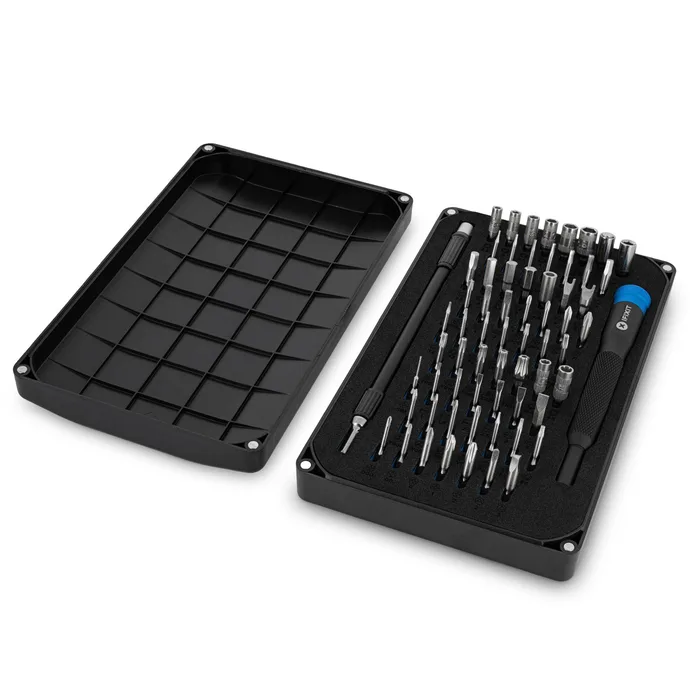
- iFixit Mako Driver Kit, 64 Precision Bits - Buy. The one kit here whose published bit list carries JIS cross point, pentalobe and tri-point together, in a case that names every slot.
- Vessel TD-56S Precision Screwdriver Set - Buy. Six fixed blade drivers whose cross points Vessel recommends for JIS and JCIS screws, which is the specific fix for cross heads that keep camming out.
- Wera Kraftform Micro ESD Big Pack 1, 25 pieces - It depends. The only set here that publishes an electrical surface resistance for its handles, which makes it a bench electronics tool rather than a device repair kit.
- Xiaomi Electric Precision Screwdriver (MJDDLSD003QW) - Skip. Xiaomi's own numbers give the motor 0.2 Nm at its higher setting against 3 Nm by hand, so the powered part cannot do the part of the job that is actually hard.
The verdict in 30 seconds
What mattered most
- Bits or fixed blades
- JIS cross point
- Apple drives
- Published bit steel or hardness
- Published ESD surface resistance
- Free spinning cap
A precision screwdriver set lives or dies on two unglamorous things: whether the exact profile your device uses is in the box, and whether the tip is hard enough to survive being the softer of the two metals. Almost every listing in this category leads with a bit count, which is the one number that tells you least. We went to the makers' own specification pages and pulled the drive lists, the steel, the handle detail and the storage, then checked those against what current phones and laptops are actually fastened with. Four kits made the cut, and they split along a line most listings hide.
The one kit here whose published bit list carries JIS cross point, pentalobe and tri-point together, in a case that names every slot.
Best for: Anyone who opens phones, laptops, consoles and Japanese built electronics and wants one case that covers all of them.
- iFixit lists JIS bits in 000, 00, 0 and 1 as separate items from its Phillips 0, 00, 000, 1 and 2, so the JIS profile is genuinely in the box rather than implied.
- Covers pentalobe P2, P5 and P6 and tri-point Y000, Y00, Y0 and Y1, which is the combination current iPhones and MacBooks call for.
- The bit metal is published as S2 steel, which is more than most makers in this category commit to.
- The 4 mm handle has a magnetic bit socket and a swivel top, and the bits sit in an ABS case with a foam insert plus a magnetic lid tray for the screws you take out.
- No hardness figure is published anywhere, so S2 is a grade claim and not a measured property.
- No electrical surface resistance is published, so it is not documented as an ESD safe tool.
- A 64 bit tray is a lot of profiles you will never use, and the ones you do use are the smallest and easiest to lose.
- One handle means one hand position, where a set of fixed blade drivers lets you keep the right size in your hand.
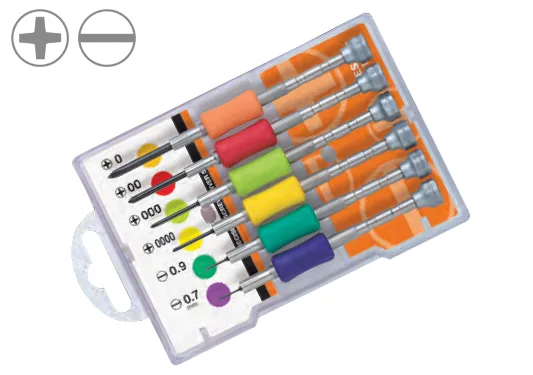
Six fixed blade drivers whose cross points Vessel recommends for JIS and JCIS screws, which is the specific fix for cross heads that keep camming out.
Best for: Someone working on cameras, lenses, audio gear, consoles or hobby electronics who is tired of Phillips drivers slipping out of Japanese cross heads.
- Vessel states outright that the cross point models are recommended for JIS and JCIS work, which is a claim about recess geometry rather than a generic 'fits Phillips'.
- Every driver has a swivel cap, so you brace with a fingertip and spin with the other hand, which is the whole point of a precision handle.
- Six fixed blades in slotted 0.7 and 0.9 mm and cross point 0000, 000, 00 and 0, colour coded, in a plastic storage case.
- Nothing to lose: there is no bit to fall off the bench and vanish.
- No pentalobe, no tri-point and no Torx, so it will not open a current iPhone or a MacBook on its own.
- Vessel publishes stainless steel for the main body and says nothing about the tip steel or its hardness.
- Six sizes is genuinely six sizes, so it is an addition to a kit rather than the whole kit.
- No electrical surface resistance is published, so it carries no ESD documentation.
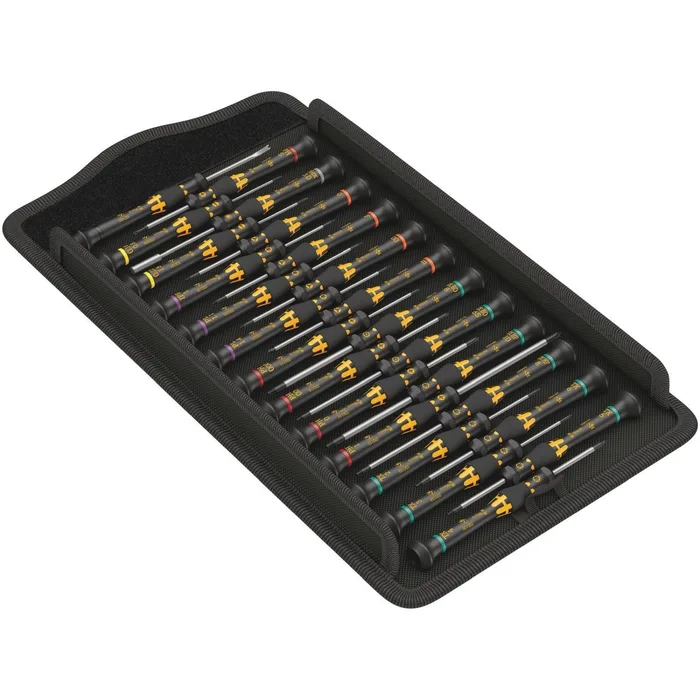
The only set here that publishes an electrical surface resistance for its handles, which makes it a bench electronics tool rather than a device repair kit.
Best for: Someone doing bench assembly or board level work who needs documented ESD handles and wants a blade per profile, not a phone repair kit.
- Wera publishes a handle surface resistance of less than or equal to 10^9 ohm and describes the tool as ESD safe, which is a number where most of this category gives you a phrase.
- Twenty five fixed blade drivers, so the profile you want is already on a handle and there is no bit to seat, drop or lose.
- The handle has a rotating cap and a fast turning zone below it, plus colour coding by profile and size.
- Includes pentalobe in PL 1.1 and PL 1.4, Torx down to T2, tamper resistant Torx BO and a Torx Plus IPR, which covers a lot of sealed consumer hardware.
- No tri-point in the contents list, so the internal bracket screws on current iPhones and Apple Watches are not covered.
- No JIS cross point either: the contents are listed as PH, so Japanese cross heads get a Phillips point.
- Wera publishes no steel grade and no hardness figure for the blades.
- It ships in a textile roll rather than a rigid case, and twenty five fixed blades take up far more room than sixty four bits.
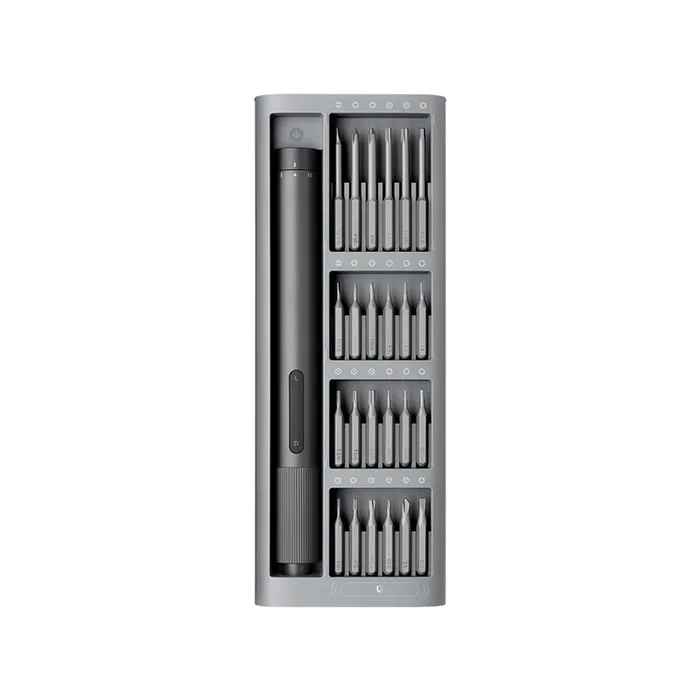
Xiaomi's own numbers give the motor 0.2 Nm at its higher setting against 3 Nm by hand, so the powered part cannot do the part of the job that is actually hard.
Best for: Someone doing genuinely repetitive assembly of loose fasteners who wants the motor for the spinning, not the loosening.
- The bit list is honest and reasonably complete: pentalobe P2 and P5, Y type Y0.6 and Y1, Torx T2 to T4, Torx with pin hole, hex from 0.7 mm and slotted.
- Xiaomi publishes the bit metal as S2 steel and the bit shanks as C4 by 28 mm and C4 by 45 mm, so replacements are a standard size.
- The aluminium container gives every one of the twenty four bits its own slot, which is better retention than most rigid cases manage.
- Xiaomi rates maximum torque at 0.05 Nm on level one and 0.2 Nm on level two, against 3 Nm applied by hand, so the motor cannot break a tight screw loose and you do that part manually.
- No-load speed is 170 rpm with no torque cutout published, which is the wrong tool behaviour for a soft brass insert or a plastic boss you cannot feel through a motor.
- The contents list no JIS cross point, only Phillips PH000 to PH1, so Japanese built gear gets the profile that cams out.
- The battery is 350 mAh and takes 160 to 200 minutes to charge, which turns a hand tool into something that can be flat when you need it.
| Criteria | Mako Driver Kit, 64 Precision Bits Top pick | TD-56S Precision Screwdriver Set | Kraftform Micro ESD Big Pack 1, 25 pieces | Electric Precision Screwdriver (MJDDLSD003QW) |
|---|---|---|---|---|
| Verdict | Buy it | Buy it | It depends | Skip it |
| Best for | Anyone who opens phones, laptops, consoles and Japanese built electronics and wants one case that covers all of them. | Someone working on cameras, lenses, audio gear, consoles or hobby electronics who is tired of Phillips drivers slipping out of Japanese cross heads. | Someone doing bench assembly or board level work who needs documented ESD handles and wants a blade per profile, not a phone repair kit. | Someone doing genuinely repetitive assembly of loose fasteners who wants the motor for the spinning, not the loosening. |
| Price tier | $$ · mid-range | $ · budget | $$$ · premium | $$ · mid-range |
| Bits or fixed blades | 64 bits into one 4 mm handle | 6 fixed blade drivers | 25 fixed blade drivers | 24 bits into a powered handle |
| JIS cross point | JIS 000, 00, 0 and 1 listed separately from Phillips | Cross points, maker recommends for JIS and JCIS | Not listed, contents are PH | Not listed, contents are PH000 to PH1 |
| Apple drives | Pentalobe P2, P5, P6 and tri-point Y000 to Y1 | None | Pentalobe PL 1.1 and PL 1.4, no tri-point | Pentalobe P2 and P5, Y type Y0.6 and Y1 |
| Published bit steel or hardness | S2 steel, no hardness figure | Stainless steel body, tip steel not stated | Not published | S2 steel, no hardness figure |
| Published ESD surface resistance | Not published | Not published | Less than or equal to 10^9 ohm, described as ESD safe | Not published |
| Free spinning cap | Swivel top on the handle | Swivel cap on every driver | Rotating cap plus a fast turning zone | Not published |
| Storage and retention | ABS case with foam insert, magnetic lid tray | Plastic storage case | Textile roll | Aluminium container, slot per bit |
| Price tier | $$ · mid-range | $ · budget | $$$ · premium | $$ · mid-range |
Which one is right for you?
- Anyone who opens phones, laptops, consoles and Japanese built electronics and wants one case that covers all of them. Buy it iFixit Mako Driver Kit, 64 Precision Bits
- Someone working on cameras, lenses, audio gear, consoles or hobby electronics who is tired of Phillips drivers slipping out of Japanese cross heads. Buy it Vessel TD-56S Precision Screwdriver Set
- Someone doing bench assembly or board level work who needs documented ESD handles and wants a blade per profile, not a phone repair kit. It depends Wera Kraftform Micro ESD Big Pack 1, 25 pieces
- Someone doing genuinely repetitive assembly of loose fasteners who wants the motor for the spinning, not the loosening. Skip it Xiaomi Electric Precision Screwdriver (MJDDLSD003QW)
How we judged the field
Five things decide whether a precision kit is any use. First, the drive list, because a bit count is not a capability list and the profiles you need are specific: pentalobe and tri-point for Apple hardware, JIS cross point for Japanese built gear, tamper resistant Torx for consoles. Second, what the maker will commit to about the metal, since a bit softer than the fastener rounds first and the screw takes the tool with it. Third, the handle, specifically whether the cap spins freely, because precision driving is a fingertip on the cap and two fingers turning the barrel, and a fixed cap makes that impossible. Fourth, how the bit is held and how the case holds it, since the practical failure in this category is not breakage but a 1.5 mm bit on the floor. Fifth, whether the maker publishes any electrical property at all, which turns out to separate the field more sharply than anything else.
The field splits three ways. There are bit kits, where one handle takes dozens of profiles and the trade is coverage against a small part you can lose. There are fixed blade sets, where every profile already has a handle and nothing can be lost but the box is large and the coverage is whatever the maker chose. And there are powered drivers, where a motor is added to a job whose difficulty is almost entirely in the first quarter turn. We took the best documented example of each, plus one specialist that exists to solve a single problem well, and read their published specifications against each other rather than against the marketing. Torque control is a separate tool and a separate question, covered in our torque screwdriver comparison; none of these is an insulated tool, which is its own standard and its own review.
iFixit Mako Driver Kit, 64 Precision Bits
Buy itThe iFixit Mako wins on the least glamorous ground available: its published bit list matches what current devices are actually fastened with. iFixit lists JIS in 000, 00, 0 and 1 as separate items from Phillips 0, 00, 000, 1 and 2, which is the difference between owning the profile and being told a Phillips will do. It carries pentalobe P2, P5 and P6, tri-point Y000 through Y1, and eight tamper resistant Torx. The bit metal is published as S2 steel, which is a grade rather than a measurement but is more than most of this category will say. The handle takes 4 mm bits into a magnetic socket and has a swivel top, so the screw stays on the tip and the cap turns under your fingertip. The bits sit in a foam insert in an ABS case, and a magnetic tray in the lid holds the fasteners you remove. The honest limits: no hardness figure, no electrical rating, and sixty four profiles of which you will use perhaps eight. For anyone who opens consumer hardware, it is the kit that stops you ordering a single driver mid job.
Vessel TD-56S Precision Screwdriver Set
Buy itThe Vessel TD-56S is deliberately narrow and very good at the narrow thing. Six fixed blade drivers, slotted at 0.7 and 0.9 mm and cross point at 0000, 000, 00 and 0, colour coded, in a plastic storage case. What earns it a place is that Vessel’s own product page recommends the cross point models for JIS and JCIS work, a statement about recess geometry rather than the usual claim that a driver fits everything. That matters because the failure mode is asymmetric: a Japanese cross point will sit in a Phillips screw, while a Phillips point in a JIS recess rides up under load and takes the head with it. Every driver has a swivel cap, which is the handle detail that makes fine work possible at all. What it will not do is open a current phone or laptop: no pentalobe, no tri-point, no Torx, and Vessel publishes stainless steel for the body without saying anything about the tip. Buy it as the second thing in the drawer, not the first.
Wera Kraftform Micro ESD Big Pack 1, 25 pieces
It dependsThe Wera Kraftform Micro ESD Big Pack 1 is the one set here that publishes an electrical number. Wera states a surface resistance of less than or equal to 10^9 ohm and describes the tool as ESD safe, which is unusual: in our ESD mat comparison most makers in an explicitly ESD product category will not publish a resistance figure at all, so a hand tool that does is worth noticing. The set is twenty five fixed blade drivers with Wera’s rotating cap and a fast turning zone, covering Phillips 000 to 1, Torx from T2, tamper resistant Torx BO, a Torx Plus IPR, pentalobe in PL 1.1 and PL 1.4, slotted and a nutdriver. The catch is what is missing rather than what is there: no tri-point, so current iPhone bracket screws are out, and no JIS, so Japanese cross heads get a Phillips point. It ships in a textile roll, which is fine on a bench and awkward in a bag. This is a bench electronics set that happens to open some phones, not the reverse.
Xiaomi Electric Precision Screwdriver (MJDDLSD003QW)
Skip itThe Xiaomi Electric Precision Screwdriver is worth skipping for a reason Xiaomi publishes itself. Maximum torque is 0.05 Nm at level one and 0.2 Nm at level two, while Xiaomi rates maximum manual torque at 3 Nm. The motor delivers a fraction of what your hand delivers through the same body, so you crack every tight fastener by hand before it is any use. No-load speed is 170 rpm and no torque cutout is published, which is the wrong combination for a soft brass insert or a plastic boss where the only feedback that saves you is feel. The rest is respectable: S2 bits on standard C4 by 28 mm and C4 by 45 mm shanks, twenty four profiles including pentalobe P2 and P5 and Y type Y0.6 and Y1, and a slot per bit. But the Phillips range runs PH000 to PH1 with no JIS listed, and a 350 mAh battery that takes 160 to 200 minutes to fill turns a hand tool into something that goes flat. If you want a motor, buy it for repetitive assembly of loose screws, not for repair.
Sources
Specs in this review come from these pages.
- Vessel Tools, TD-56S precision screwdriver set (vesseltools.com)
- iFixit, Mako Driver Kit 64 Precision Bits (ifixit.com)
- Wera, Kraftform Micro ESD Big Pack 1 (05134019001) (weratools.com)
- Xiaomi, Electric Precision Screwdriver specifications (mi.com)
- ANSI Webstore, JIS B 1012:1985 Cross recesses for screws (webstore.ansi.org)
- Apple Support, Magnetic accessories may interfere with iPhone cameras (support.apple.com)
iFixit Mako Driver Kit, 64 Precision Bits vs Vessel TD-56S Precision Screwdriver Set: which should you buy?
The Mako and the TD-56S are not really rivals, and the useful way to choose is to name the problem. If your problem is that you keep needing a profile you do not own, buy the Mako: it is the only kit here whose published list carries JIS, pentalobe and tri-point at the same time, and the case keeps them organised. If your problem is that cross head screws in cameras, lenses, audio gear or a console keep rounding out no matter how hard you push, that is a recess geometry problem and the Mako’s JIS bits or the Vessel’s cross points both solve it, but the Vessel solves it with a proper handle rather than a bit in a socket, and costs a fraction as much.
The deeper difference is bits versus blades. A bit kit gives you enormous coverage and one small part that can fall behind the bench, and the socket has to hold the bit while the bit holds the screw. A fixed blade set gives you a purpose built handle for each size, no seating, no wobble, nothing to lose, and no coverage beyond what the maker put in the box. Most people who work on their own devices are better off with the Mako as the base and the Vessel added later for the cross heads it does best. If you buy in the other order, you will still be ordering a pentalobe driver the first time you meet an iPhone.
What to look for
- JIS listed as its own profile: a kit that lists JIS bits separately from its Phillips bits owns the recess geometry, while one that lists only PH is telling you a Phillips point is going into Japanese cross heads.
- A named steel grade, since nobody publishes hardness: S2 or a specific alloy is the strongest commitment on offer here, and a spec table that names the handle and the shank but stops before the bit has omitted the part that fails.
- Just three Apple profiles, not thirty: pentalobe P2 for iPhone bottom screws, pentalobe P5 for MacBook bottom cases and tri-point Y000 for internal brackets covers current Apple hardware, and they cover the Apple jobs most people meet.
- A cap that actually spins: precision driving is a fingertip pressing the cap while two fingers turn the barrel, so a free running cap is not a comfort feature, it is the mechanism.
- Whether the magnetism is in the tool or in the bit: a magnet built into the driver socket keeps working, while a bit that has simply been stroked on a magnet carries an induced field that fades and needs restoring with a magnetiser.
- A slot per bit, labelled: the real failure in this category is losing a 1.5 mm bit, so a moulded or foam slot with the size printed beside it beats a loose tray, and a magnetic lid tray for the screws you remove is worth more than another ten profiles.
Our final take
Buy the iFixit Mako if you open your own devices. It is the only kit here whose published bit list covers JIS, pentalobe and tri-point together, it names its bit steel, and the case is organised well enough that you will still have every bit in a year. Add the Vessel TD-56S when you tire of bits in a socket for the cross head sizes you use most. Take the Wera only if you specifically need documented ESD handles and can live without tri-point and JIS. And treat the powered option as what its own numbers say it is: a motor that spins loose screws faster, on a job where the hard part is the first quarter turn.
Questions, answered
Is the JIS versus Phillips thing real, or is it a forum myth?
It is real and both standards are still live documents. JIS B 1012, Cross recesses for screws, defines the recess, and JIS B 4633, Screwdrivers for cross recessed head screws, is still listed as a current Japanese standard . The recess has more vertical flanks and a flatter floor than a Phillips recess, and the driver point is blunter, so a Phillips point sits high in the recess and rides out under load. The direction that matters is one way: Japanese fastener makers say a Japanese cross point driver will sit in a Phillips screw, while a Phillips driver in a JIS screw is the combination that chews the head. Of the sets here, only the iFixit Mako lists JIS bits as separate items from its Phillips bits, and Vessel names JIS and JCIS on its own product page.
How do I tell a JIS screw from a Phillips one before I put a driver in it?
You often cannot, which is the practical problem. Some JIS recess screws carry a single dot stamped beside the cross, but Japanese fastener makers describe that mark as a convention rather than a requirement, and say plainly that not all JIS screws have it. Drivers and bits are no more reliable: many are simply printed PH with a size number under ISO 8764, which covers Phillips geometry. The workable rule is by origin rather than by marking, so treat cross heads in Japanese built cameras, lenses, audio gear, motorcycles and older consoles as likely JIS. Since a Japanese cross point driver fits both, keeping one in the kit costs you nothing.
Do any of these publish a hardness number for the bits?
None of the four does. iFixit publishes S2 steel, Xiaomi publishes S2 steel, Vessel publishes stainless steel for the driver body and stops there, and Wera publishes no grade at all for these blades. A named grade is therefore the strongest signal available in this category, and the absence of one is informative: a spec table that names the handle material and the shank material but stops short of the bit has left out the part that fails. If you want a published Rockwell figure you have to go looking outside these four, and even then it tends to appear on a bit range rather than on a precision blade. Treat any listing that claims a hardness without naming a test as marketing.
Which security bits do I actually need in 2026?
Far fewer than a 64 bit tray implies. For current Apple hardware it is three profiles: pentalobe P2 for the two screws either side of an iPhone charging port, pentalobe P5 for MacBook bottom cases, and tri-point Y000 for the small internal connector and sensor brackets. Those cover the Apple jobs most people meet, so the 'arms race' framing oversells it. Beyond Apple, tamper resistant Torx with a centre pin turns up in consoles and appliances, and Nintendo hardware has used tri-wing and gamebit profiles. Everything else in a big tray is inventory, not need.
Is a magnetised tip risky near a phone or a laptop?
The common fears are mostly the wrong ones. Solid state storage is not magnetic media, so a small tool magnet is not going to wipe a phone or an SSD. Apple's own guidance is about temporary effects: it warns that magnets in accessories can interfere with or temporarily disable the sensors behind the rear cameras, and that magnetic stripe cards and RFID chips should be kept away from the magnets in charging accessories. The genuine exceptions are a spinning hard drive, whose own internal magnets are far stronger than anything on your bench anyway, and magnetic stripe cards left on the workspace. It is also worth separating the two ways a tool gets magnetic, because they behave differently over time.
Deciding between the top two? See our head-to-head: iFixit Mako Driver Kit, 64 Precision Bits vs Vessel TD-56S Precision Screwdriver Set.
More Tools & DIY reviews
 The Best Random Orbital Sanders: 4 Compared (and One to Skip)
  The Best Reciprocating Saws: 4 Compared (and One to Skip)
  The Best Rotary Hammers: 4 Compared (and One to Skip)
  The Best Rotary Tools: 4 Compared (and One to Skip)
  The Best Safety Glasses: 4 Compared (and One to Skip)
  The Best Scroll Saws: 4 Compared (and One to Skip)