

Tools & DIY
The Best Rotary Hammers: 4 Compared (and One to Skip)
Four SDS-Plus rotary hammers compared on impact energy in joules, the figure that decides how fast they drill concrete, and on why a hammer drill quoting 52,700 blows per minute is slower than one quoting 5,500.
The short version
Buy the Makita HR2641. At 2.9 joules it delivers the most impact energy here, more than double the weakest tool in the group, from an 8 amp corded motor with three modes: rotation only, hammering with rotation, and chipping only. Makita's AVT anti-vibration system matters on a tool held against concrete for long stretches. Buy the DEWALT D25133K if you want almost the same for less: 2.6 joules, three modes, 0 to 1,500 RPM and 0 to 5,500 BPM from an 800 watt motor. The CRAFTSMAN CMCH234B is the it-depends, a cordless brushless SDS-Plus hammer at 2 joules with a 7/8 inch capacity, which is enough for anchors and light demolition and is the only one here you can take up a ladder without a cord. Skip the DEWALT DCH172B for general work: at 1.4 joules it delivers less than half the pick's energy, and its 5/8 inch capacity and two modes make it an anchor-setting tool rather than a rotary hammer you grow into. Best for: anyone comparing a rotary hammer against a hammer drill on blows per minute.
Our picks at a glance
- Makita HR2641 1 in. AVT Rotary Hammer, SDS-Plus - Buy. The most impact energy in this comparison at 2.9 joules, with the anti-vibration system that decides how long you can keep using it.
- DEWALT D25133K 1 in. SDS Plus Rotary Hammer - Buy. Within a tenth of a joule of the pick on energy, with the same three modes, for noticeably less money.
- CRAFTSMAN CMCH234B V20 Brushless RP SDS-Plus Cordless Rotary Hammer - It depends. Two joules without a cord, which is the whole argument, and enough for anchors if not for volume.
- DEWALT DCH172B ATOMIC 20V MAX 5/8 in. Brushless Cordless SDS Plus Rotary Hammer - Skip. A compact anchor-setting tool at 1.4 joules, which is less than half the energy of the pick.
The verdict in 30 seconds
What mattered most
- Impact energy
- Concrete capacity
- Modes
- Power
- Anti-vibration system
- Chuck
Impact energy in joules is the rare specification that this category publishes consistently and that means exactly what it says. It is the energy delivered per blow, and in concrete it decides drilling speed far more than motor amps or blows per minute do. The spread across these four is more than double, from 1.4 joules to 2.9. The second thing worth understanding is the difference between a rotary hammer and a hammer drill, because the marketing blurs it and the numbers invert. A hammer drill works by two ridged plates clicking past each other, and one of them will happily advertise 52,700 blows per minute. A rotary hammer drives a piston against the bit and quotes around 5,500. The rotary hammer drills concrete several times faster, because each of its blows carries joules and each of the hammer drill's carries a tap. High blows per minute is the number that flatters.
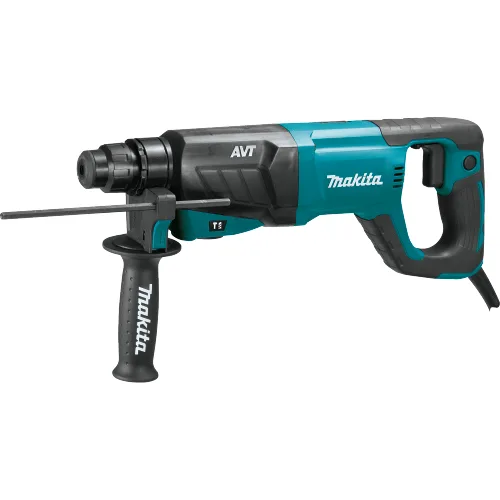
The most impact energy in this comparison at 2.9 joules, with the anti-vibration system that decides how long you can keep using it.
Best for: Anyone drilling concrete regularly who wants the most energy per blow and can work near power.
- 2.9 joules of impact energy, the highest here and more than double the weakest tool in this group.
- An 8 amp corded motor, so the energy figure holds for as long as the job runs rather than fading with a battery.
- Three modes: rotation only, hammering with rotation, and chipping only, so it drills wood and steel as well as concrete and doubles as a light breaker.
- Makita's AVT anti-vibration system, which matters because this is a tool you press into concrete for long stretches.
- Corded, and the places you drill concrete are frequently the places without a convenient outlet.
- Heavier than the cordless tools here, which is felt on overhead anchor work.
- SDS-Plus tops out well below SDS-Max, so genuine demolition wants a bigger tool entirely.
- No published vibration figure in m/s2 despite the anti-vibration branding.
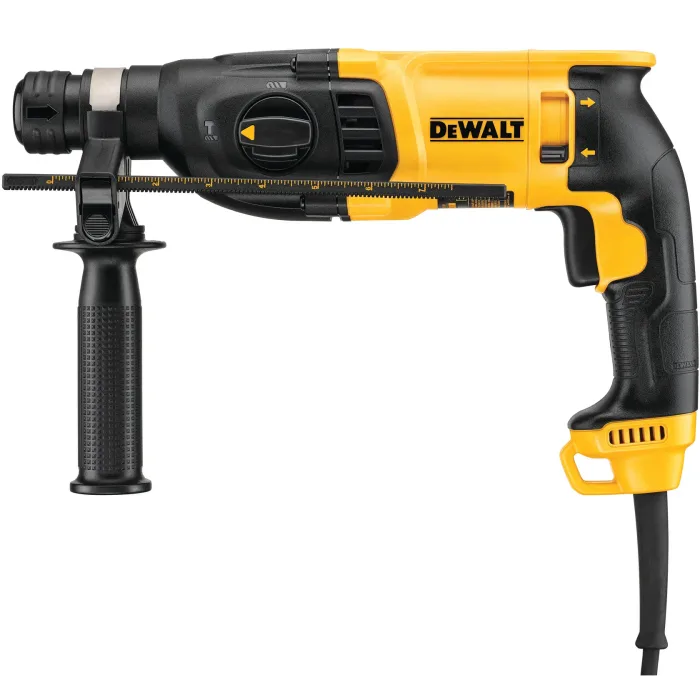
Within a tenth of a joule of the pick on energy, with the same three modes, for noticeably less money.
Best for: The default choice for a home or light trade user who drills concrete often enough to want a proper rotary hammer.
- 2.6 joules of impact energy, close behind the Makita and well ahead of both cordless tools here.
- Three-mode operation, so it covers drilling, hammer drilling and chipping.
- 0 to 1,500 RPM and 0 to 5,500 BPM from an 800 watt motor, both variable, so small bits can be started under control.
- Corded, so the energy figure is sustained rather than dropping as a pack drains.
- No anti-vibration system listed on the DEWALT page we could reach, which on a tool used against concrete for extended periods is a real difference from the Makita.
- Corded, with the same access problem as the Makita.
- 1 inch capacity in concrete, which is the SDS-Plus class ceiling rather than a fault of this tool.
- No published vibration figure.
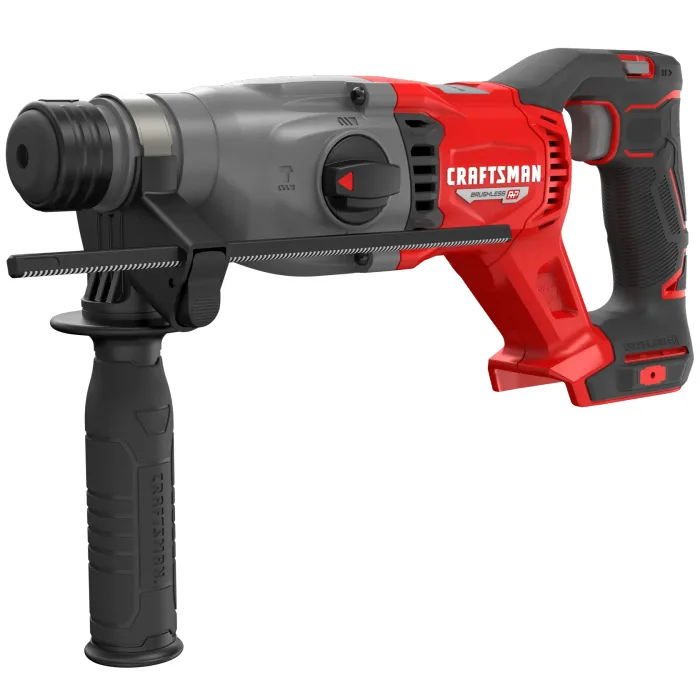
Two joules without a cord, which is the whole argument, and enough for anchors if not for volume.
Best for: Anchor setting and occasional concrete work away from power, where mobility is worth more than energy per blow.
- 2 joules of impact energy, which is ample for setting anchors and light demolition.
- Cordless and brushless, so it goes up a ladder or into a crawl space where the corded tools cannot follow.
- 7/8 inch capacity in concrete, enough for most anchor and conduit work.
- Publishes its impact energy in joules, which lets it be compared directly with the corded tools.
- 2 joules is about two thirds of the Makita's energy per blow, which shows as slower progress in hard aggregate.
- Battery drain is fast on a tool that works under continuous load against concrete.
- Bare tool, so batteries and a charger are a separate cost.
- 7/8 inch capacity is below the 1 inch of both corded tools here.
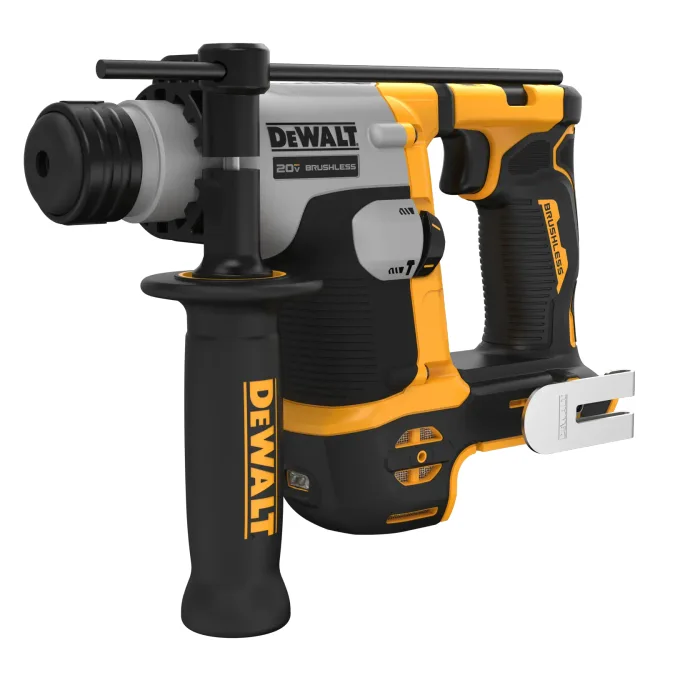
A compact anchor-setting tool at 1.4 joules, which is less than half the energy of the pick.
Best for: Electrical and mechanical trades setting small anchors overhead all day, where weight beats energy.
- Genuinely compact and light, which is the point of it and makes overhead anchor work far less tiring.
- Brushless, with DEWALT's SHOCKS Active Vibration Control system to reduce vibration at the handles.
- DEWALT publishes the 1.4 joule figure plainly rather than hiding behind blows per minute.
- Well suited to its stated jobs: rod hanging, concrete forming, cable tray and strut mounting, clip and bracket work.
- 1.4 joules is less than half the Makita's 2.9, so it is materially slower in anything but small holes.
- 5/8 inch capacity, the smallest here, and two modes rather than three so there is no chipping function.
- Priced with the premium tools while delivering the least energy in the group.
- Buying it as a general rotary hammer means replacing it the first time a real hole is needed.
| Criteria | HR2641 1 in. AVT Rotary Hammer, SDS-Plus Top pick Buy it Buy | D25133K 1 in. SDS Plus Rotary Hammer Buy it Buy | CMCH234B V20 Brushless RP SDS-Plus Cordless Rotary Hammer It depends Buy | DCH172B ATOMIC 20V MAX 5/8 in. Brushless Cordless SDS Plus Rotary Hammer Skip it Buy |
|---|---|---|---|---|
| Best for | Anyone drilling concrete regularly who wants the most energy per blow and can work near power. | The default choice for a home or light trade user who drills concrete often enough to want a proper rotary hammer. | Anchor setting and occasional concrete work away from power, where mobility is worth more than energy per blow. | Electrical and mechanical trades setting small anchors overhead all day, where weight beats energy. |
| Price tier | $$$ · premium | $$ · mid-range | $$ · mid-range | $$$ · premium |
| Impact energy | 2.9 joules | 2.6 joules | 2 joules | 1.4 joules |
| Concrete capacity | 1 in. | 1 in. | 7/8 in. | 5/8 in. |
| Modes | 3, including chipping | 3, including chipping | Rotary hammer | 2, no chipping |
| Power | 8 amp corded | 800 W corded | 20V brushless | 20V brushless |
| Anti-vibration system | Yes, AVT | Not listed | Not stated | SHOCKS Active Vibration Control per DEWALT |
| Chuck | SDS-Plus | SDS-Plus | SDS-Plus | SDS-Plus |
| Published vibration in m/s2 | No | No | No | No |
Which one is right for you?
- Anyone drilling concrete regularly who wants the most energy per blow and can work near power. Buy it Makita HR2641 1 in. AVT Rotary Hammer, SDS-Plus
- The default choice for a home or light trade user who drills concrete often enough to want a proper rotary hammer. Buy it DEWALT D25133K 1 in. SDS Plus Rotary Hammer
- Anchor setting and occasional concrete work away from power, where mobility is worth more than energy per blow. It depends CRAFTSMAN CMCH234B V20 Brushless RP SDS-Plus Cordless Rotary Hammer
- Electrical and mechanical trades setting small anchors overhead all day, where weight beats energy. Skip it DEWALT DCH172B ATOMIC 20V MAX 5/8 in. Brushless Cordless SDS Plus Rotary Hammer
How we judged the field
Impact energy in joules first, because this is one of the few power tool categories where the specification that decides performance is published consistently and means what it says. The spread here runs from 1.4 to 2.9, more than double, which is a bigger gap than anything else in the comparison. Then concrete capacity, which follows from the energy but is stated separately and sets the largest hole you can reasonably drill. Then modes, since a chipping function turns a drill into a small breaker and two of these four have it. Then whether an anti-vibration system is fitted, because this is among the highest-vibration tools in common use. We also checked all four for a published hand-arm vibration figure in metres per second squared and found none.
Makita HR2641 1 in. AVT Rotary Hammer, SDS-Plus
Buy itThe Makita HR2641 is the pick because it wins the one number that governs this category. At 2.9 joules it delivers the most energy per blow here, more than twice the compact DEWALT, and in concrete that is close to a linear relationship with how fast the hole appears. The 8 amp corded motor means that figure is sustained rather than sagging as a battery drains, which matters because drilling concrete is continuous-load work. Three modes cover rotation only for wood and steel, hammering with rotation for concrete, and chipping only, which turns the tool into a small breaker for tile removal and channel chasing. The AVT anti-vibration system is the feature that decides how long you can keep going, and this is a tool held hard against concrete. What you accept is the cord, in exactly the locations that rarely have a convenient outlet, and the weight that goes with a corded tool. SDS-Plus also has a ceiling, so genuine demolition means a larger SDS-Max tool rather than this one.
DEWALT D25133K 1 in. SDS Plus Rotary Hammer
Buy itThe DEWALT D25133K is the second buy and the sensible default for most people. At 2.6 joules it sits within a tenth of a joule of the Makita, a difference you would struggle to notice in use, and it carries the same three modes including chipping. The 800 watt motor runs 0 to 1,500 RPM and 0 to 5,500 BPM, both variable, so a small bit can be started slowly enough to stay in the mark rather than skating across the concrete. Being corded, its energy figure holds all day. We found no anti-vibration system listed for it, and against the Makita that is the real gap rather than the 0.3 joules. It shares the cord problem and the 1 inch SDS-Plus ceiling, and like everything here it publishes no vibration figure to let you quantify what you are absorbing.
CRAFTSMAN CMCH234B V20 Brushless RP SDS-Plus Cordless Rotary Hammer
It dependsThe CRAFTSMAN CMCH234B is the it-depends, and its argument is straightforward. Two joules is genuinely enough for setting anchors and light demolition, and it publishes that figure in the same units as the corded tools, which is more disclosure than this price point usually offers. Being cordless and brushless, it goes up a ladder, into a crawl space and onto a roof where the corded tools simply cannot follow, and for a great deal of concrete work that access is the binding constraint rather than energy. The costs are consistent. Two joules is about two thirds of the Makita’s, which shows as slower progress once the aggregate is hard. Battery drain is fast, because this is continuous-load work, and it is a bare tool so the platform cost lands on top. The 7/8 inch capacity is below the 1 inch of both corded tools, which rules out the largest holes in the SDS-Plus range.
DEWALT DCH172B ATOMIC 20V MAX 5/8 in. Brushless Cordless SDS Plus Rotary Hammer
Skip itThe DEWALT DCH172B is the skip for general work, and it is worth being exact about why, because it is a well-made tool doing its intended job properly. At 1.4 joules it delivers less than half the energy of the pick. DEWALT is straightforward about this and lists the jobs it is for: rod hanging, concrete forming, cable tray and strut mounting, clip and bracket work. Those are small anchors, drilled overhead, all day, and for that the compact size and light weight are worth more than energy per blow. The problem is that it is priced with the premium tools while delivering the least energy in the group, has the smallest capacity at 5/8 inch, and has only two modes so there is no chipping function. Bought as a general rotary hammer, it will be replaced the first time somebody needs a one inch hole.
Sources
Specs in this review come from these pages.
- Makita USA, HR2641 1 in. AVT rotary hammer specifications (makitatools.com)
- DEWALT D25133K 1 in. SDS Plus rotary hammer (dewalt.com)
- DEWALT DCH172B ATOMIC 20V MAX 5/8 in. cordless SDS Plus rotary hammer (dewalt.com)
- CRAFTSMAN CMCH234B V20 brushless RP SDS+ cordless rotary hammer (craftsman.com)
- SDS-Plus rotary hammer guide, on shank systems and impact energy (valuetools.co)
Makita HR2641 1 in. AVT Rotary Hammer, SDS-Plus vs DEWALT D25133K 1 in. SDS Plus Rotary Hammer: which should you buy?
The two DEWALTs isolate what going cordless and compact costs, since they share a maker and a chuck system. The corded D25133K delivers 2.6 joules, drills to 1 inch and has three modes including chipping. The cordless DCH172B delivers 1.4 joules, drills to 5/8 inch and has two modes. That is close to half the energy, a smaller hole and a lost function, in exchange for no cord and a much lighter tool. Neither is wrong, but they are not competing for the same buyer. If you drill a handful of large holes occasionally, the corded tool is faster and cheaper and the cord is an inconvenience you tolerate twice a year. If you set fifty small anchors above your head in a day, the compact tool is the one you can still hold at the end of it, and the energy figure never becomes the limit.
What to look for
- Impact energy in joules: the specification that decides drilling speed in concrete, published consistently in this category, and spread more than twofold across these four.
- Whether the tool is a rotary hammer at all: a piston-driven tool publishes joules and quotes thousands of blows per minute; a hammer drill quotes tens of thousands and no joules.
- Concrete capacity in inches: it follows from the energy but is stated separately and sets the largest hole you can drill without a struggle.
- A chipping mode: stops rotation and leaves the piston hammering, which turns the drill into a small breaker and is absent from the most compact tools.
- SDS-Plus against SDS-Max: the shank systems are not interchangeable, so the choice fixes your bit collection as well as the tool’s ceiling.
- Any anti-vibration system, and any figure for it: this is among the highest-vibration tools in common use, and none of these four publishes an m/s2 number.
Our final take
This is one of the few categories where the number that matters is printed on the box and means what it says. Read impact energy in joules, buy for the largest hole you drill regularly rather than the average one, and treat any tool advertising tens of thousands of blows per minute as a hammer drill wearing the wrong name.
Questions, answered
What is the difference between a rotary hammer and a hammer drill?
The mechanism, and it changes everything. A hammer drill has two ridged plates that click past each other as the chuck turns, producing a very high number of very light taps, which is why one will advertise tens of thousands of blows per minute. A rotary hammer uses a piston driving against the back of the bit, producing far fewer blows that each carry measurable energy. That is why a rotary hammer quoting 5,500 BPM drills concrete several times faster than a hammer drill quoting 52,700. If a tool publishes joules, it is a rotary hammer; if it publishes only BPM, it usually is not.
How much impact energy do I actually need?
For anchors up to about half an inch and general fixing work, anything from 1.4 joules up will do it, and the compact tools are pleasant to use overhead. Once you are drilling 3/4 inch and above, or working in hard aggregate, the difference between 1.4 and 2.9 joules is the difference between a job and an ordeal, because each blow either breaks material away or does not. The practical rule is to buy for the largest hole you will drill regularly rather than the average one.
What is SDS-Plus and how does it differ from SDS-Max?
SDS is the shank system that lets the bit slide back and forth under the piston rather than being clamped rigidly like a drill chuck. SDS-Plus is the smaller of the two common sizes, using a 10 mm shank, and it covers holes up to roughly an inch in concrete. SDS-Max uses an 18 mm shank and belongs to much larger tools for demolition and big-diameter drilling. The two are not interchangeable, so the choice determines your bit collection, and all four tools here are SDS-Plus.
Do I need the chipping mode?
Only if you break concrete as well as drill it. Chipping mode stops the rotation and leaves the piston hammering, which turns the tool into a small breaker for removing tile, chasing channels or cleaning up around a hole. The two corded tools here have it and the compact DEWALT does not. If your work is purely drilling anchors, its absence costs nothing; if you ever want to remove material rather than make a hole, it is the difference between owning one tool and two.
Why do the makers publish joules but not vibration?
Impact energy sells the tool and vibration does not. Rotary hammers are high-vibration tools, and hand-arm vibration limits exist precisely because of tools like these, yet none of the four here publishes a figure in metres per second squared for the US market. Makita and the cordless DEWALT both brand anti-vibration systems without quantifying what they achieve. Where a maker does offer anti-vibration, treat it as a real feature with an unstated size, and take breaks accordingly.
Deciding between the top two? See our head-to-head: Makita HR2641 1 in. AVT Rotary Hammer, SDS-Plus vs DEWALT D25133K 1 in. SDS Plus Rotary Hammer.
More in Tools & DIY
Rotary Hammers, Explained Plain-English guide → Makita HR2641 1 in. AVT Rotary Hammer, SDS-Plus vs DEWALT D25133K 1 in. SDS Plus Rotary Hammer Head-to-head →  The Best Rotary Tools: 4 Compared (and One to Skip)
  The Best Safety Glasses: 4 Compared (and One to Skip)
  The Best Scroll Saws: 4 Compared (and One to Skip)
  The Best Snow Shovels: 4 Compared (and One to Skip)