

Tools & DIY
The Best Safety Glasses: 4 Compared (and One to Skip)
We compared four pairs of safety eyewear on what is actually printed on the lens and the frame, on which edition of ANSI/ISEA Z87.1 the maker claims, and on whether anything about the claim can be checked by a buyer.
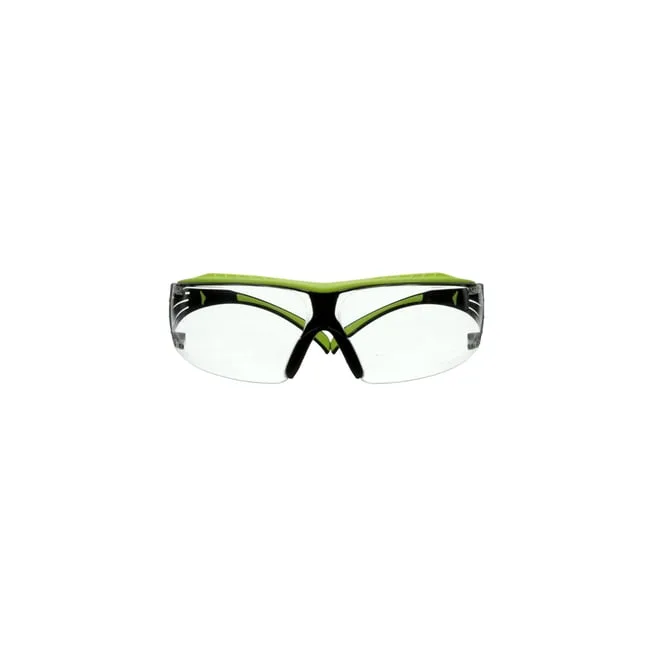
The short version
The 3M SecureFit 400 Series in the SF401AF clear anti-fog build is our overall pick: 3M publishes a 19 gram weight for the SF400 series, a polycarbonate lens rated U6 for ultraviolet, and an impact rated claim, and the frame carries the markings that let you verify it in your hand. Milwaukee's Performance Safety Glasses 48-73-2020 are the value pick, and they are the only pair here whose maker publishes a downloadable Certificate of Compliance naming the part number, plus a stated CSA third party test. The DEWALT DPG82 Concealer is the depends pick: a sealed goggle is the right answer for overhead drilling and dusty demolition and the wrong answer for a warm afternoon of woodworking, because a goggle traps heat against your face. Skip the gray Pyramex Ztek S2520S as a general purpose pair, not because it is badly made but because Pyramex marks its lens L2.5, which the standard defines as a maximum of 29 percent visible light, and that is a sunglass indoors. Read the marking before you read the listing, because a listing that says it meets Z87.1 while the glasses carry no permanent mark is describing a product that does not meet Z87.1. Best for: anyone who wants to buy eye protection on the letters stamped into it rather than on the claim in the description.
Our picks at a glance
- 3M SecureFit 400 Series Safety Glasses (SF401AF) - Buy. The pair that disappears on your face, from the one maker in this group that publishes a real technical data sheet for the series.
- Milwaukee Performance Safety Glasses (48-73-2020) - Buy. The only pair here whose maker publishes a signed compliance certificate that names the exact part number you are buying.
- DEWALT DPG82 Concealer Safety Goggle (DPG82-11) - It depends. A sealed goggle that solves the problem spectacles physically cannot solve, at the cost of heat, bulk and a strap.
- Pyramex Ztek Safety Glasses, Gray Lens (S2520S) - Skip. A well made, fully marked, genuinely cheap pair that is sold by the box and worn indoors by people who should be wearing the clear one.
The verdict in 30 seconds
What mattered most
- Protector type
- Standard the maker states
- Published lens marking
- Third party certification claim
- Anti-fog
- Lens tint
Safety glasses are one of the few things you can buy where the product is legally required to describe itself. ANSI/ISEA Z87.1 tells the manufacturer exactly which letters and numbers must be permanently marked on the lens and the frame, and each one means a specific test was passed. Almost nobody reads them. We picked four pairs that between them show the whole range: a mainstream impact rated spectacle, a hardware store pair whose maker publishes a signed compliance certificate, a sealed goggle for dust, and a tinted budget pair that is excellent at a job most buyers are not doing.
The pair that disappears on your face, from the one maker in this group that publishes a real technical data sheet for the series.
Best for: Someone who wants one comfortable, light, impact rated pair for woodworking, yard work and general shop use, and who will actually wear them all day.
- 3M publishes a 19 gram weight for the SF400 series and a polycarbonate lens and temple, which is at the light end of anything with an integrated side shield.
- 3M states the SecureFit range uses U6 rated polycarbonate lenses that absorb 99.9 percent of UVA, UVB and UVC between 200 and 380 nanometres, and U6 is the top of the Z87.1 ultraviolet filter scale.
- 3M sells a prescription insert, the RX-SF400, that fits the SecureFit 200, 300 and 400 series, so a spectacle wearer has a route that does not involve a custom frame.
- The SF401AF carries 3M's traditional anti-fog coating. It is the Scotchgard versions, sold as SF401SGAF, that 3M states meet the ANSI/ISEA Z87.1 anti-fog (X) optional testing requirement.
- 3M's own product data for the SF401AF is stated against the 2015 edition of Z87.1, not the 2020 or 2025 edition.
- 3M's European data sheet for the SF400 series notes plainly that safety spectacles cannot be tested and approved for use against liquid droplets, so this is not the pair for splash work.
- 3M's SF400 documentation also states these are not designed to be worn over prescription spectacles, so the insert or a different frame is the answer, not stacking.
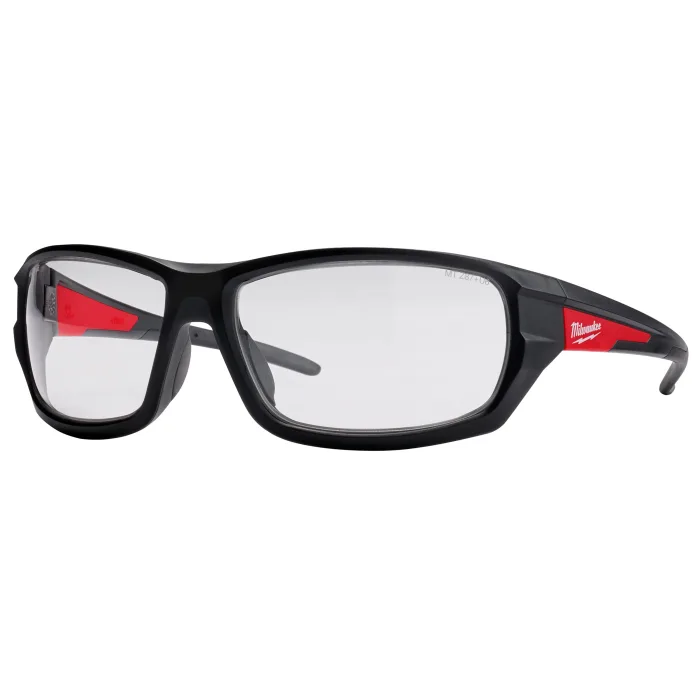
The only pair here whose maker publishes a signed compliance certificate that names the exact part number you are buying.
Best for: Someone who wants an impact rated pair from a shelf today and would rather have documentation they can download than a longer feature list.
- Milwaukee publishes a Certificate of Compliance for eye protection, signed by its Director of Product Safety and Regulatory Compliance, that lists 48-73-2020 by name against ANSI/ISEA Z87.1-2015 with the (+) impact rating and CSA Z94.3-15.
- Milwaukee's product page states CSA Z94.3 and CSA third party tested, which is a stronger statement than the self declaration most eyewear ships with.
- Milwaukee lists it as a fog-free lens with an anti-scratch treatment, and sells it in single blister packs at ordinary hardware counters rather than only by the case.
- The stated standard is the 2015 edition. The anti-fog (X) marking did not exist until the 2020 edition, so a 2015 pair cannot carry it no matter how good the coating is.
- Milwaukee does not publish the lens and temple marking strings, a weight, or a lens thickness, so there is less to check before it arrives than with Pyramex or 3M.
- The frame is a fixed size with no adjustable temple length or lens angle, which is a real problem on small or very wide faces.
- The certificate on Milwaukee's site is dated 2021, so it does not tell you whether current production has been reassessed against a newer edition.
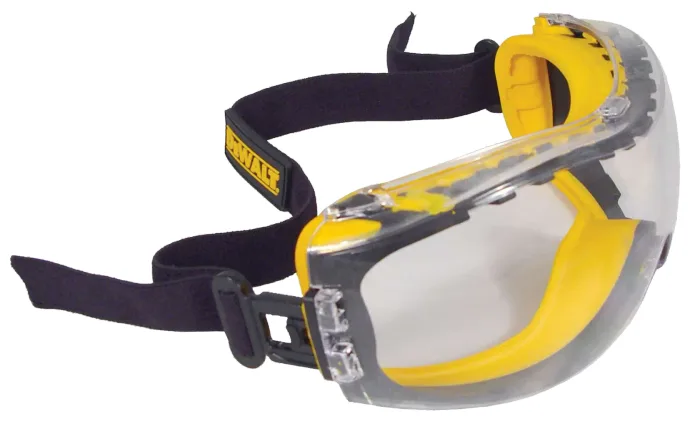
A sealed goggle that solves the problem spectacles physically cannot solve, at the cost of heat, bulk and a strap.
Best for: Overhead drilling, demolition, insulation, grinding and anything where debris arrives from above or from the side rather than straight ahead.
- It is a goggle, which matters more than the brand: under Z87.1 the droplet, dust and fine dust tests are written for goggles and faceshields, so a sealed protector is the only style that can carry a D3, D4 or D5 use marking at all.
- DEWALT states the polycarbonate lens meets ANSI Z87.1+ and provides 99.9 percent UVA and UVB protection, and describes a hard coated anti-fog lens.
- The soft dual injected rubber seal, ventilation channels and adjustable elastic cloth headstrap mean it will sit over a wide range of face shapes and stay put when you look up.
- DEWALT does not publish a D3, D4 or D5 marking for it, so if you specifically need a rated dust or splash protector you cannot confirm it from the published data. Buy it for the seal, not for a rating you have not seen.
- DEWALT does not publish which edition of Z87.1 it is assessed against, nor a weight, nor the lens and frame marking strings.
- Any sealed goggle traps heat and moisture against your face. Ventilation channels help, they do not repeal physics, and this will fog sooner than a spectacle in warm work.
- The strap and the bulk make it an annoying thing to push up on your forehead and pull down again, which is exactly the habit that gets people hurt.
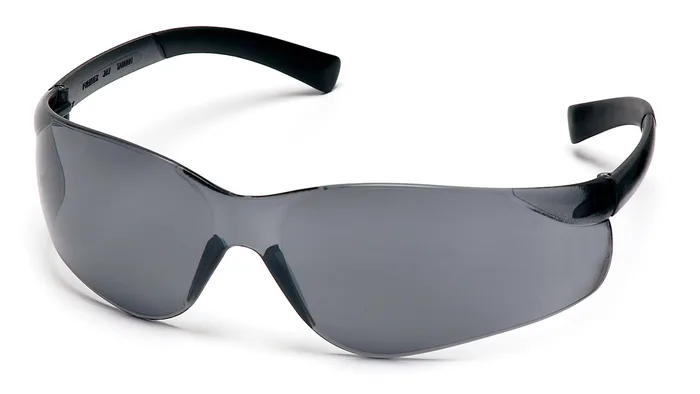
A well made, fully marked, genuinely cheap pair that is sold by the box and worn indoors by people who should be wearing the clear one.
Best for: Genuinely outdoor daytime work, mowing, landscaping and roofing, bought as a second pair alongside a clear one rather than instead of it.
- Pyramex publishes more than anyone else here: the lens marking is P Z87+ U6 L2.5 and the temple marking is P Z87+ / P cSEI Z94.3, along with a 21 gram weight and a 2.3 mm lens thickness.
- It is genuinely certified: ANSI/ISEA Z87.1-2020 with the high impact (+) rating, CAN/CSA Z94.3-2020 and CE/UKCA EN 166, and the cSEI temple mark is a third party certification mark rather than a self declaration.
- Sold in boxes of a dozen and upward, so the cost of leaving a pair in every vehicle and every drawer is close to nothing.
- The L2.5 lens marking means a maximum of 29 percent visible light transmittance under the standard's own filter table. That is sunglass territory, and it is the wrong lens for a garage, a basement or a workshop.
- The S2520S has no anti-fog treatment at all. Pyramex sells the identical frame with its H2X anti-fog coating as the S2520ST, and the difference between those two letters is whether you can see.
- Nothing on the frame adjusts. Fixed 154 mm temples, a fixed 13 mm bridge and an integrated nosepiece mean it either fits your face or it slides down it.
- Buying a tinted pair as your only pair is how people end up with the eye protection in their pocket instead of on their face when the light is poor.
| Criteria | SecureFit 400 Series Safety Glasses (SF401AF) Top pick | Performance Safety Glasses (48-73-2020) | DPG82 Concealer Safety Goggle (DPG82-11) | Ztek Safety Glasses, Gray Lens (S2520S) |
|---|---|---|---|---|
| Verdict | Buy it | Buy it | It depends | Skip it |
| Best for | Someone who wants one comfortable, light, impact rated pair for woodworking, yard work and general shop use, and who will actually wear them all day. | Someone who wants an impact rated pair from a shelf today and would rather have documentation they can download than a longer feature list. | Overhead drilling, demolition, insulation, grinding and anything where debris arrives from above or from the side rather than straight ahead. | Genuinely outdoor daytime work, mowing, landscaping and roofing, bought as a second pair alongside a clear one rather than instead of it. |
| Price tier | $$ · mid-range | $ · budget | $$ · mid-range | $ · budget |
| Protector type | Rimless wrap spectacle with integrated side shields | Full frame spectacle | Sealed goggle with head strap | Frameless wrap spectacle |
| Standard the maker states | ANSI Z87.1-2015 and CSA Z94.3 | ANSI/ISEA Z87.1 (+) 2015 and CSA Z94.3 | ANSI Z87.1+, edition not published | ANSI/ISEA Z87.1-2020 +, CAN/CSA Z94.3-2020, EN 166 |
| Published lens marking | Not published for the US part number | Not published | Not published | P Z87+ U6 L2.5 |
| Third party certification claim | None published | CSA third party tested | None published | cSEI Z94.3 mark on the temple |
| Anti-fog | 3M anti-fog coating; the SF401SGAF build is the one 3M states meets Z87.1 anti-fog (X) | Listed as fog-free, but the 2015 edition has no X marking | Anti-fog hard coat, no X marking published | None on this part number; H2X version is the S2520ST |
| Lens tint | Clear | Clear | Clear | Gray, marked L2.5, 29 percent maximum visible light |
| Published weight | 19 g for the SF400 series | Not published | Not published | 21 g |
| Prescription route | 3M RX-SF400 insert fits SecureFit 200, 300 and 400 | None published | Designed to fit over prescription spectacles | None published for this model |
Which one is right for you?
- Someone who wants one comfortable, light, impact rated pair for woodworking, yard work and general shop use, and who will actually wear them all day. Buy it 3M SecureFit 400 Series Safety Glasses (SF401AF)
- Someone who wants an impact rated pair from a shelf today and would rather have documentation they can download than a longer feature list. Buy it Milwaukee Performance Safety Glasses (48-73-2020)
- Overhead drilling, demolition, insulation, grinding and anything where debris arrives from above or from the side rather than straight ahead. It depends DEWALT DPG82 Concealer Safety Goggle (DPG82-11)
- Genuinely outdoor daytime work, mowing, landscaping and roofing, bought as a second pair alongside a clear one rather than instead of it. Skip it Pyramex Ztek Safety Glasses, Gray Lens (S2520S)
How we judged the field
Five things decide whether a pair of safety glasses is worth owning. First, the marking, because it is the only claim on the product that had to be earned: the standard specifies exactly which letters go where, and a pair with no permanent marking has failed the standard regardless of what the listing says. Second, the impact rating, because the gap between basic impact and high impact is the gap between a dropped ball test and a steel ball fired at 150 feet per second. Third, coverage and seal, because a spectacle physically cannot earn a droplet or dust rating while a goggle can. Fourth, fogging, because the 2020 edition finally made anti-fog a tested and marked property rather than an adjective. Fifth, whether you will keep them on, which sounds soft and is the single biggest cause of eye injuries in home workshops.
The field splits by how much the maker is willing to publish. At one end, Pyramex prints the actual lens and temple marking strings, the lens thickness and the weight for every part number, which means you can check the product against the standard before you buy it. In the middle, 3M publishes detailed technical data sheets by region and a US line card that explains its own test claims, and Milwaukee publishes a signed compliance certificate naming part numbers. At the other end, most brands publish a sentence. We chose one pair from each of those positions plus one sealed goggle, because a comparison of four spectacles would hide the most useful fact in the category, which is that the style of protector, not the brand, decides which hazards it can be rated for.
3M SecureFit 400 Series Safety Glasses (SF401AF)
Buy itThe 3M SecureFit 400 in the SF401AF build is the pair that solves the behavioural problem rather than the paperwork problem. 3M publishes a 19 gram weight for the SF400 series, a polycarbonate lens and temple, and pressure diffusing temples designed to spread load over the ear rather than clamp it, and the result is eyewear you forget about. The optics claim is real too: 3M rates the SecureFit polycarbonate lens U6, the top of the ultraviolet scale in the standard, absorbing 99.9 percent of UVA, UVB and UVC between 200 and 380 nanometres. Two caveats keep it honest. 3M’s own product data for the SF401AF is stated against the 2015 edition of Z87.1, and it is the Scotchgard versions sold as SF401SGAF that 3M states meet the newer anti-fog (X) requirement, not this one. There is also a prescription insert, the RX-SF400, which fits the 200, 300 and 400 series. For anyone doing general shop, yard and DIY work who wants one pair they will not take off, this is it.
Milwaukee Performance Safety Glasses (48-73-2020)
Buy itMilwaukee’s Performance Safety Glasses 48-73-2020 win on something nobody else in this group offers: you can download the paperwork. Milwaukee publishes a Certificate of Compliance for its eye protection line, signed by its Director of Product Safety and Regulatory Compliance, that lists 48-73-2020 by part number against ANSI/ISEA Z87.1-2015 with the (+) impact rating and CSA Z94.3-15. Its product page adds that the glasses are CSA third party tested, which is a meaningfully different statement from a self declaration. The lens is listed as fog-free with an anti-scratch treatment, and they are sold in single blister packs rather than by the case, so you can buy one pair and see. The limits are the edition and the fit. Certifying to the 2015 edition means the anti-fog marking that arrived in 2020 is not available to it, and the frame is one fixed size with no adjustable temple length. If documentation matters more to you than adjustability, this is the value pick.
DEWALT DPG82 Concealer Safety Goggle (DPG82-11)
It dependsThe DEWALT DPG82 Concealer is here to make a point about protector type. Under the standard, the droplet, dust and fine dust tests are written for goggles and faceshields, which is why no spectacle in this comparison carries a D3, D4 or D5 mark and this style could. DEWALT states the polycarbonate lens meets ANSI Z87.1+ and gives 99.9 percent UVA and UVB protection, and describes a hard coated anti-fog lens, a dual injected rubber seal, ventilation channels and an adjustable elastic cloth headstrap. What DEWALT does not publish is a D marking, an edition of the standard, a weight or the marking strings, so buy it for the physical seal rather than for a rating you have not seen. The trade-off is the one every goggle makes: it traps heat and moisture, it fogs sooner than a spectacle in warm work, and the strap makes it tempting to push up onto your forehead. For overhead and dusty work it is the right tool. For an afternoon at the bandsaw it is not.
Pyramex Ztek Safety Glasses, Gray Lens (S2520S)
Skip itThe gray Pyramex Ztek S2520S is the best documented product in this comparison and still the one to skip, which is the whole lesson. Pyramex publishes the lens marking as P Z87+ U6 L2.5 and the temple marking as P Z87+ / P cSEI Z94.3, plus a 21 gram weight, a 2.3 mm lens and a 154 mm temple, and lists ANSI/ISEA Z87.1-2020 with the high impact rating, CAN/CSA Z94.3-2020 and EN 166. That cSEI mark is a third party certification mark, not a self declaration. The problem is what L2.5 means. In the standard’s visible light filter table, L2.5 caps transmittance at 29 percent, so this is a sunglass, and it gets bought by the box as a general purpose pair by people working indoors. The S2520S also has no anti-fog treatment, while the identical frame with Pyramex’s H2X coating is sold as the S2520ST. Buy it as an outdoor second pair, not as your only pair.
Sources
Specs in this review come from these pages.
- ISEA: ANSI/ISEA Z87.1 standard update for eye and face protection (safetyequipment.org)
- OSHA 1910.133, Eye and face protection (osha.gov)
- ANSI/ISEA Z87.1-2020, Occupational and Educational Personal Eye and Face Protection Devices (webstore.ansi.org)
- 3M Eye Protection Product Line Card, Personal Safety Division (multimedia.3m.com)
- Milwaukee Tool Certificate of Compliance, eye protection (milwaukeetool.com)
- Pyramex Ztek product sheet with lens and temple markings (pyramex.com)
3M SecureFit 400 Series Safety Glasses (SF401AF) vs Milwaukee Performance Safety Glasses (48-73-2020): which should you buy?
Both of our picks are impact rated spectacles from large manufacturers, and both will stop the same debris. The difference is what you can verify and what you can wear. 3M gives you the better object: 19 grams, pressure diffusing temples, a U6 rated lens, an available prescription insert and a technical data sheet that explains the marking scheme it uses. Milwaukee gives you the better evidence: a signed certificate naming your exact part number, and a stated third party test route through CSA rather than a claim the maker made about itself.
Choose the SecureFit 400 if you are going to wear eye protection for hours at a stretch, if you already know that the reason your last pair failed you was that it lived on your forehead, or if you wear prescription glasses and want a documented insert rather than an over-the-glasses compromise. Choose the Milwaukee if you want an impact rated pair off a shelf this afternoon, if you like being able to download the compliance certificate before you buy, or if you are outfitting a shop and want part numbers that appear on a signed document. If you want the newest edition of the standard on the box, note that neither of these is stated against the 2020 or 2025 edition, while the Pyramex we told you to skip is.
What to look for
- Find the mark before you read the listing: the standard requires a permanent, legible marking on the lens and on the frame or temple, so a pair with nothing stamped into it cannot comply no matter what the description promises.
- Plus sign or nothing: Z87 alone means the pair passed a dropped ball test, while Z87+ means it survived a 500 gram pointed projectile and a steel ball fired at 150 feet per second, which is the level any power tool deserves.
- Read the letter after Z87 for the tint: L numbers are visible light filters and the number rises as the lens gets darker, so an L2.5 lens passes at most 29 percent of the light and belongs outdoors.
- U6 is the top of the ultraviolet scale: the standard’s ultraviolet filter table runs from U2 to U6, and a lens marked with no U number at all is not making a rated ultraviolet claim.
- Only sealed protectors get D marks: D3 is droplets and splash, D4 is dust and D5 is fine dust, and because those tests are written for goggles and faceshields no ordinary spectacle can carry them.
- X is the only honest anti-fog claim: the anti-fog marking arrived with the 2020 edition and means the lens stayed clear for at least eight seconds in a defined test, so fog-free without an X is an adjective rather than a result.
Our final take
Eye protection is the rare purchase where the product tells you the truth about itself if you turn it over. Get a pair marked Z87+ with the manufacturer’s mark on both the lens and the frame, keep the tint clear unless you are genuinely outdoors, and treat every unmarked pair as unrated regardless of the listing. The SecureFit 400 is the pair most people will keep wearing, the Milwaukee is the one with the paperwork, and a sealed goggle is the only style that can be rated for dust or splash at all. The gray Ztek is well made and correctly marked, and that marking is exactly why it should not be your only pair.
Questions, answered
A listing says the glasses meet ANSI Z87.1 but there are no markings on them. Does that mean anything?
No, and the standard is unusually blunt about it. ANSI/ISEA Z87.1 requires that all protectors bear permanent and legible markings in specified locations, and it sets out a table of exactly which mark goes on the lens, the frame and the temple. A protector with no permanent marking has failed a requirement of the standard, so it cannot comply with the standard, whatever the listing says. A sticker on the lens or a claim on the packaging is not the same thing, because the standard asks for a mark that stays on the product. If you can find the manufacturer's mark plus Z87 or Z87+ stamped into the lens and into the frame or temple, you at least know what is being claimed. If you cannot, you have no claim to check.
What is the difference between Z87 and Z87+?
Z87 on its own means the protector met the basic impact requirement, which the standard tests with a drop ball: a 25.4 mm steel ball weighing 68 grams dropped from 127 cm onto the lens. Z87+ means it passed the high impact tests instead, which are a different order of severity. The high mass test drops a pointed projectile of at least 500 grams from at least 127 cm. The high velocity test fires a steel ball at the lens, and for spectacles the required speed is 45.7 metres per second, which is 150 feet per second, rising to 76.2 metres per second for goggles and 91.4 metres per second for faceshields. On a spectacle lens the high impact mark is just a plus sign next to the manufacturer's mark; on the frame it appears as Z87+. If you are running a grinder, a chainsaw or a nail gun, the plus is the mark that matters.
I wear prescription glasses. Does OSHA require my safety glasses to be Z87 marked, and what are my options?
OSHA's rule at 1910.133 requires employers to ensure that anyone who wears prescription lenses in an eye hazard operation either wears eye protection that incorporates the prescription in its design, or wears eye protection that can go over the prescription lenses without disturbing either pair. The eye protection itself has to comply with one of the ANSI editions OSHA lists, and those editions require marking. Prescription protectors are marked differently from ordinary ones: the standard uses Z87-2 rather than Z87, and Z87-2+ if the frame is impact rated. There is a third route that catches people out. A prescription lens carrier that sits behind a plano protector, like 3M's RX-SF400 insert, is marked only with the manufacturer's mark and carries no Z87 markings at all, because the protection is coming from the outer protector, not from the insert.
Is anti-fog on safety glasses tested against anything, or is it just marketing?
It is both, depending on the pair. The 2020 edition of ANSI/ISEA Z87.1 added a real anti-fog test and a marking for it. A lens marked X has been tested over a warm water bath and stayed free from fogging for at least eight seconds before its transmittance dropped below the threshold. Eight seconds sounds trivial and it is a low bar, but it is a measured bar, and the standard is explicit that the test applies to the lens only and does not assess whether the complete device fogs on your face. Anything marked X has been tested. Anything sold as fog-free, anti-fog or fog resistant without an X marking is a marketing claim, and if the pair is certified to the 2015 edition or earlier the X marking did not exist yet, so its absence tells you nothing on its own.
What do D3, D4 and D5 mean, and why do my safety glasses not have them?
They are use markings for specific hazards: D3 for droplets and splash, D4 for dust, D5 for fine dust. They appear on the frame or on a complete device, not on a spectacle lens, and there is a physical reason your safety glasses do not carry them. The droplet and splash test in the standard is written for goggles and for faceshields, and the fine dust test is one that in practice only a fully sealed protector passes. An ordinary spectacle has an open gap at the top and the sides, so there is no route for it to earn a D mark. 3M makes the same point from the other direction in its own literature: goggles with a direct vent system generally fail the liquid splash test, while indirect vented goggles pass. If your hazard is a chemical splash or fine dust, you need a sealed or indirect vented goggle, not a better pair of glasses.
Deciding between the top two? See our head-to-head: 3M SecureFit 400 Series Safety Glasses (SF401AF) vs Milwaukee Performance Safety Glasses (48-73-2020).
More Tools & DIY reviews
 The Best Scroll Saws: 4 Compared (and One to Skip)
  The Best Snow Shovels: 4 Compared (and One to Skip)
  The Best Socket Sets: 4 Compared (and One to Skip)
  The Best Solder Wire for Electronics: 4 Compared (and One to Skip)
  The Best Solder Fume Extractors: 4 Compared (and One to Skip)
  The Best Soldering Irons and Stations: 4 Compared (and One to Skip)