

Tech & Gadgets
The Best Solder Fume Extractors: 4 Compared (and One to Skip)
We compared four benchtop and bench-side solder fume extractors on what their makers actually publish: filter media, particle rating, airflow, static pressure, noise and ESD construction.
The short version
The Weller Zero Smog EL Kit 1 is our pick because it is the only one here whose manufacturer documents both halves of the job, a combined H13 particle filter working with an activated carbon filter, alongside airflow, vacuum and power figures. The Hakko FA-400 is the value pick and the honest one in its class: Hakko publishes its airflow, its noise level and, unusually, states that the airflow was measured with the filter in place. The Hakko FA-430 is the depends pick, moving far more air than any benchtop box and doing it quietly, but Hakko documents a HEPA particle filter and never names a carbon stage. Skip the Aoyue 486: its maker publishes no airflow, no filter efficiency and no ESD claim while promising it removes toxic gases. Before you spend anything, understand that a bare fan relocates fume rather than cleaning it, which is fine if the plume ends up somewhere other than your breathing zone and useless if it does not. Best for: anyone doing more than a few joints a month at a fixed bench.
Our picks at a glance
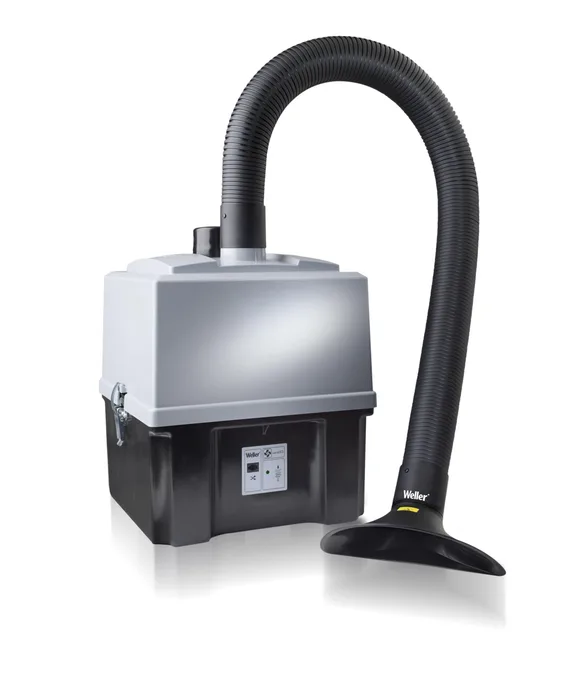
- Weller Zero Smog EL Kit 1 - Buy. The only unit here whose manual specifies a particle filter and an activated carbon filter working together, with the airflow and vacuum numbers to go with it.
- Hakko FA-400 Smoke Absorber - Buy. A carbon pad in front of a small fan, but Hakko publishes real numbers for it and says outright that the airflow figure was taken with the filter installed.
- Hakko FA-430 Fume Extractor - It depends. Pulls far more air at the nozzle than any benchtop box here and stays quiet doing it, but Hakko documents a particle filter and never names a carbon stage.
- Aoyue 486 Smoke Absorber - Skip. A widely sold carbon pad on a wire stand whose manufacturer publishes no airflow, no filter efficiency and no ESD claim.
The verdict in 30 seconds
What mattered most
- Filter media (as published)
- Particle rating
- Published airflow
- Is the airflow stated with the filter fitted
- Vacuum or static pressure
- Noise
The smoke that comes off a soldering iron is mostly flux, not metal. Heated rosin breaks down into a mix of resin acid particles and gases, and the UK Health and Safety Executive lists rosin-based solder flux fume as a respiratory sensitiser with a legal exposure limit attached. That means a useful extractor has two jobs: pull the plume away from your face, and hold on to both the particles and the gases. We looked at what four commonly bought units publish about themselves, and where the published numbers run out.
The only unit here whose manual specifies a particle filter and an activated carbon filter working together, with the airflow and vacuum numbers to go with it.
Best for: Someone soldering most days, or covering two benches, who wants a maker that documents the gas stage as clearly as the particle stage.
- Weller's manual specifies a combined H13 filter rated at 99.95 percent particle separation down to 0.12 um in combination with an activated carbon filter.
- Published figures are unusually complete: 150 m3/h maximum quantity supplied, 2,500 Pa maximum vacuum at 230 V and 2,100 Pa at 120 V, 110 W power draw.
- An M5 pre-filter changes separately from the main cartridge, and a filter warning light plus a documented replacement schedule tell you when the carbon is spent.
- Big and heavy for a hobby desk at 335 x 360 x 445 mm and 8.6 kg, and Weller positions it for placement under or beside the bench rather than on it.
- Weller does not publish a noise figure for this unit.
- The manual states it is designed as a surface extraction unit and is not suitable for extracting fumes directly from the soldering gun.
- The compact filter has to be changed at least once a year regardless of hours used, so running cost is real and recurring.
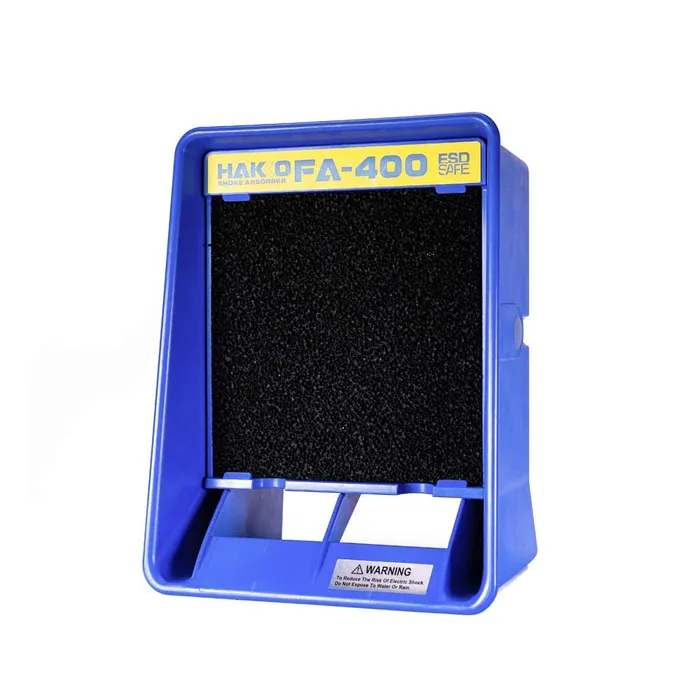
A carbon pad in front of a small fan, but Hakko publishes real numbers for it and says outright that the airflow figure was taken with the filter installed.
Best for: Occasional hobby soldering where the realistic goal is keeping the plume off your face rather than cleaning the room's air.
- Hakko publishes maximum suction of 1.0 to 1.1 m3/min mounted vertically and 0.4 to 0.5 m3/min horizontally, and states that the figure is measured with a filter present.
- Noise is published at 48 dB on 50 Hz and 51 dB on 60 Hz, measured one metre from the face of the unit.
- Carries Hakko's ESD SAFE marking, which the company defines by an electrostatic attenuation test to MIL-STD-3010A method 4046, and weighs only 0.91 kg.
- The standard A1001 filter is urethane foam with carbon: Hakko lists it at 12 g new with a maximum absorbing weight of 4 g, so the gas-phase capacity is small.
- The optional 999-198 particulate filter is not HEPA rated, and Hakko requires the unit to stand vertically when it is fitted.
- At around one cubic metre per minute the intake has to sit within a few centimetres of the tip to catch the plume at all.
- No published particle collection efficiency for the standard carbon filter.
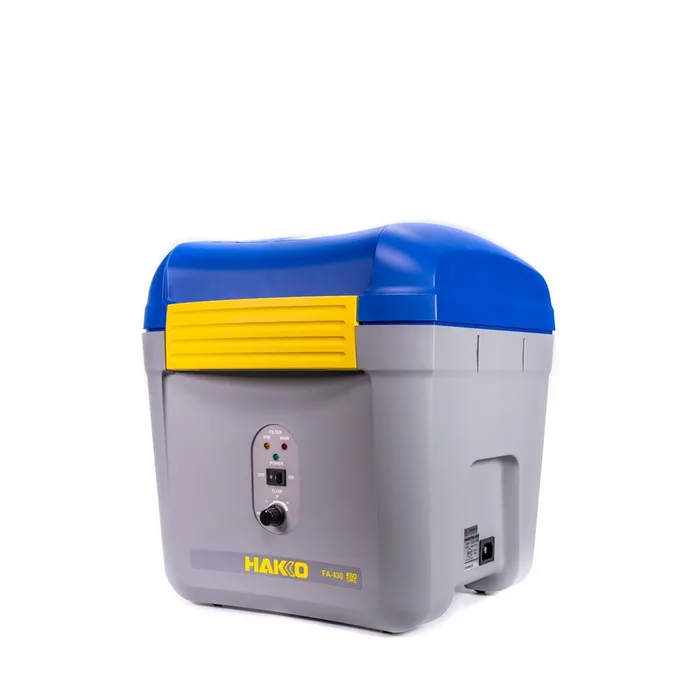
Pulls far more air at the nozzle than any benchtop box here and stays quiet doing it, but Hakko documents a particle filter and never names a carbon stage.
Best for: A two-bench workshop that wants a lot of air moved right at the nozzle, with per-mode numbers published behind the claim.
- Published maximum suction of 4.1 m3/min with a single duct and 4.7 m3/min with two, backed by 1,500 Pa of static pressure.
- Filtering efficiency is published as 99.97 percent at 0.3 um on low and medium modes and 99.96 percent on high.
- Noise is published per mode at 44, 50 and 53 dB(A), and a filter-life indicator counts pre-filter changes to flag the main filter.
- Hakko's spec sheet and parts list name a pre-filter and a HEPA main filter and do not state an activated carbon stage for the gas fraction of flux fume.
- Hakko cautions that processes involving highly corrosive substances or organic solvents are not recommended with this unit.
- It is 7.5 kg and 330 x 366 x 343 mm, and the duct set is sold separately.
- Hakko notes that the nets in the duct sets are not protected against electrostatic discharge, even though the ducts themselves are ESD safe.
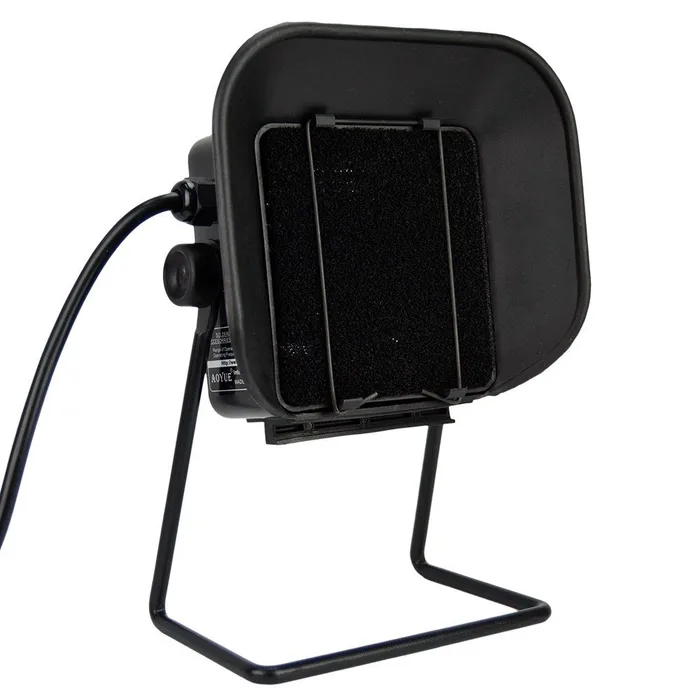
A widely sold carbon pad on a wire stand whose manufacturer publishes no airflow, no filter efficiency and no ESD claim.
Best for: Hard to justify over an equally cheap unit whose maker at least publishes an airflow figure and an ESD test method.
- Cheap and light at 1 kg, and offered in both 110 V and 220 V versions.
- Uses a brushless motor, which tends to outlast the brushed fans found in some units at this price.
- The wire stand tilts, so you can aim the intake face at the joint instead of at the ceiling.
- Aoyue's own specification table lists only power input, 20 W consumption, brushless motor and 1 kg weight, with no airflow figure of any kind.
- No published filter efficiency, no filter media rating and no particle size claim.
- The manufacturer page says it quickly absorbs and removes the toxic gases released during soldering, without publishing anything that would let you check it.
- No ESD-safe claim appears on the manufacturer's page, which matters when the thing sits inches from bare boards.
| Criteria | Zero Smog EL Kit 1 | FA-400 Smoke Absorber | FA-430 Fume Extractor | 486 Smoke Absorber |
|---|---|---|---|---|
| Verdict | Buy it | Buy it | It depends | Skip it |
| Best for | Someone soldering most days, or covering two benches, who wants a maker that documents the gas stage as clearly as the particle stage. | Occasional hobby soldering where the realistic goal is keeping the plume off your face rather than cleaning the room's air. | A two-bench workshop that wants a lot of air moved right at the nozzle, with per-mode numbers published behind the claim. | Hard to justify over an equally cheap unit whose maker at least publishes an airflow figure and an ESD test method. |
| Price tier | $$$ · premium | $ · budget | $$$ · premium | $ · budget |
| Filter media (as published) | M5 pre-filter, H13 particle filter plus activated carbon filter | Activated carbon foam pad (A1001); optional particulate filter | Pre-filter plus HEPA main filter; no carbon stage stated | Carbon filter pad; media not specified |
| Particle rating | 99.95 percent down to 0.12 um (combined H13 filter) | None for the standard filter | 99.97 percent at 0.3 um low and medium; 99.96 percent high | None published |
| Published airflow | 150 m3/h maximum quantity supplied | 1.0 to 1.1 m3/min vertical; 0.4 to 0.5 m3/min horizontal | 4.1 m3/min one duct; 4.7 m3/min two ducts | None published |
| Is the airflow stated with the filter fitted | Method not stated | Yes, Hakko states measured with a filter present | Method not stated | No figure to qualify |
| Vacuum or static pressure | 2,500 Pa at 230 V; 2,100 Pa at 120 V | Not published | 1,500 Pa | Not published |
| Noise | Not published | 48 dB at 50 Hz; 51 dB at 60 Hz, at 1 m | 44 / 50 / 53 dB(A) low / medium / high | Not published |
| ESD construction (maker's claim) | ESD-compatible design stated in the manual | ESD SAFE marking (MIL-STD-3010A method 4046) | ESD SAFE marking; duct nets not ESD protected | Not claimed on the manufacturer's page |
| How it captures | Flexible arm and funnel nozzle at the bench surface | Benchtop box, horizontal or vertical | One or two ducted nozzles placed at the source | Benchtop box on a tilting wire stand |
Which one is right for you?
- Someone soldering most days, or covering two benches, who wants a maker that documents the gas stage as clearly as the particle stage. Buy it Weller Zero Smog EL Kit 1
- Occasional hobby soldering where the realistic goal is keeping the plume off your face rather than cleaning the room's air. Buy it Hakko FA-400 Smoke Absorber
- A two-bench workshop that wants a lot of air moved right at the nozzle, with per-mode numbers published behind the claim. It depends Hakko FA-430 Fume Extractor
- Hard to justify over an equally cheap unit whose maker at least publishes an airflow figure and an ESD test method. Skip it Aoyue 486 Smoke Absorber
How we judged the field
Five things separate a fume extractor from a desk fan. First, what the filter is made of, because rosin fume arrives as both particles and gases and a media that handles one does not handle the other. Second, whether the maker publishes a particle rating and says what it means, since a percentage without a particle size is decoration. Third, airflow, and specifically whether the figure was taken with the filter installed or in free air. Fourth, capture geometry, because a unit that has to sit 30 cm away needs many times the air of one whose nozzle sits at the joint. Fifth, ESD construction, which matters the moment the thing shares a bench with bare boards.
Judged that way the field splits cleanly into two groups that get sold as if they were one. On one side sit real filtration systems with a pre-filter, a rated particle filter and, sometimes, a gas filter, plus published pressure and flow. On the other sit fan-and-pad absorbers, which are useful for redirecting a plume and close to useless as filters once the carbon loads up. We picked two from the first group, the Weller Zero Smog EL Kit 1 and the Hakko FA-430, and two from the second, the Hakko FA-400 and the Aoyue 486, so the comparison shows where the line actually falls and what you give up on either side of it.
Weller Zero Smog EL Kit 1 - buy
The Weller Zero Smog EL Kit 1 is the only unit in this group whose own documentation describes both stages of the job. Weller’s manual specifies a combined H13 filter, rated at 99.95 percent particle separation down to 0.12 um, working together with an activated carbon filter, with a medium dust M5 pre-filter ahead of it that you replace separately. The rest of the numbers are there too: 150 m3/h maximum quantity supplied, 2,500 Pa maximum vacuum on 230 V and 2,100 Pa on 120 V, 110 W. It arrives with a flexible arm and a funnel nozzle. The catches are physical and financial. At 335 x 360 x 445 mm and 8.6 kg it lives under or beside the bench rather than on it, Weller publishes no noise figure, and the compact filter has to be replaced at least once a year whatever your hours. Weller is also clear that this is a surface extraction unit and not something to hang off the iron itself. For anyone soldering regularly at a fixed bench, that is the right set of compromises.
Hakko FA-400 Smoke Absorber - buy
The Hakko FA-400 is a small fan behind a carbon-loaded foam pad, and it is the honest version of that idea. Hakko publishes maximum suction of 1.0 to 1.1 m3/min mounted vertically and 0.4 to 0.5 m3/min horizontally, notes the corresponding face velocities, and states in a footnote that the figure is measured with a filter present. That single sentence is more disclosure than most of this category offers. Noise is published at 48 dB on 50 Hz and 51 dB on 60 Hz at one metre, the housing carries Hakko’s ESD SAFE marking with a stated test method, and the whole thing weighs 0.91 kg. What you do not get is filtration you can put a number on. The standard A1001 pad is listed at 12 g new with a maximum absorbing weight of 4 g, and the optional 999-198 particulate filter is not HEPA rated. Treat it as a way to move the plume away from your face, park it within a few centimetres of the tip, and it earns its keep.
Hakko FA-430 Fume Extractor - it depends
The Hakko FA-430 is the airflow answer. Hakko publishes maximum suction of 4.1 m3/min with one duct and 4.7 m3/min with two, at 1,500 Pa of static pressure, along with a per-mode table of 44, 50 and 53 dB(A) against 2.8, 3.7 and 4.7 m3/min. Filtering efficiency is given as 99.97 percent at 0.3 um on low and medium and 99.96 percent on high, qualified as an initial value measured on a single unfolded plate of media. A filter-life indicator counts pre-filter changes and flags the main filter. The reason it is a depends rather than a straight buy is what Hakko does not say: the spec sheet and parts list name a pre-filter and a HEPA main filter and never mention an activated carbon stage, and Hakko separately warns that processes involving organic solvents are not recommended with it. Add 7.5 kg, a separately sold duct set and duct nets that are not ESD protected, and it suits a busy two-bench shop more than a hobby desk.
Aoyue 486 Smoke Absorber - skip
The Aoyue 486 is everywhere at this price, and that is the problem. Look at what Aoyue publishes for it and the specification table has four lines: power input in 110 V or 220 V, 20 W consumption, brushless motor, 1 kg weight. There is no airflow figure, no filter efficiency, no particle size, no media description in the spec table and no ESD claim, while the product copy states it quickly absorbs and removes the toxic gases released during soldering. You cannot verify any part of that, and the whole point of the free-air airflow question is moot when there is no figure to qualify in the first place. It is not that the unit does nothing: a fan on a tilting stand with a carbon pad will pull a plume sideways, same as the FA-400. It is that you are paying similar money for the same physics with none of the disclosure, and if you are handling bare boards the missing ESD statement is a second, separate reason to look elsewhere.
Weller Zero Smog EL Kit 1 vs Hakko FA-400 Smoke Absorber: which should you buy?
The Weller Zero Smog EL Kit 1 and the Hakko FA-400 are not really competing on capability, and pretending otherwise would be dishonest. The Weller is a filtration system: pre-filter, rated H13 particle stage, activated carbon for the gases, published vacuum and flow, a filter alarm and a defined replacement interval. The Hakko is a fan with a carbon pad, and Hakko says as much by publishing an airflow figure and a noise figure and nothing about collection efficiency. What they share is a maker willing to put verifiable numbers on the box, which is exactly what the cheap end of this category does not do.
Choose on how much soldering you actually do and where you do it. If you are at a fixed bench several days a week, or if flux fume already makes your eyes or throat react, the Weller is the one that addresses both the particles and the gases and tells you when the carbon is spent. If you solder in bursts, on a desk that has to be clear afterwards, the FA-400 at a fraction of the price and under a kilogram is a reasonable buy as long as you accept its job is redirection and you park it close enough to the tip to do that job. What you should not do is buy the small one and believe you have bought filtration.
What to look for
- Two filter stages, named: rosin fume is particles plus gases, so look for a rated particle filter and a separate activated carbon or gas filter, both described by the maker rather than implied by a photo.
- A particle rating with a particle size attached: 99.97 percent at 0.3 um means something, while ‘high efficiency’ or ‘absorbs up to 80 percent of odours’ means nothing you can check.
- Airflow that says how it was measured: a free-air figure taken with no filter fitted flatters the fan, so prefer makers who state the figure was taken with the filter in place, as Hakko does for the FA-400.
- A nozzle you can get close to the joint: HSE reckons a moveable capturing hood reliably captures fume only within about one to two hood diameters, roughly 50 to 100 mm, so an arm or duct that reaches the work beats a bigger fan parked further back.
- A replacement filter you can actually buy: check that the pre-filter and main filter have part numbers, are stocked, and have a stated replacement interval, because a saturated carbon filter releases what it caught back into the room.
- An ESD statement with a test behind it: for electronics work you want conductive housing and grounding described by the maker, ideally with a named test method rather than the letters ESD printed on the front.
Our final take
Buy the extractor that matches what solder fume is. It is flux, not lead, and it arrives as resin acid particles together with gases, which is why the useful units carry a rated particle filter and a carbon filter rather than one thin pad doing duty for both. The Weller Zero Smog EL Kit 1 documents that pairing and its own performance, so it gets the pick. The Hakko FA-400 is worth the small money on the honest understanding that it redirects the plume rather than cleaning it, and Hakko says so in its numbers. The Hakko FA-430 is the right call when volume of air at the nozzle is the priority. The Aoyue 486 publishes nothing you can verify, and at this price you can do better.
Questions, answered
Is it the lead in solder that makes the smoke dangerous?
No, and this is the most common misunderstanding in the hobby. Lead does not meaningfully vaporise at the temperatures a soldering iron works at, so the visible plume is not lead fume. HSE's guidance is explicit that the hazard comes from the flux: heated above about 200 C, rosin-based fluxes form fumes containing a range of resin acid particulates plus other components as gases. HSE also notes that particulate fume levels can triple between 250 C and 400 C, which is a good argument for running your iron no hotter than the joint needs. Lead is still worth respecting, but the route is your hands rather than your lungs, so wash them before you eat.
Does a fan with a carbon pad actually do anything?
It does two different things and it is worth separating them. The fan relocates the plume, and if the intake is a few centimetres from the tip that alone keeps a lot of fume out of your breathing zone. The carbon pad then adsorbs some of the gas-phase flux products, but only until it is saturated. Weller's own manual puts it bluntly: a saturated activated carbon filter will not be able to capture harmful substances, and the harmful substances will be released back into the environment unfiltered. Capacities on benchtop pads are small. Hakko lists its A1001 pad at 12 g new with a maximum absorbing weight of 4 g.
Do I need HEPA, carbon, or both?
Both, if you want the filter to match what rosin fume actually is. HSE describes the fume as resin acid particulates plus other components as gases, so a particulate filter and a gas filter each catch a different half. HSE's advice on soldering and occupational asthma also warns that bench-mounted boxes are of limited use unless fitted with a HEPA filter. That is why the Weller's combined H13 plus activated carbon cartridge is the closest thing here to a complete answer, and why the Hakko FA-430's published HEPA main filter with no named carbon stage is a genuine caveat rather than nitpicking.
Are the airflow numbers on these things real?
Sometimes, and the difference is whether the maker says how the figure was taken. A free-air rating measured with no filter in the housing will always look better than the same fan pulling through a loaded pad, and most cheap units do not say which they quoted. Hakko is the exception in this group: its FA-400 spec sheet states that maximum suction capacity is measured with a filter present. Weller publishes a vacuum figure alongside its flow figure, which tells you something about how the fan behaves under load. Where no figure is published at all, as with the Aoyue, there is nothing to check.
Should I vent outside instead of filtering?
If you can, ducting to outside air is the simplest way to avoid the saturation problem entirely, because nothing has to be adsorbed and nothing gets released back when a filter is spent. The trade-offs are practical rather than technical: you need a window or a wall penetration, you are pushing conditioned air out of the room, and you should not be dumping the plume where someone else breathes it. Recirculating units exist because most workshops cannot duct outside. If you go the recirculating route, HSE's point about needing genuine filtration rather than a bare fan is the one to hold on to.
More Tech & Gadgets reviews
 The Best Soldering Irons and Stations: 4 Compared (and One to Skip)
  The Best Stream Decks: 4 Compared (and One to Skip)
  The Best Surge Protectors: 4 Compared (and One to Skip)
  The Best Thermal Imaging Cameras: 4 Compared (and One to Skip)
  The Best Thermal Paste: 4 Compared (and One to Skip)
  The Best Thunderbolt Docks: 4 Compared (and One to Skip)