Explained
Solder Fume Extractors, Explained
After reading, you'll understand what is actually in solder fume, why a filter needs two stages to deal with it, and how to tell a real airflow figure from a marketing one.
In this guide
Most people buy their first fume extractor to stop breathing the smoke, then discover the spec sheets are a mix of numbers with no units, percentages with no particle size, and airflow figures that seem impossible for a 20 W fan. The confusion is not accidental. Two very different products are sold under the same name: filtration systems, and fans with a pad in front of them. Knowing which one you are looking at, and which numbers separate them, is most of the buying decision.
The 30-second version
- The hazard is the flux, not lead vapour, because lead does not meaningfully vaporise at soldering temperatures while rosin decomposes readily above about 200 C.
- Rosin fume is two things at once, resin acid particulates plus gases, so a filter needs a particulate stage and a gas stage to deal with all of it.
- A bare fan relocates, it does not clean, which is still useful if the plume ends up away from your breathing zone and worthless if it just circles the room.
- Airflow figures need context, because a rating taken in free air with no filter fitted will always beat the same fan pulling through a loaded pad.
- Carbon has a finite capacity, and once it is saturated it stops holding what it caught, which is why every serious maker publishes a replacement interval.
The products this guide is about
Our verdict on each, with the full reasoning on the companion review.
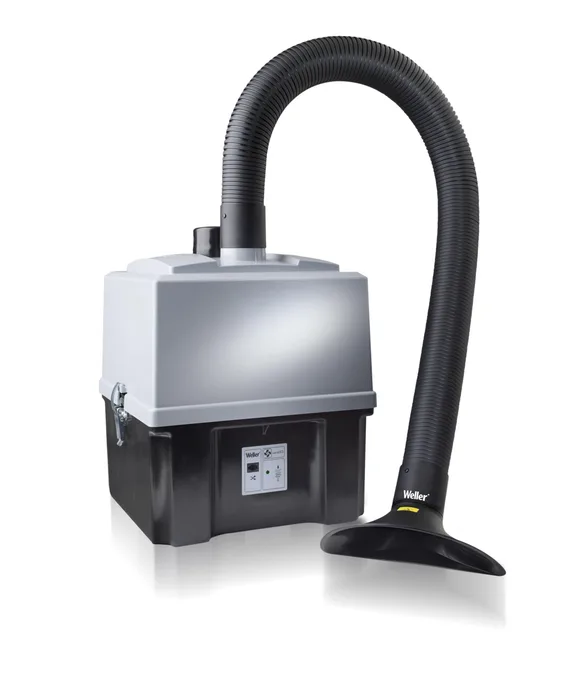
- Buy Weller Zero Smog EL Kit 1 The only unit here whose manual specifies a particle filter and an activated carbon filter working together, with the airflow and vacuum numbers to go with it. Amazon
- Buy Hakko FA-400 Smoke Absorber A carbon pad in front of a small fan, but Hakko publishes real numbers for it and says outright that the airflow figure was taken with the filter installed. Amazon
- It depends Hakko FA-430 Fume Extractor Pulls far more air at the nozzle than any benchtop box here and stays quiet doing it, but Hakko documents a particle filter and never names a carbon stage. Amazon
- Skip Aoyue 486 Smoke Absorber A widely sold carbon pad on a wire stand whose manufacturer publishes no airflow, no filter efficiency and no ESD claim. Amazon
What actually matters
- Colophony (rosin) - the resin from pine trees that forms the basis of most solder flux, and the substance that occupational health authorities actually regulate here. HSE lists rosin-based solder flux fume with a workplace exposure limit and a sensitiser notation, and describes it as one of the most important causes of occupational asthma in Britain.
- Particulate versus gas - heated rosin produces both, and the distinction drives everything about filter choice. A HEPA filter catches the particulate fraction and does essentially nothing for the gases, while activated carbon adsorbs gases and does little for particles.
- Filter class (H13, M5) - these are European classifications, where M5 describes a medium dust pre-filter and H13 describes a high efficiency particulate filter. A maker quoting a class is telling you something checkable, which is more than 'high efficiency' does.
- Airflow versus face velocity - volume moved per minute and speed of air at the intake are different numbers that behave differently. Hakko's FA-400 moves more air standing vertically but has a higher face velocity lying horizontally, so the better orientation depends on how close the unit sits to the work.
- Static pressure - the pressure the fan can generate against resistance, quoted in pascals. It predicts whether a unit keeps working once the filter loads and a duct is attached, which raw airflow does not.
- Capture distance - fume extraction is a game of inverse squares, and doubling the distance from the joint costs far more airflow than most people expect. HSE puts a number on it for a moveable capturing hood, saying it reliably captures fume only within roughly one to two hood diameters of the face, about 50 to 100 mm, with capture efficiency falling off beyond that.
- ESD-safe construction - conductive housings and a grounding path so the extractor does not build up a charge next to bare components. Hakko defines its ESD SAFE marking by an electrostatic attenuation test, which is the kind of specificity worth looking for.
The specs, in plain English
Green flags vs red flags
Green flags
- The maker names both a particle filter class and a gas or activated carbon filter, rather than a single unspecified pad.
- A collection efficiency percentage is quoted with the particle size it applies to, and ideally with the test method.
- Airflow is published alongside a static pressure or vacuum figure, and the maker says whether the filter was fitted.
- Replacement pre-filters and main filters have part numbers, are in stock, and come with a stated replacement interval.
- The ESD claim references a test standard or describes the conductive and grounding measures rather than just printing the letters.
Red flags
- An airflow figure much larger than the wattage plausibly supports, with no note about how it was measured.
- Claims that the filter absorbs lead fumes, which misstates what is actually in the plume.
- Percentages with no particle size, such as removes up to 90 percent of airborne particles, presented as a filtration rating.
- A proprietary pad with no published media, no efficiency figure and no separate pre-filter.
- No manufacturer specification page at all, so every number you can find traces back to a retailer's product description.
Who's who: the brands
- Hakko - Japanese soldering equipment maker that publishes unusually complete spec sheets, including footnotes on how airflow and noise were measured.
- Weller - Long-established soldering brand whose filtration line documents filter classes, vacuum and replacement intervals in the operating instructions.
- Quick - Chinese manufacturer of repair-bench extraction systems that publishes system flow figures stated as including the filtration device.
- Xytronic - Budget bench tool brand whose fume extractors are sold widely through electronics distributors as carbon-pad absorbers.
- Aoyue - High-volume Chinese rework equipment maker whose fume products are cheap and popular but thinly specified.
How to read a listing without getting fooled
Start at the filter section, not the headline. If the listing names a filter class such as H13 and separately names an activated carbon or gas filter, you are looking at a filtration system and the rest of the numbers are probably worth reading. If it says 'carbon filter' and nothing else, you are looking at a fan with a pad, which is a legitimate product but a different one. Next, find the airflow figure and check for a footnote about how it was taken; Hakko's spec pages, for instance, state that maximum suction capacity is measured with a filter present. Cross-check that figure against the wattage, since a 20 W fan claiming three cubic metres per minute deserves scepticism. Then look for static pressure, a noise figure and an ESD statement with a named test. Finally, search the maker's own site for the replacement filter part numbers. If they do not exist, the consumable story is going to be a problem later.
How much should you spend?
Budget units in this category are fans with carbon pads, and their price reflects that: they are worth buying when you accept the job is moving a plume away from your face and you position them accordingly. Mid-range gets you a better fan, a tilting or arm-mounted intake and sometimes a genuine pre-filter, but rarely a rated particle stage. Premium is where you find the combination that actually matches rosin fume: a pre-filter, a classified particulate filter and an activated carbon stage, plus published pressure figures and a filter-change alarm. The recurring cost matters as much as the purchase. Cheap pads are individually inexpensive but have small capacity, while premium compact filters cost real money and typically carry a once-a-year replacement requirement regardless of hours used. Budget for consumables before you decide which tier you are shopping in.
Questions, answered
How often should I replace the filter?
Follow the maker's interval rather than waiting for a smell, because a saturated carbon filter can release what it captured back into the room. Weller specifies replacing the Zero Smog EL compact filter at least once a year, or sooner if the workplace concentration limit is exceeded or the pre-filter has been changed ten times. On a simple carbon pad, replace it on the maker's schedule rather than waiting for a smell.
What does ESD safe mean on a fume extractor?
It means the housing and airflow path are designed not to build up a static charge that could damage the components you are soldering. The useful version of the claim comes with a method: Hakko defines its ESD SAFE marking by an electrostatic attenuation test to MIL-STD-3010A method 4046, with the unit grounded. Weller states an ESD-compatible design in its manual. Read the small print, since Hakko notes that the nets supplied in FA-430 duct sets are not themselves ESD protected.
Does lead-free or no-clean solder change what I need?
Not fundamentally. Lead-free alloys run hotter, and HSE notes that particulate fume levels can triple between 250 C and 400 C, so a higher tip temperature generally means more fume rather than less. No-clean fluxes still contain flux chemistry that decomposes when heated. The safe assumption is that the extraction requirement is at least as high with lead-free work, not lower, and that running the iron only as hot as the joint needs is a free improvement.
Is a nozzle at the tip better than a benchtop box?
Usually yes, because capture velocity falls away quickly with distance and a nozzle placed at the joint needs far less air than a box sitting behind it. That is the argument for ducted systems with a flexible arm. There are trade-offs: tip-mounted extraction can clog quickly, and Weller specifically states that the Zero Smog EL is a surface extraction unit not intended for extracting fumes directly from the soldering gun. Check what the maker actually designed the unit to do before you rig it up differently.
Or jump to the head-to-head: Weller Zero Smog EL Kit 1 vs Hakko FA-400 Smoke Absorber.