Explained
Table Saws, Explained
After reading, you'll know which single number decides whether a saw suits your work, and which specs are noise.
In this guide
Table saw listings lead with amps and blade size. The number that decides what the saw can actually cut is rip capacity, and it varies enormously.
The 30-second version
- Twenty-four inches is the threshold, because ripping a standard 4 foot sheet down the middle needs it, and a saw below that cannot do the job most people buy one for.
- Amps never vary, since 15 is the ceiling on a standard circuit and every saw in the class is built to it, so the figure separates nothing.
- Blade diameter is a depth spec, with 10 inches giving roughly three to three and a half inches of cut and 8-1/4 giving less, while also deciding how wide a blade market you can buy from.
- A riving knife stays with the blade, rising and falling with it so it keeps working on non-through cuts, where a fixed splitter has to be removed.
- The fence decides whether capacity is real, because a fence that drifts out of parallel at the far end makes the last several inches of a published figure unusable.
The products this guide is about
Our verdict on each, with the full reasoning on the companion review.
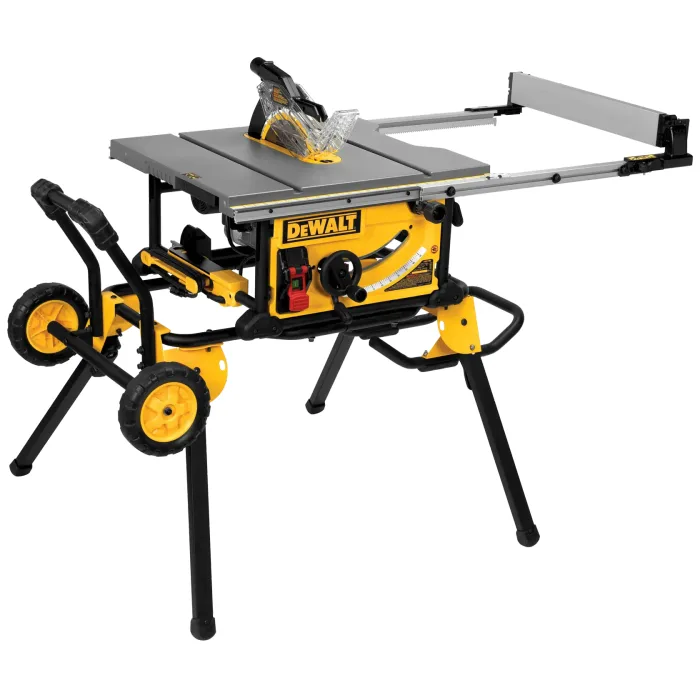
- Buy DEWALT DWE7491RS 10 in. Jobsite Table Saw with Rolling Stand Thirty-two and a half inches of rip to the right, which is the specification the whole category turns on. Amazon
- Buy Makita 2705 10 in. Contractor Table Saw The deepest cut in this comparison and a riving knife with three positions, including one for dado work.
- It depends DEWALT DWE7485 8-1/4 in. Compact Jobsite Table Saw Still halves a sheet at 24 and a half inches of rip, on a smaller blade that costs depth and narrows blade choice (maker page no longer loads, specs unconfirmed). Amazon
- Skip CRAFTSMAN CMXETAX69434502 10 in. 15 Amp Corded Jobsite Table Saw with Folding Stand Twelve inches of rip capacity, which cannot reach the middle of a 4 foot sheet, on the job most people buy a table saw for.
What actually matters
- Rip capacity right of blade - the distance from blade to fence at maximum. The primary specification, ranging from about 12 to 32 inches on jobsite saws. Twenty-four is the sheet-goods threshold.
- Rip capacity left of blade - usually smaller, and it determines whether a cut can be approached from the other side. Often half the right-hand figure.
- Blade diameter - 10 inches is standard and gives roughly 3 to 3-1/2 inches of cut at 90 degrees, depending on the saw. Smaller blades reduce depth and narrow blade availability.
- Riving knife - a curved plate behind the blade that rises with it, holding the kerf open to prevent pinching. The main defence against kickback.
- Fence mechanism - a rack and pinion fence is intended to hold parallel across its travel; simpler fences can rack at the far end.
- Table material and flatness - cast aluminium is flatter and more stable than pressed steel, and flatness is what keeps a cut square through the thickness.
The specs, in plain English
Green flags vs red flags
Green flags
- Rip capacity is published for both sides of the blade.
- Blade diameter is stated alongside depth of cut at 90 and 45 degrees.
- A riving knife is named specifically rather than described as a guard.
- The fence mechanism is described, ideally as rack and pinion.
- Riving knife blade compatibility is given as a kerf range.
Red flags
- Only a maximum rip capacity is given, with no side specified.
- Amps and RPM lead the listing while rip capacity is buried.
- Blade guard is mentioned but riving knife is not.
- A 10 inch blade is promoted on a saw whose rip capacity is under 20 inches.
- Table material is described only as heavy duty.
Who's who: the brands
- DEWALT - Jobsite saws with large rip capacities and rack and pinion fences, plus a compact 8-1/4 inch option that trades depth for portability.
- Makita - Contractor saws with precision machined tables and the most adjustable riving knives, including positions for non-through and dado cuts.
- Bosch - Long-running jobsite saws, a common alternative to the DEWALT range.
- CRAFTSMAN - Budget saws with a riving knife, guard and pawls, but at least one model is limited by rip capacity well below the sheet-goods threshold.
- SawStop - Built around a flesh-detection brake that stops the blade on contact, sold at a considerable premium and in larger formats.
How to read a listing without getting fooled
Find the rip capacity to the right of the blade and compare it against 24 inches before reading anything else. Then check the left-hand figure. Then read blade diameter as a depth specification and check the depth of cut at 90 and 45 degrees. Confirm a riving knife rather than only a splitter, and look at how the fence is driven. Read amps last, since they are 15 on everything.
How much should you spend?
Budget buys a saw with the full safety set and a rip capacity that may be too small for sheet goods, so check that figure before anything else. Mid-range buys a capacity that clears the 24 inch threshold, sometimes on a smaller blade. Premium buys both a large capacity and a fence mechanism that holds parallel across it, which is where the money actually goes.
Questions, answered
Can I add rip capacity to a saw later?
Generally no. Rip capacity is set by the length of the fence rails and the table extension, and on jobsite saws those are integral to the frame. Some contractor and cabinet saws accept extension rails and wings, but the compact saws that most often disappoint on capacity are the ones least able to be extended. Treat the published figure as permanent.
Do I really need a riving knife?
It is a key anti-kickback feature on a table saw, because it physically prevents the workpiece closing onto the back of the blade. That is the mechanism behind most kickback events, where the rising teeth at the back catch the wood and throw it. Unlike a splitter it stays in place for non-through cuts, which is exactly when people are most tempted to remove safety equipment and forget to put it back.
Why does my cut come out not square through the thickness?
Usually the blade is not perpendicular to the table, or the workpiece lifted during the cut. Check the blade against a square at 90 degrees rather than trusting the detent, and make sure the piece is held flat and against the fence throughout. A thin-kerf blade deflecting in dense hardwood will do it as well, particularly on deep cuts where there is more blade in the material.
Is a track saw a better option for sheet goods?
For breaking down full sheets, often yes, because you bring the tool to the work rather than manoeuvring an 8 foot sheet across a small table. Many people use both: a track saw to break sheets down to manageable pieces and a table saw for accurate repeatable rips after that. If you only ever cut sheets, a track saw and a straightedge may serve better than a small table saw with inadequate capacity.
Or jump to the head-to-head: DEWALT DWE7491RS 10 in. Jobsite Table Saw with Rolling Stand vs Makita 2705 10 in. Contractor Table Saw.