Explained
Utility Knives, Explained
After reading, you'll understand why the blade is not the thing you are choosing, and which mechanism suits how you actually work.
In this guide
The utility knife is one of the few tools where the consumable is standardised and the tool is not. The trapezoid blade fits essentially every knife on the shelf, so brand loyalty on blades is a habit rather than a requirement. What differs is the mechanism holding it, how the knife carries, and whether you can control how far the blade projects. Those are the specs worth reading, and they are usually further down the page than the ones that are not.
The 30-second version
- The blade is standard, so any brand's trapezoid blades fit any brand's knife and you can buy them separately on quality.
- Depth control is the retractable's real advantage, letting you score a surface instead of cutting through it.
- A clip decides whether you carry it, and the knife you have on you beats the better one in the van.
- Bi-metal blades resist snapping, which matters most when a blade gets twisted in a cut.
- Onboard blade storage is worth more than it sounds, because a dull blade is more dangerous than a sharp one.
The products this guide is about
Our verdict on each, with the full reasoning on the companion review.
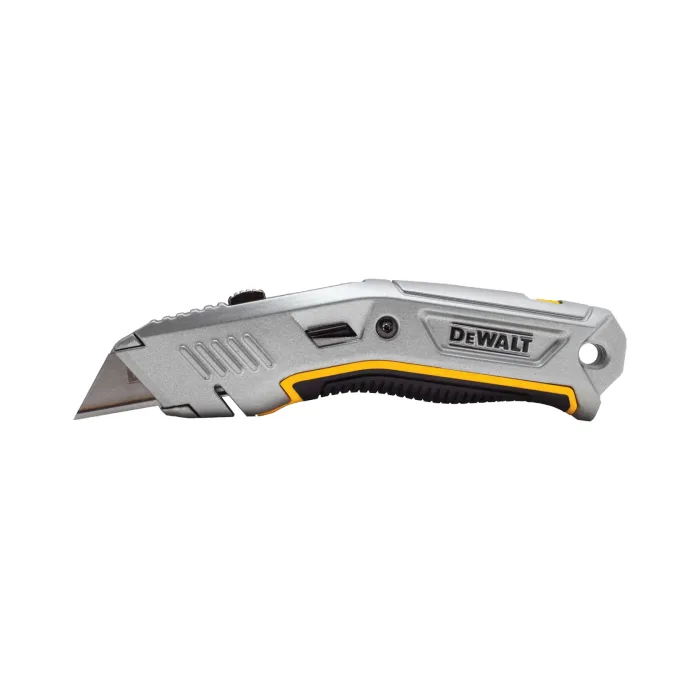
- Buy DeWalt DWHT10319 Retractable Utility Knife Metal body, 3x blade retention and five spare blades on board, which is the full job in one tool.
- Buy DeWalt DWHT10991 Push and Flip Folding Utility Knife Opens one-handed, weighs 0.29 lb, and clips deep in a pocket, which is why it gets carried and used. Amazon
- It depends Craftsman CMHT10353 Folding Utility Knife with 3-Blade Storage An all-metal folder with spare blades stored inside it, which neither DeWalt manages, on a listing that will not tell you exactly what arrives. Amazon
- Skip Craftsman CMHT10588 Quick Change Utility Knife, 2 Pack A retractable with three cut depths, sold in a two-pack, on a spec sheet that does not describe the object in the photo. Amazon
What actually matters
- Mechanism - retractable knives slide the blade in and out, usually with detent positions; folders pivot the whole head into the handle. Retractables give depth control, folders give pocket carry, and the choice is about where the knife lives.
- Blade retention - how firmly the carrier grips the blade. A blade that shifts under load is the main cause of a cut going wrong, and better knives use a positive lock rather than friction.
- Body material - metal bodies are built for jobsite abuse; plastic bodies are more likely to crack at the pivot or the slide. Every knife in the comparison above is metal, which is now normal above the cheapest tier.
- Blade storage - onboard compartments for three to five spares. It sounds trivial and it is the difference between changing a dull blade and forcing one, which is how injuries happen.
- Blade change - tool-free is standard now, but the mechanisms vary in how easily they can be triggered by accident. Look for a release that needs a deliberate two-step action.
- Carry - a pocket clip, and whether it is reversible and deep-carry. This decides availability, which in practice decides which knife gets used.
- Blade type - standard carbon steel, bi-metal, or carbide-edged. The differences are in edge life and in whether the blade snaps or bends when twisted.
The specs, in plain English
Green flags vs red flags
Green flags
- A metal body stated explicitly in the specification list.
- Onboard storage for three or more spare blades.
- Detent or multi-position blade retention on a retractable.
- A reversible pocket clip on a folder.
- A blade change that needs a deliberate two-step release rather than a single button.
Red flags
- A blade length figure that does not match the size of the knife, or that carries no unit.
- A piece count that does not match the product description.
- Dimensions that are obviously transposed, such as a length shorter than the height on a pocket tool.
- A plastic body on a knife sold for jobsite use.
- A multi-pack presented as the only way to buy the tool.
Who's who: the brands
- DeWalt - A broad line covering both folders and retractables, with metal bodies and onboard blade storage on some models.
- Stanley - A long-established brand best known for fixed and retractable utility knives used across the trades.
- Craftsman - Budget and mid-tier knives, often sold in multi-packs, with all-metal bodies at low prices and thin published specifications.
- Milwaukee - Jobsite-focused knives built around fast blade changes and secure retention, aimed at electricians and drywall trades.
- Olfa - The originator of the snap-off blade, and the reference point for knives where a fresh edge is snapped off rather than replaced.
How to read a listing without getting fooled
Skip the blade length row. Every knife on the shelf takes the same blade, and the figures published for these four knives are 2.44 in., 1.25 and 1, and one page lists none, which tells you about the page rather than the product. Read the mechanism instead, and decide whether you want detent positions or a pocket clip, because no knife here gives you both. Check the body material, which should say metal. Look for onboard blade storage and a count. Then read the dimensions and the piece count for internal consistency, because a spec table that lists a 10 in. height on a pocket tool has not been checked, and that is the only quality signal you get when you are buying online.
How much should you spend?
Utility knives are cheap enough that the budget tier and the mid-range are separated by a small amount of money and a large amount of tool. At the bottom you get plastic bodies, friction blade retention and no onboard storage. A modest step up buys a metal body, a positive blade lock and somewhere to keep spares, which is most of what there is to buy. Above that you are paying for carry hardware, better clips and fit and finish rather than function. Spend the real money on blades instead: a box of bi-metal blades costs less than the knife and changes how the tool cuts far more than the knife does.
Questions, answered
How often should I change the blade?
As soon as it stops cutting cleanly, which is much sooner than most people do. A dull blade needs more force, and more force is what turns a slip into a cut. On cardboard a blade lasts a long time; on drywall the gypsum dulls an edge in a few sheets, and on roofing material it can be a few cuts. Flip the blade to use the second edge before you replace it.
Can I sharpen utility blades instead of replacing them?
You can put an edge back on one, but it is not worth doing. The blade is designed as a consumable, a fresh one costs very little, and a resharpened blade rarely returns to the geometry that made it cut well. Buy blades in bulk and treat them as disposable.
What do I do with used blades?
Put them in a blade disposal container, which is a small metal or rigid plastic box with a one-way slot, or in a taped-up rigid container if you do not have one. Loose blades in a bin bag will cut through the bag and whoever handles it. Many knives with onboard storage keep a separate slot for used blades, which is worth using rather than mixing them with the fresh ones.
Is a snap-off knife better than a trapezoid blade knife?
For different work. A snap-off knife gives you a fresh point every time you break a segment, which is ideal for detailed cutting, film, wallpaper and packaging. A trapezoid blade is thicker and stiffer, which is what you want for drywall, carpet, roofing and anything where the blade gets loaded sideways. Snap-off blades flex and break under that kind of use, which is a hazard rather than a feature.
Or jump to the head-to-head: DeWalt DWHT10319 Retractable Utility Knife vs DeWalt DWHT10991 Push and Flip Folding Utility Knife.