Explained
Welding Gloves, Explained
After reading, you'll understand what EN 12477 Type A and Type B actually require, how to decode a six digit EN 407 thermal code, why the United States has no welding glove standard of its own, and which leather, lining and thread combination suits the process you run.
In this guide
First time buyers almost always shop this category on thickness and cuff length, because those are the two things you can see. What they miss is that welding gloves are process specific in a way that no other work glove is: the same pair cannot serve a 200 amp stick root pass and a 40 amp TIG fillet. They also miss that the numbers they are looking for mostly are not printed, because the American standard for welding safety requires flame resistant gloves without grading them. The Europeans do grade them, and once you can read that code you can read any welding glove listing properly.
The 30-second version
- EN 12477 is the only welder specific glove standard, and it sorts gloves into Type A for protection and Type B for dexterity, with different minimum scores for each.
- The EN 407 code is six results, not one score, and an X in any of the six positions means that particular test was never run on the glove.
- America has no welding glove standard, because ANSI Z49.1 asks only for protective flame resistant gloves that are dry and in good repair.
- The thread is a real failure mode, because cotton stitching chars and parts under spatter while aramid thread such as Kevlar does not.
- Process fit beats brand every time, since AWS itself notes that a glove right for low current TIG is wrong for high current arc cutting.
The products this guide is about
Our verdict on each, with the full reasoning on the companion review.
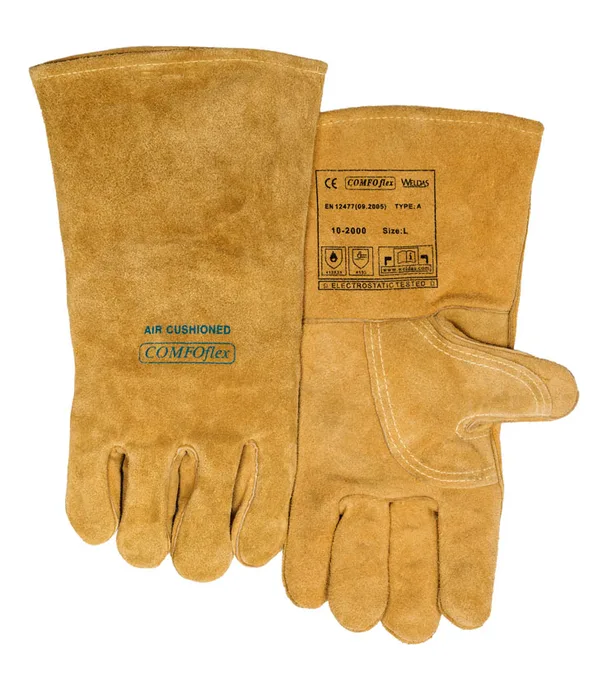
- Buy Weldas COMFOflex 10-2000 The only glove here that tells you what it was tested to, with EN 12477 Type A and a full EN 407 thermal code printed on the cuff. Amazon
- Buy Tillman 1018 Split Cowhide Stick Welding Glove A plain 14 inch split cowhide stick glove that gets the three construction details right and costs the least here. Amazon
- It depends Black Stallion 25K Premium Grain Kidskin TIG Glove An unlined kidskin glove built for the one process where feeling the filler rod matters more than stopping heat. Amazon
- Skip Tillman 1000 Standard Split Cowhide Stick Welding Glove A perfectly ordinary economy stick glove whose own product page says it is sewn with cotton stitching. Amazon
What actually matters
- EN 12477 type - This is the classification that tells you what the glove was designed to do. Type A carries higher minimums for burning behaviour, convective heat and molten splash, while Type B trades those away for the fine dexterity that TIG needs.
- EN 407 thermal code - Six digits in a fixed order covering flame spread, contact heat, convective heat, radiant heat, small splashes and large quantities of molten metal. It is the only place a welding glove's heat performance appears as a measured number.
- Contact heat level - The position that gets misread most often. Level 1 means the glove held off the pain threshold for at least 15 seconds against a 100 degree Celsius contact, and level 4 means it did so at 500 degrees.
- Leather and cut - Split leather is the fuzzy inner layer of the hide and grain leather is the smooth outer layer. Split is thicker and cheaper, grain is thinner and more tactile, and welding gloves mix them deliberately.
- Lining - Cotton and foam creates an air barrier for heat, wool traps air and works for both heat and cold, plain cotton is thin and relies on the leather, and aramid linings are mainly there for cut resistance with some heat benefit.
- Stitching thread and welting - Aramid thread resists the heat that destroys cotton thread, and a welt is a strip of leather sewn over the seam so spatter lands on hide rather than on the stitching.
- Named process - MIG, stick and TIG place completely different demands on a glove, and a maker naming the process is telling you which compromise it chose.
The specs, in plain English
Green flags vs red flags
Green flags
- An EN 12477 type printed on the cuff or the listing, with the amendment year alongside it.
- A six digit EN 407 code and a four or five character EN 388 code published together rather than one without the other.
- The maker naming a specific process, such as MIG and MAG or TIG, rather than saying suitable for all welding.
- Aramid stitching named explicitly, plus welted fingers, plus a stated lining material.
- A published specification sheet that lets you compare models in the same range.
Red flags
- A bare temperature claim such as a Fahrenheit or Celsius figure with no standard, no test method and no duration attached.
- The word insulated or heat resistant with no lining material named anywhere on the listing.
- No mention of the stitching thread at all, in a category where the seam is the usual failure point.
- One glove marketed for MIG, stick and TIG at once, which the AWS glove selection guidance specifically warns against.
- A cut level quoted as the only number, since cut resistance says nothing about how the glove behaves against flame or spatter.
Who's who: the brands
- Weldas - A Dutch maker whose gloves carry CE marking, so the EN 12477 type and the EN 407 and EN 388 codes are printed on the cuff and published on the product page.
- Tillman - A long established American welding glove maker that publishes a leather guide and an insulation guide, which is unusually transparent for a market with no standard.
- Black Stallion - Sells separate stick, MIG and TIG lines and lists the intended application on its product pages, for example TIG only on the 25K, including specialist features such as reinforced drag patches.
- Lincoln Electric and Miller - Welding machine makers whose branded gloves are sold alongside their equipment, generally described by construction rather than by any published test result.
- PIP, Caiman and Ironcat - A safety products group and its welding glove brands, covering stick, MIG and TIG with a wide range of leathers and aramid linings.
How to read a listing without getting fooled
Start at the bottom of the listing rather than the top. Look for a CE block or a pictogram, because that is where EN 12477 and the EN 407 and EN 388 codes live, and if there is none then no graded test result exists for that glove and everything above is description. Next find the process the maker names and treat it as binding: TIG means thin, unlined and grain leather, stick means thick, lined and split leather, and a glove marketed for all three is telling you it was designed for none. Then check three construction words in order, thread, welting and lining, because those decide how the glove dies. Finally check the size run and the length. A single size offering is a warning on a product where fit governs whether you can hold anything, and cuff length matters more than most buyers expect once you weld overhead.
How much should you spend?
This is a category where the budget tier is genuinely usable, because the leather and the pattern of a plain split cowhide stick glove have not changed much in decades. At the budget tier you should still insist on aramid stitching and welted fingers, and you can get both, which is exactly why one economy glove in our comparison is a buy and its stablemate is a skip. The mid tier buys you either a published certification, as with the CE marked European gloves, or a better leather and a purpose built lining, and occasionally both. The premium tier is mostly about specialist leathers, longer cuffs, drag patches and aramid linings for cut resistance, none of which help unless your job actually presents that hazard. Since gloves are consumables that are hard to clean, buying two cheaper appropriate pairs, one for heat and one for feel, usually beats buying one expensive pair and asking it to do both.
Questions, answered
Is elkskin really more heat resistant than cowhide?
That claim is repeated everywhere and is hard to pin to a primary source. The AWS fact sheet on selecting welding gloves lists cowhide, calfskin, pigskin, goatskin, deerskin, rubber, treated cotton, aluminized material and para-aramid, and does not mention elkskin at all. Tillman, which sells plenty of elkskin gloves, describes the leather as having excellent dexterity, natural resistance to oils and moisture, and the ability to stay soft and flexible after exposure to heat, and recommends it for stick welding. Notice that none of that is a heat resistance claim. Elkskin's real advantage is that it does not go hard after it gets hot and wet, which is about comfort and service life rather than insulation.
Does a Kevlar lining make a glove more heat resistant?
Less than the marketing implies. Tillman's own insulation guide groups DuPont Kevlar, Nomex and para-aramid linings together and says they are extremely strong and primarily used for added cut resistance, and that they also provide some protection against heat. Compare that with what the same guide says about cotton and foam, which creates a barrier of air between the leather and your hand, and about wool, whose fibres contain air that insulates against both heat and cold. Trapped air is what insulates. An aramid lining is a good thing to have if your hazard includes sharp edges as well as heat, but if pure thermal insulation is what you are buying, look at what the lining does with air, not at what it is made of.
Can one pair of gloves cover MIG, stick and TIG?
The American Welding Society says not really. Its glove selection fact sheet states that one pair of gloves may not be suitable for all processes and gives the example that gloves proper for low current gas tungsten arc welding, meaning thin and flexible, would not be proper for high current air carbon arc cutting, which needs insulated, tough and durable. The European standard encodes the same idea by splitting welding gloves into two types with different dexterity requirements. In practice most welders who run more than one process own at least two pairs: something thick and lined for stick and heavy MIG, and something thin and unlined for TIG. The cost of a second pair is small next to the cost of doing either job badly.
Which standards apply to welding gloves in 2026?
In Europe, EN 12477 is the welder specific standard and the version in force is still the 2001 edition with the 2005 amendment, which is why CE marked welding gloves carry a 2005 date next to the standard number. It sits on top of EN 388 for mechanical risks and EN 407 for thermal risks, the latter revised in 2020. One quirk worth knowing is that EN 12477's dexterity requirement still points at EN 420, which has since been replaced by EN ISO 21420:2020, so a current manual may size the glove under the newer document while grading dexterity under the older one. In the United States, ANSI Z49.1 requires flame resistant gloves without grading them, and ANSI/ISEA 105 offers voluntary thermal classifications that welding glove makers rarely use.
Or jump to the head-to-head: Weldas COMFOflex 10-2000 vs Tillman 1018 Split Cowhide Stick Welding Glove.