

Tools & DIY
The Best Welding Gloves: 4 Compared (and One to Skip)
We compared four welding gloves on the things makers actually print: the EN 12477 welder classification, the six digit EN 407 thermal code, leather and lining, stitching thread, and which process the maker names.
The short version
The Weldas COMFOflex 10-2000 is our overall pick because it is the only glove here that publishes what it was tested to: EN 12477 Type A, an EN 407 thermal code of 412X3X and an EN 388 code of 4143X, printed on the glove itself. The Tillman 1018 is the value pick, a 14 inch split cowhide stick glove with a cotton and foam lined back, fully welted fingers and Kevlar stitching, sold at the cheapest tier here. The Black Stallion 25K suits one buyer very well and nobody else: it is unlined premium grain kidskin built for TIG, and Black Stallion names TIG as its only application. Skip the Tillman 1000, not because it is cheap but because Tillman's own page says it is sewn with cotton stitching, and cotton thread is the seam that fails first under spatter. Before you buy anything, work out which process you actually run, because a glove that is right for stick is wrong for TIG and the other way around. Best for: anyone who wants to buy a welding glove on published construction instead of on how thick it looks.
Our picks at a glance
- Weldas COMFOflex 10-2000 - Buy. The only glove here that tells you what it was tested to, with EN 12477 Type A and a full EN 407 thermal code printed on the cuff.
- Tillman 1018 Split Cowhide Stick Welding Glove - Buy. A plain 14 inch split cowhide stick glove that gets the three construction details right and costs the least here.
- Black Stallion 25K Premium Grain Kidskin TIG Glove - It depends. An unlined kidskin glove built for the one process where feeling the filler rod matters more than stopping heat.
- Tillman 1000 Standard Split Cowhide Stick Welding Glove - Skip. A perfectly ordinary economy stick glove whose own product page says it is sewn with cotton stitching.
The verdict in 30 seconds
What mattered most
- EN 12477 welder classification
- EN 407 thermal code published
- Main leather
- Lining
- Stitching thread
- Welted fingers
Welding gloves are the one piece of hand protection where the American rulebook has almost nothing to say. ANSI Z49.1 requires flame resistant gloves and stops there, so a US welding glove can legally be sold with no graded heat number of any kind. Europe does have a welder specific standard, EN 12477, which sorts gloves into Type A and Type B and forces a six digit EN 407 thermal code onto the cuff. Only one glove in this comparison carries either, and reading its code tells you something surprising about how much heat any welding glove actually stops.
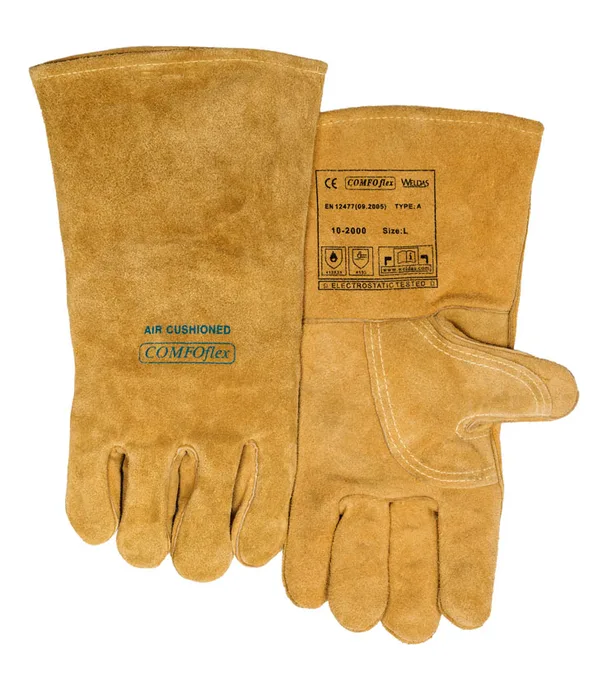
The only glove here that tells you what it was tested to, with EN 12477 Type A and a full EN 407 thermal code printed on the cuff.
Best for: MIG and stick work where you want a mainstream welding glove whose heat performance is a published number instead of a guess.
- Weldas publishes EN 12477:2001+A1:2005 Type A, EN 407 412X3X and EN 388 4143X, so the heat and mechanical claims are graded rather than adjectives.
- Class A split cow leather with the COMFOflex lining, Kevlar stitching and 95 percent welting on the seams.
- Weldas names the processes it is for, MIG and MAG plus manual metal arc, and offers a 46 cm (18 inch) length plus left hand only pairs.
- The EN 407 code reads contact heat level 1, which is the bottom band, so the glove is verified only to 100 degrees Celsius of contact for at least 15 seconds.
- Radiant heat and large molten metal are both reported as X, meaning not tested, so two of the six thermal positions are blank.
- Type A is the low dexterity class by design, and EN 12477 only asks a Type A glove to pick up an 11 mm rod against 6.5 mm for Type B.
- Weldas gives no washing guidance on the product page, so treat it as a glove you replace rather than clean.
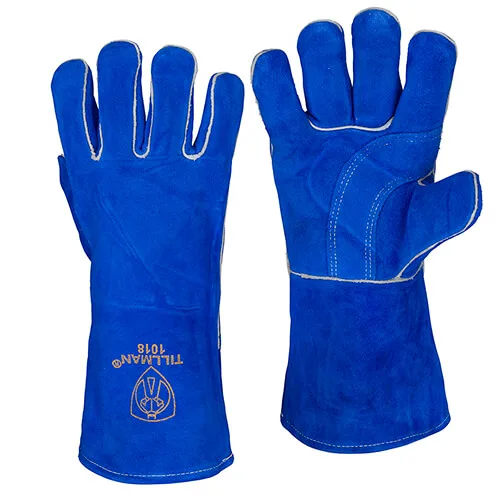
A plain 14 inch split cowhide stick glove that gets the three construction details right and costs the least here.
Best for: Stick and general fabrication work where you buy gloves by the pair regularly and want welted fingers and Kevlar thread without paying for anything else.
- Tillman lists DuPont Kevlar stitching and fully welted fingers, which puts a layer of leather over the seam that spatter would otherwise land on.
- The cotton and foam lined back puts insulation where the arc radiates and leaves the palm thinner for feel on the electrode.
- Fourteen inch length with a reinforced thumb, in large and extra large, with a separate 1018W for smaller hands.
- No EN 12477 type, no EN 407 code and no ANSI/ISEA 105 thermal classification appear anywhere on the listing.
- Split cowhide is the least tactile of the common welding leathers, so this is not a glove for fine fit up or for a MIG trigger.
- Tillman's own copy calls it engineered for high heat without naming a temperature, a duration or a test method.
- Being budget leather, it is a consumable, and there is no published service life to plan replacement against.
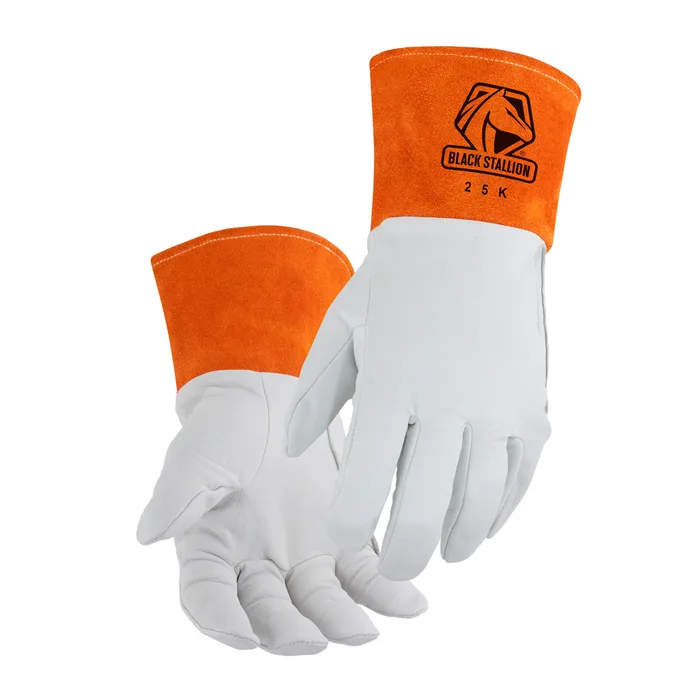
An unlined kidskin glove built for the one process where feeling the filler rod matters more than stopping heat.
Best for: TIG welders and anyone doing low current precision work who needs to feel the rod, and who owns a second, heavier pair for everything else.
- Supple thin premium grain kidskin, which is the leather Tillman and Black Stallion both point TIG welders toward for tactile feel.
- Unlined for dexterity, with a 4 inch cuff and DuPont Kevlar stitching, in an unusually wide size run of XS through 2XL.
- The DragPatch reinforcement on the heel of the hand is the part that actually wears out when you rest and drag on the work.
- Black Stallion names TIG welding as the only application, and unlined thin grain leather is the wrong build for stick or high current MIG.
- There is no lining at all, so nothing sits between the leather and your hand when you touch a hot part.
- No EN 12477 type, no EN 407 code and no thermal rating of any kind is published for it.
- Thin grain leather on a glove you drag across steel is a short lived thing no matter how good the patch is.
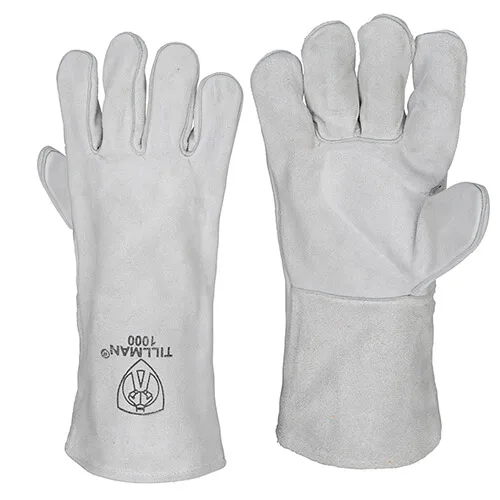
A perfectly ordinary economy stick glove whose own product page says it is sewn with cotton stitching.
Best for: Handling and light spark work rather than sustained arc welding, and even then the 1018 costs about the same and is sewn with Kevlar.
- Tillman states the thread material plainly, which is more than most economy welding gloves do in either direction.
- Welted fingers are still there, so the seams have a leather flap over them rather than sitting exposed.
- Standard shoulder split cowhide, cotton lined, 14 inch, lock stitched, from a maker with a real specification sheet behind it.
- Tillman's page describes the seams as protecting cotton stitching, and cotton thread has none of the heat resistance of the aramid thread used on every other glove here.
- The lining is plain cotton, where the 1018 adds a cotton and foam lined back for extra insulation.
- It is sold in a single size, large, so there is no way to get a proper fit.
- Like the rest of the field it carries no EN 12477 type and no EN 407 code, so nothing offsets the thread.
| Criteria | COMFOflex 10-2000 Top pick | 1018 Split Cowhide Stick Welding Glove | 25K Premium Grain Kidskin TIG Glove | 1000 Standard Split Cowhide Stick Welding Glove |
|---|---|---|---|---|
| Verdict | Buy it | Buy it | It depends | Skip it |
| Best for | MIG and stick work where you want a mainstream welding glove whose heat performance is a published number instead of a guess. | Stick and general fabrication work where you buy gloves by the pair regularly and want welted fingers and Kevlar thread without paying for anything else. | TIG welders and anyone doing low current precision work who needs to feel the rod, and who owns a second, heavier pair for everything else. | Handling and light spark work rather than sustained arc welding, and even then the 1018 costs about the same and is sewn with Kevlar. |
| Price tier | $$ · mid-range | $ · budget | $$ · mid-range | $ · budget |
| EN 12477 welder classification | Type A, printed on the cuff | None published | None published | None published |
| EN 407 thermal code published | 412X3X | None published | None published | None published |
| Main leather | Class A split cow leather | Slightly select split cowhide | Premium grain kidskin | Standard shoulder split cowhide |
| Lining | COMFOflex lining | Cotton and foam lined back | Unlined | Cotton |
| Stitching thread | Kevlar, 4 and 5 ply | DuPont Kevlar | DuPont Kevlar | Cotton |
| Welted fingers | 95 percent welting | Fully welted | Not stated | Welted fingers |
| Process the maker names | MIG and MAG, manual metal arc | Arc and stick | TIG only | Arc and stick |
| Sizes and length | S to XXL, plus a 46 cm length | L and XL, 14 inch | XS to 2XL, 4 inch cuff | Large only, 14 inch |
Which one is right for you?
- MIG and stick work where you want a mainstream welding glove whose heat performance is a published number instead of a guess. Buy it Weldas COMFOflex 10-2000
- Stick and general fabrication work where you buy gloves by the pair regularly and want welted fingers and Kevlar thread without paying for anything else. Buy it Tillman 1018 Split Cowhide Stick Welding Glove
- TIG welders and anyone doing low current precision work who needs to feel the rod, and who owns a second, heavier pair for everything else. It depends Black Stallion 25K Premium Grain Kidskin TIG Glove
- Handling and light spark work rather than sustained arc welding, and even then the 1018 costs about the same and is sewn with Kevlar. Skip it Tillman 1000 Standard Split Cowhide Stick Welding Glove
How we judged the field
Five things decide whether a welding glove is worth buying, and only one of them is the leather. First, whether the maker publishes a welder specific classification at all, because EN 12477 is the only standard written for this job and it forces a glove into Type A or Type B with minimum thermal and mechanical scores attached. Second, the EN 407 thermal code, which is six separate results in a fixed order and not one overall heat score. Third, process fit, because the AWS fact sheet on glove selection says outright that one pair may not suit all processes and gives the example of a thin flexible glove being right for low current TIG and wrong for high current air carbon arc cutting. Fourth, the seams, since a welding glove usually fails where the thread is, which is why welted fingers and aramid thread exist. Fifth, the lining, which is doing a different job on the back of the hand than on the palm.
The field splits on paperwork rather than on quality. European brands sold into the US, of which Weldas is the obvious one, put an EN 12477 type and an EN 407 code on the cuff because the CE marking requires it. American brands sell on construction language instead: leather grade, welted fingers, Kevlar thread, lining type, and the process the glove is meant for. Both approaches can produce a good glove and only the first lets you check. We picked one glove from each side of that line, one specialist that exists for a single process, and one economy glove whose maker publishes the exact detail that should send you to the model next to it on the shelf.
Weldas COMFOflex 10-2000
Buy itThe Weldas COMFOflex 10-2000 is here because you can read it. The cuff is stamped CE, EN 12477 with the 2005 amendment date, and TYPE: A, alongside two pictograms carrying the codes. Weldas publishes those codes as EN 407 412X3X and EN 388 4143X. Decoded, that is limited flame spread at level 4, contact heat at level 1, convective heat at level 2, radiant heat not tested, small molten metal splashes at level 3, large quantities of molten metal not tested, then abrasion 4, coup cut 1, tear 4 and puncture 3. The construction behind it is class A split cow leather with the COMFOflex lining, Kevlar stitching and welting on 95 percent of the seams, and Weldas also offers a 46 cm (18 inch) length. Weldas names MIG, MAG and manual metal arc as the intended processes. The honest reading of that code is that a good Type A welding glove is verified against 100 degrees Celsius of contact, not against picking up glowing steel. Buy it if you want that written down.
Tillman 1018 Split Cowhide Stick Welding Glove
Buy itThe Tillman 1018 is the plain American-style version of this glove, and it gets the important parts right without publishing a single test result. It is slightly select split cowhide, 14 inch, with a reinforced thumb, fully welted fingers and DuPont Kevlar stitching, and a cotton and foam lined back that leaves the palm thinner. That combination is the sensible one: the back of your hand faces the arc and takes the radiant load, the palm has to feel the electrode, so you insulate one and not the other. What you do not get is any graded number. Tillman calls it engineered for high heat with no temperature, no duration and no test named. For the money that is a fair trade, and it is the glove to buy if you burn through gloves and want the seams to outlast the leather.
Black Stallion 25K Premium Grain Kidskin TIG Glove
It dependsThe Black Stallion 25K is a good glove that most people should not buy, and Black Stallion is upfront about why. The listed application is TIG welding, singular. It is supple thin premium grain kidskin, unlined for dexterity, with a 4 inch cuff, DuPont Kevlar stitching and the DragPatch reinforcement on the part of the hand that rests on the work. Kidskin is the leather both Tillman and Black Stallion steer TIG welders toward, and unlined is the point rather than a cost saving, because a lining between your fingers and the rod is exactly what you are trying to avoid. Run the EN 12477 logic over it and this is Type B territory: high dexterity, low protection, the class the standard associates with TIG. Put it on for stick or high current MIG and you have thin grain leather with nothing behind it. It is a second pair, not a first pair, and it sits in this comparison to make that distinction concrete.
Tillman 1000 Standard Split Cowhide Stick Welding Glove
Skip itThe Tillman 1000 looks like the 1018’s grey twin and is not. Tillman’s own product page describes it as standard shoulder split cowhide, cotton lined for comfort, with welted fingers that protect cotton stitching. That last phrase is the whole case. Every other glove in this comparison is sewn with an aramid thread, Kevlar or equivalent, because cotton thread chars and parts under spatter long before the leather gives up, and a welding glove that has lost a finger seam is finished. The lining is plain cotton, against the cotton and foam lined back on the 1018. Add that it comes in one size, large, and there is no version of this that beats the 1018 sitting next to it. This is not a bad company or a fake product, it is a specification you can read and decline.
Sources
Specs in this review come from these pages.
- American Welding Society: Safety and Health Fact Sheet No. 37, Selecting Gloves for Welding and Cutting (aws-p-001-delivery.sitecorecontenthub.cloud)
- AWS: ANSI Z49.1:2021 Safety in Welding, Cutting, and Allied Processes (pubs.aws.org)
- SATRA: EN 12477:2001 + A1:2005, Protective gloves for welders (satra.com)
- SATRA: EN 407:2020, protective gloves against thermal risks (satra.com)
- Weldas: COMFOflex 10-2000 product page with EN 12477, EN 407 and EN 388 codes (weldaseurope.com)
- ISEA: 5 Facts About ANSI/ISEA 105-2024 (safetyequipment.org)
Weldas COMFOflex 10-2000 vs Tillman 1018 Split Cowhide Stick Welding Glove: which should you buy?
The Weldas COMFOflex 10-2000 and the Tillman 1018 are aimed at the same welder and answer him in two different languages. Weldas answers with a certificate: EN 12477 Type A on the cuff, EN 407 412X3X, EN 388 4143X, a named lining and a stated welting percentage. Tillman answers with a build sheet: split cowhide, cotton and foam lined back, unlined palm, fully welted fingers, Kevlar thread, 14 inch, large and extra large. Neither is bluffing. The difference is that with the Weldas you can compare the numbers against another CE marked glove and with the Tillman you have to take construction as a proxy for performance.
Choose on how much you care about verifiability and how many pairs a year you go through. If you are buying for a shop, writing a PPE spec, or you simply want to know that the contact heat claim was measured rather than asserted, the Weldas is the one, and its longer 46 cm option covers more forearm than a 14 inch cuff. If you are a working welder buying pairs off the shelf, the Tillman 1018 costs less, has the same three construction features that decide whether a stick glove survives, and is a stock stick glove. One caution in the other direction: the Weldas EN 407 code has X in the radiant heat and large molten metal positions, so on a job dominated by radiated heat rather than spatter, that published code is silent exactly where you wanted it to speak.
What to look for
- Find the EN 12477 type first: it is the only classification written specifically for welding gloves, and Type A means higher protection with lower dexterity while Type B means the reverse, with TIG the process the standard names for Type B.
- Read the EN 407 code as six separate results: the order is limited flame spread, contact heat, convective heat, radiant heat, small molten splashes, large molten metal, and an X in any position means that test was simply not done.
- Do not confuse contact heat level with a temperature rating: level 1 is 100 degrees Celsius and level 4 is 500, each held for at least 15 seconds, so a bare number like 932 degrees Fahrenheit on a listing with no standard behind it is a marketing figure and not a result.
- Check the thread material before the leather grade: aramid thread such as Kevlar survives spatter that chars cotton thread, and at least one economy welding glove on sale today states cotton stitching on its own product page.
- Match the leather to the process the maker names: cowhide and elkskin are what makers put on stick gloves, goatskin and pigskin turn up on MIG and TIG, and kidskin and deerskin are the tactile leathers TIG welders are pointed toward.
- Look for welted fingers and a lined back with a thinner palm: welting puts leather over the seams, and lining the back where the arc radiates while leaving the palm thinner is the construction that gives you heat protection and feel at the same time.
Our final take
Buy the Weldas COMFOflex 10-2000 if you want a welding glove whose heat performance is a published, checkable code rather than an adjective, and the Tillman 1018 if you want the three construction details that matter on a stick glove at the lowest tier here. Keep the Black Stallion 25K as a second pair for TIG and nothing else. Skip the Tillman 1000 on the strength of one line in Tillman’s own copy about cotton stitching. The broader lesson is that this category is almost entirely unregulated in the United States, so the buyer has to do the grading. Ask which process the maker names, ask what the thread is, and if a temperature appears anywhere, ask which test produced it.
Questions, answered
What is the difference between EN 12477 Type A and Type B?
Type A is the higher protection, lower dexterity class and Type B is the higher dexterity, lower protection class, which is the way round most people assume and it is correct. The standard sets different minimums for each. A Type A glove must reach EN 388 abrasion level 2, tear level 2 and puncture level 2, EN 407 burning behaviour level 3, convective heat level 2 and small molten splash level 3. A Type B glove only needs abrasion, tear and puncture level 1, burning behaviour level 2, no convective heat requirement at all and molten splash level 2. The trade shows up in the dexterity test: Type A only has to pick up an 11 mm rod, while Type B has to manage 6.5 mm. Type B is the class the standard associates with TIG, where you need to feel the filler.
How do I read a six digit EN 407 code?
The six positions are always in the same order: limited flame spread, contact heat, convective heat, radiant heat, small splashes of molten metal, and large quantities of molten metal. Each is graded 1 to 4 and an X means that test was not performed. Contact heat is the one people misread most, because the level is a temperature paired with a time: level 1 is 100 degrees Celsius, level 2 is 250, level 3 is 350 and level 4 is 500, and in each case the glove has to hold the pain threshold off for at least 15 seconds. Convective heat is a heat transfer index in seconds, at least 4 for level 1, 7 for level 2, 10 for level 3 and 18 for level 4. Under EN 407:2020 a glove cannot claim level 3 or 4 on any thermal property unless it also achieves at least level 3 on limited flame spread.
Is there an American standard for welding gloves specifically?
No. ANSI Z49.1:2021, the American Welding Society safety standard, says in clause 4.3.2 only that all welders and cutters shall wear protective flame resistant gloves, that gloves shall be in good repair and dry, and that they shall be capable of providing protection from electric shock by the welding process. There is no grading and no test method attached. ANSI/ISEA 105 is the American hand protection classification standard, and it does cover more than cut: it also classifies ignition resistance, burning behaviour, heat degradation and conductive heat resistance. Following it is voluntary, though, and welding glove makers almost never publish those thermal classifications. The AWS fact sheet on selecting gloves for welding tells readers to look at EN 388, EN 407 and EN 12477, which are all European documents.
Does a welding glove protect me from electric shock?
Not in the way people hope. ANSI Z49.1 requires gloves capable of providing protection from electric shock by the welding process, which is about open circuit voltage on a healthy machine, not about a fault. Weldas states the position bluntly in the instruction sheet that ships with its welding gloves: these gloves do not provide protection against electric shock caused by defective equipment or live working, and the electrical resistance is reduced if gloves are wet, dirty or soaked with sweat. That last clause is the important one. Dry leather is a reasonable insulator and damp leather is not, which is why Z49.1 also has a separate clause requiring dry gloves in good condition for work at elevation. If you need real electrical insulation you are looking at a different product entirely, tested to a live working standard.
Can I wash welding gloves?
Check the care label, and assume washing is a bad idea. Vegetable and chrome tanned leather shrinks and hardens when it is wetted and dried with heat, and the lining and the thread are not necessarily built to survive a wash cycle either. The practical consequence is that a welding glove is a consumable with a finite life. Inspect before every use for holes, cracks, tears and colour change, and bin any glove that shows them.
Deciding between the top two? See our head-to-head: Weldas COMFOflex 10-2000 vs Tillman 1018 Split Cowhide Stick Welding Glove.
More Tools & DIY reviews
 The Best Auto-Darkening Welding Helmets: 4 Compared (and One to Skip)
  The Best Welding Jackets: 4 Compared (and One to Skip)
  The Best Wet/Dry Shop Vacuums for Garages: 4 Compared (and One to Skip)
  The Best Wire Strippers: 4 Compared (and One to Skip)
  The Best Wood Chisel Sets: 4 Compared for Fine Joinery
  The Best Wood Routers: 4 Compared (and One to Skip)