

Tools & DIY
The Best Wire Strippers: 4 Compared (and One to Skip)
We compared four wire strippers on the thing that actually matters: whether the tool takes the insulation off without scoring the copper underneath. Everything here is checked against what the makers publish.
The short version
The IDEAL Stripmaster 45-092 is the pick, because IDEAL is the maker that publishes actual numbers: a stripping hole diameter for every gauge its blade set covers, a stated tolerance of plus one thousandth of an inch, and catalog numbers for replacement blades and even a replacement frame. The Klein Tools 11055 is the value choice, a plain fixed hole stripper that separates its solid and stranded markings on the tool face and handles 10-18 AWG solid and 12-20 AWG stranded. The Knipex 12 52 195 PreciStrip16 suits bench, panel and vehicle work down to 28 AWG, and Knipex says plainly on its own page that it does not strip THHN wire, which is the honest reason it is not the general pick. Skip the IRWIN VISE-GRIP 2078300 Self-Adjusting Wire Stripper for precision work: IRWIN's own listing says a swivel knob micro-adjusts for gauges smaller than 20 AWG, which is an admission that the self-adjusting part stops self-adjusting exactly where wire gets fragile, and the built in crimper covers insulated and non-insulated terminals in the same plier jaw. None of these four is an insulated tool, and all three makers who mention it say so. Best for: anyone who has ever had a joint fail and could not work out why.
Our picks at a glance
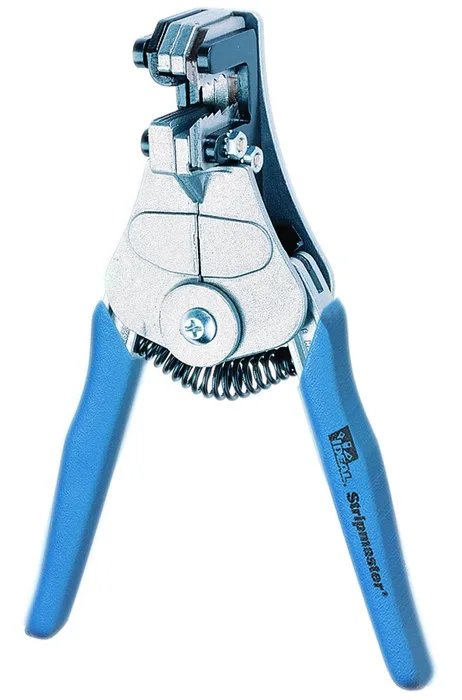
- IDEAL Electrical Stripmaster Wire Stripper 45-092, 10-22 AWG - Buy. The one tool here whose maker publishes a hole diameter and a tolerance for every gauge it claims.
- Klein Tools 11055 Wire Stripper and Cutter, Solid and Stranded Copper - Buy. A plain fixed hole stripper that puts the solid and stranded scales in separate columns on the tool face, where you can see them.
- Knipex 12 52 195 PreciStrip16 Automatic Wire Stripper, 28-6 AWG - It depends. A blade type automatic stripper with a fine adjustment dial and a wide range, from a maker that tells you in writing what it will not strip.
- IRWIN VISE-GRIP 2078300 Self-Adjusting Wire Stripper, 8 inch - Skip. IRWIN's own page says a knob micro-adjusts it for gauges smaller than 20 AWG, which is where you wanted the self-adjusting part to work.
The verdict in 30 seconds
What mattered most
- Stripping mechanism
- Wire range the maker states
- Reach into fine gauge
- What the maker says about insulation type
- Published dimensional tolerance
- Blade replacement path
A wire stripper has one job, and the failure mode is invisible. If the blade scores a strand, the joint still looks fine, still tests fine, and then breaks weeks later when someone tugs the harness or the panel warms up. On solid conductor a nick is worse, because it takes metal out of a cross section that was sized for a current. So the useful question is not which tool feels nicest in the hand, it is which maker will tell you what the tool is cut for and what it is not cut for. Three of the four here answer that in writing.
The one tool here whose maker publishes a hole diameter and a tolerance for every gauge it claims.
Best for: Anyone who strips the same handful of gauges over and over and wants the result to be identical every time.
- IDEAL lists the stripping hole diameter for each gauge, from .144 inch at 10 AWG to .048 inch at 20 and 22 AWG, with a stated tolerance of plus .001 inch.
- Replacement blade pairs and a replacement frame are sold by catalog number, so a worn tool is a parts order rather than a new tool.
- A gripper holds the wire on the centerline of the stripping hole and the jaws hold open afterwards, so the stripped end is not dragged back across a blade.
- One blade set covers one range, so 10 to 22 AWG is what you get until you buy different blades.
- IDEAL's own product listing gives a limited 90 day warranty, which is short for a tool at this level.
- Bulky and lever operated, so it is a bench and panel tool rather than something that lives in a pouch.
- IDEAL lists it as not insulated, so it is not a tool for energized work.
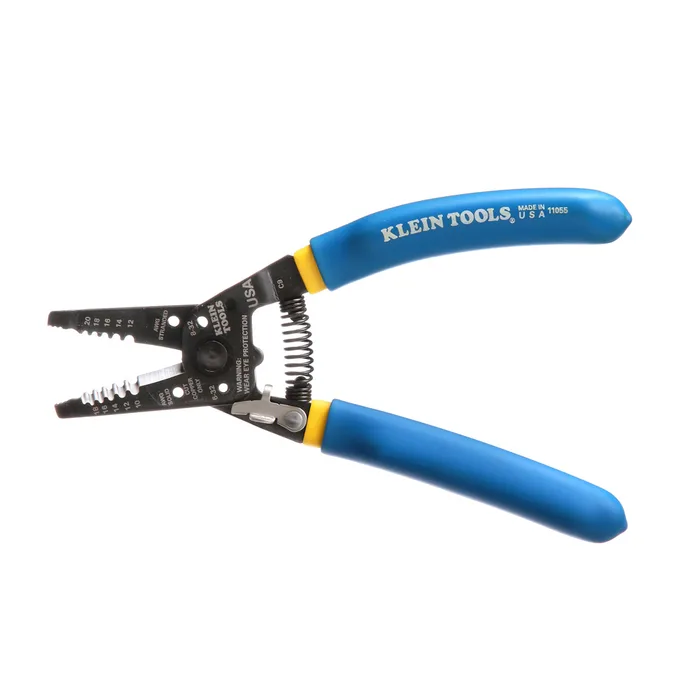
A plain fixed hole stripper that puts the solid and stranded scales in separate columns on the tool face, where you can see them.
Best for: Residential and light commercial work where the gauges are known and the tool needs to be cheap enough to replace.
- Klein states 10-18 AWG solid and 12-20 AWG stranded, with the two scales marked in separate columns on the tool.
- Precision ground stripping holes, shear type cutting blades and a serrated nose for bending and looping, so one tool covers most of a rough in.
- Light at 5.4 oz and 7.4 inches long, with a coil spring and a closure lock, so it actually lives in a pouch.
- Klein publishes no hole diameter and no tolerance, only the description precision ground.
- Nothing on the tool is replaceable, so a dull hole means a new stripper.
- Stops at 20 AWG stranded, which rules out most electronics and a lot of low voltage work.
- Klein states it is NOT insulated and that the plastic dipped handles are not intended for protection against electrical shock.
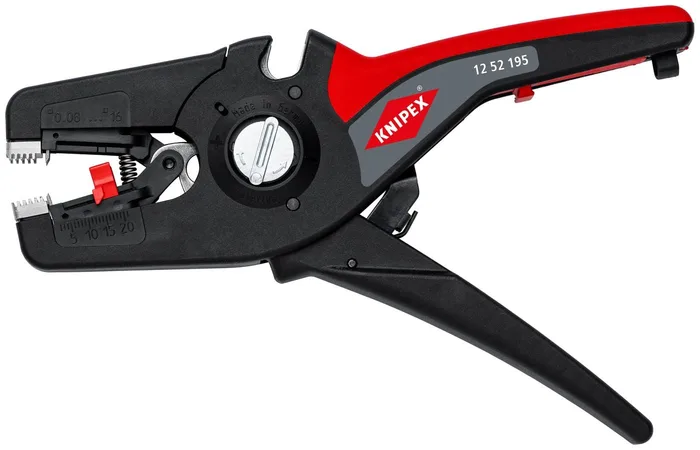
A blade type automatic stripper with a fine adjustment dial and a wide range, from a maker that tells you in writing what it will not strip.
Best for: Control panel, automotive, low voltage and bench work with mixed fine and heavy conductors, where THHN is not the daily material.
- Knipex states a range of 28 to 6 AWG (0.08 to 16 mm2) and says it strips very fine flexible wire as well as solid conductor.
- A fine adjustment dial lets you set the blade to what Knipex calls special material requirements, plus there is an adjustable length stop for repeat work.
- The blade cassette is described as easy to replace and Knipex publishes the spare part number, 12 49 31.
- Knipex states plainly that it does not strip THHN wire, which is a common branch circuit insulation in US building work.
- It is a blade tool, so the fine adjustment is something you have to get right rather than something the tool does for you.
- Knipex lists it as not 1000 volt insulated and warns against use on live circuits.
- The premium outlay is hard to justify if most of your day is 12 and 14 AWG building wire.
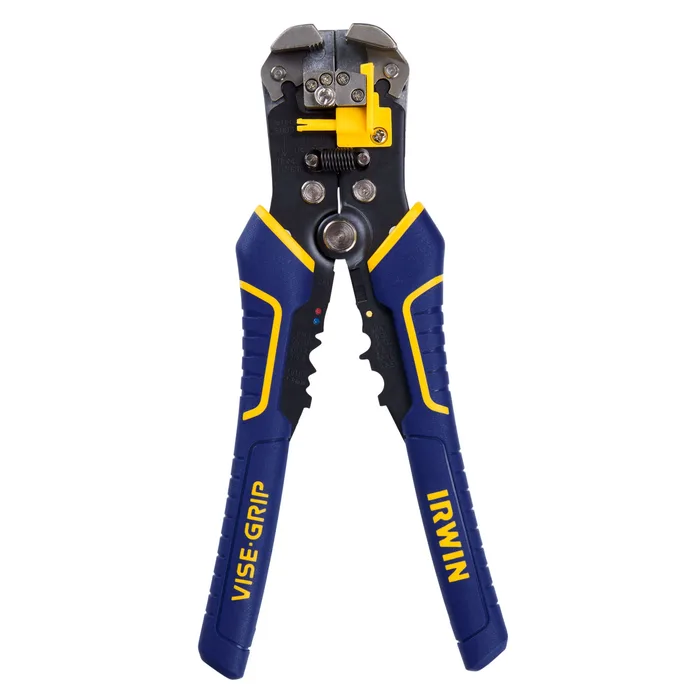
IRWIN's own page says a knob micro-adjusts it for gauges smaller than 20 AWG, which is where you wanted the self-adjusting part to work.
Best for: Occasional household or automotive work at 20 AWG and up where a single cheap tool beats owning three, and precision is not the point.
- IRWIN states a self-adjusting range of 10-24 AWG plus an adjustable stopper that controls the length of the core strip.
- The crimper is listed for insulated and non-insulated terminals and 7 to 9 mm ignition terminals, so one tool covers a lot of a glovebox job.
- IRWIN lists a lifetime limited warranty, which is longer than what the makers of two of the other tools here publish.
- IRWIN's own feature list says a swivel knob micro-adjusts for gauges smaller than 20 AWG, so below 20 AWG it is a manually adjusted tool wearing a self-adjusting label.
- IRWIN names no insulation type anywhere in the listing, so the AWG marks carry no stated assumption about what the insulation is.
- The crimp function shares the plier jaw with the strip and cut functions, and IRWIN publishes no ratchet, no cycle completion and no crimp height.
- IRWIN's overview paragraph and its feature bullet disagree about the insulated crimp range, one saying 22 AWG and the other 10-22 AWG, which is a poor sign on a spec you might rely on.
| Criteria | Stripmaster Wire Stripper 45-092, 10-22 AWG Top pick | 11055 Wire Stripper and Cutter, Solid and Stranded Copper | 12 52 195 PreciStrip16 Automatic Wire Stripper, 28-6 AWG | VISE-GRIP 2078300 Self-Adjusting Wire Stripper, 8 inch |
|---|---|---|---|---|
| Verdict | Buy it | Buy it | It depends | Skip it |
| Best for | Anyone who strips the same handful of gauges over and over and wants the result to be identical every time. | Residential and light commercial work where the gauges are known and the tool needs to be cheap enough to replace. | Control panel, automotive, low voltage and bench work with mixed fine and heavy conductors, where THHN is not the daily material. | Occasional household or automotive work at 20 AWG and up where a single cheap tool beats owning three, and precision is not the point. |
| Price tier | $$ · mid-range | $ · budget | $$$ · premium | $ · budget |
| Stripping mechanism | Lever action, fixed knife blades cut per gauge | Manual fixed stripping holes | Automatic parabolic blade with fine adjustment dial | Self adjusting jaws with a tension knob |
| Wire range the maker states | 10-22 AWG | 10-18 AWG solid, 12-20 AWG stranded | 28-6 AWG (0.08 to 16 mm2) | 10-24 AWG |
| Reach into fine gauge | Stops at 22 AWG; IDEAL sells 45-097 for 16-26 and 45-098 for 20-30 | Stops at 20 AWG stranded | Down to 28 AWG, and Knipex names fine stranded wire | Stops at 24 AWG, with a knob adjustment below 20 AWG |
| What the maker says about insulation type | Not named for this model; separate blade sets are sold for solid and for stranded | Not named; solid and stranded scales only | States it does not strip THHN wire | Not named anywhere in the listing |
| Published dimensional tolerance | Yes, hole diameter per gauge plus .001 inch | None published; described as precision ground | None published; blade set by dial | None published |
| Blade replacement path | Replacement blade pairs and a replacement frame by catalog number | None; replace the tool | Replacement blade cassette, part 12 49 31 | None published |
| Crimper built in | No | No | No | Yes, insulated and non-insulated terminals plus 7-9 mm ignition |
| Warranty stated on the product page | Limited 90 day | Not stated on the product page | Not stated on the product page | Lifetime limited |
Which one is right for you?
- Anyone who strips the same handful of gauges over and over and wants the result to be identical every time. Buy it IDEAL Electrical Stripmaster Wire Stripper 45-092, 10-22 AWG
- Residential and light commercial work where the gauges are known and the tool needs to be cheap enough to replace. Buy it Klein Tools 11055 Wire Stripper and Cutter, Solid and Stranded Copper
- Control panel, automotive, low voltage and bench work with mixed fine and heavy conductors, where THHN is not the daily material. It depends Knipex 12 52 195 PreciStrip16 Automatic Wire Stripper, 28-6 AWG
- Occasional household or automotive work at 20 AWG and up where a single cheap tool beats owning three, and precision is not the point. Skip it IRWIN VISE-GRIP 2078300 Self-Adjusting Wire Stripper, 8 inch
How we judged the field
Five things separate a good wire stripper from a bad one. First, whether the tool clears the insulation without touching the conductor, because a scored strand is a crack waiting to happen and a scored solid conductor is a permanent reduction in cross section. Second, whether the maker publishes a dimension rather than an adjective, since precision ground is a claim and .072 inch plus .001 is a specification. Third, whether the gauge markings come with a stated assumption about the insulation they were cut for, because 14 AWG under thin PVC and 14 AWG under a nylon jacketed building wire are different jobs for the same blade. Fourth, whether the blade can be replaced, since every stripping tool goes dull and the ones that go dull quietly are the dangerous ones. Fifth, whether the tool reaches the gauges you actually work in, which for a lot of people now means below 22 AWG.
The field splits three ways, and we took one of each plus the combination tool that most people end up buying by accident. Fixed hole tools cut a hole to a diameter and let you choose it, which is the most repeatable approach when you know the gauge, and the Klein 11055 is the plain version of that. Automatic fixed die tools do the same thing with a lever and a gripper so the wire is held on the centerline, which is the IDEAL Stripmaster. Blade type tools press a shaped blade into the insulation and pull, which covers a much wider range and is what the Knipex PreciStrip16 does. The fourth, the IRWIN self-adjusting plier with a crimper in the jaw, is here because it is genuinely common and because its own published feature list contains the sentence that explains the whole category.
IDEAL Electrical Stripmaster Wire Stripper 45-092, 10-22 AWG
Buy itThe Stripmaster is the tool here that shows its work. IDEAL publishes a stripping hole diameter for every gauge in every blade set it sells, and states a tolerance of plus one thousandth of an inch. For the 45-092 blade pair that runs from .144 inch at 10 AWG through .090 at 14 and .072 at 16, down to .048 inch at both 20 and 22 AWG. A gripper holds the wire on the centerline of the hole while the blades close, and IDEAL says the jaws are automatically held open afterwards so you can pull the wire out without dragging the stripped end back over an edge. One squeeze takes up to seven eighths of an inch. The trade-offs are real and IDEAL does not hide them. This blade pair covers 10 to 22 AWG and nothing outside it, so a different range means the L-4994 or L-5361 blades or a different tool entirely. The listed warranty is a limited 90 days, which is short. It is also bulky, lever operated and not insulated. For anyone stripping the same few gauges all day, the repeatability is worth all of that.
Klein Tools 11055 Wire Stripper and Cutter, Solid and Stranded Copper
Buy itThe 11055 is the version of this tool that most electricians own, and the reason is that it does the obvious thing well. Klein states 10-18 AWG solid and 12-20 AWG stranded, and puts those two scales in separate labelled columns on the tool face, so you are choosing a hole rather than guessing at one. The holes are precision ground, the cutting edges are shear type, the nose is serrated for bending and looping, and it shears 6-32 and 8-32 screws. At 5.4 ounces and 7.4 inches with a coil spring and a closure lock, it goes in a pouch and stays there. What you give up is information and longevity. Klein publishes no hole diameter and no tolerance, so precision ground is the whole story. Nothing is replaceable, so a rounded hole means a new tool, though at this outlay that is a reasonable plan. It stops at 20 AWG stranded, and Klein states it is not insulated and that the dipped handles are not intended for shock protection. For known gauges in residential work, it is enough.
Knipex 12 52 195 PreciStrip16 Automatic Wire Stripper, 28-6 AWG
It dependsThe PreciStrip16 is the widest range tool here and the most honest listing. Knipex states 28 to 6 AWG, or 0.08 to 16 mm2, and says the tool strips very fine flexible wire as well as solid conductor. Semi-circular grooved jaws hold the wire while a parabolic blade takes the insulation off, a fine adjustment dial sets the blade for what Knipex calls special material requirements, and an adjustable length stop makes repeat work repeatable. The blade cassette is meant to be replaced and Knipex gives the part number, 12 49 31. Then there is the sentence that decides who should buy it: Knipex says it does not strip THHN wire. Its sister tool, the 12 42 195 MultiStrip 10, is even blunter, describing its range as conductors with standard PVC insulation and adding NOT FOR THHN CABLE in capitals. That is a maker telling you the truth about insulation type, and it is the reason this is a specialist pick rather than the general one. For panel builders, vehicle work and low voltage, it is superb.
IRWIN VISE-GRIP 2078300 Self-Adjusting Wire Stripper, 8 inch
Skip itThe 2078300 is the tool that made this comparison worth writing, because IRWIN documents its own limitation. The listing says the self-adjusting head strips 10-24 AWG, then adds that a swivel knob micro-adjusts for gauges smaller than 20 AWG. Read that again: below 20 AWG you are setting it by hand, which is exactly where thin insulation and thin strands punish a tool that is a little bit wrong. Klein’s own self-adjusting 11061 says something similar about a tensioning thumb wheel, so this is a property of the mechanism rather than a knock on IRWIN. The crimper compounds it. IRWIN lists insulated terminals, non-insulated terminals and 7 to 9 mm ignition terminals in a plier jaw, with no ratchet, no full cycle and no crimp height published, and its own overview paragraph and feature bullet disagree about the insulated crimp range. No insulation type is named anywhere. As one cheap tool for occasional work at 20 AWG and up it is fine. As the stripper you rely on, buy a stripper.
Sources
Specs in this review come from these pages.
- IDEAL Electrical - Stripmaster 10-22 AWG (45-092) (idealelectricalinc.com)
- IDEAL Electrical - Stripmaster and Stripmaster Lite specification sheet (hole diameters, tolerances, blade catalog numbers) (p1.aprimocdn.net)
- Klein Tools - 11055 Solid and Stranded Copper Wire Stripper and Cutter (kleintools.com)
- KNIPEX - 12 52 195 PreciStrip16 Automatic Wire Stripper 28-6 AWG (knipex-tools.com)
- KNIPEX - 12 42 195 MultiStrip 10 Automatic Stripper 32-8 AWG (knipex-tools.com)
- IRWIN - 2078300 Self-Adjusting Wire Stripper (irwintools.com)
IDEAL Electrical Stripmaster Wire Stripper 45-092, 10-22 AWG vs Klein Tools 11055 Wire Stripper and Cutter, Solid and Stranded Copper: which should you buy?
The Stripmaster and the Klein 11055 both work the same way, by putting the conductor through a hole cut to a diameter, and they differ in how much they tell you and how long they stay right. IDEAL gives you the diameter, the tolerance, a replacement blade pair and even a replacement frame catalog number, which means the tool has a defined maintenance path and you can tell when it has drifted. Klein gives you a well made tool, two clearly separated scales for solid and stranded, and no numbers at all. When the Klein goes dull you find out by feel, and the fix is a new one.
Choose on volume and on where your gauges sit. If you are stripping the same two or three sizes for hours, at a bench or in a panel, the Stripmaster pays for itself in consistency and in not having to think, and the lever action saves your hand. If you are moving around a house with a pouch, cutting, looping and shearing screws as well as stripping, the Klein is the better tool for the day even though it tells you less, and it is cheap enough that replacing it annually is a rounding error. Neither is insulated, so neither is a tool for energized work. If a lot of your wire is below 20 AWG, neither of these is your answer and you should be looking at the Knipex or at a different IDEAL blade set.
What to look for
- A published dimension, not an adjective: precision ground tells you nothing, while a table of stripping hole diameters per gauge with a stated tolerance tells you the maker measured something.
- A named insulation type: Knipex states that two of its automatic strippers do not strip THHN, and a listing that says nothing at all about insulation is giving you an AWG number without the assumption behind it.
- Separate solid and stranded markings: the same gauge is a different conductor diameter in solid and in stranded, and IDEAL sells different blade sets for the two at identical gauges for exactly that reason.
- A blade replacement path: a stripper that can be rebladed by catalog number stays accurate, and one that cannot is a consumable whether or not the maker says so.
- Honest fine gauge reach: if you work below 22 AWG, look for a tool or blade set specified for that range rather than a general purpose stripper with a knob you are supposed to fiddle with.
- A length stop if you repeat a strip: an adjustable stop turns a judgement call into a mechanical one, which matters more than it sounds when you are making the same termination fifty times.
Our final take
Buy the tool whose maker will commit to a number. That is the whole test here, and it sorts these four cleanly: IDEAL publishes hole diameters, a tolerance and replacement part numbers, Knipex publishes what its tool will not strip, Klein publishes the ranges but nothing dimensional, and IRWIN publishes a feature that quietly concedes the mechanism needs your help below 20 AWG. Get the Stripmaster if you strip the same gauges repeatedly and want the result identical every time. Get the Klein 11055 if you want a competent fixed hole stripper that lives in a pouch. Get the PreciStrip16 if your work is fine, mixed and not THHN. And if you own the IRWIN, keep it for the glovebox and buy a real stripper for the panel.
Questions, answered
What actually goes wrong when a stripper nicks the conductor?
A nick is a stress riser. The copper is fine until something flexes it, and then the crack starts at the scratch and works inward, which is why a nicked joint often fails weeks after it was made rather than on the day. On solid conductor there is a second problem, because the conductor was sized for a current and you have just removed some of its cross section at one point. Stranded wire hides it better, since a few broken strands still conduct, but you have lost some of the bundle and the remaining strands carry more. The published defence against this is dimensional: IDEAL lists a stripping hole diameter for every gauge in its blade tables with a stated tolerance of plus .001 inch, so the hole is cut slightly larger than the conductor rather than to it. Klein describes its holes as precision ground but publishes no number.
Self-adjusting or fixed holes, which should I buy?
Fixed holes win when you know the gauge and the insulation is what the tool expects, because a hole cut to a diameter cannot wander. That is why the two picks here are both fixed geometry. Self-adjusting tools earn their place on mixed work, where you are moving between gauges constantly and stopping to find the right hole costs more time than it saves. What is not true is that self-adjusting means adjustment free at every size. IRWIN's own listing for the 2078300 says a swivel knob micro-adjusts for gauges smaller than 20 AWG, and Klein's listing for its self-adjusting 11061 says a tensioning thumb wheel allows for precise stripping of smaller gauge wire. Two makers, the same admission, in their own words. So a self-adjusting tool moves the problem rather than removing it, and it moves it to exactly the gauges where wire is easiest to ruin.
The hole says 14 AWG, so why did it mangle my THHN?
Because the marking describes the conductor, and the tool has to get through the insulation around it. Insulation thickness and toughness vary by type, and a blade geometry tuned for thin flexible PVC will not behave the same on a thicker nylon jacketed building wire. Knipex is unusually direct about this. Its PreciStrip16 page says the tool does not strip THHN wire, and its MultiStrip 10 page says the automatic adjustment works on conductors with standard PVC insulation and then adds, in capitals, NOT FOR THHN CABLE. So the trap in your question is real and at least one major maker documents it. Check for that kind of statement before you buy, and if a listing says nothing at all about insulation type, treat the AWG marking as a starting point rather than a guarantee.
Can any of these handle 26 to 30 AWG?
Only one of the four gets close. Knipex states 28 AWG at the fine end of the PreciStrip16 and says it strips very fine flexible wire. The Klein 11055 stops at 20 AWG stranded and the IRWIN 2078300 at 24 AWG, and the Stripmaster 45-092 blade set stops at 22 AWG. If fine gauge is your real work, IDEAL's blade tables show it sells the same tool with different blades: 45-097 covers 16 to 26 AWG and 45-098 covers 20 to 30 AWG, each with its own replacement blade catalog number. Knipex also lists a 12 80 040 SB mini stripper at 36 to 26 AWG. The point is that fine gauge is a different tool or a different blade set, not a setting on a general purpose stripper.
Do combination tools with a crimper built in do either job well?
Not really, and the published specs show why rather than needing an accusation. On the IRWIN 2078300 the crimp dies sit in the same plier jaw as the strip and cut functions, and IRWIN publishes no ratchet, no full cycle mechanism and no crimp height, only the terminal types the jaw accepts. A plier crimp closes as hard as your hand closes it, which is why terminal makers specify ratcheting tools with a defined cycle. The stripping half is compromised too, because the jaw geometry has to leave room for everything else. A combination tool is a genuinely good answer to one question, which is how to carry one thing instead of three for occasional work. It is a bad answer to the question of how to make a connection that will still be good in five years.
Should I just buy a combination stripper and crimper?
It is the obvious economy and it is where both jobs go wrong. A combination tool gives you one jaw geometry to cover insulated terminals, non-insulated terminals and sometimes ferrules, and those want different die profiles, so the crimp can look finished and not be. The stripping side is usually the better half of the bargain. If you crimp more than occasionally, our [crimping tool comparison](/best-crimping-tools/) explains what the die actually has to do and why the ratchet is not the guarantee people assume.
Deciding between the top two? See our head-to-head: IDEAL Electrical Stripmaster Wire Stripper 45-092, 10-22 AWG vs Klein Tools 11055 Wire Stripper and Cutter, Solid and Stranded Copper.
More Tools & DIY reviews
 The Best Wood Chisel Sets: 4 Compared for Fine Joinery
  The Best Wood Routers: 4 Compared (and One to Skip)
  The Best Work Gloves: 4 Compared (and One to Skip)
  The Best Work Lights: 4 Compared (and One to Skip)
  The Best Adjustable Wrenches: 4 Compared (and One to Skip)
  The Best Air Compressors: 4 Compared (and One to Skip)