

Tools & DIY
The Best Work Lights: 4 Compared (and One to Skip)
We compared four cordless work lights on published lumens, runtime and ingress protection, and only one of the four states how long it runs at each brightness.
The short version
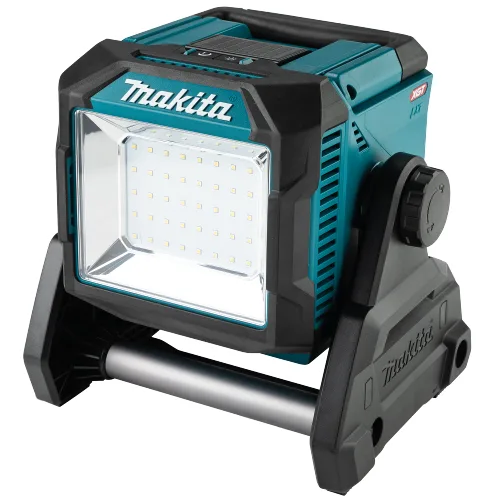
Makita's ML005G is the pick and the only light here that publishes runtime at each brightness: 3,600 lumens for 3.5 hours, 1,800 for 7.5, or 900 for 15, with an AC adapter included so it works corded too. DeWalt's DCL043 is the value buy but it is a different kind of light, a 1,500 lumen handheld spotlight with four LEDs and a pivoting head, built to throw a beam a long way rather than to fill a room. The DCL074 is the depends pick: 5,000 lumens and an IP54 rating make it the one to light a whole area, but at 10.38 lbs it is site equipment rather than something you carry. Skip the Craftsman CMCL020B. At 140 lumens it is roughly a tenth of the DeWalt handheld and about the output of a decent headlamp, sold as a work light. Best for: anyone who needs to decide between lighting an area and reaching into one.
Our picks at a glance
- Makita ML005G 40V max XGT LED Work Light - Buy. The only light here that tells you how long each brightness setting lasts, and it runs on AC as well as battery.
- DeWalt DCL043 20V MAX LED Pivoting Work Light - Buy. A 1,500 lumen handheld spotlight with a pivoting head at 1.75 lbs, built to throw a beam rather than fill a room.
- DeWalt DCL074 Tool Connect 20V MAX All-Purpose Cordless Work Light - It depends. The brightest light here by a wide margin, with an IP54 rating, in a 10.38 lb package.
- Craftsman CMCL020B V20 Cordless Work Light - Skip. 140 lumens, which is headlamp territory being sold as a work light.
The verdict in 30 seconds
What mattered most
- Published output
- Published runtime
- Ingress protection
- Weight
- Mains power option
- Battery platform
A work light is bought on one number, and lumens is the wrong number to buy on alone. Total output says nothing about how long the light stays on, or whether the beam floods an area or throws a spot at it, and those two lights are not substitutes. Across four current cordless lights the published output ranges from 140 lumens to 5,000, and only one manufacturer pairs each brightness setting with a runtime. We lined up what each one actually states.
The only light here that tells you how long each brightness setting lasts, and it runs on AC as well as battery.
Best for: Lighting a work area for a full day, where knowing you get 7.5 hours at 1,800 lumens is worth more than a higher peak number.
- 3,600 / 1,800 / 900 lumens paired with 3.5 / 7.5 / 15 hour runtimes, a runtime for every setting.
- AC adapter included, so it works plugged in when the job outlasts the battery.
- Works with both 40V max XGT and 18V LXT packs.
- Adapts to a tripod and folds from 16-5/8 in. tall to 11-5/8 in. for transport.
- 12.5 lbs with a battery, second heaviest here and not a tool you hold.
- The 15 hour figure is for the low setting on a 4.0Ah XGT battery, which is sold separately.
- Peak output is 1,400 lumens below the DeWalt DCL074.
- 40V max XGT is Makita's newer battery platform.
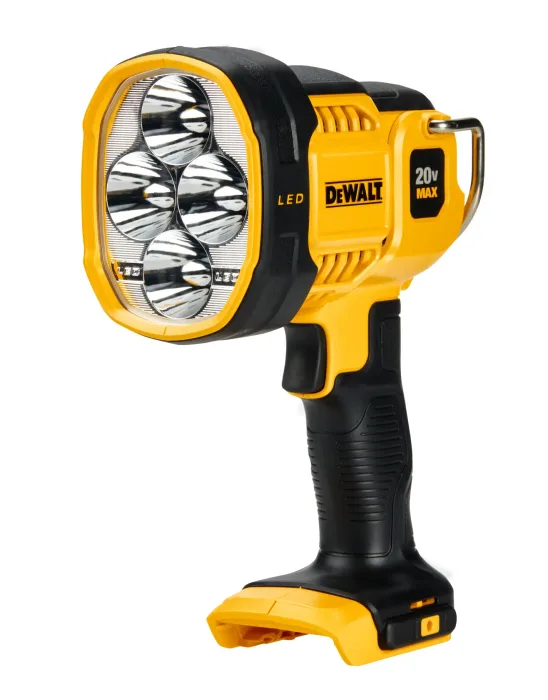
A 1,500 lumen handheld spotlight with a pivoting head at 1.75 lbs, built to throw a beam rather than fill a room.
Best for: Seeing a long way into a crawl space, a roof void, a duct or a dark yard, where reaching the far end matters more than lighting everything between.
- 1,500 lumens on high and 500 on low, giving a genuine choice between output and runtime.
- 1.75 lbs, light enough to hold and aim for long stretches.
- 90 degree pivoting head aims the beam without moving your hand.
- Four LEDs with a throw DeWalt quotes at 508 yards.
- DeWalt publishes no runtime for either brightness setting.
- No ingress protection rating stated, unlike the larger DCL074.
- A focused beam is the wrong tool for lighting a work area evenly, where it produces a hot spot and dark edges.
- Bare tool, with battery and charger sold separately.
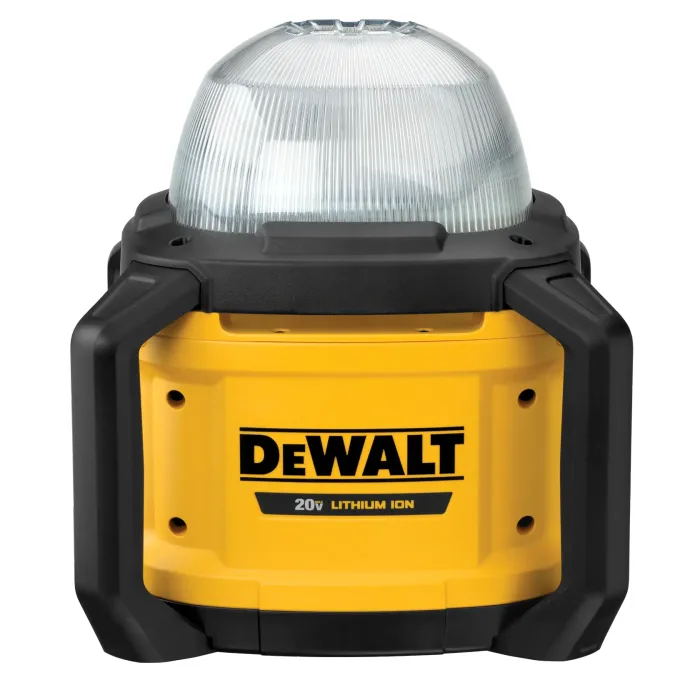
The brightest light here by a wide margin, with an IP54 rating, in a 10.38 lb package.
Best for: Lighting a whole room or an exterior work area, where output matters more than portability and there is a spare battery nearby.
- 5,000 lumens, the highest published output in this comparison by 1,400 lumens.
- IP54 rating for weather and dust resistance.
- Freestanding or hangs from a hook, so it can light a ceiling cavity or a whole room.
- Impact-resistant housing, with a 3 year limited warranty and 1 year free service.
- 10.38 lbs, which puts it in the category of equipment you carry to a site rather than around it.
- DeWalt's only runtime figure is up to 11 hours, tied to a 6.0Ah pack on the low setting, with no figure at full output.
- The page mentions a low setting but does not list the lumens at each level.
- Bare tool, and running 5,000 lumens off a 20V MAX pack is a heavy draw on the battery.
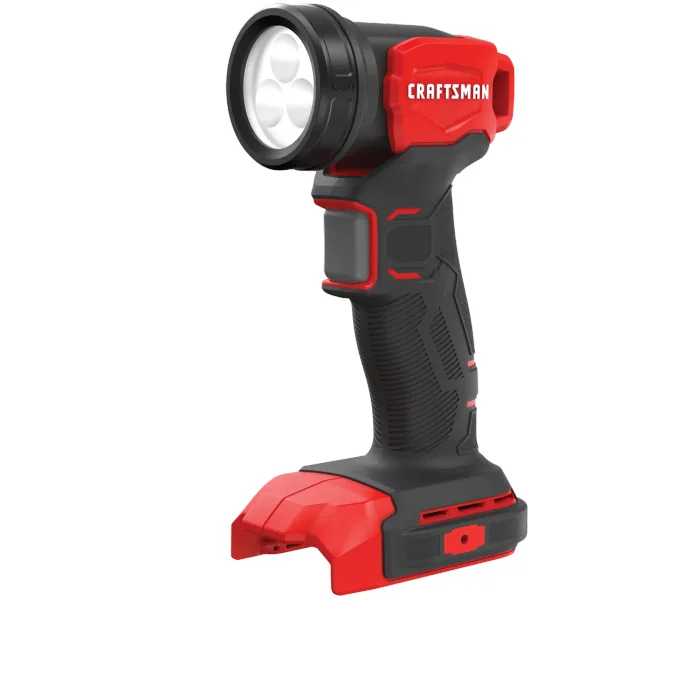
140 lumens, which is headlamp territory being sold as a work light.
Best for: Finding something you dropped behind a washing machine. For actual work, a light this dim means you are still guessing at what you are looking at.
- 0.77 lb, by far the lightest thing here and easy to carry in a pocket of a bag.
- Pivoting head and a contoured over-molded handle.
- Runs on the Craftsman V20 platform.
- 140 lumens, roughly a tenth of the DeWalt DCL043 and about a thirty-fifth of the DCL074.
- No runtime published, so the one advantage a low-output light should have is not stated.
- No ingress protection rating.
- Three LEDs at that output means it lights the thing directly in front of it and little else.
| Criteria | ML005G 40V max XGT LED Work Light Top pick Buy it Buy | DCL043 20V MAX LED Pivoting Work Light Buy it Buy | DCL074 Tool Connect 20V MAX All-Purpose Cordless Work Light It depends Buy | CMCL020B V20 Cordless Work Light Skip it Buy |
|---|---|---|---|---|
| Best for | Lighting a work area for a full day, where knowing you get 7.5 hours at 1,800 lumens is worth more than a higher peak number. | Seeing a long way into a crawl space, a roof void, a duct or a dark yard, where reaching the far end matters more than lighting everything between. | Lighting a whole room or an exterior work area, where output matters more than portability and there is a spare battery nearby. | Finding something you dropped behind a washing machine. For actual work, a light this dim means you are still guessing at what you are looking at. |
| Price tier | $$$ · premium | $$ · mid-range | $$$ · premium | $ · budget |
| Published output | 3,600 / 1,800 / 900 lm | 1,500 / 500 lm | 5,000 lm | 140 lm |
| Published runtime | 3.5 / 7.5 / 15 hrs | Not published | Up to 11 hrs, 6.0Ah pack on low | Not published |
| Ingress protection | IP65 | Not published | IP54 | Not published |
| Weight | 12.5 lbs with battery | 1.75 lbs | 10.38 lbs | 0.77 lb |
| Mains power option | AC adapter included | No | No | No |
| Battery platform | 40V max XGT and 18V LXT | 20V MAX | 20V MAX | V20 |
| Beam type | Area flood panel | Spot, four LEDs | Area flood | Small task light |
| Brightness levels | 3 | 2 | Low setting mentioned | Not published |
Which one is right for you?
- Lighting a work area for a full day, where knowing you get 7.5 hours at 1,800 lumens is worth more than a higher peak number. Buy it Makita ML005G 40V max XGT LED Work Light
- Seeing a long way into a crawl space, a roof void, a duct or a dark yard, where reaching the far end matters more than lighting everything between. Buy it DeWalt DCL043 20V MAX LED Pivoting Work Light
- Lighting a whole room or an exterior work area, where output matters more than portability and there is a spare battery nearby. It depends DeWalt DCL074 Tool Connect 20V MAX All-Purpose Cordless Work Light
- Finding something you dropped behind a washing machine. For actual work, a light this dim means you are still guessing at what you are looking at. Skip it Craftsman CMCL020B V20 Cordless Work Light
How we judged the field
Five things decide a work light. Output in lumens comes first, but only as a starting point, because it describes how much light leaves the fixture and nothing about where it goes. Runtime at each output level comes second and matters more than most buyers expect, since a bright light that dies in ninety minutes is a worse tool than a dimmer one that lasts a shift. Third is beam type, because a light that throws a focused spot and a light that floods an area are different tools and almost nobody publishes a beam angle to tell them apart. Fourth is ingress protection, because a light with no rating gives you no assurance about the rain it will eventually sit in. Fifth is whether it can also run on mains, which turns a battery tool into a fixture.
The field splits cleanly by weight. Under about 2 lbs are handheld lights meant to be moved constantly and aimed by hand, and they usually sit between 500 and 1,500 lumens. Above about 8 lbs are area lights meant to be placed once and left, running 3,000 lumens and up. There is very little in between, because the middle would be too heavy to hold and too dim to light a room. We took one light from each end on the two biggest professional platforms, added DeWalt’s high-output area light to show what 5,000 lumens costs in weight, and included the Craftsman because it is what a low price buys.
Makita ML005G 40V max XGT LED Work Light
Buy itThe ML005G is the only light here that behaves like a specified product rather than a headline. Makita publishes three brightness levels and pairs each one with a runtime: 3,600 lumens for 3.5 hours, 1,800 for 7.5, 900 for 15. That single table is the most useful spec in this comparison, because it lets you work backwards from how long you need light to how bright you can afford to run. The AC adapter in the box is the second reason to buy it, turning the light into a mains fixture when the job runs long. It also works with both 40V max XGT and 18V LXT packs. The main cost is weight. At 12.5 lbs with a battery it is a thing you carry to the work and set down, though Makita lists it as IP65 for dust and water resistance. Buy it if you need light for a day rather than for ten minutes.
DeWalt DCL043 20V MAX LED Pivoting Work Light
Buy itThe DCL043 is the light people reach for and the one most often bought for the wrong job. It is a handheld spotlight: a 90 degree pivoting head, and four LEDs that throw a focused beam DeWalt quotes as visible at 508 yards. Aimed down a crawl space or into a roof void it shows you the far end, which no flood panel in this comparison will do. At 1.75 lbs it is light enough to hold for a long time and to aim precisely with one hand, and 1,500 lumens on high with 500 on low is a real choice between brightness and battery. What it is not is an area light. Point it at a bench and you get a bright circle with dark edges, which is worse for close work than a dimmer flood would be. DeWalt also publishes no runtime for either setting and no ingress rating. Buy it to reach into somewhere, not to light somewhere.
DeWalt DCL074 Tool Connect 20V MAX All-Purpose Cordless Work Light
It dependsThe DCL074 is the one to think about, because 5,000 lumens is a genuinely different capability and it comes attached to 10.38 lbs. This is the light that fills a garage bay or an unfinished room rather than illuminating what is directly in front of you, and it carries an IP54 rating, meaning dust-protected and safe from splashing water. It stands on its own or hangs from a hook, and DeWalt backs it with a 3 year limited warranty and a year of free service. What the page does not say is how long it runs at full output: its one runtime figure, up to 11 hours, is tied to a 6.0Ah pack on the low setting. Five thousand lumens from a 20V MAX pack is a large continuous draw, so treat that figure as the low-setting best case. Take it if you need to light a space and you have spare batteries.
Craftsman CMCL020B V20 Cordless Work Light
Skip itThe CMCL020B is the one to skip, and the number does the arguing. One hundred and forty lumens is about what a decent headlamp produces, roughly a tenth of the DeWalt handheld and about a thirty-fifth of the DeWalt area light. At that output the light shows you the thing directly in front of it and leaves everything around it dark, which is exactly the condition that makes work slow and mistakes likely. It is genuinely tiny at 0.77 lb and the head pivots, and if you want something to find a dropped socket behind an appliance it will do that. But no runtime is published either, which removes the one argument a low-output light should be able to make, and there is no ingress rating. Craftsman’s own page leads with increased brightness with 140 LED lumen output, which is a strange sentence once you have seen what the rest of the category produces.
Sources
Specs in this review come from these pages.
Makita ML005G 40V max XGT LED Work Light vs DeWalt DCL043 20V MAX LED Pivoting Work Light: which should you buy?
The Makita ML005G and the DeWalt DCL043 are not competing, and treating them as competitors is the main mistake in this category. The Makita is a flood panel: 3,600 lumens at its top setting, published runtimes at all three levels, an included AC adapter, and a body that stands on the floor or a tripod at 12.5 lbs. It fills a space with even light for hours and you plan around its numbers.
The DeWalt is a spotlight. Four LEDs, 1.75 lbs and a pivoting head, throwing a beam DeWalt quotes as visible at 508 yards. It shows you the end of a crawl space or the far corner of an attic, and it produces a hot spot with dark edges if you try to light a bench with it. Most people working on a house end up wanting both, and if you can only have one the question is which failure you would rather have: a room you can see all of, or a dark corner you can reach into. For general work the flood is the safer buy, which is why the Makita is the pick.
What to look for
- Runtime published alongside lumens: one of these four gives both, and a lumen figure with no hours attached tells you only half of what you need.
- More than one brightness level: the ability to drop output is what turns a two-hour light into an all-day one.
- An IP rating: IEC 60529 ingress figures are the published evidence a light has been tested against dust and water, and only two of these four list one.
- Weight, read as a category: under about 2 lbs is a light you hold, over about 8 lbs is a light you place, and the two are not substitutes.
- Whether it floods or throws: a wide panel spreads light across an area, a focused spotlight throws a beam at a distant point, and the two are not interchangeable.
- A mains option: an included AC adapter means the light keeps working after the batteries do, which matters most on the biggest lights.
Our final take
Lumens is the number every work light is sold on and the number that decides the least on its own. The Makita ML005G is the pick because it is the only light here that pairs output with runtime, and that pairing is the whole specification: 3,600 lumens for 3.5 hours, or 900 for 15, and you choose. The DeWalt DCL043 is excellent and it is a spotlight, so buy it to reach into a crawl space rather than to light a workbench. The DCL074 is real area lighting at real weight and with an IP54 rating, though its runtime figure only covers the low setting. The Craftsman is 140 lumens, and no amount of pivoting head changes what that means.
Questions, answered
Why is runtime more important than lumens?
Because lumens without runtime is half a specification. A light rated at 5,000 lumens on a 20V pack will run for a fraction of the time the same pack gives a 1,500 lumen light, and DeWalt's DCL043 page states no time at all while the DCL074 page gives a single up to 11 hours figure. The Makita is the only light in this group that publishes both together, and the shape of its numbers is instructive: dropping from 3,600 to 900 lumens takes runtime from 3.5 hours to 15. That relationship is what you are actually buying, and the others give at most a single figure.
What does an IP54 rating actually mean?
IP ratings come from IEC 60529 and have two digits. The first, here a 5, covers solid ingress and means dust-protected: dust can get in but not in enough quantity to interfere with operation. The second, here a 4, covers liquids and means protected against splashing water from any direction. IP54 is enough for a light left out in weather on a site. It is not a rating for immersion, and Makita lists the ML005G at IP65, which is dust-tight and protected against water jets.
How many lumens do I actually need?
For close work in front of you, such as under a sink or inside an electrical box, 500 to 1,500 lumens is plenty and more just creates glare on nearby surfaces. For lighting a room or a work bay so you can move around, 3,000 lumens and up is the right range. The Craftsman's 140 lumens is below both of those and is closer to what a decent headlamp produces, which is why we would not buy it as a work light. Higher is not automatically better, because output and runtime trade against each other on the same battery.
Does beam spread matter more than total output?
Often, yes, and none of the pages we read gives a beam angle. Total lumens describes how much light leaves the fixture, not where it goes. The DCL043 uses four LEDs to throw a focused beam DeWalt quotes as visible at 508 yards, which is what you want for seeing to the end of a crawl space and exactly wrong for lighting a bench. The Makita and the DCL074 spread light across an area instead. With no beam angle quoted, the shape of the housing and the distance claim are the main clues you get.
Is a quoted beam distance a useful number?
On a spotlight, yes. DeWalt states the DCL043 can be seen up to 508 yards, and for a light designed to throw that is a fair description of what it does. The mistake is comparing it against an area light's lumen figure as though they measured the same thing. A flood panel rarely quotes a large distance and a spotlight does not light a room evenly. Read a distance figure as a statement that the light is focused, and then ask whether focused is what you need.
Deciding between the top two? See our head-to-head: Makita ML005G 40V max XGT LED Work Light vs DeWalt DCL043 20V MAX LED Pivoting Work Light.
More in Tools & DIY
Work Lights, Explained Plain-English guide → Makita ML005G 40V max XGT LED Work Light vs DeWalt DCL043 20V MAX LED Pivoting Work Light Head-to-head →  The Best Adjustable Wrenches: 4 Compared (and One to Skip)
  The Best Air Compressors: 4 Compared (and One to Skip)
  The Best Angle Grinders: 4 Compared (and One to Skip)
  The Best Bar Clamps: 4 Compared (and One to Skip)