

Tools & DIY
The Best Welding Jackets: 4 Compared (and One to Skip)
We compared four welding jackets on what the makers actually publish: the fabric and the leather, the standard printed on the spec sheet, what that standard was written to test, the wash life, and the collar and cuff details that decide whether sparks get in.
The short version
The Steiner 1260 Weldlite Plus Hybrid is our pick because it puts side split cowhide on the sleeves, where spatter lands, over a 9 oz flame retardant cotton torso, with Kevlar thread and leather reinforced anodized snaps. The Tillman 6230 is the value pick and the most honest spec sheet here: it names the fabric as Westex FR-7A, states the flame test it meets, publishes a wash life of 50 home washings, and prints Arc Rating: NA rather than letting you assume one. The Steiner 9215 Weld-Cool is all leather with a snap down welding collar, and it suits heavy spatter work, but its underarm vents and open seam back trade coverage for airflow on purpose. Skip the Black Stallion JF2220 unless you actually work on rigs or energised gear, because its NFPA 2112, NFPA 70E and ATPV credentials are all for flash fire and arc flash rather than welding spatter, and Black Stallion says as much on the page. Work out which hazard you have before you pay for a certificate. Best for: anyone who wants to buy a welding jacket on published construction rather than on how tough the photo looks.
Our picks at a glance
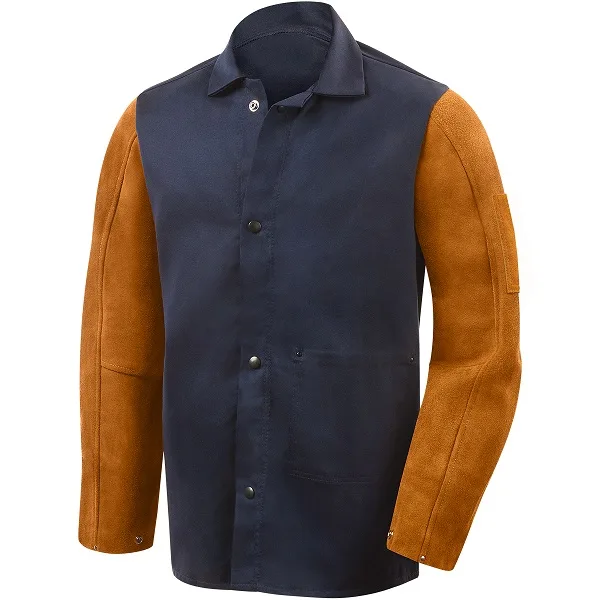
- Steiner 1260 Weldlite Plus Hybrid Jacket, 30 inch - Buy. Leather sleeves where the sparks land, flame retardant cotton where they do not, with the hardware details that matter done properly.
- Tillman 6230 Lightweight FR Cotton Welding Jacket, 30 inch - Buy. The cheapest jacket here and the one whose spec sheet tells you the most, including the thing it does not do.
- Steiner 9215 Weld-Cool Premium Side Split Cowhide Jacket, 30 inch - It depends. Full leather with a proper snap down welding collar, and deliberate ventilation openings that are either the best or the worst thing about it.
- Black Stallion JF2220-GY NFPA 2112 and NFPA 70E FR Cotton Welding Jacket, 32 inch - Skip. A well made jacket whose entire credential list was earned against flash fire and arc flash rather than welding spatter, and Black Stallion says so on the page.
The verdict in 30 seconds
What mattered most
- Torso material
- Sleeve material
- Standards the maker publishes
- Hazard those standards address
- EN ISO 11611 welding class
- Published wash life
A welding jacket is the one piece of welding kit where the American rulebook grades nothing. ANSI Z49.1 tells you clothing shall provide sufficient coverage and be made of suitable materials, and stops. So makers reach for the flame resistance standards that do exist, and those were written for electrical workers and for flash fires, not for a shower of molten steel. Europe has a welding clothing standard with real spatter and radiant heat classes, EN ISO 11611, and nothing in this field carries it. What is left is the spec sheet, which turns out to be enough if you know which lines matter.
Leather sleeves where the sparks land, flame retardant cotton where they do not, with the hardware details that matter done properly.
Best for: The welder who wants one jacket for general shop work and would rather have leather on the forearms than a lighter garment.
- Side split rust cowhide sleeves sewn with Kevlar thread, on a torso of 9 oz flame retardant 100 percent cotton that Steiner states meets ASTM D6413-10.
- Leather reinforced, black anodized non-reflective snaps, which is the construction that keeps bare metal fasteners off your skin and out of the arc's reflection.
- Adjustable snap wrist, soapstone pocket on each sleeve, large inside pocket and bar tacking at the stress points, in sizes S to 4XL at 30 inches.
- Steiner publishes no wash life for the cotton torso, so you have no number to plan replacement against.
- No stand-up welding collar is listed, unlike Steiner's own leather jacket, so neck coverage depends on what you wear under it.
- ASTM D6413-10 is a vertical flame test on fabric, not a molten metal spatter test or a radiant heat test, so it says nothing about spatter.
- The size run stops at 4XL, where the Tillman goes to 8X and the leather Steiner to 6XL.
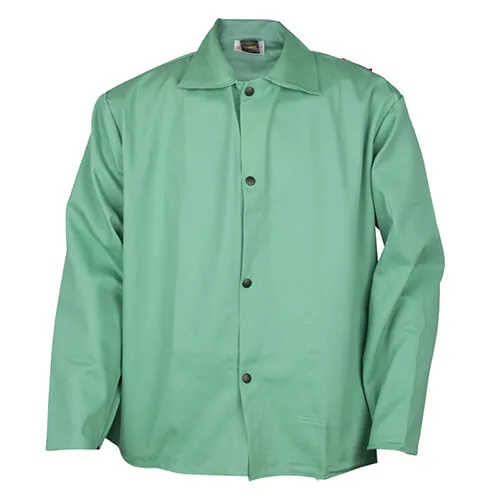
The cheapest jacket here and the one whose spec sheet tells you the most, including the thing it does not do.
Best for: Anyone starting out, or anyone who wants a spare, and who welds where sparks fall rather than fly.
- Tillman names the fabric outright as 9 oz US made Westex FR-7A flame resistant 100 percent cotton rather than saying flame retardant and leaving it there.
- It publishes a wash life, flame resistance maintained for up to 50 home washings at 145 degrees Fahrenheit or 25 commercial washings up to 165 degrees.
- The technical table prints Arc Rating: NA, which stops a buyer assuming an arc rating that was never measured.
- Thirty inch length, snap closure, two inner pockets, cut to fit over a shirt, in the widest size run here at S through 8X.
- There is no leather anywhere on it, so heavy spatter lands on cloth and burns pinholes.
- Tillman's application list names TIG and MIG welding, not stick, which is the process that throws the most spatter.
- The published flame credential, ASTM D6413-10, is a vertical flame char length test, and Tillman itself explains it as the pass or fail criterion behind ASTM F1506, an electrical arc standard.
- No stand-up collar and no thread material are stated on the spec sheet.
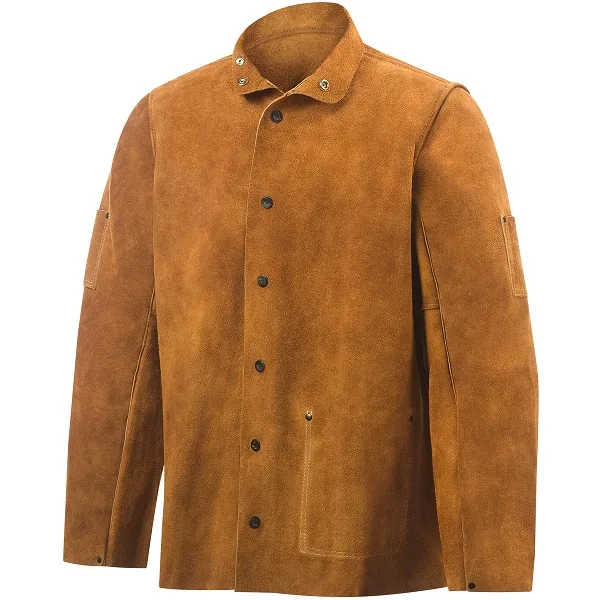
Full leather with a proper snap down welding collar, and deliberate ventilation openings that are either the best or the worst thing about it.
Best for: Stick and heavy MIG work in a hot shop, where the arc is in front of you and the spatter is heavy enough that cloth would not last.
- Premium side split cowhide lock stitched with flame resistant Kevlar thread, with rivet reinforced seams and stress points.
- A stand-up or roll-down leather collar that snaps securely in place to protect the neck, plus non-reflective reinforced snaps at the front, the wrist and the collar.
- Satin lined shoulders and upper arms, soapstone pockets on both sleeves, an inside pocket, adjustable waist cinch straps, and sizes S through 6XL.
- The Weld-Cool design uses underarm ventilation and a riveted open seam across the upper back, which is coverage traded for airflow by design.
- Steiner publishes no test result of any kind for it, no ASTM number and no EN ISO 11611 class.
- Leather cannot be laundered the way FR cotton can, so a jacket that gets oily is a problem rather than a wash cycle.
- Steiner's own listing carries a Proposition 65 warning about hexavalent chromium, which comes with chrome tanned leather.
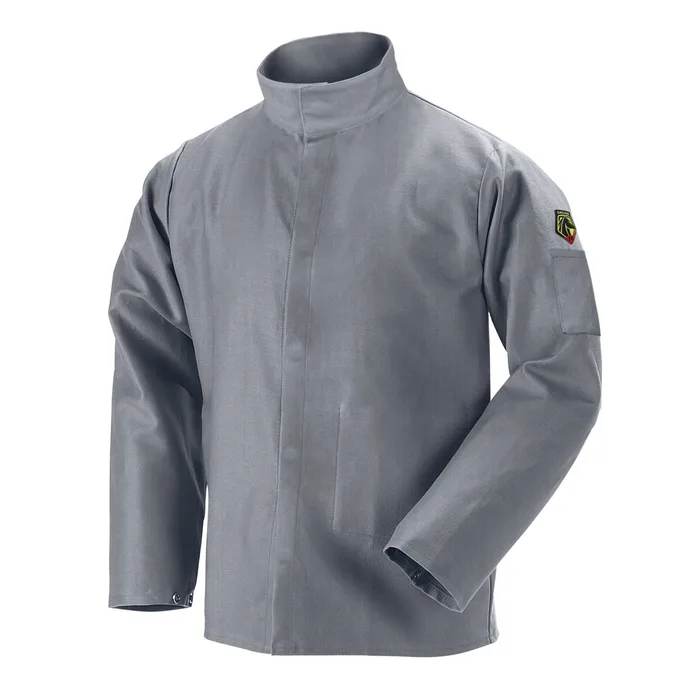
A well made jacket whose entire credential list was earned against flash fire and arc flash rather than welding spatter, and Black Stallion says so on the page.
Best for: Welders on rigs, in refineries or on utility crews whose employer's PPE program actually requires NFPA 2112 and an arc rating.
- The longest published wash life in this comparison, 100 home washings or 50 commercial laundry cycles.
- Stitched with FR aramid thread throughout, and at 32 inches it is the longest jacket here for torso coverage.
- If you genuinely face flash fire or arc flash, the paperwork is real: ASTM F1506, NFPA 2112 certified, UL classified, NFPA 70E compliant, ATPV 10 cal/cm2.
- Black Stallion describes it as designed for welders exposed to potential flash fire and arc flash hazards typically associated with oil and gas, utility and industrial applications, which is not most welding.
- NFPA 2112 is the flash fire standard and ASTM F1506 is written for workers exposed to flames and electric arcs, so neither credential involves a molten metal droplet or welding radiant heat.
- The ATPV of 10 cal/cm2 is an arc flash number that buys a welder nothing unless the work is on energised equipment.
- It is a premium tier price for 9 oz FR cotton with no leather anywhere, which is the same fabric class as the budget jacket in this comparison.
| Criteria | 1260 Weldlite Plus Hybrid Jacket, 30 inch Top pick | 6230 Lightweight FR Cotton Welding Jacket, 30 inch | 9215 Weld-Cool Premium Side Split Cowhide Jacket, 30 inch | JF2220-GY NFPA 2112 and NFPA 70E FR Cotton Welding Jacket, 32 inch |
|---|---|---|---|---|
| Verdict | Buy it | Buy it | It depends | Skip it |
| Best for | The welder who wants one jacket for general shop work and would rather have leather on the forearms than a lighter garment. | Anyone starting out, or anyone who wants a spare, and who welds where sparks fall rather than fly. | Stick and heavy MIG work in a hot shop, where the arc is in front of you and the spatter is heavy enough that cloth would not last. | Welders on rigs, in refineries or on utility crews whose employer's PPE program actually requires NFPA 2112 and an arc rating. |
| Price tier | $$ · mid-range | $ · budget | $$$ · premium | $$$ · premium |
| Torso material | 9 oz FR 100 percent cotton, Weldlite | 9 oz Westex FR-7A FR cotton | Premium side split cowhide | 9 oz FR cotton |
| Sleeve material | Side split rust cowhide | Same FR cotton as the body | Same cowhide as the body | Same FR cotton as the body |
| Standards the maker publishes | ASTM D6413-10 | ASTM D6413-10 | None published | ASTM F1506, NFPA 2112, NFPA 70E |
| Hazard those standards address | Fabric flame spread only | Fabric flame spread only | Nothing tested | Flash fire and electric arc |
| EN ISO 11611 welding class | None published | None published | None published | None published |
| Published wash life | Not published | 50 home at 145 F, 25 commercial | Not applicable, leather | 100 home, 50 commercial |
| Length and collar | 30 inch, collar not specified | 30 inch, collar not specified | 30 inch, stand-up leather collar with snap | 32 inch, collar not specified |
| Thread and sizes | Kevlar on sleeves, S to 4XL | Not stated, S to 8X | Kevlar lock stitched, S to 6XL | FR aramid throughout, sizes not stated |
Which one is right for you?
- The welder who wants one jacket for general shop work and would rather have leather on the forearms than a lighter garment. Buy it Steiner 1260 Weldlite Plus Hybrid Jacket, 30 inch
- Anyone starting out, or anyone who wants a spare, and who welds where sparks fall rather than fly. Buy it Tillman 6230 Lightweight FR Cotton Welding Jacket, 30 inch
- Stick and heavy MIG work in a hot shop, where the arc is in front of you and the spatter is heavy enough that cloth would not last. It depends Steiner 9215 Weld-Cool Premium Side Split Cowhide Jacket, 30 inch
- Welders on rigs, in refineries or on utility crews whose employer's PPE program actually requires NFPA 2112 and an arc rating. Skip it Black Stallion JF2220-GY NFPA 2112 and NFPA 70E FR Cotton Welding Jacket, 32 inch
How we judged the field
Five things decide whether a welding jacket earns its place, and only the first is the material. First, what is on the sleeves and forearms, because that is where spatter lands and where cloth burns pinholes first. Second, which standard the maker publishes and what that standard was written to test, since the two FR standards American welding jackets usually cite were drafted for electrical workers and for flash fire, and neither drops molten metal on the fabric. Third, the wash life, because flame resistant cotton is treated cotton and ANSI Z49.1’s own guidance warns that treated clothing may lose some protection after repeated washing. Fourth, the closure and collar detail, since ANSI Z49.1 recommends sleeves and collars kept buttoned and pockets kept off the front, and EN ISO 11611 requires welding clothing to be designed so metal fasteners cannot conduct from outside to in. Fifth, coverage in the position you actually weld in, which EN ISO 11611 tests by asking whether the jacket still overlaps the trousers with both arms fully extended above the head.
The field splits on which hazard the paperwork addresses. On one side are jackets sold on construction, where the maker names the leather, the fabric weight, the thread and a fabric flame test, and lets you judge the rest. On the other are jackets sold on certificates, where NFPA 2112, NFPA 70E and an arc rating in cal/cm2 do the talking even though none of those tests involves welding spatter. Nothing sold into the United States mainstream carries the one standard written for this job, EN ISO 11611, so no jacket here can show you a spatter class. We picked one hybrid with leather sleeves, one all cloth jacket with the most transparent spec sheet in the category, one full leather jacket that trades coverage for ventilation, and one heavily certified jacket to show what those certificates actually cover.
Steiner 1260 Weldlite Plus Hybrid Jacket, 30 inch
Buy itThe Steiner 1260 is the shape most welders should buy: leather where the sparks land and cloth where they do not. Steiner puts side split rust cowhide on the sleeves, sewn with Kevlar thread, over a torso of 9 oz flame retardant 100 percent cotton it calls Weldlite and states meets ASTM D6413-10. The hardware is the detail worth noticing. The snaps are leather reinforced and black anodized so they are non-reflective, and EN ISO 11611 asks welding clothing to be designed to prevent electrical conduction from the outside to the inside through metal fasteners, which is exactly why good jackets reinforce and cover their snaps rather than leaving bare studs. You also get an adjustable snap wrist, soapstone pockets on both sleeves, a large inside pocket and bar tacking at stress points, in sizes S to 4XL at 30 inches. What Steiner does not publish is a wash life, a stand-up collar or any welding specific classification. For general shop work it is still the best mix of protection and comfort here.
Tillman 6230 Lightweight FR Cotton Welding Jacket, 30 inch
Buy itThe Tillman 6230 is the cheapest jacket in this comparison and the one whose spec sheet tells you the most. It names the fabric outright as 9 oz US made Westex FR-7A flame resistant 100 percent cotton, states that it meets ASTM D6413-10, explains in its own words that D6413-10 is the pass or fail criterion behind ASTM F1506 with its 6 inch maximum char length, and then prints Arc Rating: NA rather than letting a buyer assume one. It also publishes the number almost nobody publishes: flame resistance maintained for up to 50 home washings at 145 degrees Fahrenheit or 25 commercial washings up to 165 degrees. Thirty inches, snap closure, two inner pockets, cut to fit over a shirt, and a size run from small to 8X that is wider than anything else here. The limits are simply what it is made of. There is no leather anywhere, and Tillman’s own application list names TIG and MIG welding rather than stick, which is the process that throws the most spatter.
Steiner 9215 Weld-Cool Premium Side Split Cowhide Jacket, 30 inch
It dependsThe Steiner 9215 is all leather, and it is the right jacket for exactly the work that ruins a cloth one. Premium side split cowhide, lock stitched with flame resistant Kevlar thread, rivet reinforced seams and stress points, satin lined shoulders and upper arms, and a stand-up or roll-down leather collar that snaps securely closed against the neck, which is the one protective detail no cloth jacket here publishes. Snaps at the front, the wrist and the collar are non-reflective and reinforced, and the size run reaches 6XL. The catch is in the model name. Weld-Cool means underarm ventilation and a riveted open seam across the upper back, which is Steiner trading coverage for airflow deliberately. That is a good trade in a hot shop with the arc in front of you and a poor one if sparks arrive from above or behind. Steiner publishes no test result at all for it, and its own listing carries a Proposition 65 warning about hexavalent chromium, which comes with chrome tanned leather.
Black Stallion JF2220-GY NFPA 2112 and NFPA 70E FR Cotton Welding Jacket, 32 inch
Skip itThe Black Stallion JF2220 is a well made garment sold against the wrong hazard, and the honest part is that Black Stallion says so on the page. It is described as designed for welders who may be exposed to potential flash fire and arc flash hazards typically associated with oil and gas, utility and industrial applications. Read the credential list with that sentence in mind. NFPA 2112 is the flash fire standard, ASTM F1506 is written for workers exposed to flames and electric arcs, and the ATPV of 10 cal/cm2 is an arc flash number. None of the three involves a molten metal droplet or a welding arc’s radiant heat. What you do get is real: 9 oz FR cotton, aramid thread throughout, 32 inches of length, and 100 home washings or 50 commercial cycles, the longest published wash life in this field. If you weld on rigs or on energised gear, buy it. If you weld in a shop, you are paying a premium tier for certificates aimed at fires you will not have, and getting no leather for the money.
Sources
Specs in this review come from these pages.
- ISO 11611:2015, Protective clothing for use in welding and allied processes (cdn.standards.iteh.ai)
- AWS: ANSI Z49.1:2021 Safety in Welding, Cutting, and Allied Processes (pubs.aws.org)
- American Welding Society: Safety and Health Fact Sheet No. 7, Burn Protection (aws-p-001-delivery.sitecorecontenthub.cloud)
- OSHA: 29 CFR 1910.252, Welding, Cutting, and Brazing, General Requirements (osha.gov)
- Tillman: 6230 FR Cotton Welding Jacket specification sheet (jtillman.com)
- Westex by Milliken: Care and Maintenance Guidelines for FR fabrics (webapi.westex.com)
Steiner 1260 Weldlite Plus Hybrid Jacket, 30 inch vs Tillman 6230 Lightweight FR Cotton Welding Jacket, 30 inch: which should you buy?
The Steiner 1260 and the Tillman 6230 start from the same 9 oz flame retardant cotton and part company at the sleeves. Steiner replaces the sleeves with side split cowhide and sews them with Kevlar thread, then reinforces and anodizes the snaps, which is a direct answer to two of the three ways a welding jacket fails: spatter burning through cloth at the forearms, and bare metal fasteners sitting against the arc and against your skin. Tillman answers a different question. Its jacket is one fabric throughout, which makes it lighter, cooler and far cheaper, and its spec sheet is the most candid in the category, naming Westex FR-7A, stating the flame test, publishing the wash life and printing Arc Rating: NA instead of implying one.
Choose on what your sparks do. If you run stick or high current MIG, or you weld out of position where spatter runs down your forearms, the Steiner’s leather sleeves are the difference between a jacket that lasts a season and one that develops pinholes in a month. If you run TIG or light MIG at a bench, or you are buying a first jacket, or you want a spare to keep clean, the Tillman is the sensible one, and it is the only jacket here that goes to 8X. One caution in the other direction: Steiner publishes no wash life for the 1260’s cotton torso, so you get better construction and less information about how long the flame resistance lasts.
What to look for
- Look at the sleeves first: spatter lands on the forearms and the tops of the arms, so a jacket with leather sleeves over a cloth body solves the real problem, and a jacket that is cloth everywhere is a light duty jacket whatever the label says.
- Ask what the standard was written to test: ASTM D6413 is a vertical flame test on fabric, ASTM F1506 is for workers exposed to flames and electric arcs, and NFPA 2112 is for flash fire, so none of them tells you how many molten droplets the fabric will take.
- Treat an arc rating as a different product category: a cal/cm2 number describes electric arc energy, not weld spatter, and buying a higher one does not buy more protection from the thing coming off your electrode.
- Find the published wash life before you buy FR cotton: the treatment is a chemical process rather than a fibre property, ANSI Z49.1 warns that treated clothing can lose protection with repeated laundering, and the makers that publish a number range from 50 home washings to 100.
- Check the collar and the cuffs, not just the length: ANSI Z49.1 recommends sleeves and collars kept buttoned and pockets kept off the front of the garment, and a stand-up welding collar that snaps closed is the detail most cloth jackets leave out.
- Try it with your arms up: EN ISO 11611 checks coverage by asking whether the jacket still overlaps the trousers when the wearer fully extends both arms above the head and then bends to touch the ground, which is the test your own jacket will fail if you bought it too short.
Our final take
Buy the Steiner 1260 if you want one jacket that puts leather where spatter actually lands, and the Tillman 6230 if you want the lowest tier and the most honest spec sheet in the category. Keep the Steiner 9215 in mind if you run heavy stick in a hot shop and understand that its vents are holes you chose. Skip the Black Stallion JF2220 unless your work genuinely involves flash fire or arc flash, because its credentials are excellent and aimed elsewhere. The broader point is that American welding clothing is graded by nobody. Europe’s EN ISO 11611 has actual spatter and radiant heat classes, nothing mainstream here carries it, so the buyer has to do the grading from construction.
Questions, answered
Is there an American standard that grades welding jackets?
No. ANSI Z49.1:2021 clause 4.3 says only that clothing shall be selected to minimize the potential for ignition, burning, trapping hot sparks, or electric shock, and clause 4.3.1 adds that clothing shall provide sufficient coverage, and be made of suitable materials, to minimize skin burns caused by sparks, spatter, or radiation. No test method and no grading are attached. OSHA is no more specific: 29 CFR 1910.252(b)(3) requires PPE in accordance with 1910.132 and then says appropriate protective clothing will vary with the size, nature and location of the work. The result is that a jacket sold in the United States can be called a welding jacket with no graded protection number of any kind. This is the same gap we found on the glove side, where ANSI Z49.1 asks only for flame resistant gloves and the graded classification, EN 12477 with its six digit EN 407 thermal code, is a European document.
Does an NFPA 2112 or ASTM F1506 label mean a jacket is better for welding?
Not for welding specifically. NFPA 2112 is the Standard on Flame-Resistant Clothing for Protection of Industrial Personnel Against Short-Duration Thermal Exposures From Fire, and it is a flash fire standard used in oil, gas and chemical work. ASTM F1506 is the Standard Performance Specification for Flame Resistant and Electric Arc Rated Protective Clothing Worn by Workers Exposed to Flames and Electric Arcs, written around momentary electric arc exposure. Neither test protocol drops molten metal on the fabric or measures radiant heat from a welding arc. They are real credentials for real hazards, and a garment that passes them will also be flame resistant, which is not nothing. But if you are buying against spatter, an arc rating in cal/cm2 is answering a question you did not ask, and you should not read a higher number as more spatter protection.
What do EN ISO 11611 Class 1 and Class 2 mean?
EN ISO 11611 is the welding clothing standard, currently in its 2015 edition, which cancelled and replaced the 2007 one. It sorts garments into two classes on two tests. On molten metal spatter, a Class 1 garment must withstand 15 droplets before a 40 degree Celsius temperature rise behind the fabric, and Class 2 must withstand 25. On radiant heat, the RHTI 24 time to a 24 degree Celsius rise must be at least 7 seconds for Class 1 and at least 16 seconds for Class 2. The classes map to processes: Class 1 for lower spatter work such as gas welding, bench welding and oxygen or plasma cutting machines, Class 2 for manual metal arc with basic or cellulose covered electrodes, MAG, high current MIG, overhead work and confined spaces. None of the jackets in this comparison publishes a class.
Does the flame resistant treatment wash out of an FR cotton jacket?
It depends on the treatment, and the makers do not all say the same thing. ANSI Z49.1's guidance note E4.3 warns that clothing treated with flame resistant materials may lose some of its protective characteristics after repeated washing or cleaning, and tells you to follow the manufacturer's care instructions. Westex, whose FR cotton is named on the Tillman jacket, uses a process that locks a flame retardant polymer into the cotton fibre rather than coating it, and says its fabrics maintain FR performance for the useful life of the garment when washed according to care instructions. Garment makers are more conservative: Tillman prints 50 home washings at 145 degrees Fahrenheit for the 6230, and Black Stallion prints 100 home washings for the JF2220. What definitely does damage FR cotton is additives. Westex's own care guide says to use only oxygen based bleaches, never detergents containing chlorine bleach, and no starches, fabric softeners or other laundry additives, because they can coat the fibre.
Can I just weld in a heavy cotton shirt?
You can, and AWS says heavy cotton is acceptable, but it is the floor rather than the target. AWS Safety and Health Fact Sheet No. 33 tells welders to wear oil-free protective clothing made of wool or heavy cotton and notes that heavier materials are harder to ignite. ANSI Z49.1's guidance note goes a step further and says leather or flame resistant clothing is preferable to lighter materials for the same reason. Untreated cotton is not fireproof, it simply takes more heat to start and burns rather than melts. The material to actually avoid is synthetic: Fact Sheet No. 33 says not to wear man-made fabrics because they may burn easily, melt, stick to your skin and cause serious burns, and ANSI Z49.1 says materials which can melt should not be used as clothing when welding or cutting. That rules out polyester, nylon and blends containing them, including most fleece and most hoodies.
Deciding between the top two? See our head-to-head: Steiner 1260 Weldlite Plus Hybrid Jacket, 30 inch vs Tillman 6230 Lightweight FR Cotton Welding Jacket, 30 inch.
More Tools & DIY reviews
 The Best Wet/Dry Shop Vacuums for Garages: 4 Compared (and One to Skip)
  The Best Wire Strippers: 4 Compared (and One to Skip)
  The Best Wood Chisel Sets: 4 Compared for Fine Joinery
  The Best Wood Routers: 4 Compared (and One to Skip)
  The Best Work Gloves: 4 Compared (and One to Skip)
  The Best Work Lights: 4 Compared (and One to Skip)