

Tools & DIY
The Best Table Saws: 4 Compared (and One to Skip)
Four jobsite table saws compared on rip capacity to the right of the blade, which ranges from 12 inches to 32 and a half across this group, and decides whether you can cut a sheet of plywood at all.
The short version
Buy the DEWALT DWE7491RS. Its 32 and a half inches of rip capacity to the right is the largest here by a wide margin, enough for a full sheet ripped anywhere across its width, and the rack and pinion fence is the mechanism that makes that capacity usable rather than approximate. It runs a 10 inch blade at 4,800 RPM and comes on a rolling stand. Buy the Makita 2705 if cut depth matters more than width: 3 and 9 sixteenths at 90 degrees and 2 and a half at 45, against 3 and 1/8 for the DEWALT, lets it cut 4x material in a single pass by Makita's own account, and its riving knife has three positions for through cuts, non-through cuts and dado work, which is more adjustment than anything else here offers. The DEWALT DWE7485 is the it-depends, cheaper and lighter with 24 and a half inches of rip, which still halves a sheet, at the cost of an 8 and a quarter inch blade that limits depth and blade choice. Skip the CRAFTSMAN CMXETAX69434502 if you cut sheet goods: 12 inches of rip capacity will not reach the middle of a 4 foot sheet, so the saw cannot perform the job most people buy a table saw for. Best for: anyone comparing table saws on amps, which are 15 on all four.
Our picks at a glance
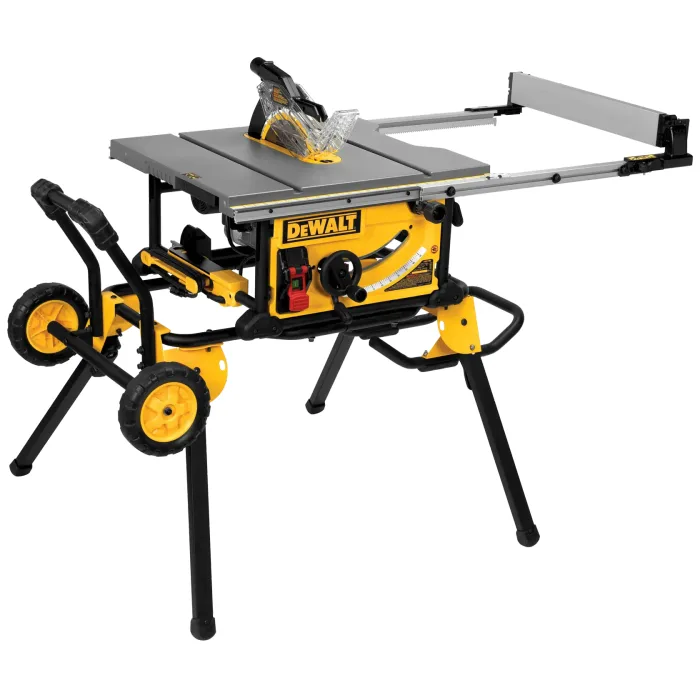
- DEWALT DWE7491RS 10 in. Jobsite Table Saw with Rolling Stand - Buy. Thirty-two and a half inches of rip to the right, which is the specification the whole category turns on.
- Makita 2705 10 in. Contractor Table Saw - Buy. The deepest cut in this comparison and a riving knife with three positions, including one for dado work.
- DEWALT DWE7485 8-1/4 in. Compact Jobsite Table Saw - It depends. Still halves a sheet at 24 and a half inches of rip, on a smaller blade that costs depth and narrows blade choice (maker page no longer loads, specs unconfirmed).
- CRAFTSMAN CMXETAX69434502 10 in. 15 Amp Corded Jobsite Table Saw with Folding Stand - Skip. Twelve inches of rip capacity, which cannot reach the middle of a 4 foot sheet, on the job most people buy a table saw for.
The verdict in 30 seconds
What mattered most
- Rip capacity right of blade
- Rip capacity left of blade
- Can rip a 4 ft sheet in half
- Blade diameter
- Depth of cut at 90 degrees
- Riving knife
Rip capacity to the right of the blade is the specification you are actually buying, and it varies more across these four than anything else does. The spread runs from 12 inches to 32 and a half, which is not a difference of degree. Ripping a 4 by 8 sheet of plywood down the middle needs 24 inches of capacity, so one of these saws can do it comfortably, two can do it, and one cannot do it at all. Every one of them has a 15 amp motor, so the number people compare tells you nothing. The second thing worth checking is blade diameter, because one saw here takes an 8 and a quarter inch blade rather than a 10, which quietly costs depth of cut and narrows what blades will fit it.
Thirty-two and a half inches of rip to the right, which is the specification the whole category turns on.
Best for: Anyone breaking down sheet goods, where 24 inches of rip is the minimum and 32 gives you room to work.
- 32-1/2 in. of rip capacity, comfortably the largest in this comparison.
- A rack and pinion fence, which is what makes a large capacity usable, because a fence that racks out of parallel makes the extra inches worthless.
- Ten inch blade at 4,800 RPM, so blade choice is the widest available.
- Ships with a riving knife specified for 10 in. blades of 0.094 in. minimum kerf and 0.067 in. maximum body thickness, so blade compatibility is stated rather than assumed.
- The heaviest and bulkiest saw here, which the rolling stand mitigates rather than solves.
- The most expensive in this group.
- The riving knife is matched to a kerf range, so an unusually thin-kerf blade needs checking against the published figures.
- Maximum cut depth is 3-1/8 in. at 90 degrees and 2-1/4 in. at 45, so it does not clear 4x material in one pass.
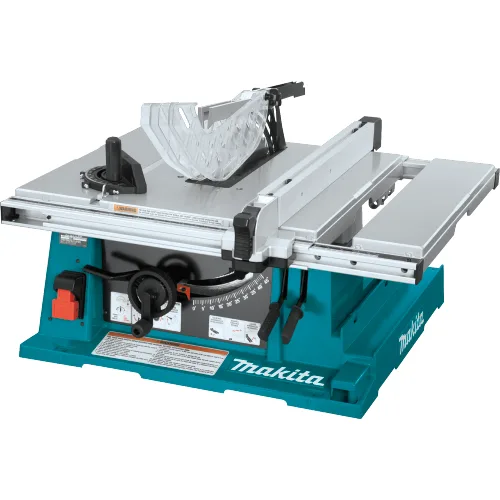
The deepest cut in this comparison and a riving knife with three positions, including one for dado work.
Best for: Anyone cutting thick stock or doing non-through and dado work, where depth and riving knife adjustment beat raw rip width.
- Cuts 3-9/16 in. at 90 degrees and 2-1/2 in. at 45, which Makita says is enough to rip 4x material in one pass.
- The riving knife has three positions for through cuts, non-through cuts and dado, which is genuinely more adjustment than the rest of this group offers.
- A right-extension table that Makita says gives the capacity to rip 4x8 sheets of plywood.
- A precision machined table, which is what keeps a workpiece flat and the cut square across the width.
- Its rip capacity is shorter than the DEWALT's 32-1/2 in., so the widest cuts need a different approach.
- Heavy, and the contractor format is less portable than a compact jobsite saw.
- Premium pricing without the largest capacity in the group.
- Dado capability needs the appropriate insert and blade set, which is a further purchase.
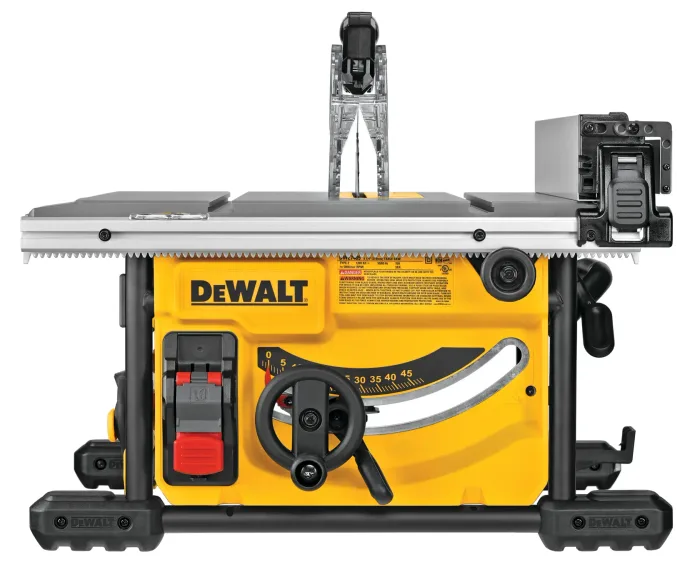
Still halves a sheet at 24 and a half inches of rip, on a smaller blade that costs depth and narrows blade choice (maker page no longer loads, specs unconfirmed).
Best for: Site carpentry in sheet goods and dimensional lumber where portability matters and 4x material never comes up.
- 24-1/2 in. of rip capacity to the right, which clears the 24 in. needed to rip a 4 foot sheet down the middle.
- Compact and considerably lighter than the full-size saws here, which matters if it is carried to a site.
- 5,800 RPM, the highest no-load speed in this comparison.
- Substantially cheaper than either premium saw.
- An 8-1/4 in. blade rather than 10, which reduces depth of cut and rules out cutting 4x material in one pass.
- Eight and a quarter inch blades are a much smaller market than 10 in., so choice and availability are narrower.
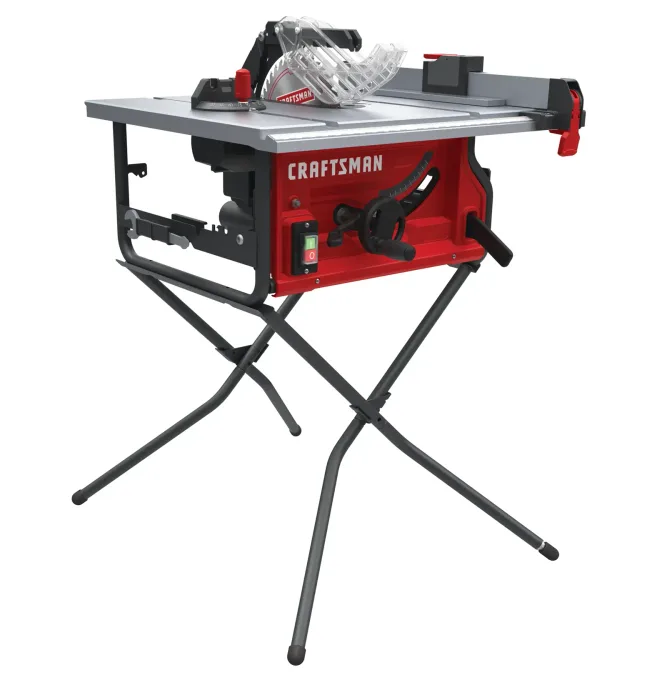
Twelve inches of rip capacity, which cannot reach the middle of a 4 foot sheet, on the job most people buy a table saw for.
Best for: Cutting dimensional lumber and narrow stock to width, where nothing wider than a foot ever crosses the table.
- Carries the full safety set: riving knife, blade guard and anti-kickback pawls.
- A cast aluminium table top, which is flatter and more stable than pressed steel at this price.
- Ten inch blade at 5,000 RPM from a 15 amp motor, so blade choice and depth are unrestricted.
- A folding stand and the lowest price in this comparison by a clear margin.
- 12 in. of rip capacity to the right, so ripping a 4 foot sheet down the middle, which needs 24 in., is impossible.
- The left side of the blade offers little more, so approaching the cut from the other side does not rescue it either.
- The 10 in. blade and 15 amp motor promise a capability the fence rails cannot deliver.
- Nothing about the saw can be upgraded to fix the rip capacity, since it is set by the rails.
| Criteria | DWE7491RS 10 in. Jobsite Table Saw with Rolling Stand Top pick Buy it Buy | 2705 10 in. Contractor Table Saw Buy it Buy | DWE7485 8-1/4 in. Compact Jobsite Table Saw It depends Buy | CMXETAX69434502 10 in. 15 Amp Corded Jobsite Table Saw with Folding Stand Skip it Buy |
|---|---|---|---|---|
| Best for | Anyone breaking down sheet goods, where 24 inches of rip is the minimum and 32 gives you room to work. | Anyone cutting thick stock or doing non-through and dado work, where depth and riving knife adjustment beat raw rip width. | Site carpentry in sheet goods and dimensional lumber where portability matters and 4x material never comes up. | Cutting dimensional lumber and narrow stock to width, where nothing wider than a foot ever crosses the table. |
| Price tier | $$$ · premium | $$$ · premium | $$ · mid-range | $ · budget |
| Rip capacity right of blade | 32-1/2 in. | Extension table, figure not published here | 24-1/2 in. | 12 in. |
| Rip capacity left of blade | Not published here | Not published here | Not published here | 10 in. |
| Can rip a 4 ft sheet in half | Yes, with margin | Yes | Yes, just | No |
| Blade diameter | 10 in. | 10 in. | 8-1/4 in. | 10 in. |
| Depth of cut at 90 degrees | 3-1/8 in. | 3-9/16 in. | Reduced by 8-1/4 in. blade | Full 10 in. class |
| Riving knife | Yes, kerf range specified | Yes, three positions | Yes | Yes |
| No-load speed | 4,800 RPM | 4,800 RPM | 5,800 RPM | 5,000 RPM |
Which one is right for you?
- Anyone breaking down sheet goods, where 24 inches of rip is the minimum and 32 gives you room to work. Buy it DEWALT DWE7491RS 10 in. Jobsite Table Saw with Rolling Stand
- Anyone cutting thick stock or doing non-through and dado work, where depth and riving knife adjustment beat raw rip width. Buy it Makita 2705 10 in. Contractor Table Saw
- Site carpentry in sheet goods and dimensional lumber where portability matters and 4x material never comes up. It depends DEWALT DWE7485 8-1/4 in. Compact Jobsite Table Saw
- Cutting dimensional lumber and narrow stock to width, where nothing wider than a foot ever crosses the table. Skip it CRAFTSMAN CMXETAX69434502 10 in. 15 Amp Corded Jobsite Table Saw with Folding Stand
How we judged the field
Rip capacity to the right of the blade first, because it is the specification that decides what work the saw can do at all and because it varies here from 12 inches to 32 and a half. Twenty-four inches is the threshold that matters, since that is what ripping a 4 foot sheet down the middle requires, and one of these four falls a foot short of it. Then blade diameter, which sets depth of cut and decides how wide a blade market you are buying into. Then the riving knife arrangement, because it is the safety component that stays in place for non-through cuts where a splitter cannot. Then the fence mechanism, which determines whether the published capacity is usable across its whole range or only near the blade. Amperage we ignored, since all four are 15 amp.
DEWALT DWE7491RS 10 in. Jobsite Table Saw with Rolling Stand
Buy itThe DEWALT DWE7491RS is the pick because it wins the number the category is about and then makes that number trustworthy. At 32-1/2 inches of rip to the right it can take a cut anywhere across a 4 foot sheet without turning the workpiece around, and the fence can be mounted on either side of the blade. The rack and pinion fence is the part that matters as much as the capacity: DEWALT describes it as a telescoping rack and pinion fence, intended to stay parallel across the full range, which is a common weakness of cheaper saws with large capacities. It runs a full 10 inch blade at 4,800 RPM, and DEWALT specifies the riving knife against a blade kerf range rather than leaving compatibility to guesswork. The costs are physical and financial: it is the heaviest and bulkiest saw here, the rolling stand manages that rather than removing it, and it is the most expensive in the group.
Makita 2705 10 in. Contractor Table Saw
Buy itThe Makita 2705 is the second buy and the better saw for thick stock. It cuts 3-9/16 inches at 90 degrees and 2-1/2 at 45, which Makita says is enough to rip 4x material in one pass, and the DEWALT 10 inch saw reaches 3-1/8 at 90 degrees. Its riving knife has three positions covering through cuts, non-through cuts and dado work, which is more adjustment than the rest of the group offers combined and is a real safety and capability advantage, because a riving knife that has to be removed for a non-through cut usually stays off afterwards. The precision machined table keeps the workpiece flat across the cut. What it gives up is width: Makita says the right extension table can rip 4x8 sheets, but it publishes no figure to set beside the DEWALT’s 32-1/2 inches, so the widest cuts may need repositioning. It is heavy, the contractor format is less portable than a compact jobsite saw, and it is priced at the premium end without the largest capacity.
DEWALT DWE7485 8-1/4 in. Compact Jobsite Table Saw
It dependsThe DEWALT DWE7485 is the it-depends, and the trade is clear once you see it. Its 24-1/2 inches of rip to the right clears the 24 inch threshold, so it will halve a 4 foot sheet, which is the capability that separates a usable table saw from a limited one. It is compact, considerably lighter than the full-size saws, runs at 5,800 RPM and costs substantially less. What you accept is the blade: 8-1/4 inches rather than 10. That reduces depth of cut so 4x material is out of reach in a single pass, and it commits you to a much smaller blade market, where specialist blades are harder to find and often more expensive per unit. As a site saw for sheet goods and dimensional lumber it is well judged.
CRAFTSMAN CMXETAX69434502 10 in. 15 Amp Corded Jobsite Table Saw with Folding Stand
Skip itThe CRAFTSMAN CMXETAX69434502 is the skip, and the reason is a single number that no other feature compensates for. Twelve inches of rip capacity to the right cannot reach the middle of a 4 foot sheet, which needs 24, and the left side does not rescue it from the other direction. That is the job most people buy a table saw to do. Everything else about the saw is reasonable for the money: it has the full safety set of riving knife, blade guard and anti-kickback pawls, a cast aluminium top that is flatter than pressed steel at this price, a 10 inch blade so depth and blade choice are unrestricted, and a 15 amp motor at 5,000 RPM. That is the frustrating part, because the motor and blade promise a capability the fence rails cannot deliver, and rip capacity is fixed by the rails so nothing can be upgraded to fix it. For ripping dimensional lumber to width it is a sound cheap saw.
Sources
Specs in this review come from these pages.
- DEWALT DWE7491RS 10 in. jobsite table saw and rolling stand (dewalt.com)
- DEWALT DWE7485 8-1/4 in. compact jobsite table saw (dewalt.com)
- Makita 2705 10 in. contractor table saw specifications (makitatools.com)
- CRAFTSMAN CMXETAX69434502 10 in. 15 amp corded jobsite table saw (lowes.com)
- DEWALT DWE7491RS instruction manual, including riving knife blade limits (assets.dewalt.com)
DEWALT DWE7491RS 10 in. Jobsite Table Saw with Rolling Stand vs Makita 2705 10 in. Contractor Table Saw: which should you buy?
The two DEWALTs isolate what the smaller blade costs, since both are jobsite saws from the same maker with rip capacities that clear the 24 inch threshold. The DWE7491RS gives 32-1/2 inches of rip on a 10 inch blade with a rack and pinion fence and a rolling stand. The DWE7485 gives 24-1/2 inches on an 8-1/4 inch blade, weighs much less and costs much less. Both will rip a sheet in half, so the width question is settled for either. What separates them is depth and blade supply: the 10 inch saw has the deeper cut and can use any blade on the shelf, while the 8-1/4 inch saw has less depth and a narrower choice of blades. If the saw is carried daily and never sees thick stock, the compact one is the better buy and the money saved is real. If it lives in a shop, the larger blade is worth having.
What to look for
- Rip capacity to the right of the blade: the figure that decides what the saw can do, and 24 inches is the threshold for ripping a 4 foot sheet in half.
- Rip capacity to the left as well: it decides whether you can approach a cut from either side, and it is often half the right-hand figure.
- Blade diameter, read as a depth spec: 10 inches buys the deeper cut and the widest blade market, with 4x material reachable in one pass on the deepest saws; 8-1/4 does neither.
- A riving knife rather than a splitter: it rises with the blade and stays in place for non-through cuts, where a splitter has to come off and usually stays off.
- The fence mechanism: a rack and pinion fence is intended to stay parallel across the full range, which is what makes a large published capacity usable at its limits.
- Amps, read as a formality: every saw in this class is 15 amp because that is what a standard circuit allows.
Our final take
Table saws are advertised on amps, which are identical across the class, and decided by rip capacity, which varies by a factor of nearly three here. Find the right-hand rip figure, check it against 24 inches, and only then look at blade diameter and the fence. A saw that cannot halve a sheet is a different tool from one that can, whatever else it shares.
Questions, answered
How much rip capacity do I actually need?
Twenty-four inches is the number that matters, because it is what lets you rip a standard 4 foot sheet down the middle. Below that, a sheet has to be broken down with a circular saw or track saw first, which for many people defeats the reason they bought a table saw. Above 24 the extra is margin and convenience rather than capability, though 32 inches means you can take a cut anywhere across a sheet without turning it around. The Craftsman here offers 12, which is a different tool for a different job.
Does blade diameter matter if the rip capacity is the same?
It changes depth, not width. A 10 inch blade gives three to three and a half inches of cut at 90 degrees, with the Makita reaching 4x material in one pass and the DEWALT 10 inch saw falling just short; an 8 and a quarter inch blade gives noticeably less. Diameter also decides what blades you can buy, and 8 and a quarter is a much smaller market than 10, so specialist blades are harder to find. The DEWALT DWE7485 here is the compromise: a fully usable rip capacity on a smaller blade.
What does a riving knife do that a splitter does not?
It rises and falls with the blade, staying the same distance behind it at every depth setting, which means it keeps working on non-through cuts. A fixed splitter has to be removed for anything that does not cut all the way through, and once removed it usually stays off. The riving knife holds the kerf open so the workpiece cannot pinch the back of the blade and be thrown, which is the mechanism behind most kickback. The Makita here goes further with three positions, including one low enough for dado cuts.
Why is every table saw 15 amps?
Because that is the practical ceiling for a standard 120 volt household or site circuit, so every saw in this class is designed right up to it. The figure has converged and stopped distinguishing between tools, which is why it should be read as a formality rather than a specification. What varies is rip capacity, blade diameter, fence quality and the riving knife arrangement, none of which the amperage predicts.
Is the fence more important than the capacity number?
They are the same question. A published rip capacity assumes the fence stays parallel to the blade at that setting, and a fence that racks or flexes turns the last several inches of capacity into a number you cannot trust. That is why the rack and pinion mechanism on the DEWALT matters as much as its 32 and a half inches: DEWALT describes it as a telescoping rack and pinion fence, which is the mechanism intended to keep it square across the full range.
Deciding between the top two? See our head-to-head: DEWALT DWE7491RS 10 in. Jobsite Table Saw with Rolling Stand vs Makita 2705 10 in. Contractor Table Saw.
More in Tools & DIY
Table Saws, Explained Plain-English guide → DEWALT DWE7491RS 10 in. Jobsite Table Saw with Rolling Stand vs Makita 2705 10 in. Contractor Table Saw Head-to-head →  The Best Tape Measures: 4 Compared (and One to Skip)
  The Best Thermal Imaging Cameras: 4 Compared (and One to Skip)
  The Best Torque Screwdrivers: 4 Compared (and One to Skip)
  The Best Utility Knives: 4 Compared (and One to Skip)