

Tools & DIY
The Best Soldering Irons and Stations: 4 Compared (and One to Skip)
We compared four soldering tools on the thing that actually decides whether a joint goes well: how fast the tip gets back to its setpoint after it dumps heat into a pad. Wattage on the box turns out to be close to irrelevant.
The short version
The Hakko FX-971 is the pick: its T39 composite tip carries both the heating element and the temperature sensor inside the tip itself, which is why it recovers faster than slip-on designs. The Hakko FX-888DX is the value buy, a genuinely ESD-safe closed-loop station with cheap T18 tips, giving up cartridge-class recovery because its ceramic heater lives in the handpiece and the tip slides over it. The Pine64 Pinecil V2 is the one that depends on you: it heats through the tip and runs off a USB-C PD charger, which is brilliant in a toolbag and awkward as a main bench iron, and it needs you to fit the ground wire yourself for ESD work. Skip the Weller WLIR6012A 60 W pencil iron, which is nicely made but publishes no temperature setting, no sensor, and a heating range of 471 C, well above the 370 C that JBC advises never exceeding with its own tools. Wattage is the trap: a 100 W station and a 60 W iron are not on the same performance ladder, because one of them is closing a loop and the other is just getting hot. Buy for the control loop and the tip design, and the wattage sorts itself out. Best for: anyone choosing their first real iron, or replacing an unregulated one that keeps chewing tips.
Our picks at a glance
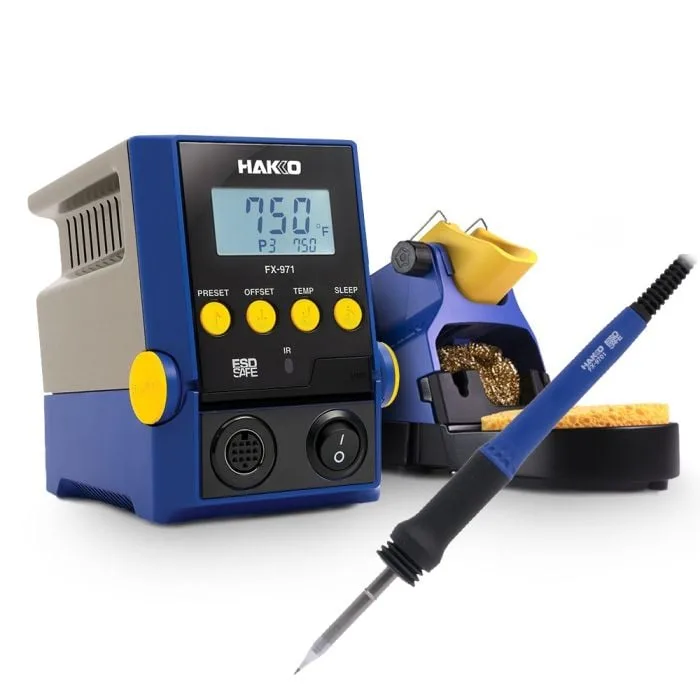
- Hakko FX-971 Soldering Station - Buy. A 100 W bench station whose composite T39 tips carry the heater and the sensor inside the tip, which is what lets it recover fast enough to solder heavy copper at a sane temperature.
- Hakko FX-888DX Digital Soldering Station - Buy. The default hobby bench station: real closed-loop control, ESD safety, cheap tips, and a heater that lives in the handpiece instead of the tip.
- PINE64 Pinecil V2 Smart Mini Portable Soldering Iron - It depends. A pocket-sized iron that heats through the tip and runs off a USB-C PD charger, which makes it excellent away from a bench and compromised on one.
- Weller WLIR6012A 60W Soldering Iron - Skip. A well-made 60 W pencil iron with a ring light and no temperature control, marketed for the PCB work it is least suited to.
The verdict in 30 seconds
What mattered most
- Heating method
- Temperature control
- Temperature range
- Idle stability
- Power
- ESD and grounding
Almost every soldering iron listing leads with a wattage number, and almost every buyer treats that number as the spec. It is not. What decides whether solder flows cleanly is thermal recovery - how quickly the tip climbs back to the temperature you set after heat drains out of it into copper - and that is a function of where the heater and the sensor sit, not how many watts the transformer can theoretically pass. We looked at four tools that sit at very different points on that curve, from a cartridge-tip bench station to a pencil iron with no temperature control at all.
A 100 W bench station whose composite T39 tips carry the heater and the sensor inside the tip, which is what lets it recover fast enough to solder heavy copper at a sane temperature.
Best for: Anyone who solders often enough that waiting for the tip to catch up is costing them joints, especially through-hole work into ground planes.
- The patented composite tip puts the heating element and the sensor inside the tip, so the control loop reads the metal that is actually touching your joint.
- Hakko rates the station at 100 W with the FX-9701 iron drawing 95 W at 24 V, across a 50 to 450 C range.
- ESD safe with tip-to-ground resistance under 2 ohms and tip-to-ground potential under 2 mV.
- T39 cartridge tips cost more than the slip-on T18 tips used by cheaper Hakko stations, and you will want several shapes.
- Tips are a recurring cost, so the real cost of entry is higher than the station price suggests.
- Idle temperature stability is specified at plus or minus 3 C, looser on paper than the cheaper FX-888DX's plus or minus 1 C.
- It is a mains bench station with a 1.2 m iron cord, so nothing about it travels.
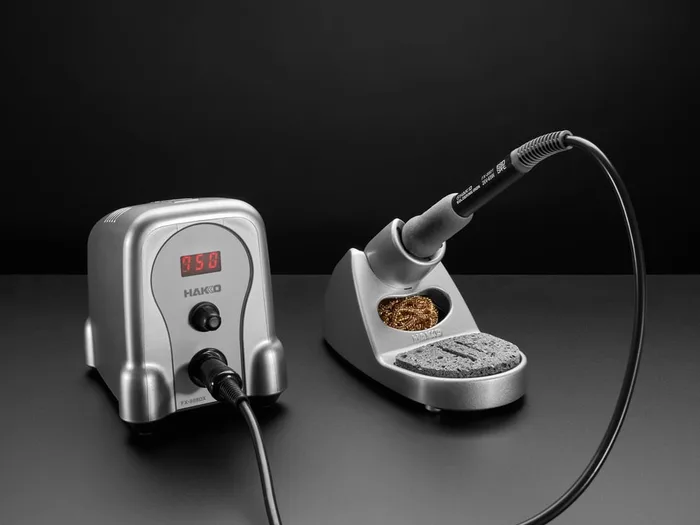
The default hobby bench station: real closed-loop control, ESD safety, cheap tips, and a heater that lives in the handpiece instead of the tip.
Best for: The hobbyist or repair tech who wants a station that will outlast several projects and does not need cartridge-class recovery.
- Hakko USA lists the temperature control as a closed-loop sensor with idle stability of plus or minus 1.0 C across a 50-480 C range.
- ESD safe with tip-to-ground resistance under 2 ohms and potential under 2 mV.
- T18 tips are inexpensive and come in many shapes, so trying a new tip geometry costs little.
- The ceramic heater sits in the FX-8801 handpiece and the T18 tip slides over it, so heat crosses one more interface than in a cartridge design.
- The iron itself draws 65 W at 26 V; the 100 W on the station spec is what the station consumes, not what reaches the joint.
- The display and dial interface takes a little learning.
- Mains bench station only, with no battery or USB option.
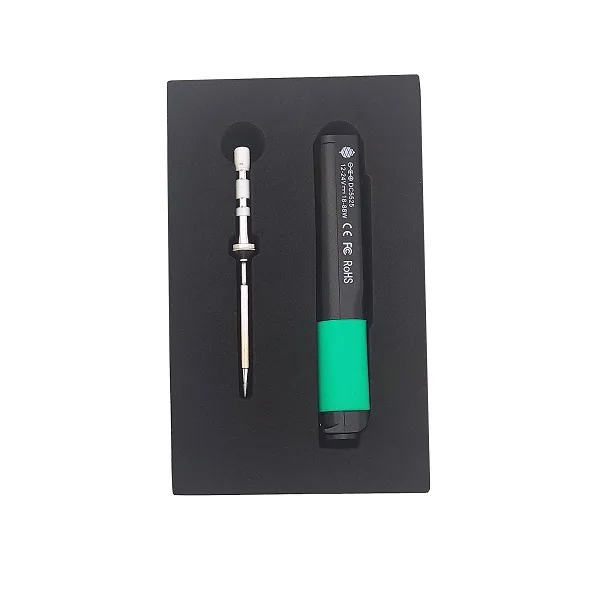
A pocket-sized iron that heats through the tip and runs off a USB-C PD charger, which makes it excellent away from a bench and compromised on one.
Best for: Field repairs, toolbag and van work, and anyone who already owns a capable USB-C PD charger.
- The tip is the heating element, and Pine64 states it reaches operating temperature in six seconds.
- Setpoint is adjustable from 100 C to 400 C on the OLED, with auto standby when you put it down.
- Runs from USB-C PD or QC 3.0 at 12-20 V or a DC5525 barrel jack at 12-24 V, with input rated at 3 A.
- No power supply is included, and an underpowered charger quietly caps what the iron can deliver.
- ESD work requires you to ground the tip yourself, and Pine64 publishes no tip-to-ground resistance or potential figures.
- The 400 C ceiling and small thermal mass make it a poor match for heavy ground planes and thick wire.
- It runs community firmware (Ralim's IronOS) and Pine64 lists a 30 day device warranty.
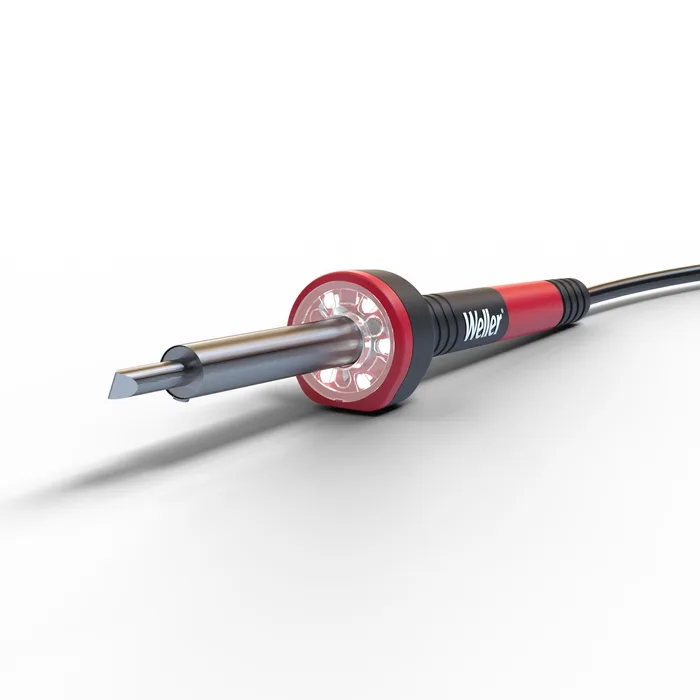
A well-made 60 W pencil iron with a ring light and no temperature control, marketed for the PCB work it is least suited to.
Best for: Heavy, forgiving work like automotive wiring, terminals and chassis tabs, where a setpoint was never going to matter.
- Genuinely good ergonomics: a molded pencil grip, an integrated safety rest, and a ring of LEDs that lights the joint from all sides.
- Tips are cheap and quick to swap, and Weller lists four replacement tip shapes for it.
- Certified to UL, CUL and NOM, RoHS compliant, and backed by a brand with a real service network.
- Weller's technical data lists no temperature setting and no sensor, only a heating range of 471 C, which is well above the 370 C JBC advises never exceeding with its own tools.
- No ESD rating or tip-to-ground figure is published, which matters because Weller lists electronics and PCB work among the recommended applications.
- Running a tip that hot shortens its life, because oxidation and burnt flux both accelerate with temperature.
- Once you add tips and a stand, a closed-loop station is not far away, and the control loop is the thing that actually makes joints easier.
| Criteria | FX-971 Soldering Station Top pick | FX-888DX Digital Soldering Station | Pinecil V2 Smart Mini Portable Soldering Iron | WLIR6012A 60W Soldering Iron |
|---|---|---|---|---|
| Verdict | Buy it | Buy it | It depends | Skip it |
| Best for | Anyone who solders often enough that waiting for the tip to catch up is costing them joints, especially through-hole work into ground planes. | The hobbyist or repair tech who wants a station that will outlast several projects and does not need cartridge-class recovery. | Field repairs, toolbag and van work, and anyone who already owns a capable USB-C PD charger. | Heavy, forgiving work like automotive wiring, terminals and chassis tabs, where a setpoint was never going to matter. |
| Price tier | $$$ · premium | $$ · mid-range | $ · budget | $ · budget |
| Heating method | Composite cartridge tip, heater and sensor inside the tip | Ceramic heater in the handpiece, slip-on T18 tip | Heater built into the replaceable tip | Fixed internal element, slip-on tip |
| Temperature control | Closed loop, sensor in the tip | Closed-loop sensor in the handpiece | Closed loop, setpoint chosen on the OLED | None published |
| Temperature range | 50-450 C (120-850 F) | 50-480 C (120-899 F) | 100-400 C | Heating range listed as 471 C, not settable |
| Idle stability | Plus or minus 3 C | Plus or minus 1.0 C | Not published | Not published |
| Power | 100 W station, 95 W iron at 24 V | 100 W station, 65 W iron at 26 V | Powered from your own supply, 3 A input | 60 W at 120 V |
| ESD and grounding | ESD safe, under 2 ohms and under 2 mV at the tip | ESD safe, under 2 ohms and under 2 mV at the tip | No figures published | No ESD rating published |
| Tip system | T39 cartridges, tips sold separately | T18 tips, many shapes, inexpensive | Replacement tips sold by Pine64 | Four listed replacement tips |
| Power source | AC mains bench station | AC mains bench station | USB-C PD or QC 3.0, or DC5525 barrel | AC mains, corded pencil iron |
Which one is right for you?
- Anyone who solders often enough that waiting for the tip to catch up is costing them joints, especially through-hole work into ground planes. Buy it Hakko FX-971 Soldering Station
- The hobbyist or repair tech who wants a station that will outlast several projects and does not need cartridge-class recovery. Buy it Hakko FX-888DX Digital Soldering Station
- Field repairs, toolbag and van work, and anyone who already owns a capable USB-C PD charger. It depends PINE64 Pinecil V2 Smart Mini Portable Soldering Iron
- Heavy, forgiving work like automotive wiring, terminals and chassis tabs, where a setpoint was never going to matter. Skip it Weller WLIR6012A 60W Soldering Iron
How we judged the field
Five things decide whether a soldering tool is good, and wattage is not one of them. First is thermal recovery: how fast the tip returns to its setpoint after heat drains into the joint. Second is where the sensor lives, because a sensor inside the tip regulates the metal touching your work while a sensor in the handpiece regulates something one interface away. Third is whether there is a closed loop at all, since a great many irons sold for electronics simply get hot and stay there. Fourth is ESD safety, which for a bench tool means a published tip-to-ground resistance and potential rather than a sticker. Fifth is consumables: tips wear out, and the cost, range and availability of replacement tips is a running expense that dwarfs the difference between two stations at purchase.
The field splits cleanly along the heater question. At the top are cartridge designs, where the heater and sensor are built into the tip, which is why they dominate professional benches and why they cost more per tip. In the middle are conventional stations with a ceramic heater in the handpiece and a slip-on tip, which is still closed-loop and still perfectly good, just slower to recover. At the bottom sit unregulated pencil irons with no sensor at all. We picked one of each of the first two, added a portable that heats through its tip but asks you to bring your own power, and included one unregulated iron because it is a genuinely popular purchase that most electronics buyers should not make.
Two of the four picks are Hakko, and that is deliberate rather than brand loyalty. The FX-971 and the FX-888DX are the cleanest illustration of the divide above: the same maker, the same ESD standard, the same closed-loop philosophy, differing in the one thing that decides thermal recovery, which is whether the heater and the sensor live inside the tip or back in the handpiece. Putting them side by side isolates that variable instead of tangling it up with another company’s control algorithm, tip alloy and calibration. It also reflects the market honestly. Hakko is the brand that sells both sides of that divide at prices a hobbyist or repair tech will actually pay: the rival cartridge stations professionals swear by, JBC and Metcal, start well above the FX-971 and climb steeply from there, and at the FX-888DX’s level the obvious alternatives, Weller’s WE1010 among them, are separate-element stations of the same architecture rather than a different one. If you want to see what a cartridge buys you without a professional budget, this is where that comparison lives.
Hakko FX-971 Soldering Station
Buy itThe Hakko FX-971 is the current cartridge station in Hakko’s line and it is built around a patented composite tip. Hakko describes the T39 as a design with improved sensor sensitivity that smoothly transfers heat from the heater to the tip. The station is rated at 100 W, the FX-9701 iron draws 95 W at 24 V, and the temperature range runs 50-450 C with idle stability of plus or minus 3 C. It is ESD safe on the published numbers: under 2 ohms tip-to-ground resistance and under 2 mV tip potential. The cost is consumables: T39 tips cost more than slip-on T18 tips, and most people end up owning three or four shapes. If you solder weekly and your joints involve heavy copper, that is money well spent. If you solder twice a year, it is not.
Hakko FX-888DX Digital Soldering Station
Buy itThe Hakko FX-888DX is what most people should actually buy, and the honest reason is that its compromise is the right one at its price. Hakko USA specifies closed-loop sensor control, a 50-480 C range, idle stability of plus or minus 1.0 C, ESD safety with under 2 ohms and under 2 mV at the tip. The catch is architectural: the ceramic heater lives in the FX-8801 handpiece and the T18 tip slides over it. Heat has an extra interface to cross, and the loop is reading the heater rather than the working face of the tip, so recovery on a big joint is slower than a cartridge design no matter what the idle stability number says. Note also that the 100 W figure is station consumption; the iron itself is 65 W at 26 V. In exchange, T18 tips are inexpensive and come in many shapes, so you can own a fine conical, a fat chisel and a knife tip without thinking about it. For hobby electronics, small repairs and kit building, it is hard to argue with.
PINE64 Pinecil V2 Smart Mini Portable Soldering Iron
It dependsThe Pinecil V2 is the interesting one, because architecturally it belongs with the cartridge irons: the tip is the heating element, and Pine64 states it reaches operating temperature in six seconds. It runs Ralim’s open-source IronOS, holds a setpoint anywhere from 100 C to 400 C, sleeps when you put it down. Power comes from USB-C PD or QC 3.0 at 12-20 V, or a DC5525 barrel jack at 12-24 V. The trade-off is that none of that power is included. Feed it a weak charger and you have a weak iron, and the specification you care about lives in a wall wart you have to choose correctly. ESD work needs you to ground the tip yourself, and Pine64 publishes no tip-to-ground figures. With a 400 C ceiling and very little thermal mass, it is not the tool for a ground plane. It is the tool for the job that is not at your bench.
Weller WLIR6012A 60W Soldering Iron
Skip itThe Weller WLIR6012A is a nicely engineered object and the wrong purchase for most of the people who buy it. It is a 60 W corded pencil iron with a molded grip, an integrated safety rest and a ring of LEDs around the barrel that genuinely helps you see the joint. Weller’s technical data lists 60 W, 120 V, UL, CUL and NOM certification, four replacement tip shapes, and a heating range of 471 C. What it does not list is a temperature setting, a sensor, or an ESD rating, and Weller recommends it for electronics and PCB work. An open-loop iron settles wherever thermal equilibrium puts it, which here is far above the 370 C JBC advises never exceeding with its own tools, and heat is exactly what kills tips through oxidation and burnt flux. It is also the reason unregulated irons feel unpredictable: they are hot when idle and cold when you actually need heat. For chassis wiring, spade terminals and speaker leads it is fine. For a circuit board it is a handicap you will pay for in tips and lifted pads.
Sources
Specs in this review come from these pages.
- HAKKO FX-971 specifications (hakko.com)
- HAKKO FX-888D specifications (hakko.com)
- PINE64 Pinecil V2 product page (pine64.com)
- Weller WLIR6012A 60W soldering iron technical data (weller-tools.com)
- JBC Tools FAQ: soldering temperatures, heating system and tip life (jbctools.com)
- HSE (UK): Solder fume and you, INDG248 (hse.gov.uk)
Hakko FX-971 Soldering Station vs Hakko FX-888DX Digital Soldering Station: which should you buy?
The FX-971 and the FX-888DX are the same company solving the same problem two ways, which is exactly why both are here: hold the maker, the ESD spec and the control philosophy constant and the only variable left is the one that matters. The difference is one interface. In the FX-971 the sensor sits inside the T39 tip, so when you touch a via connected to a ground pour and the tip face plummets, the station knows immediately and dumps power in. In the FX-888DX the sensor sits with the ceramic heater in the handpiece, and the T18 tip slides over it, so the station learns about the drop slightly later and corrects slightly later. On a resistor lead nobody could tell them apart. On a two-ounce copper pour, a battery tab or a shield can, the difference is whether you sit there with the tip parked on a pad hoping the solder wets.
Choose on how often you meet a joint that fights back, and on what you are willing to spend on tips. If most of your work is small through-hole and light SMD, the FX-888DX is the better value by a wide margin, and its cheap T18 tips mean you will actually own the right shape for the job rather than forcing a chisel into a fine-pitch corner. If you solder several times a week, or your work involves heavy copper, connectors or anything thermally hungry, buy the FX-971 and accept the tip cost as the price of not fighting the tool. One thing that should not decide it: the idle stability spec. The FX-888DX’s plus or minus 1.0 C beats the FX-971’s plus or minus 3 C, but idle stability measures what happens when nothing is touching the tip, which is precisely the condition you do not care about.
What to look for
- Closed-loop control, not a power dial: a knob marked with numbers means nothing unless there is a sensor reporting tip temperature back to the station, so look for a stated temperature range and a stability figure rather than a variable wattage claim.
- Where the sensor lives: manufacturers say this plainly when it is good news, so look for phrases like composite tip, cartridge, or heating element and sensor integrated, and assume a separate ceramic heater with a slip-on tip when the page is silent.
- A published tip-to-ground figure: ESD safe should mean numbers, and the bench standard is tip-to-ground resistance under 2 ohms with tip potential under 2 mV, which both Hakko stations here publish.
- The tip catalogue and what it costs: a station is only as useful as the tip shapes available for it, so check the range and the per-tip price before you buy, because a cartridge tip can cost several times a slip-on one.
- A sleep or standby function: dropping the tip temperature when the iron is in its stand is the cheapest tip-life feature there is, since oxidation accelerates with temperature and idle time is most of the day.
- Where the power comes from: a USB-C PD iron is only as strong as the charger you feed it, so if you go portable, budget for a supply that can actually deliver the voltage and current the iron is rated for.
Our final take
Stop shopping on wattage. The number that predicts how a joint will go is how quickly the tip recovers its setpoint, which comes down to whether there is a sensor at all and how close it sits to the tip’s working face. The Hakko FX-971 puts both heater and sensor inside the tip and is worth its consumable cost if you solder regularly. The FX-888DX gives you real closed-loop control, real ESD numbers and cheap tips, and suits most home benches. The Pinecil V2 is a genuinely good iron with an asterisk shaped like a power supply. And a 60 W pencil iron with no sensor is not a cheaper version of a station, it is a different and worse tool wearing the same shape.
Questions, answered
Is a 60 W iron better than a 40 W station?
Usually not, and this is the single most common buying mistake in the category. Wattage describes what the supply can push, not what the tip does when heat drains out of it into a copper pour. JBC's own explanation of the problem is blunt: on a conventional iron's tip there is a strong drop in temperature while the tip transfers heat to the board, and if the thermal response is slow the tip does not have time to recover, especially over a series of joints. That is why people crank an unregulated iron hotter and hotter. A lower-wattage station with a sensor close to the tip holds its setpoint through the joint, so it works better at a lower dial number.
What is a cartridge tip and why does everyone recommend them?
In a cartridge design the heating element and the temperature sensor live inside the tip itself rather than in the handpiece. Hakko calls its version a composite tip and describes it as a soldering tip integrated with heating element and sensor, and JBC describes the same idea as the thermocouple and the heating element being one and the same wire buried in the copper. The practical consequence is that the control loop measures the metal that is touching your joint, with no interface in between, so it can respond in a fraction of a second. JBC states its tip temperature drops only 30 C across three consecutive solder joints. A separate heater with a slip-on tip is not bad, it is just always reading one step behind.
What temperature should I actually set it to?
Lower than you think, and lower than the internet folklore. JBC's guidance is that 90 percent of solder joints can be done successfully at 350 C or less, and that exceeding 370 C is not recommended. That applies to lead-free work too. Leaded solder melts lower, so you can go lower still: Kester lists Sn63Pb37 melting at 183 C against 217-220 C for lead-free SAC305, which is why lead-free work generally needs a higher tip temperature. If you are reaching for a higher setpoint to make joints flow, the real fix is usually a bigger tip, more flux, or an iron that recovers faster.
How long do tips last and what kills them?
Tips are consumables, not permanent parts, and the two things that end them are heat and dryness. Oxidation and burnt flux both accelerate with temperature, so running hot is the fastest way to ruin a tip. JBC's advice is to add fresh solder before returning the iron to its stand, so the tip is never sitting hot and bare, and to use a damp sponge or brass wool rather than an aggressive re-tinner unless the tip genuinely will not wet. Lead-free work is harder on tips than leaded: the combination of silver, more flux and higher temperatures deposits silver oxide and burnt flux on the tip. A sleep function that drops the tip temperature when you put the iron down is one of the better tip-life features you can buy.
Do I need ventilation, and what about the lead?
Two separate issues. The fume you see is flux, not lead, and rosin-based flux fume is the health hazard people underestimate: UK HSE guidance for solderers says rosin-based solder flux can cause asthma and dermatitis, tells workers to keep their face out of the solder fume, and lists local exhaust ventilation, on-tip extraction and downdraught benches as the control measures. A small fan pulling fume away from your face, or a filtered extractor, covers most hobby use. Lead is a contact and ingestion issue rather than an inhalation one at soldering temperatures. OSHA's lead standard requires, in covered workplaces, that employees wash hands and face before eating, drinking or smoking, and that food, beverages and cosmetics are not present in lead work areas. That is a sensible habit to copy at home regardless of exposure level.
Deciding between the top two? See our head-to-head: Hakko FX-971 Soldering Station vs Hakko FX-888DX Digital Soldering Station.
More Tools & DIY reviews
 The Best Splitting Axes and Mauls: 4 Compared (and One to Skip)
  The Best Step Ladders: 4 Compared (and One to Skip)
  The Best Stud Finders: 4 Compared (and One to Skip)
  The Best Table Saws: 4 Compared (and One to Skip)
  The Best Tape Measures: 4 Compared (and One to Skip)
  The Best Thermal Imaging Cameras: 4 Compared (and One to Skip)