

Tools & DIY · Head-to-head
Hakko FX-971 Soldering Station vs Hakko FX-888DX Digital Soldering Station
Which should you buy? Our verdict on both, pulled from our full The Best Soldering Irons and Stations: 4 Compared (and One to Skip) comparison.
The FX-971 wins because the sensor is inside the tip, so the station is regulating the exact piece of metal touching your joint rather than a heater an interface away. The FX-888DX gets you closed-loop control, ESD safety and much cheaper consumables for meaningfully less money, and it is the right call if your work is light.
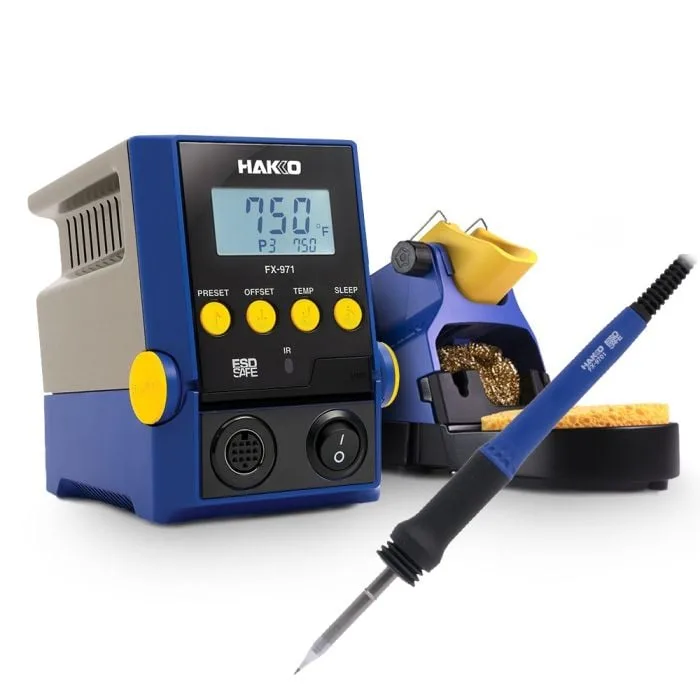
Hakko FX-971 Soldering Station
Buy itA 100 W bench station whose composite T39 tips carry the heater and the sensor inside the tip, which is what lets it recover fast enough to solder heavy copper at a sane temperature.
- The patented composite tip puts the heating element and the sensor inside the tip, so the control loop reads the metal that is actually touching your joint.
- Hakko rates the station at 100 W with the FX-9701 iron drawing 95 W at 24 V, across a 50 to 450 C range.
- ESD safe with tip-to-ground resistance under 2 ohms and tip-to-ground potential under 2 mV.
- T39 cartridge tips cost more than the slip-on T18 tips used by cheaper Hakko stations, and you will want several shapes.
- Tips are a recurring cost, so the real cost of entry is higher than the station price suggests.
- Idle temperature stability is specified at plus or minus 3 C, looser on paper than the cheaper FX-888DX's plus or minus 1 C.
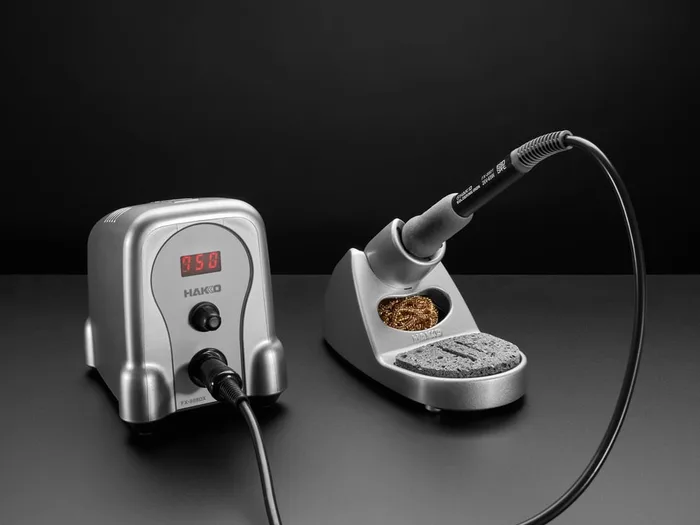
Hakko FX-888DX Digital Soldering Station
Buy itThe default hobby bench station: real closed-loop control, ESD safety, cheap tips, and a heater that lives in the handpiece instead of the tip.
- Hakko USA lists the temperature control as a closed-loop sensor with idle stability of plus or minus 1.0 C across a 50-480 C range.
- ESD safe with tip-to-ground resistance under 2 ohms and potential under 2 mV.
- T18 tips are inexpensive and come in many shapes, so trying a new tip geometry costs little.
- The ceramic heater sits in the FX-8801 handpiece and the T18 tip slides over it, so heat crosses one more interface than in a cartridge design.
- The iron itself draws 65 W at 26 V; the 100 W on the station spec is what the station consumes, not what reaches the joint.
- The display and dial interface takes a little learning.
Side by side
| Hakko FX-971 Soldering Station | Hakko FX-888DX Digital Soldering Station | |
|---|---|---|
| Our verdict | Buy | Buy |
| Best for | Anyone who solders often enough that waiting for the tip to catch up is costing them joints, especially through-hole work into ground planes. | The hobbyist or repair tech who wants a station that will outlast several projects and does not need cartridge-class recovery. |
| Price tier | $$$ · premium | $$ · mid-range |
The bottom line
Our overall pick is the Hakko FX-971 Soldering Station - A 100 W bench station whose composite T39 tips carry the heater and the sensor inside the tip, which is what lets it recover fast enough to solder heavy copper at a sane temperature. Choose the Hakko FX-888DX Digital Soldering Station instead if the hobbyist or repair tech who wants a station that will outlast several projects and does not need cartridge-class recovery.
Want the full picture, including the other options we compared and the popular one we'd skip? Read the complete The Best Soldering Irons and Stations: 4 Compared (and One to Skip).