

Tools & DIY
The Best Splitting Axes and Mauls: 4 Compared (and One to Skip)
We compared four splitting tools on head weight, overall length, handle material, blade geometry, wedge use and warranty, using each maker's published specs.
The short version
The Gränsfors Large Splitting Axe is the best overall: hand-forged in Sweden from high-carbon steel, a concave blade that bites and then pushes the wood apart, a hickory handle in two lengths and a 20 year warranty on axes. The Husqvarna Composite Splitting Axe (Large) is the value pick, with a 27.5 in fiber-reinforced shaft, a coated head and a milled back you can use to tap in non-steel wedges. The Council Tool 7 lb Splitting Maul suits anyone facing big, knotty or frozen rounds, but its weight wears you out on small splits. Skip the Estwing Fireside Friend for firewood rounds: at 14 in long it is a kindling splitter, and it cannot give you the safe, two-handed swing that full rounds need. Best for: Gränsfors if you split every year and want a tool for decades, Husqvarna if you want a tough, low-fuss axe for a few cords.
Our picks at a glance
- Gränsfors Bruk Gränsfors Large Splitting Axe - Buy. A hand-forged Swedish splitting axe with a concave, fairly thin bit, a hickory handle and a 20 year warranty on axes.
- Husqvarna Composite Splitting Axe (Large) - Buy. A 27.5 in composite-handled splitting axe with a coated 5.07 lb head and a milled back for tapping in non-steel wedges.
- Council Tool 7 lb Splitting Maul, Axe Eye "Ol' No. 7" (70MA) - It depends. A 7 lb American-made maul on a 36 in hickory handle, built for big rounds where a lighter axe bounces.
- Estwing Fireside Friend Splitting Tool (E3-FF4) - Skip. A well-made, one-piece forged steel splitter that is only 14 in long, which makes it a kindling tool rather than a firewood splitter.
The verdict in 30 seconds
What mattered most
- Type
- Overall length
- Weight
- Handle
- Head
- Wedge use
Splitting firewood by hand is mostly about letting the tool's weight and geometry do the work, and the wrong tool turns an afternoon at the woodpile into a sore back and a lot of bounced strikes. A splitting axe is lighter and quicker for medium rounds, a maul trades speed for brute force on big or knotty wood, and short splitting hatchets are really for kindling. We picked a hand-forged premium splitting axe, a composite-handled axe with a wedge-ready back, a 7 lb American maul, and a popular short splitter that people buy for the wrong job.
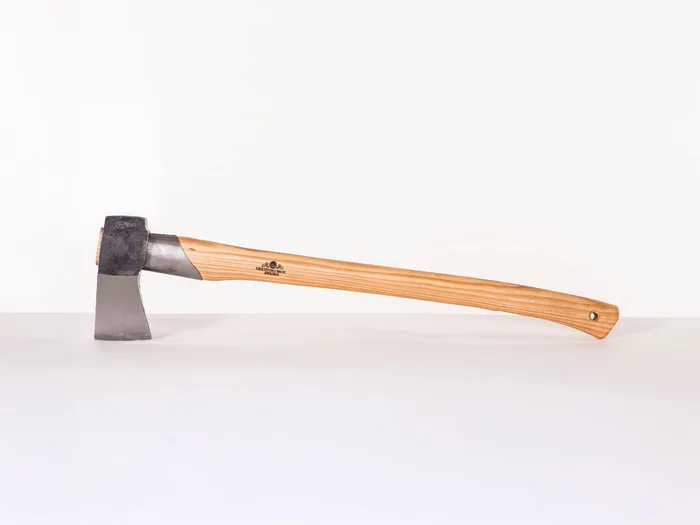
A hand-forged Swedish splitting axe with a concave, fairly thin bit, a hickory handle and a 20 year warranty on axes.
Best for: People who split firewood every season and want a precise, long-lived axe for small to medium rounds.
- Gränsfors forges and grinds the head to a concave, quite thin bit so it enters the wood quickly before the broader section pushes it apart.
- Hickory handle with a protective steel collar under the head and grip grooves near the end, offered in a shorter and a longer version (70 to 80 cm).
- Made in Sweden from recycled high-carbon steel (C55/C60), delivered with a vegetable-tanned leather sheath and a 20 year warranty on axes.
- Gränsfors says splitting axes must not be used to strike a wedge or as a wedge; only its Splitting Maul is designed for that.
- At 2.3 kg it is lighter than a maul, so very large or knotty rounds take more strikes.
- Gränsfors' own store does not list the US among its shipping countries, so US buyers go through retailers.
- A wooden handle needs some care and can break from overstrikes, unlike a composite shaft.
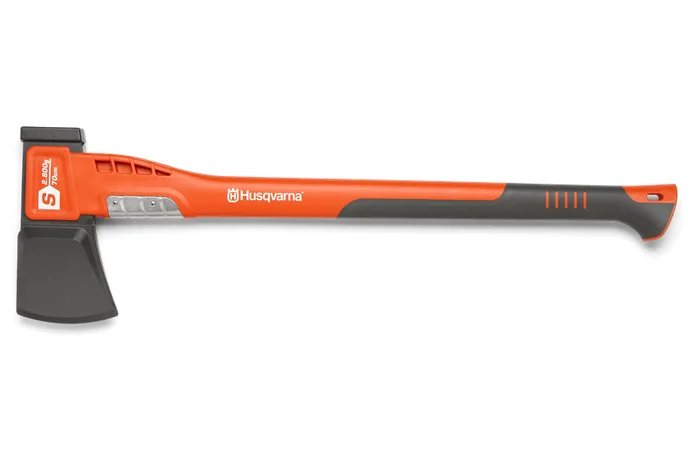
A 27.5 in composite-handled splitting axe with a coated 5.07 lb head and a milled back for tapping in non-steel wedges.
Best for: Homeowners splitting a few cords a year who want a durable, low-maintenance axe that can also drive non-steel wedges.
- Husqvarna lists a 5.07 lb head on a 6.17 lb tool, with the balance point close to the head to concentrate force in the split.
- The fiber-reinforced PA shaft has a stainless steel guard below the head, which protects the spot where wooden handles usually break from overstrikes.
- A non-stick coated head eases entry into the wood, and the milled back works as a hammer for splitting wedges, as long as they are not steel.
- Husqvarna rules out steel wedges, so you need aluminum, plastic or composite wedges for the hammer function.
- At 27.5 in it is shorter than a full-length maul, which gives less swing speed on the biggest rounds.
- The head coating will wear with use, and Husqvarna's page does not state the steel type or a hardness figure.
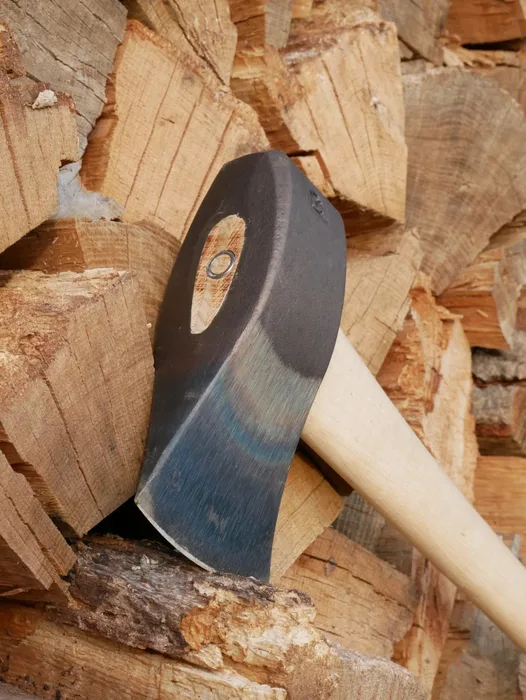
A 7 lb American-made maul on a 36 in hickory handle, built for big rounds where a lighter axe bounces.
Best for: Strong users splitting large, knotty or frozen hardwood rounds who want mass more than speed.
- The 7 lb head has a concave, wedge-shaped blade with a high centerline that Council Tool says helps keep it from sticking.
- A heavy, tapered poll balances the head and puts the center of mass within the eye, which Council Tool says improves accuracy and safety.
- Hung on a 36 in straight American hickory handle and made in Lake Waccamaw, North Carolina.
- Seven pounds of head is tiring over a long session and overkill for small or straight-grained rounds.
- Council Tool does not publish the total tool weight on its page.
- Council Tool sells through dealers, so availability varies by retailer.
- A wooden handle is more exposed to overstrike damage than a guarded composite shaft.
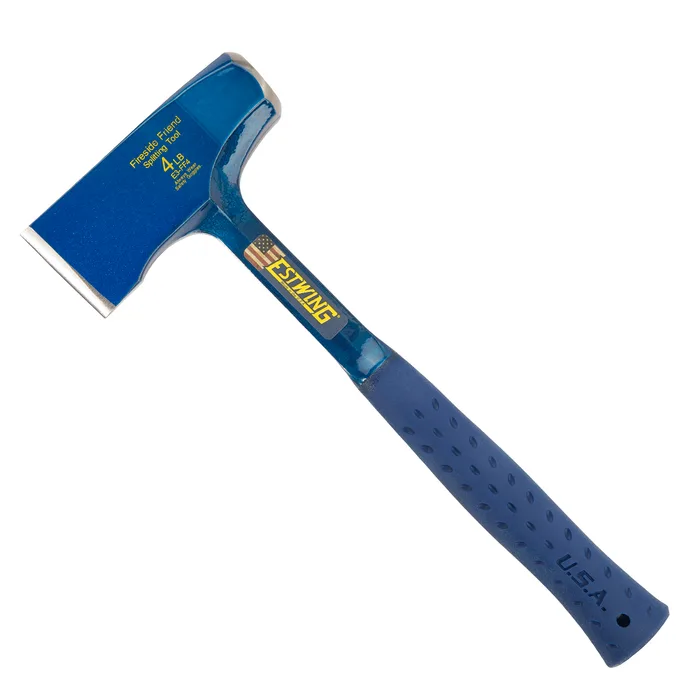
A well-made, one-piece forged steel splitter that is only 14 in long, which makes it a kindling tool rather than a firewood splitter.
Best for: Only for splitting kindling and small pieces at a fireplace or campfire, never as your main firewood tool.
- Head and handle are forged in one piece of American steel, so there is no handle to loosen or break.
- Estwing says its Shock Reduction Grip reduces impact vibration by 70%.
- Comes with a ballistic nylon sheath and is made in the USA.
- At 14 in overall it cannot give you a full two-handed swing, so it lacks the speed and reach a full round needs.
- A short tool keeps your hands and the edge close to your body and legs, which is the wrong geometry for splitting at a chopping block.
- Estwing's page does not list the head or overall weight, so you cannot compare its mass to a full-size axe.
- The 2-3/8 in edge and short handle suit kindling and small splits, not seasoned rounds.
| Criteria | Gränsfors Large Splitting Axe Top pick | Husqvarna Composite Splitting Axe (Large) | Council Tool 7 lb Splitting Maul, Axe Eye "Ol' No. 7" (70MA) | Estwing Fireside Friend Splitting Tool (E3-FF4) |
|---|---|---|---|---|
| Verdict | Buy it | Buy it | It depends | Skip it |
| Best for | People who split firewood every season and want a precise, long-lived axe for small to medium rounds. | Homeowners splitting a few cords a year who want a durable, low-maintenance axe that can also drive non-steel wedges. | Strong users splitting large, knotty or frozen hardwood rounds who want mass more than speed. | Only for splitting kindling and small pieces at a fireplace or campfire, never as your main firewood tool. |
| Price tier | $$$ · premium | $$ · mid-range | $$ · mid-range | $$ · mid-range |
| Type | Splitting axe | Splitting axe | Splitting maul | Short splitting tool |
| Overall length | 70 to 80 cm (two versions) | 27.5 in | Just under 36 in | 14 in |
| Weight | 2.3 kg | 6.17 lb (head 5.07 lb) | 7 lb head, total not published | Not published |
| Handle | Hickory, steel collar | Fiber-reinforced PA, stainless guard | Straight American hickory | One-piece forged steel, rubber grip |
| Head | High-carbon steel C55/C60, concave bit | Coated head, steel type not stated | Concave wedge blade, tapered poll | Forged steel, 2-3/8 in edge |
| Wedge use | No, maker says do not strike wedges | Yes, non-steel wedges only | Not stated | Not stated |
| Sheath | Leather sheath | Edge cover | Not listed | Ballistic nylon sheath |
| Made in / warranty | Sweden / 20 years on axes | Not stated / see Husqvarna | USA / see Council Tool | USA / see Estwing |
Which one is right for you?
- People who split firewood every season and want a precise, long-lived axe for small to medium rounds. Buy it Gränsfors Bruk Gränsfors Large Splitting Axe
- Homeowners splitting a few cords a year who want a durable, low-maintenance axe that can also drive non-steel wedges. Buy it Husqvarna Composite Splitting Axe (Large)
- Strong users splitting large, knotty or frozen hardwood rounds who want mass more than speed. It depends Council Tool 7 lb Splitting Maul, Axe Eye "Ol' No. 7" (70MA)
- Only for splitting kindling and small pieces at a fireplace or campfire, never as your main firewood tool. Skip it Estwing Fireside Friend Splitting Tool (E3-FF4)
How we judged the field
Five things decide how a splitting tool performs. Head weight and geometry come first: a thin, concave bit bites into the wood, while a broad wedge body pushes it apart, and more mass helps on big rounds but tires you faster. Overall length sets swing speed and how far the edge stays from your legs. The handle decides durability, since most broken tools fail just below the head from overstrikes. Wedge compatibility matters because stubborn rounds often need one, and not every axe may be used to drive it. Finally, build quality and warranty tell you whether the tool is meant to last one season or decades.
The field splits into splitting axes, mauls and short splitting hatchets. We picked the Gränsfors Large Splitting Axe as the premium axe, Husqvarna’s Composite Splitting Axe (Large) as the durable value pick, Council Tool’s 7 lb maul for big rounds, and Estwing’s Fireside Friend as the popular short splitter that does not suit firewood rounds. If you are cutting the rounds yourself, see our chainsaws and chainsaw chaps comparisons; if you have a lot of wood, our log splitters review covers powered options.
The Gränsfors Large Splitting Axe is the one to buy if you split every year and want a tool that lasts. Gränsfors forges and grinds the head to a concave, quite thin bit, so it enters the wood quickly, and the broader section behind it then pushes the round apart. The head is Swedish recycled high-carbon steel (C55/C60), the handle is hickory with a protective steel collar below the head and grip grooves near the end, and it comes in a shorter and a longer version between 70 and 80 cm. Gränsfors lists 2.3 kg, includes a vegetable-tanned leather sheath and the axe book, and backs its axes with a 20 year warranty. The trade-offs are real. Gränsfors says not to strike a wedge with it or use it as a wedge, so stubborn rounds need a separate maul, and at 2.3 kg it takes more strikes on big knotty wood. Its own store does not list the US as a shipping country, so US buyers use retailers. It is for regular splitters who value precision.
The Husqvarna Composite Splitting Axe (Large) is the practical value pick. Husqvarna lists a 27.5 in overall length, a 6.17 lb total weight and a 5.07 lb head, with the balance point placed close to the head so the light shaft concentrates force in the split. The shaft is fiber-reinforced PA with a stainless steel guard below the head, which protects exactly the spot where wooden handles crack after an overstrike, and the hooked end and soft grip help you hold on. The head has a non-stick coating to reduce friction going into the wood, and the milled back works as a hammer for splitting wedges, as long as they are not steel. That restriction is the main catch: you need aluminum, plastic or composite wedges. Husqvarna does not publish the steel type, and the coating will wear over time. It comes with an edge cover. For homeowners splitting a few cords a year who want an axe they can leave in the shed without worrying about the handle, it is the easy choice.
The Council Tool 7 lb Splitting Maul, nicknamed Ol’ No. 7, is for big wood. Council Tool designed it to sit between its old 6 lb and 8 lb mauls, with a compact head, a concave wedge-shaped blade and a high centerline that it says helps keep the head from sticking. The heavy, tapered poll balances the head front to back and puts the center of mass within the eye, which Council Tool says improves strike accuracy and safety, and you can use the poll to finish a split without driving the blade back into the stump. It is hung on a 36 in straight American hickory handle, finished slightly shorter, and made in Lake Waccamaw, North Carolina. The cost is effort: seven pounds of head is tiring over a long session and overkill on small, straight-grained rounds, and Council Tool does not publish the total weight. It sells through dealers. Buy it if your woodpile is full of large, knotty or frozen hardwood rounds and you have the strength to swing it.
The Estwing Fireside Friend is a well-made tool sold into the wrong job. Estwing forges the head and handle in one piece of American steel, adds its Shock Reduction Grip, which it says cuts impact vibration by 70%, and includes a ballistic nylon sheath. There is no handle to loosen or break, and it is made in the USA. The problem is the 14 in overall length. Splitting a full round safely and efficiently needs a two-handed swing with your feet planted, so the head arrives with speed and the arc finishes in the wood or block rather than near your legs. A 14 in tool cannot do that, so you end up chopping one-handed close to your body or kneeling over the round, and a glancing blow lands much nearer to you. Estwing’s page also leaves out the weight, so you cannot compare its mass to a full-size axe. Keep it, if you like it, for kindling at the fireplace; buy a full-length axe or maul for firewood.
Gränsfors Bruk Gränsfors Large Splitting Axe vs Husqvarna Composite Splitting Axe (Large): which should you buy?
The Gränsfors and the Husqvarna are both splitting axes, but they come at the job differently. Gränsfors relies on a hand-forged, fairly thin concave bit and a 2.3 kg tool that bites cleanly and stays accurate, with a hickory handle, a leather sheath and a 20 year warranty on axes. Husqvarna puts a heavier 5.07 lb coated head on a guarded composite shaft, which takes abuse and weather better and lets you drive non-steel wedges with the back of the head, something Gränsfors tells you not to do with its axe.
Choose the Gränsfors if you split regularly, enjoy a precise tool and are happy to keep a separate maul or sledge for wedges. Choose the Husqvarna if you want one tool that handles most rounds, survives overstrikes and can tap in a plastic or aluminum wedge when a round fights back. If your wood is mostly big and knotty, neither replaces a maul like the Council Tool.
What to look for
- Axe or maul: Pick an axe for small to medium straight-grained rounds and a maul for large, knotty or frozen wood.
- Overall length: A full-length handle gives a safe two-handed swing; tools around 14 in are for kindling only.
- Head geometry: A thin, concave bit bites into the wood while a wide body pushes it apart, and a high centerline helps stop the head sticking.
- Handle protection: Look for a steel collar or guard below the head, because overstrikes are what break most handles.
- Wedge rules: Check whether the maker allows striking wedges and with what kind, since some axes forbid it and others allow only non-steel wedges.
- Sheath and warranty: A real edge cover and a long warranty on the head are signs the maker expects the tool to last.
Our final take
For most people who heat with wood or burn a few cords a year, the Gränsfors Large Splitting Axe is the best splitting tool you can buy, with a hand-forged high-carbon head, a hickory handle and a 20 year warranty on axes. The Husqvarna Composite Splitting Axe (Large) costs less, shrugs off overstrikes and drives non-steel wedges, which makes it the better all-rounder for many homeowners. Add the Council Tool 7 lb maul if your rounds are big and knotty. Leave the Estwing Fireside Friend for kindling; at 14 in it is not a firewood splitter.
Questions, answered
Splitting axe or maul: which should I buy?
A splitting axe is lighter and faster, and it handles small to medium rounds of straight-grained wood with less fatigue. A maul carries more mass, so it opens big, knotty or frozen rounds that make an axe bounce, at the cost of tiring you out sooner. If most of your wood is under about a foot across and reasonably clean, start with an axe like the Gränsfors or Husqvarna. If you split large hardwood rounds, a maul like the Council Tool 7 lb is the better tool, and many people own one of each.
Can I hit a splitting wedge with my axe?
Only if the maker says so. Gränsfors says its splitting axes must not be used to strike a wedge or as a wedge, and reserves that job for its Splitting Maul. Husqvarna builds a milled back into its Composite Splitting Axe for hammering wedges, but only non-steel ones. Hitting a steel wedge with a tool not made for it can mushroom or crack the poll and send chips flying.
Is a composite handle better than hickory?
Composite handles shrug off weather and, with a guard like Husqvarna's stainless shaft protection, survive the overstrikes that crack wooden handles just below the head. Hickory absorbs shock well, feels good in the hand and can be replaced when it breaks, which suits a hand-forged head meant to last decades. Neither is wrong; composite is lower maintenance, hickory is repairable. Keep a wooden handle out of the rain and check the head for looseness.
Why is a short splitting tool a bad choice for firewood?
A full round needs a two-handed swing with your feet planted, so the head arrives with speed and the arc ends in the wood or the block instead of near your legs. A 14 in tool like the Estwing Fireside Friend cannot give you that swing, so you either chop one-handed close to your body or kneel over the round. It is fine for splitting kindling from pieces that are already small. For rounds, use a full-length axe or maul.
What safety gear do I need for splitting wood?
Eye protection is the first item, since chips and bark fly off the round. Sturdy boots and work gloves protect your feet and hands, and our work gloves comparison covers grippy options. Split on a solid chopping block at a comfortable height so the edge does not end its swing in the dirt or near your shins. Keep other people and pets well clear of your swing arc.
Deciding between the top two? See our head-to-head: Gränsfors Bruk Gränsfors Large Splitting Axe vs Husqvarna Composite Splitting Axe (Large).
More Tools & DIY reviews
 The Best Step Ladders: 4 Compared (and One to Skip)
  The Best Stud Finders: 4 Compared (and One to Skip)
  The Best Table Saws: 4 Compared (and One to Skip)
  The Best Tape Measures: 4 Compared (and One to Skip)
  The Best Thermal Imaging Cameras: 4 Compared (and One to Skip)
  The Best Torque Screwdrivers: 4 Compared (and One to Skip)