

Tools & DIY
The Best Step Ladders: 4 Compared (and One to Skip)
Four step ladders compared on the number that decides which one is safe for you: the ANSI duty rating, which is a working load counting you, your clothing, your PPE and every tool and material on the ladder, not your body weight.
The short version
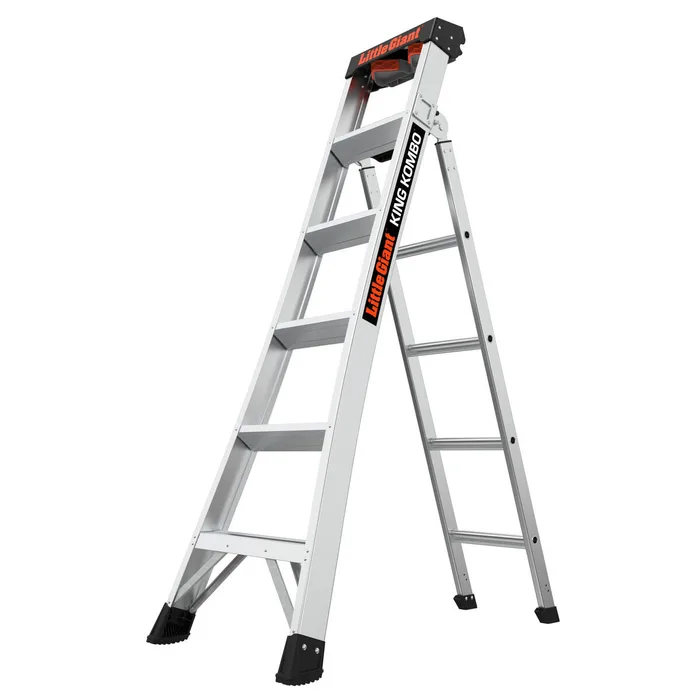
Buy the Little Giant King Kombo 2.0 in aluminium, part 14906-001. Little Giant's own spec page rates it ANSI Type IA at 300 pounds, puts it at 21.5 pounds to carry, and lists the warranty as Limited Lifetime, which is the longest published cover of anything here. Buy the Louisville FS2006 instead if you go anywhere near live wiring: it is fiberglass, so it satisfies the nonconductive siderail requirement in OSHA 1910.333(c)(7), and at 17 pounds with a Type I 250 pound rating it is the cheapest way to be legal near a panel. The fiberglass King Kombo is the it-depends: Little Giant rates it Type IAA at 375 pounds, the highest here, but its published warranty is 1-Year against the aluminium version's Limited Lifetime, which is a strange gap between two ladders sharing a name. Skip the Cosco Lite Solutions 20-552ABL for real work. It is a Type II at 225 pounds and it is aluminium, so it fails the working load arithmetic for an adult carrying tools and it is the wrong material for the exact job it gets bought for. Best for: anyone who has been buying ladders on height and price and has never once checked what the duty rating is actually counting.
Our picks at a glance
- Little Giant King Kombo 2.0 3-in-1 Combination Ladder, aluminium, 6 ft (14906-001) - Buy. The only ladder here that pairs a 300 pound Type IA rating with a Limited Lifetime warranty, and it converts between three configurations.
- Louisville Ladder FS2006 6 ft Fiberglass Step Ladder, Type I 250 lb - Buy. The cheapest way to satisfy the nonconductive siderail rule, and the lightest ladder here at 17 pounds.
- Little Giant King Kombo Professional 3-in-1 Combination Ladder, fiberglass (13470-071) - It depends. The highest duty rating here at Type IAA 375 pounds, sold with a published warranty far shorter than its aluminium twin.
- Cosco Lite Solutions 3-Step Aluminium Folding Step Ladder, 5 ft (20-552ABL) - Skip. A Type II aluminium ladder at 225 pounds, which is the wrong rating and the wrong material for the jobs it gets bought for.
The verdict in 30 seconds
What mattered most
- ANSI duty rating
- Siderail material
- Legal near exposed energized parts
- Published product weight
- Published warranty
- Configurations
Every step ladder in a shop has a number on it, and almost everybody reads that number wrong. A 225 pound rating is not a limit on how much you weigh. The American Ladder Institute defines the working load as the combined weight of the user, any special clothing or protective equipment worn, and the total weight of all tools, supplies and material to be carried and stored on the ladder, and it says that working load shall not exceed the duty rating. A 190 pound person in boots with a 20 pound tool bag and a gallon of paint is already past a Type II. The second thing nobody reads is the material, and that one is not a preference. OSHA 1910.333(c)(7) requires portable ladders to have nonconductive siderails where the worker or the ladder could contact exposed energized parts, which is the light fixture job most people buy a household ladder for.
The only ladder here that pairs a 300 pound Type IA rating with a Limited Lifetime warranty, and it converts between three configurations.
Best for: Someone who wants one ladder for a whole house and is not working on live circuits.
- Little Giant's spec page lists it as ANSI Type IA - Extra Heavy Duty at 300 lb (136 kg), which clears the working load of an adult carrying a full tool bag.
- Published product weight is 21.5 lb (9.75 kg), so the Type IA rating does not cost you a ladder you avoid carrying.
- The warranty field on Little Giant's own SKU page reads Limited Lifetime, against 1-Year for the fiberglass King Kombo.
- Converts between stepladder, extension and a wall-leaning configuration, and Little Giant states the straight-line legs are narrow enough to fit between studs.
- Aluminium, so OSHA 1910.333(c)(7) rules it out anywhere the ladder or the user could contact exposed energized parts.
- A combination ladder has hinges and locks that a plain stepladder does not, and Little Giant publishes no cycle life for them.
- Costs several times a plain fiberglass stepladder of the same rating.
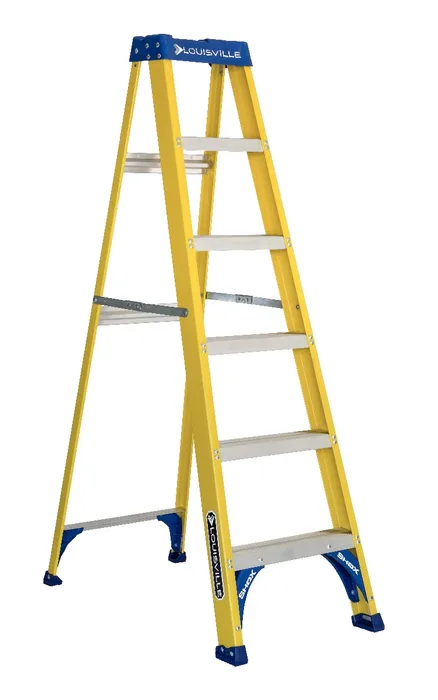
The cheapest way to satisfy the nonconductive siderail rule, and the lightest ladder here at 17 pounds.
Best for: Anyone whose ladder will ever be near a panel, a fixture or a service drop.
- Fiberglass siderails, which is what OSHA 1910.333(c)(7) requires where contact with exposed energized parts is possible.
- Louisville publishes 17 lb product weight and a 124 in maximum reach height, so both the carry and the reach are numbers rather than guesses.
- Louisville states the ladder meets or exceeds the safety standards set by ANSI and OSHA.
- The ProTop has multiple tool slots, which matters because tools left on a step are what the duty rating is quietly counting.
- Type I at 250 lb is the lowest usable rating here, so a heavy user with a loaded bag should size up to a Type IA.
- Fiberglass rails chalk and degrade in sustained UV, and Louisville publishes no service life figure.
- A single-configuration stepladder, so no leaning or extension use.
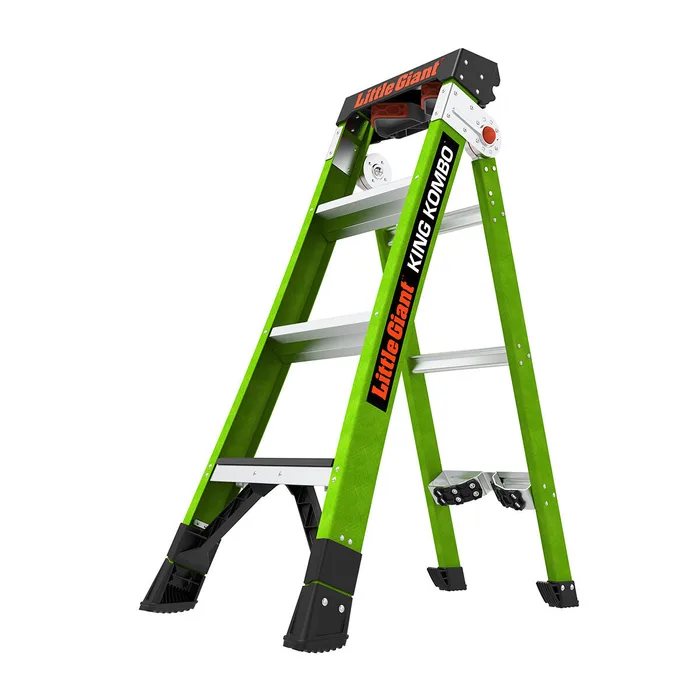
The highest duty rating here at Type IAA 375 pounds, sold with a published warranty far shorter than its aluminium twin.
Best for: A working electrician who genuinely needs both nonconductive rails and a 375 pound working load, and who has read the warranty term.
- ANSI Type IAA - Special Duty at 375 lb, the highest working load of anything in this comparison.
- Fiberglass, so it is usable where OSHA 1910.333(c)(7) rules out the aluminium version.
- Published product weight of 21 lb, essentially the same carry as the aluminium King Kombo despite the higher rating.
- Little Giant's spec page lists the warranty as 1-Year, where the aluminium King Kombo 2.0 page lists Limited Lifetime for a ladder of the same name.
- You pay a premium price for a Type IAA rating that almost no individual user's working load will ever approach.
- Combination-ladder hinges plus fiberglass rails is the most mechanically complex option here.
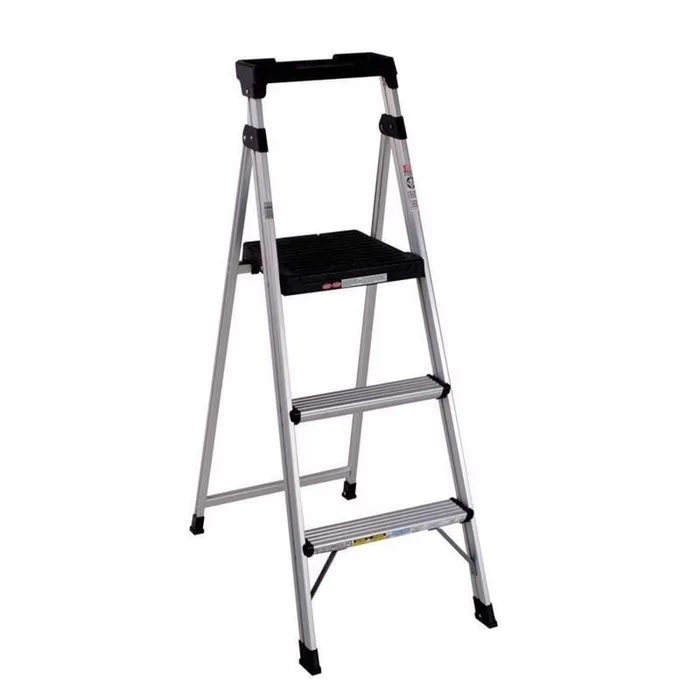
A Type II aluminium ladder at 225 pounds, which is the wrong rating and the wrong material for the jobs it gets bought for.
Best for: Reaching a high cupboard empty-handed, and genuinely nothing heavier than that.
- At a published 7.48 lb it is by far the lightest thing here, and it folds flat.
- Cosco publishes a 10-year limited warranty, which is longer than the fiberglass King Kombo's 1-Year.
- The large platform step is genuinely more comfortable to stand on than a rung.
- Type II at 225 lb is a working load, so a 190 lb adult in boots with a 20 lb tool bag and a gallon of paint is already over it.
- Aluminium, which OSHA 1910.333(c)(7) rules out where contact with exposed energized parts is possible, and changing a light fixture is the archetypal use.
- Five feet of ladder with three steps, so the usable standing height is low for anything above head height.
| Criteria | King Kombo 2.0 3-in-1 Combination Ladder, aluminium, 6 ft (14906-001) Top pick | FS2006 6 ft Fiberglass Step Ladder, Type I 250 lb | King Kombo Professional 3-in-1 Combination Ladder, fiberglass (13470-071) | Lite Solutions 3-Step Aluminium Folding Step Ladder, 5 ft (20-552ABL) |
|---|---|---|---|---|
| Verdict | Buy it | Buy it | It depends | Skip it |
| Best for | Someone who wants one ladder for a whole house and is not working on live circuits. | Anyone whose ladder will ever be near a panel, a fixture or a service drop. | A working electrician who genuinely needs both nonconductive rails and a 375 pound working load, and who has read the warranty term. | Reaching a high cupboard empty-handed, and genuinely nothing heavier than that. |
| Price tier | $$$ · premium | $$ · mid-range | $$$ · premium | $ · budget |
| ANSI duty rating | Type IA, 300 lb | Type I, 250 lb | Type IAA, 375 lb | Type II, 225 lb |
| Siderail material | Aluminium | Fiberglass | Fiberglass | Aluminium |
| Legal near exposed energized parts | No | Yes | Yes | No |
| Published product weight | 21.5 lb | 17 lb | 21 lb | 7.48 lb |
| Published warranty | Limited Lifetime | Not stated on the product page | 1-Year | 10-year limited |
| Configurations | 3-in-1 combination | Stepladder only | 3-in-1 combination | Stepladder only |
| Height or reach published | 6 ft | 124 in max reach | Not published for this SKU | 5 ft |
Which one is right for you?
- Someone who wants one ladder for a whole house and is not working on live circuits. Buy it Little Giant King Kombo 2.0 3-in-1 Combination Ladder, aluminium, 6 ft (14906-001)
- Anyone whose ladder will ever be near a panel, a fixture or a service drop. Buy it Louisville Ladder FS2006 6 ft Fiberglass Step Ladder, Type I 250 lb
- A working electrician who genuinely needs both nonconductive rails and a 375 pound working load, and who has read the warranty term. It depends Little Giant King Kombo Professional 3-in-1 Combination Ladder, fiberglass (13470-071)
- Reaching a high cupboard empty-handed, and genuinely nothing heavier than that. Skip it Cosco Lite Solutions 3-Step Aluminium Folding Step Ladder, 5 ft (20-552ABL)
How we judged the field
Four things decide a step ladder, and only one of them is on the shelf label. First, the duty rating, which is a working load rather than a bodyweight limit, so the honest comparison is the rating against you plus your clothing plus your PPE plus every tool and material that will be on the ladder. Second, the siderail material, because OSHA 1910.333(c)(7) turns fiberglass from a preference into a requirement wherever contact with exposed energized parts is possible, and that covers most of the reasons a ladder comes out of the garage. Third, the published product weight, because a ladder you resent carrying is a ladder you replace with a chair. Fourth, the warranty term, which for ladders is the only durability number any maker will commit to in writing, and which turned out to run from Limited Lifetime to 1-Year between two ladders that share a product name.
Little Giant King Kombo 2.0 3-in-1 Combination Ladder, aluminium, 6 ft (14906-001)
Buy itThe aluminium King Kombo 2.0, part 14906-001, is the pick because its published numbers line up better than anything else here. Little Giant lists it as ANSI Type IA - Extra Heavy Duty at 300 lb (136 kg), which comfortably covers the working load of an adult carrying a loaded tool bag, and it does that at a published 21.5 lb (9.75 kg), so the higher rating has not been bought with a ladder you leave in the garage. The warranty field on Little Giant’s own SKU sheet reads Limited Lifetime. It converts between stepladder, extension and leaning configurations, and Little Giant specifically states the straight-line legs are narrow enough to fit between studs, which is the kind of claim that only matters once you have tried to get a conventional A-frame into a stud bay. The disqualifying trait is the material: it is aluminium, so OSHA 1910.333(c)(7) takes it off the job anywhere the ladder or the user could contact exposed energized parts. Buy it for carpentry, painting and reaching, and own something else for the fixture work.
Louisville Ladder FS2006 6 ft Fiberglass Step Ladder, Type I 250 lb
Buy itThe Louisville FS2006 is the runner-up and, for most households, quietly the more sensible purchase. It is fiberglass, which is the entire point: OSHA 1910.333(c)(7) requires nonconductive siderails where contact with exposed energized parts is possible, and that requirement covers the ceiling fixture and service panel jobs people actually buy ladders for. Louisville publishes 17 lb of product weight and 124 in of maximum reach height, and states the ladder meets or exceeds the safety standards set by ANSI and OSHA. The ProTop carries multiple tool slots, which is worth more than it sounds given that the duty rating is counting every tool you bring up with you. The limitation is that rating: Type I at 250 lb is the lowest usable figure in this group, so a heavier user with a full bag should be looking at a Type IA instead. It is also a single-configuration stepladder, with no leaning or extension use, and fiberglass rails chalk under sustained UV with no published service life to tell you when that matters.
Little Giant King Kombo Professional 3-in-1 Combination Ladder, fiberglass (13470-071)
It dependsThe fiberglass King Kombo, 13470-071, is the it-depends because it is simultaneously the strongest ladder here and the one with the shortest published warranty. Little Giant rates it ANSI Type IAA - Special Duty at 375 lb, the highest working load in this comparison, and gets there at a published 21 lb, essentially the same carry as the aluminium version rated 75 lb lower. Being fiberglass, it is usable in exactly the electrical situations that rule out its aluminium twin. Then you read the warranty field, and Little Giant’s own pages give it 1-Year where the aluminium King Kombo 2.0 gets Limited Lifetime. That is the same product name, the more expensive material, the higher rating, and a fraction of the cover. Fiberglass does degrade under UV in a way aluminium does not, which is the obvious explanation, but no maker publishes a service life for fiberglass rails, so the warranty term is the only signal available and this one is pointing down. Worth it if you genuinely need 375 lb and nonconductive rails together; otherwise the arithmetic favours the other two.
Cosco Lite Solutions 3-Step Aluminium Folding Step Ladder, 5 ft (20-552ABL)
Skip itThe Cosco Lite Solutions 20-552ABL is the skip, and not because it is badly made. At a published 7.48 lb it is by far the lightest thing here, it folds flat, the large platform step is more comfortable than a rung, and Cosco publishes a 10-year limited warranty, which is ten times the fiberglass King Kombo’s. The problem is that it gets bought for work it is not rated for, twice over. It is a Type II at 225 lb, and since that is a working load rather than a bodyweight limit, a 190 lb adult in boots with a 20 lb tool bag and a gallon of paint has already gone past it before climbing. And it is aluminium, which OSHA 1910.333(c)(7) rules out wherever contact with exposed energized parts is possible, which is a precise description of changing a light fixture. Five feet with three steps also puts the usable standing height low for anything meaningfully above head height. As a kitchen ladder for reaching a high cupboard empty-handed it is fine, and that is the whole of its remit.
Sources
Specs in this review come from these pages.
- ANSI/ALI A14.2, Ladders - Portable Metal - Safety Requirements, American Ladder Institute (americanladderinstitute.org)
- American Ladder Institute, Choosing the Right Ladder (duty ratings and working load definition) (americanladderinstitute.org)
- OSHA 29 CFR 1910.333, Selection and use of work practices (osha.gov)
- Little Giant Ladders, King Kombo 2.0 product specifications (littlegiantladders.com)
- Little Giant Ladders, SKU 14906-001 specification sheet (info.littlegiantladders.com)
- Louisville Ladder, FS2006 6-foot fiberglass step ladder (louisvilleladder.com)
Little Giant King Kombo 2.0 3-in-1 Combination Ladder, aluminium, 6 ft (14906-001) vs Louisville Ladder FS2006 6 ft Fiberglass Step Ladder, Type I 250 lb: which should you buy?
The two King Kombos are the interesting pair, because they are the same design in two materials and Little Giant’s own pages disagree about how long they will stand behind them. The aluminium 14906-001 is Type IA at 300 pounds, weighs 21.5 pounds and carries a Limited Lifetime warranty. The fiberglass version is rated higher, Type IAA at 375 pounds, weighs about the same at 21 pounds, and its warranty field reads 1-Year. Buying the stronger, more expensive, regulation-satisfying version of the same ladder gets you a much shorter warranty. Against those, the Louisville FS2006 is the unglamorous answer: Type I at 250 pounds is a lower rating, but it is fiberglass, it is the lightest full-size ladder here at 17 pounds, and it costs a fraction of either King Kombo. For a homeowner who mostly needs to be legal and light near a fixture, the cheap one is the right one.
What to look for
- The ANSI type, before anything else: it decides whether the rest of the listing is even relevant to you, and it is the spec most often buried under height and price.
- Your own working load, worked out once: the American Ladder Institute counts the user, clothing, PPE and every tool, supply and material carried or stored on the ladder, so the honest comparison is that total against the rating, not your bodyweight against it.
- Siderail material matched to the job: OSHA 1910.333(c)(7) requires nonconductive siderails where the worker or ladder could contact exposed energized parts, which makes fiberglass a legal question rather than a taste one.
- A published product weight: a ladder you resent carrying is a ladder you replace with a chair, and the makers who publish this figure are the ones confident in it.
- The warranty term, read per material: for ladders it is the only durability figure any maker commits to in writing, and it runs from Limited Lifetime to 1-Year between two ladders that share a product name.
- Maximum standing height rather than nominal size: the top cap is a tool tray and a structural member, and the maker’s own figure tells you which step they intend you to stop at.
Our final take
Step ladders are a category where the number on the sticker is doing something other than what buyers think. Read the duty rating as a total that includes your tools, then read the siderail material as a legal question rather than a taste one, and most of the decision makes itself. The Cosco is not a bad object for what it is, but a 225 pound aluminium ladder is sold into a job that regularly exceeds both of its limits at once.
Questions, answered
Does a 300 pound duty rating mean I can weigh up to 300 pounds?
No. The American Ladder Institute defines the working load as the combined weight of the user, any special clothing or protective equipment worn, and the total weight of all tools, supplies and material to be carried and stored on the ladder, and it states the working load shall not exceed the duty rating. Your body weight is one term in that sum. A 190 pound person wearing boots and a tool belt, carrying a 20 pound bag and a gallon of paint, is running a working load somewhere near 240 pounds and has already exceeded a Type II ladder rated at 225.
What are the ANSI ladder types, in order?
There are five. Type IAA is Special Duty at 375 pounds, Type IA is Extra Heavy Duty at 300 pounds, Type I is Heavy Duty at 250 pounds, Type II is Medium Duty at 225 pounds, and Type III is Light Duty at 200 pounds. The counterintuitive part is that the numbering runs the opposite way to the strength, so Type III is the weakest rating rather than the strongest.
Do I actually need a fiberglass ladder, or is that just upselling?
It is a regulation, not an upsell, whenever electricity is in reach. OSHA 1910.333(c)(7) requires portable ladders to have nonconductive siderails if they are used where the employee or the ladder could contact exposed energized parts, and 1910.23(b)(4) and 1926.1053(b)(4) prohibit metal or wire-reinforced ladders near live conductors or equipment. Changing a ceiling fixture or working at a panel is exactly that situation, which is awkward because the light aluminium household ladder is the one most people reach for to do it.
Why is the fiberglass King Kombo's warranty shorter than the aluminium one's?
Little Giant does not explain it, but their own SKU pages are where the difference shows up: the aluminium King Kombo 2.0 lists the warranty as Limited Lifetime, while the fiberglass King Kombo pages list 1-Year. Fiberglass rails do degrade under sustained UV in a way aluminium does not, which is the obvious guess, but no maker publishes a service life figure for fiberglass rails, so the warranty term is the only number you are given.
Is a taller ladder always the safer choice?
No, because the duty rating and the standing height are separate decisions and a taller ladder tempts you onto the top steps. The usable standing height of a stepladder is well below its nominal length, which is why makers publish a maximum standing height separately from the ladder size. Louisville publishes 124 inches of maximum reach for a six foot FS2006, and that reach figure already assumes a person of average height with an arm raised, not standing on the cap.
Deciding between the top two? See our head-to-head: Little Giant King Kombo 2.0 3-in-1 Combination Ladder, aluminium, 6 ft (14906-001) vs Louisville Ladder FS2006 6 ft Fiberglass Step Ladder, Type I 250 lb.
More Tools & DIY reviews
 The Best Stud Finders: 4 Compared (and One to Skip)
  The Best Table Saws: 4 Compared (and One to Skip)
  The Best Tape Measures: 4 Compared (and One to Skip)
  The Best Thermal Imaging Cameras: 4 Compared (and One to Skip)
  The Best Torque Screwdrivers: 4 Compared (and One to Skip)
  The Best Utility Knives: 4 Compared (and One to Skip)