

Tech & Gadgets
The Best Thermal Paste: 4 Compared (and One to Skip)
We compared four CPU thermal interface materials on what their makers actually publish: electrical behaviour, metal compatibility, burn-in, and stated service life. The headline W/mK number turned out to be the least useful spec of the lot.
The short version
Noctua NT-H2 is the best all-round choice: not electrically conductive, safe on copper or aluminium coolers, no burn-in, and Noctua states a recommended usage time of up to five years on the CPU, which few makers will commit to. Arctic MX-6 is the value pick and gives up very little, and Arctic publishes volume resistivity, breakdown voltage and a continuous-use range instead of a conductivity number, on the stated grounds that the industry inflates those numbers. Thermal Grizzly Conductonaut is a genuinely different product, a gallium-indium-tin liquid metal that is electrically conductive and that Thermal Grizzly says must not be brought into contact with aluminium, so it suits experienced builders working on nickel-plated copper and nobody else. Arctic Silver 5 is the one to skip: its own maker describes it as very slightly capacitive and says it needs up to 200 hours and several thermal cycles to reach full performance. Treat the W/mK arms race with caution. Thermal Grizzly's own Kryonaut datasheet plots its whole paste range on one test and the gap from its cheapest paste to its best is about 2.6 degrees, with only 0.06 degrees between the flagship and the standard version. Best for: anyone mounting a cooler who wants the boring, safe, long-lived option rather than the biggest number on the box.
Our picks at a glance
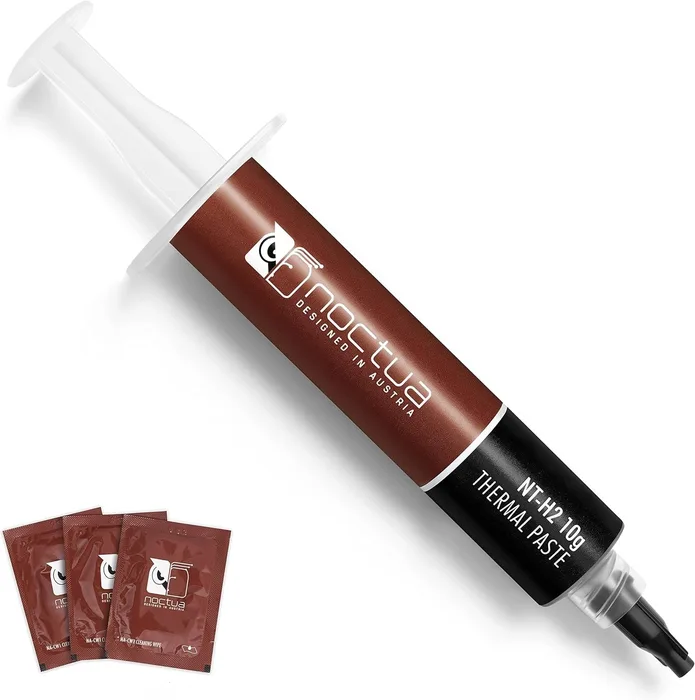
- Noctua NT-H2 - Buy. The safe default: non-conductive, non-corroding, no burn-in, and the only paste here with a published service life on the CPU.
- Arctic MX-6 - Buy. The value pick, and the only maker here that explains in writing why it refuses to print a W/mK number.
- Thermal Grizzly Conductonaut - It depends. A gallium-indium-tin liquid metal that genuinely outperforms grease and will genuinely destroy an aluminium cooler.
- Arctic Silver 5 - Skip. A well-made compound from an earlier era that still asks you to wait 200 hours and still carries a capacitance warning.
The verdict in 30 seconds
What mattered most
- Composition family
- Published W/mK and test method
- Electrically conductive
- Aluminium cooler safe
- Burn-in or cure
- Operating temperature
Thermal paste is one of the cheapest parts in a build and one of the most argued about. The spec everyone quotes is thermal conductivity in watts per metre-kelvin, so we went looking for it on manufacturer spec sheets and mostly did not find it. Noctua, Arctic, Thermal Grizzly and Arctic Silver all publish technical data for their current pastes without listing a W/mK figure anywhere on the product page. That absence tells you more about this category than any number would, so we judged these four on the things the makers are willing to put in writing.
The safe default: non-conductive, non-corroding, no burn-in, and the only paste here with a published service life on the CPU.
Best for: Anyone who wants to mount a cooler once, forget about it, and never worry about what the cooler base is made of.
- Noctua states a recommended usage time of up to five years on the CPU and up to three years of storage before use (per its spec page at the time of writing).
- Described as not electrically conductive and non-corroding, and safe on copper or aluminium coolers whether or not they are nickel-plated.
- No break-in or burn-in period, so the temperature you see on day one is the temperature you keep.
- Noctua publishes no thermal conductivity figure and no test standard, so there is nothing to compare on paper.
- The 3.5 g syringe covers fewer mounts than the 10 g, so heavy re-mounters will want the larger size.
- Costs noticeably more per gram than the Arctic pastes for a difference most builds will not measure.
- No published pump-out or thermal-cycling test data behind the five-year figure.
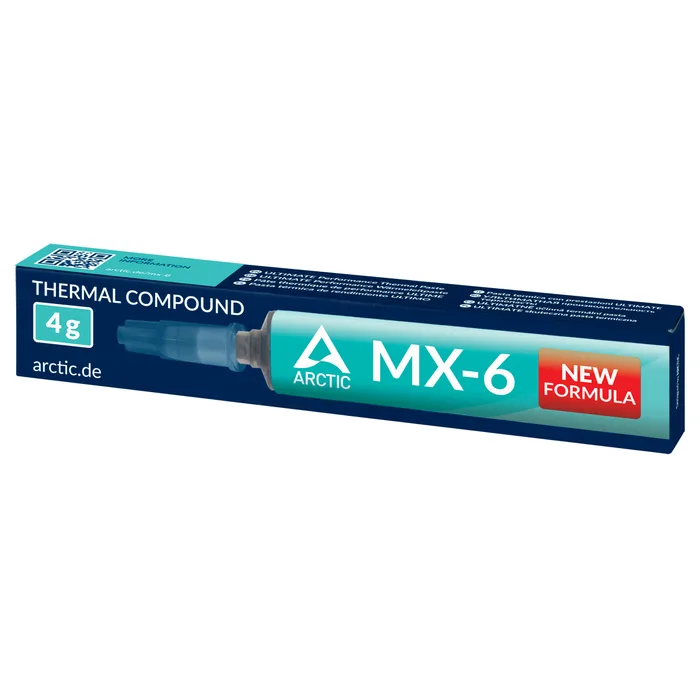
The value pick, and the only maker here that explains in writing why it refuses to print a W/mK number.
Best for: The builder who wants the safety fundamentals covered and would rather spend the difference on a better cooler.
- Publishes the electrical specs that actually matter near pins: volume resistivity of 1.8 x 10^12 Ohm-cm and breakdown voltage of 7.5 kV/mm.
- Stated to be neither electrically conductive nor capacitive, and free of liquid metal components.
- Reaches full performance immediately with no burn-in, and comes in 2 g, 4 g and 8 g resealable syringes.
- At 45,000 poise it is too stiff to spread with a spatula, so you have to trust the cooler's mounting pressure.
- Continuous use temperature tops out at 150 C, lower than the 200 C the other two greases here claim.
- Arctic has shipped several silent revisions of MX-6, so a syringe bought today may not match one from a couple of years ago.
- No published conductivity number at all, which makes cross-shopping on paper impossible by design.
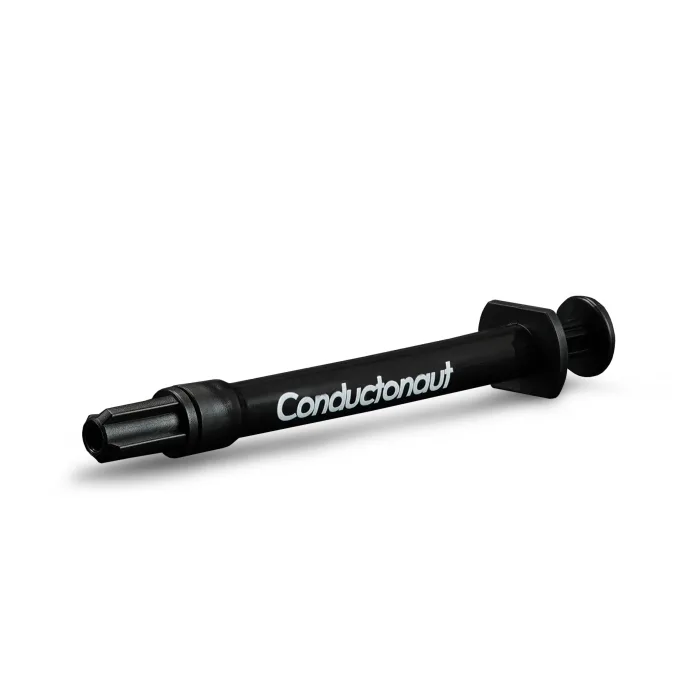
A gallium-indium-tin liquid metal that genuinely outperforms grease and will genuinely destroy an aluminium cooler.
Best for: Experienced builders delidding or direct-die mounting onto a nickel-plated copper block, who have somewhere to put insulation tape.
- Being liquid rather than a filled grease, it forms an extremely thin bond line and fills surface irregularities that particles cannot.
- Rated for an operating range of -50 C to 200 C, with a density of 6.24 g/cm3 and no silicone in the mix.
- Ships with a metal needle for dosing, a plastic needle for taking excess back into the syringe, cotton swabs and cleaning pads.
- Electrically conductive, so a single stray bead near pins or passives can kill the board.
- Thermal Grizzly states it must not be used with aluminium coolers and lists aluminium under substances to be avoided in the safety data sheet.
- The safety sheet also notes it amalgamates with copper, tin, zinc, gold and silver, so bare copper stains and Thermal Grizzly recommends nickel-plated bases.
- It can diffuse into the heat spreader and make the engraved markings illegible, which Thermal Grizzly warns may void the CPU warranty.
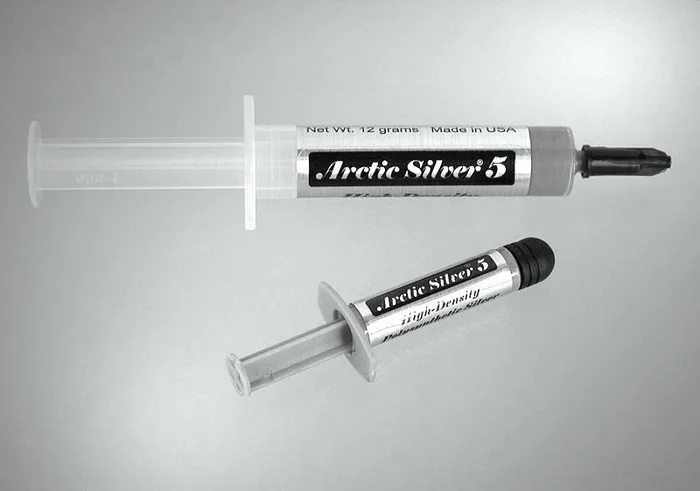
A well-made compound from an earlier era that still asks you to wait 200 hours and still carries a capacitance warning.
Best for: Restoring a period-correct build, or people who already have a syringe and are not putting it near exposed pins.
- Genuinely dense filler load: over 88 percent thermally conductive filler by weight, including micronised silver at under 0.49 micron average particle size.
- Contains no silicone, using a polysynthetic oil carrier that Arctic Silver says will not separate, run, migrate or bleed.
- Long-term rating of -50 C to 130 C with a peak above 180 C, and it is RoHS3 compliant.
- Needs up to 200 hours and several thermal cycles to reach full performance, and the machine has to be switched off periodically to cool.
- Arctic Silver states the compound is not electrically conductive but is very slightly capacitive and could cause problems if it bridges close electrical paths.
- Nothing else on this list asks you to wait; two of the three competitors here explicitly need no burn-in at all.
- Arctic Silver publishes no thermal conductivity figure either, so the silver content is a story rather than a measurement.
| Criteria | NT-H2 Top pick | MX-6 | Conductonaut | Arctic Silver 5 |
|---|---|---|---|---|
| Verdict | Buy it | Buy it | It depends | Skip it |
| Best for | Anyone who wants to mount a cooler once, forget about it, and never worry about what the cooler base is made of. | The builder who wants the safety fundamentals covered and would rather spend the difference on a better cooler. | Experienced builders delidding or direct-die mounting onto a nickel-plated copper block, who have somewhere to put insulation tape. | Restoring a period-correct build, or people who already have a syringe and are not putting it near exposed pins. |
| Price tier | $$ · mid-range | $ · budget | $$ · mid-range | $ · budget |
| Composition family | Metal oxide micro-particles | Silicone gel carrier, non-metallic filler | Gallium, indium and tin eutectic alloy | Silver plus zinc oxide, aluminium oxide, boron nitride |
| Published W/mK and test method | None published, no method | None, by stated policy, no method | None published, no method | None published, no method |
| Electrically conductive | No, and non-corroding | No, and stated non-capacitive | Yes | No, but stated very slightly capacitive |
| Aluminium cooler safe | Yes, any cooler metal | Yes | No, maker says do not contact aluminium | Yes |
| Burn-in or cure | None required | None, full performance at once | None stated | Up to 200 hours and several cycles |
| Operating temperature | -50 C to 200 C | -50 C to 150 C continuous | -50 C to 200 C | -50 C to 130 C long term |
| Syringe sizes | 3.5 g and 10 g | 2 g, 4 g and 8 g | 1 g and 5 g | 3.5 g up to 100 g |
| Maker durability figure | Up to 5 years on the CPU | Non-drying and non-bleeding, no figure | None; nickel plating advised | Stability claimed, no figure |
Which one is right for you?
- Anyone who wants to mount a cooler once, forget about it, and never worry about what the cooler base is made of. Buy it Noctua NT-H2
- The builder who wants the safety fundamentals covered and would rather spend the difference on a better cooler. Buy it Arctic MX-6
- Experienced builders delidding or direct-die mounting onto a nickel-plated copper block, who have somewhere to put insulation tape. It depends Thermal Grizzly Conductonaut
- Restoring a period-correct build, or people who already have a syringe and are not putting it near exposed pins. Skip it Arctic Silver 5
How we judged the field
Five things decide whether a thermal interface material is a good buy, and thermal conductivity is not one of them. First, what the maker is actually willing to publish and under what test standard, because a number with no method behind it is not a specification. Second, electrical behaviour, which splits into conductive and capacitive: a non-conductive paste can still be slightly capacitive and cause trouble if it bridges two close traces. Third, metal compatibility, which matters enormously for liquid metal and not at all for a normal grease. Fourth, long-term behaviour through heat cycles, meaning pump-out and dry-out, plus whether the maker will commit to a service life. Fifth, the practical stuff: viscosity, whether it needs a burn-in period, syringe size and how much mess it makes.
The field splits cleanly into three families. Filled greases are the mainstream: a carrier oil loaded with metal-oxide or ceramic particles, non-conductive, cheap, and the right answer for almost everybody. Liquid metals are a separate product category that trades a real performance gain for a real hazard. And phase-change pads are a third family, solid at room temperature and melting into a very thin film once the chip warms up, which ASTM D5470 covers alongside greases. We picked two mainstream greases that represent the safe premium and safe value ends, one liquid metal to show what the trade actually costs you, and one long-selling compound that still asks its buyers to do something no modern paste asks.
Noctua NT-H2
Buy itNoctua’s NT-H2 is the least exciting product here and that is the point. It uses a mixture of metal oxide micro-particles, which Noctua says gives lower thermal resistance and a reduced bond line at typical mounting pressures, and it is rated from -50 C to 200 C. What separates it from everything else is the paperwork. Noctua publishes a recommended storage time of up to three years before use and a recommended usage time of up to five years on the CPU, which is the closest thing to a durability commitment anyone in this comparison makes. It is described as not electrically conductive and non-corroding, and explicitly safe on any cooler regardless of whether the base is copper or aluminium, plated or bare. There is no burn-in. The trade-off is price per gram and a complete absence of any comparable performance figure. For most people that is a fair swap.
Arctic MX-6
Buy itArctic’s MX-6 is the value answer and it explains what it will not tell you. Its spec table lists viscosity at 45,000 poise, density at 2.6 g/cm3, continuous use temperature from -50 C to 150 C, volume resistivity of 1.8 x 10^12 Ohm-cm and breakdown voltage of 7.5 kV/mm. Where thermal conductivity should be, there is a link to a FAQ explaining that Arctic will not publish one because competitors inflate the figure. The paste itself is a silicone gel carrier with no liquid metal, no diamond dust and no precious metals, and Arctic calls it neither electrically conductive nor capacitive. It needs no burn-in and comes in 2 g, 4 g and 8 g resealable syringes. The catches are minor but real: at that viscosity you cannot spread it with a spatula and must rely on mounting pressure, the 150 C ceiling is lower than its rivals, and Arctic has quietly shipped several revisions.
Thermal Grizzly Conductonaut
It dependsConductonaut is not a paste in the same sense as the others. It is a eutectic alloy of gallium, indium and tin, liquid at operating temperature, with a density of 6.24 g/cm3 and an operating range of -50 C to 200 C. Because it is a liquid rather than a filled grease, it wets the surface and forms a far thinner joint than particles allow, which is where its performance comes from. Everything after that is a warning. Thermal Grizzly labels it electrically conductive, states it must not be used with aluminium coolers, and lists aluminium under both conditions and substances to be avoided in the safety data sheet. The same sheet notes the alloy amalgamates with copper, tin, zinc, gold and silver, so Thermal Grizzly recommends nickel-plated copper bases. It can also diffuse into the heat spreader and erase the engraved markings, which the company says risks voiding the CPU warranty. Applied below 8 C it misbehaves, so it needs warming first.
Arctic Silver 5
Skip itArctic Silver 5 is a genuinely well-engineered compound that has been overtaken by the expectations around it. The formulation is serious: over 88 percent thermally conductive filler by weight, micronised silver in three particle shapes averaging under 0.49 micron, plus sub-micron zinc oxide, aluminium oxide and boron nitride, all suspended in polysynthetic oils rather than silicone. Arctic Silver rates it from -50 C to 130 C long term. The problem is what it asks of you. It uses a deliberate triple-phase viscosity design, thinning during initial use then thickening over the next 50 to 200 hours, and Arctic Silver says it takes up to 200 hours and several thermal cycles to reach maximum conduction, with the machine needing to cool to room temperature periodically for that to happen. It is also, by Arctic Silver’s own description, very slightly capacitive. Two of the three alternatives here reach full performance immediately and carry no capacitance caveat.
Sources
Specs in this review come from these pages.
- Noctua NT-H2 3.5g product specifications (noctua.at)
- ARCTIC MX-6 product page and technical specifications (arctic.de)
- ARCTIC FAQ: Why do we not specify the thermal conductivity? (arctic.de)
- ASTM D5470, Standard Test Method for Thermal Transmission Properties of Thermally Conductive Electrical Insulation Materials (astm.org)
- Thermal Grizzly Conductonaut technical datasheet (PDF) (thermal-grizzly.com)
- Arctic Silver 5 product page and specifications (arcticsilver.com)
Noctua NT-H2 vs Arctic MX-6: which should you buy?
The comparison between NT-H2 and MX-6 is not about temperature. Both are non-conductive filled greases, both need no burn-in, both are safe on any cooler metal, and neither publishes a conductivity figure you could use to separate them. On paper MX-6 actually gives you more hard data: Arctic prints volume resistivity, breakdown voltage, viscosity and density, and states the paste is non-capacitive as well as non-conductive. Noctua prints a more limited set of figures. If you are the kind of buyer who wants numbers, the cheaper paste is the one that gives you some.
What NT-H2 buys is time and indifference. Noctua is the only maker here that we found saying how long the paste should last on the CPU, and up to five years is a specific, checkable commitment rather than a vague claim about long-term stability. It is also rated to 200 C against MX-6’s 150 C continuous ceiling, which only matters in hot laptop and small-form-factor situations. Choose MX-6 if you re-paste every year or two anyway, or if you are buying several syringes. Choose NT-H2 if this cooler is going on once and you would rather not think about it again until the machine is retired.
What to look for
- Ignore the headline W/mK: no maker in this comparison publishes one, and Arctic states plainly that many manufacturers invent, artificially inflate or embellish the value, putting the real range at 1 to 4 W/mK.
- Check for a cited test method: ASTM D5470 is the usual reference, and it deliberately reports apparent thermal conductivity because these are heterogeneous mixtures, so a number with no standard attached is not comparable to anything.
- Read conductive and capacitive as two separate questions: a paste can be non-conductive and still slightly capacitive, which is exactly the caveat Arctic Silver attaches to Arctic Silver 5 and which Arctic explicitly rules out for MX-6.
- Match the material to your cooler base: normal greases work on anything, but Thermal Grizzly says Conductonaut must not contact aluminium and recommends nickel-plated copper, so liquid metal narrows your cooler choices before you buy it.
- Look for a stated service life, not adjectives: most makers offer phrases like non-drying or long-term stability, while Noctua publishes up to five years on the CPU, which is the only figure in this group you could hold anyone to.
- Buy the syringe size you will actually use: these run from 1 g to 100 g, a 3.5 g syringe covers a limited number of mounts, and a resealable syringe matters more than a gram or two of extra paste.
Our final take
The most useful thing we found researching this category is what is missing. Four major makers publish detailed technical data for their current pastes and none of them prints a thermal conductivity figure, and one of them explains in writing that the numbers competitors quote are inflated. So buy on the things that are actually specified. NT-H2 is the pick because Noctua commits to a service life and to being safe on any cooler metal with no burn-in. MX-6 is the value choice and gives up almost nothing real. Conductonaut earns its place only if you are working on nickel-plated copper and understand the aluminium warning. Arctic Silver 5 is the skip, because in 2026 nothing should ask you to wait 200 hours.
Questions, answered
Does a higher W/mK number actually mean lower CPU temperatures?
Not reliably, and the makers themselves are useful evidence. None of the four pastes compared here publishes a W/mK figure on its spec sheet, and Arctic says outright that it refuses to because many manufacturers invent, artificially inflate or embellish the value. Arctic puts the real range for thermal paste at 1 to 4 W/mK and calls figures like 12.5 W/mK at odds with the truth. The number is also measured differently by different companies, and the standard usually invoked, ASTM D5470, calls what it produces apparent thermal conductivity rather than thermal conductivity, because these pastes are heterogeneous mixtures rather than homogeneous materials. Two figures from two brands are not necessarily measuring the same thing.
How much temperature difference is there between a good paste and a great one?
Often less than the marketing implies. Thermal Grizzly's own Kryonaut datasheet includes a bar chart of its paste range measured on the same 30x30 mm, 240 W test, and the results run from 6.50 K for its cheapest listed compound to 9.09 K for its entry-level paste. Its flagship Kryonaut Extreme lands at 6.87 K and standard Kryonaut at 6.93 K, a gap of 0.06 K between them. That is a manufacturer showing you, in its own document, that the difference between good and best inside its own range is a rounding error. Mounting pressure, cooler contact flatness and how evenly you spread the paste all move the number more than the choice of a reputable paste does.
Is liquid metal worth the risk?
Only if you are the specific buyer it suits. Conductonaut is a eutectic alloy of gallium, indium and tin and Thermal Grizzly labels it electrically conductive, so a spilled bead near pins or surface-mount components can short the board permanently. The bigger issue is metal compatibility: Thermal Grizzly's datasheet says it must not be brought into contact with aluminium, and the safety data sheet lists aluminium under both conditions and substances to be avoided. Gallium alloys attack aluminium rather than just sitting on it. Copper works but is not inert either, since the same safety sheet notes the alloy amalgamates with copper, tin, zinc, gold and silver, which is why Thermal Grizzly recommends nickel-plated copper bases for long-term stability.
What actually makes thermal paste fail over time?
Two main mechanisms, and neither depends on the conductivity number. Pump-out is the paste being squeezed sideways out of the joint as the chip and cooler expand and contract at different rates through heat cycles, leaving a starved centre. Dry-out is the carrier oil evaporating or bleeding away, leaving behind dry filler that no longer conforms. Makers address these obliquely: Arctic claims non-drying and non-bleeding properties and says MX-6's viscosity resists pump-out, Thermal Grizzly says Kryonaut's carrier structure does not begin to dry out at 80 C, and Noctua goes furthest by publishing a recommended usage time of up to five years on the CPU. None of them publishes an actual cycling test result.
Do I need to worry about paste touching the motherboard?
It depends which paste, and the distinction people miss is conductive versus capacitive. Arctic states MX-6 is neither electrically conductive nor capacitive and backs it with a volume resistivity of 1.8 x 10^12 Ohm-cm and a breakdown voltage of 7.5 kV/mm. Noctua describes NT-H2 as not electrically conductive and non-corroding. Arctic Silver is more careful: it says Arctic Silver 5 is not electrically conductive but is very slightly capacitive, and warns it could cause problems if it bridges two close-proximity electrical paths. Conductonaut is simply conductive and should be treated as live. Wipe up squeeze-out either way, but only two of these four are genuinely benign if a smear ends up on the substrate.
Deciding between the top two? See our head-to-head: Noctua NT-H2 vs Arctic MX-6.
More Tech & Gadgets reviews
 The Best Thunderbolt Docks: 4 Compared (and One to Skip)
  The Best Travel Adapters: 4 Compared (and One to Skip)
  The Best Ultrawide Monitors: 4 Compared (and One to Skip)
  The Best UPS Battery Backups: 4 Compared (and One to Skip)
  The Best USB-C Cables: 4 Compared (and One to Skip)
  The Best USB-C Hubs and Docks for Laptops in 2026