

Tech & Gadgets
The Best Travel Adapters: 4 Compared (and One to Skip)
Four travel adapters compared on the things the box art glosses over: which plug types they cover, whether they are grounded, the AC load limit, USB-C wattage per port and what the maker states about fuses and certifications.
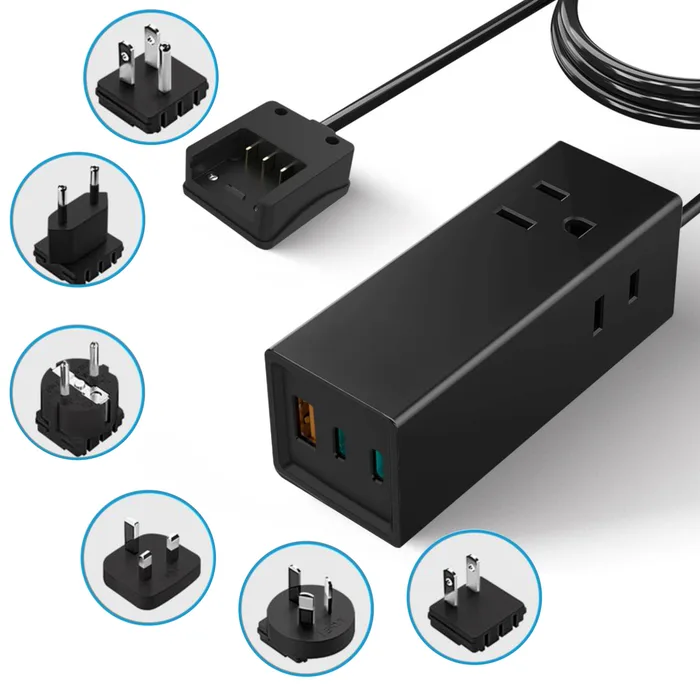
The short version
The Ceptics 65W World Travel Adapter (NANFUSE-WS) is the pick: it is the one unit here whose maker states a fully grounded connection, it has a 65W USB-C port and it brings two US outlets along. The TESSAN Universal Travel Adapter in its 35W version is the value choice, a one-piece cube with a published 10A replaceable fuse and a 35W USB-C port. The Momax 1-World² Pocket 70W suits travellers who want the fastest single USB-C port in a one-piece design and can live with a second USB-C port fixed at 5V. Skip the Epicka TA-105C: its USB-C port is listed at 5V only, its manual tells you not to use it with appliances that need a ground wire, and Epicka's own page points buyers to a newer fast-charging model. None of the four is a voltage converter, so check that every device you pack is marked 100-240V. Best for: travellers carrying a laptop, a phone and one or two plug-in chargers across several plug regions.
Our picks at a glance
- Ceptics 65W World Travel Adapter (NANFUSE-WS) - Buy. A small grounded power strip with a 65W USB-C port, two US outlets and six swappable plug attachments.
- TESSAN Universal Travel Adapter (35W, TS-WTA02) - Buy. A one-piece sliding cube with Type A, C, G and I plugs, a 35W USB-C port and a published 10A replaceable fuse.
- Momax 1-World² Pocket 70W - It depends. A one-piece GaN adapter with a 70W USB-C port, PPS support and two AC outputs, but a second USB-C port fixed at 5V.
- Epicka TA-105C Universal Travel Adapter - Skip. A widely sold sliding cube whose USB ports are all 5V, with an ungrounded AC socket and a newer replacement on the maker's own page.
The verdict in 30 seconds
What mattered most
- Plug types it fits (maker-stated)
- Grounding
- AC rating
- Fastest USB-C port
- USB output with several ports in use
- USB ports
A travel adapter changes the shape of a plug. It does not change the voltage coming out of the wall, and that one fact decides most of what is safe to plug into it. The category is crowded with near-identical sliding cubes, many of them ungrounded and many quoting a USB wattage that is a total across every port instead of what one port can deliver. We read the manufacturer pages and manuals for four currently sold units from four different companies and compared only what each maker puts in writing.
A small grounded power strip with a 65W USB-C port, two US outlets and six swappable plug attachments.
Best for: US and Canadian travellers who carry a three-prong laptop charger and want one grounded unit for most plug regions.
- Ceptics states a fully grounded connection from the input to the output, which no other unit in this comparison claims.
- USB-C1 is rated 65W max on its own, with a second USB-C port and a USB-A port each rated 30W max.
- Two US outlets accept standard two-prong or three-prong North American plugs, so a laptop brick and a camera charger can run together.
- It is a kit with six separate attachments and a 5-foot detachable cord, so there are loose pieces to keep track of.
- The outlets take North American plugs only, which makes it a poor fit for travellers whose devices have other plug shapes.
- Ceptics' own spec panel does not list surge protection as a feature of this model.
- Stated compliance is CE and RoHS; no fuse rating and no wattage ceiling for the outlets are published beyond a 10A maximum.
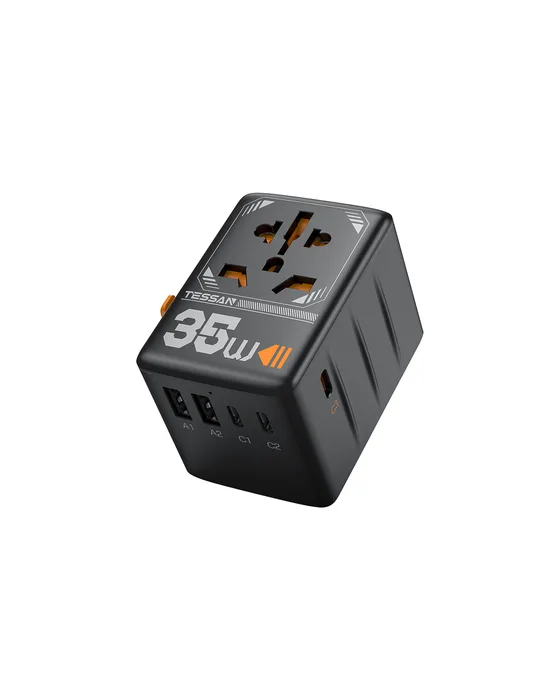
A one-piece sliding cube with Type A, C, G and I plugs, a 35W USB-C port and a published 10A replaceable fuse.
Best for: Phone and tablet travellers who want a single cube with a documented fuse and do not need laptop-speed USB-C.
- TESSAN publishes the AC rating in full: 100-250V, 10A max, 2500W max.
- The fuse is listed as a replaceable 250V 10A part and a spare is included.
- USB-C3 is rated up to 35W (15V/2.33A or 20V/1.75A), enough for a phone or tablet at fast-charge speed and a slow top-up for a small laptop.
- Total DC output is 35W across all five USB ports, and the other four ports are listed at 5V/2.4A (12W) each.
- TESSAN's page does not state whether the adapter is grounded, and lists no safety certifications or weight for it.
- The listing also sells 65W, 100W and 140W versions, but the published spec block covers the 35W version only.
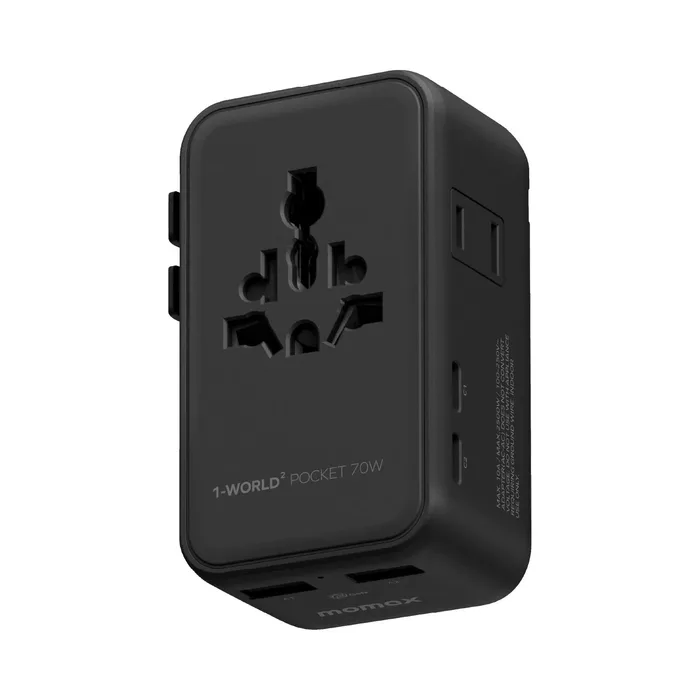
A one-piece GaN adapter with a 70W USB-C port, PPS support and two AC outputs, but a second USB-C port fixed at 5V.
Best for: Light packers with one USB-C laptop who want a single-piece adapter and charge everything else slowly overnight.
- USB-C1 is rated 70W max (20V/3.5A) with PPS from 5V to 11V at 5.5A, the highest single-port figure in this comparison.
- Momax publishes the multi-port splits: 45W + 15W with both USB-C ports in use, and 45W + 15W with all four USB ports in use.
- Two AC outputs, one universal and one Type A, with a 10A, 2500W rating and CE, FCC, UKCA and RoHS listed as safety certifications.
- USB-C2 is listed at 5V/3A only, so a second laptop or fast-charging tablet will not get a PD voltage from it.
- Grounding is not stated on the product page, and the fuse is described only as overload fuse protection with no rating or replacement details.
- Plug coverage is given as pin regions (CN/TW/JP/US, UK, EU, AU) and 180+ countries instead of a list of plug type letters.
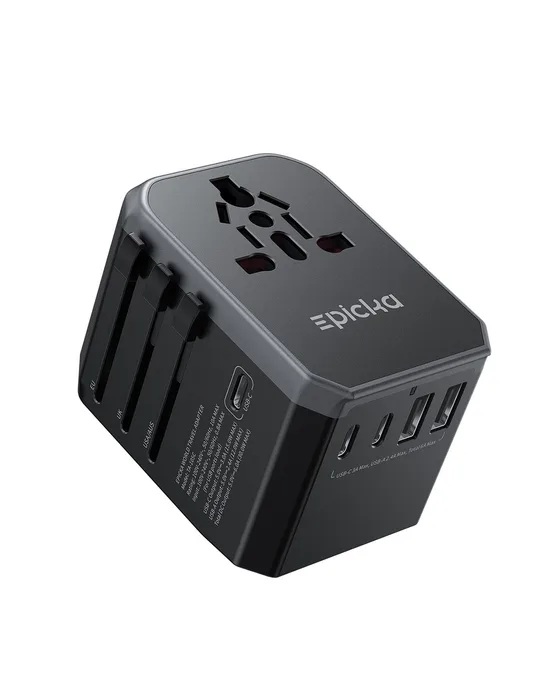
A widely sold sliding cube whose USB ports are all 5V, with an ungrounded AC socket and a newer replacement on the maker's own page.
Best for: Almost nobody buying new; it only makes sense if every device you carry charges happily at 5V.
- Epicka publishes clear AC limits: 10A max, 1000W at 100V and 2400W at 240V.
- The fuse is user-replaceable and the manual says four fuses ship with the adapter, including spares.
- The manual lists exactly which socket types it fits and which plugs it accepts, including the fact that it does not fit Type D or Type M sockets.
- USB-C output is listed as 5V/3A and USB-A as 5V/2.4A, with a total DC output of 30W shared across the USB ports; no Power Delivery voltage is listed.
- The manual says not to use it with appliances requiring a ground wire.
- The manual also rules out any appliance over 1600W, even one labelled dual voltage, which is tighter than the headline 2400W figure suggests.
- Epicka's product page links to the TA-105S as the newly upgraded 45W fast-charging version.
| Criteria | Ceptics 65W World Travel Adapter (NANFUSE-WS) Top pick | TESSAN Universal Travel Adapter (35W, TS-WTA02) | Momax 1-World² Pocket 70W | Epicka TA-105C Universal Travel Adapter |
|---|---|---|---|---|
| Verdict | Buy it | Buy it | It depends | Skip it |
| Best for | US and Canadian travellers who carry a three-prong laptop charger and want one grounded unit for most plug regions. | Phone and tablet travellers who want a single cube with a documented fuse and do not need laptop-speed USB-C. | Light packers with one USB-C laptop who want a single-piece adapter and charge everything else slowly overnight. | Almost nobody buying new; it only makes sense if every device you carry charges happily at 5V. |
| Price tier | $ · mid-range | $ · budget | $$ · premium | $ · budget |
| Plug types it fits (maker-stated) | A, B, C, E/F, G, I via 6 attachments | A, C, G, I sliding plugs | CN/TW/JP/US, UK, EU, AU pins; type letters not published | US, UK, EU, AUS plugs; fits A, B, C, E, F, G, H, I, J, K, L, N, O sockets |
| Grounding | Fully grounded, per maker | Not published | Not published | Not for appliances needing a ground wire |
| AC rating | 10A max, up to 240V; watts not published | 10A max, 2500W max (100-250V) | 10A, 2500W (100-250V) | 10A max; 1000W at 100V, 2400W at 240V |
| Fastest USB-C port | 65W max (20V/3.25A) | 35W (20V/1.75A) | 70W max (20V/3.5A) plus PPS | 5V/3A only |
| USB output with several ports in use | 60W max across three ports (45W + 15W) | 35W total across five ports | 45W + 15W across four ports | 30W total at 5V |
| USB ports | 2 USB-C, 1 USB-A | 3 USB-C, 2 USB-A | 2 USB-C, 2 USB-A | USB-C and USB-A, all 5V |
| Fuse | Not published | Replaceable 250V 10A, spare included | Overload fuse; rating not published | Replaceable 10A, spares included |
| Certifications stated by maker | CE, RoHS | Not published | CE, FCC, UKCA, RoHS | RoHS, CE, FCC |
Which one is right for you?
- US and Canadian travellers who carry a three-prong laptop charger and want one grounded unit for most plug regions. Buy it Ceptics 65W World Travel Adapter (NANFUSE-WS)
- Phone and tablet travellers who want a single cube with a documented fuse and do not need laptop-speed USB-C. Buy it TESSAN Universal Travel Adapter (35W, TS-WTA02)
- Light packers with one USB-C laptop who want a single-piece adapter and charge everything else slowly overnight. It depends Momax 1-World² Pocket 70W
- Almost nobody buying new; it only makes sense if every device you carry charges happily at 5V. Skip it Epicka TA-105C Universal Travel Adapter
How we judged the field
Five things separate a good travel adapter from a risky one. First, plug coverage: which plug types the unit physically fits, stated as type letters, because “works in 200 countries” tells you nothing about the one you are visiting. Second, grounding: whether the ground pin of a three-prong device is connected through to the wall. Third, the AC load limit, which is set by amps, so the same adapter carries far fewer watts on a 100-120V supply than on 230-240V. Fourth, USB-C output per port, including what happens when several ports are in use at once. Fifth, what the maker puts in writing about the fuse and safety certifications, since an adapter sits between mains power and everything you own.
The field splits into two designs. One-piece sliding cubes are convenient and mostly ungrounded or silent on the subject. Kits with separate plug attachments are fiddlier but can carry a ground connection. We picked one grounded kit with laptop-level USB-C (Ceptics), one budget cube with a clearly documented fuse (TESSAN), one high-wattage GaN cube with a notable catch (Momax) and one very commonly bought cube that has been overtaken (Epicka). Each comes from a different company, and every figure below is taken from that company’s own page or manual. This guide covers plug adapters only; for protection at home see our surge protector guide, and for charging away from a socket see our portable power bank guide.
The Ceptics NANFUSE-WS is closer to a tiny power strip than a cube. A 5-foot detachable cord ends in a base that takes one of six SWadAPt attachments (Type A, B, C, E/F, G and I), and the body carries two US outlets, two USB-C ports and one USB-A port. Ceptics states a fully grounded connection from the input to the output, which is the reason it leads this comparison: a three-prong laptop charger keeps its ground path when you use a grounded attachment in a grounded socket. USB-C1 is rated 65W on its own. With both USB-C ports in use the split is 45W + 20W, and with all three USB ports it is 60W max. The limits are stated as 10A and up to 240V, with CE and RoHS compliance and a 2-year limited warranty. The trade-offs are real. There are loose parts to lose, the outlets accept North American plugs only, the spec panel lists no surge protection, and no fuse rating is published. Weight is listed at 5.4 oz. It is for North American travellers who carry a laptop and want grounding.
TESSAN’s universal adapter is the familiar sliding cube: Type A, C, G and I plugs push out of one body, so there is nothing separate to lose. What earns it the value slot is that the basics are written down. The AC rating is 100-250V, 10A max, 2500W max, and the fuse is a replaceable 250V 10A part with a spare in the box. On the 35W version (TS-WTA02) one USB-C port, labelled C3, delivers up to 35W at 15V or 20V. The other two USB-C ports and both USB-A ports are listed at 5V/2.4A, 12W each, and the total DC output is 35W, so that figure is shared, not multiplied. That is fine for a phone, earbuds and a tablet, and slow for a laptop. The gaps: TESSAN’s page does not say whether the adapter is grounded, and it lists no safety certifications or weight. The same listing sells 65W, 100W and 140W versions, but only the 35W spec block is published, so we judged that one. It is for travellers whose kit charges over USB.
The Momax 1-World² Pocket 70W is the strongest charger here and the hardest to recommend without conditions. Its main USB-C port is rated 70W max at 20V/3.5A with PPS from 5V to 11V at 5.5A, in a body listed at 87.6 x 54.7 x 36mm and 166g with a foldable plug. It has two AC outputs, one universal and one Type A, rated 10A and 2500W, and Momax lists CE, FCC, UKCA and RoHS. The catch is the second USB-C port, which is listed at 5V/3A only, alongside two USB-A ports at 5V/2.4A. Plug anything into them and the main port drops to 45W. So the 70W figure is a single-device number, and two laptops are not an option. Momax also leaves several things unsaid: grounding is not mentioned, the fuse is described only as overload fuse protection, and plug coverage is given as pin regions and 180+ countries, not type letters. It is for one-laptop travellers who value a single compact piece.
The Epicka TA-105C is a long-running, widely sold sliding cube, and it is the one to pass on. Its AC side is documented well: 10A max, 1000W at 100V and 2400W at 240V, with a replaceable 10A fuse and spares in the box. The USB side is the problem. Epicka lists the USB-C output as 5V/3A and USB-A as 5V/2.4A, with a total DC output of 5V/6A, 30W. No higher Power Delivery voltage is listed, so the USB-C port is a 15W port and the 30W total is shared. A modern phone will charge, slowly, and a laptop is out of the question. The manual says not to use it with appliances requiring a ground wire and rules out any appliance over 1600W even when it is dual voltage. It also notes that the adapter does not fit Type D or Type M sockets. Epicka’s own product page directs buyers to the TA-105S as the upgraded 45W fast-charging version, which says enough. It suits only travellers whose devices all charge at 5V.
Ceptics 65W World Travel Adapter (NANFUSE-WS) vs TESSAN Universal Travel Adapter (35W, TS-WTA02): which should you buy?
Ceptics against TESSAN is a choice between a grounded kit and an ungrounded-or-unstated cube. If anything you plug into the AC side has three prongs, or you want two outlets for a laptop brick and a camera charger, the Ceptics is the better tool. Its 65W USB-C port can also replace a laptop charger outright for many thin laptops, which claws back some of the bag space the cord and attachments take up.
The TESSAN wins on simplicity. It is one piece, it fits Type A, C, G and I sockets by sliding a lever, and its 10A replaceable fuse is documented with a spare supplied. Choose it if your trip is phones, tablets, earbuds and a camera battery over USB, and the only thing going into the AC socket is a two-pin charger. Choose the Ceptics if a laptop is coming along or if grounding matters to you. Neither changes voltage, and both top out at 10A on the AC side.
What to look for
- Plug type letters: look for the actual types the unit fits (A, C, G, I and so on) and check them against your destination, not a country count.
- Grounding in writing: if the maker does not state that the adapter is grounded, assume the ground pin of a three-prong device is not connected.
- Watts at both voltages: a 10A adapter carries roughly 1000W on a 100V supply and far more on 240V, so check the lower figure if you travel to Japan or North America.
- Per-port USB-C output: find the line for each port and for several ports in use together, because the headline wattage is usually a single-port or total figure.
- Fuse details: a stated amp rating, a replaceable fuse and a spare in the box are signs the maker has thought about overloads.
- Dual-voltage devices only: an adapter does not convert voltage, so every device you plug into the AC socket needs 100-240V printed on its label.
Our final take
Buy the Ceptics 65W World Travel Adapter if you travel with a laptop: it is the only one of the four whose maker states a grounded connection, and its 65W USB-C port and two outlets cover a full work kit. Buy the TESSAN 35W cube if you want one small piece for phones and tablets and like having the fuse rating in writing. Consider the Momax 1-World² Pocket 70W only if a single fast USB-C port in a one-piece body is the priority and the unstated grounding does not bother you. Skip the Epicka TA-105C, whose 5V-only USB ports belong to an earlier generation. Whatever you choose, check each device label for 100-240V first, because no adapter here changes voltage.
Questions, answered
Does a travel adapter convert voltage?
No. An adapter only changes the plug shape so your plug fits a foreign socket. Ceptics and Epicka both say in their own listings that the adapter does not convert voltage and should be used with devices rated for dual or worldwide voltage, and the same holds for any plug-only adapter. Phone chargers and most laptop power bricks are marked that way. A single-voltage 120V hair tool plugged into a 230V socket through an adapter can overheat or fail, so read the label on the device before you pack it.
Do I need a grounded travel adapter?
It depends on what you plug into the AC socket. Devices with a three-prong plug are built to use the ground pin as a safety path, and an ungrounded adapter leaves that pin unconnected. Epicka's manual for the TA-105C says not to use it with appliances requiring a ground wire. Of the four units here, only Ceptics states a fully grounded connection, and that still depends on using a grounded attachment in a grounded wall socket, since a two-pin Type C plug has no ground contact. If you only charge over USB, grounding matters much less.
Can I run a hair dryer through a travel adapter?
Only if the dryer is dual voltage and its wattage is inside the adapter's limit at the local voltage. A 10A adapter carries about half as many watts on a 100-120V supply as it does on 230-240V, which is why Epicka lists 1000W at 100V and 2400W at 240V for the same unit. Epicka's manual goes further and rules out any appliance over 1600W, even a dual-voltage one. Full-size dryers often draw more than these limits. A travel dryer with a voltage switch is the safer route.
Why does my laptop charge slowly from a 65W or 70W travel adapter?
The headline wattage is usually what one port delivers when nothing else is plugged in. On the Momax Pocket 70W the main USB-C port drops to 45W as soon as a second USB port is used, and the Ceptics 65W unit also falls to 45W on its main port with other ports in use. Some second ports are 5V only and never offer a laptop voltage at all. The cable matters too, and our USB-C cable guide covers which cables carry higher wattages. Plug the laptop into the port labelled C1 and move the phone elsewhere if speed drops.
Will one universal adapter work in every country?
Not quite. Most one-piece cubes carry four plug shapes, usually described as US, UK, EU and Australian, which map to Types A, G, C and I. Epicka's manual states its adapter does not fit Type D sockets found in India and Nepal or Type M sockets found in South Africa. Countries with several socket standards can catch travellers out. The IEC publishes a country-by-country plug list that is worth checking before a trip to a less common destination.
Deciding between the top two? See our head-to-head: Ceptics 65W World Travel Adapter (NANFUSE-WS) vs TESSAN Universal Travel Adapter (35W, TS-WTA02).
More Tech & Gadgets reviews
 The Best Ultrawide Monitors: 4 Compared (and One to Skip)
  The Best UPS Battery Backups: 4 Compared (and One to Skip)
  The Best USB-C Cables: 4 Compared (and One to Skip)
  The Best USB-C Hubs and Docks for Laptops in 2026
  The Best USB Flash Drives: 4 Compared (and One to Skip)
  The Best USB Power Meters: 4 Compared (and One to Skip)