

Tools & DIY
The Best Solder Wire for Electronics: 4 Compared (and One to Skip)
We compared four flux-cored solder wires on the two things that actually decide how a joint turns out: the alloy and the flux core classification under IPC J-STD-004. Every spec here comes from the maker's own product page or data sheet.
The short version
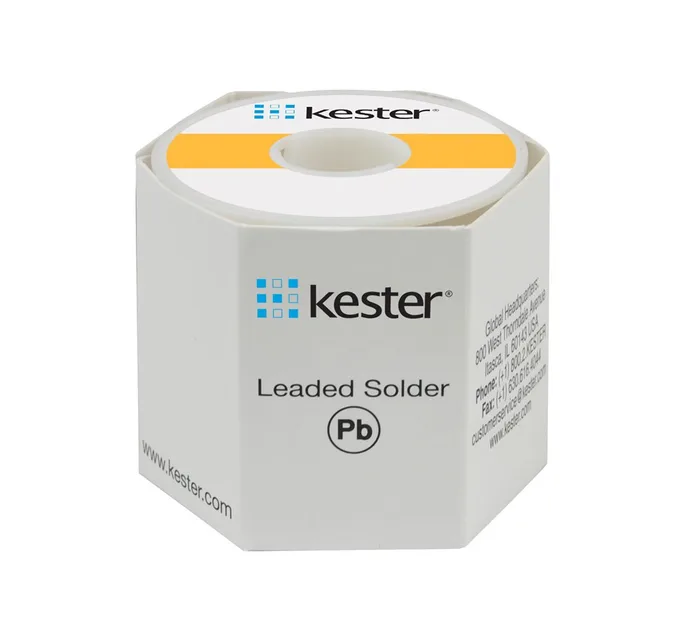
Kester 44 in Sn63Pb37 is the best all-round choice for hand soldering: a eutectic leaded alloy that melts and freezes at 183 °C with no plastic range, paired with a moderately activated rosin flux Kester classifies as ROM1, and offered in everything from .010 in hair-thin wire to .125 in. MG Chemicals 4880-4888 is the value pick, the same eutectic alloy and the same ROM1 RA rosin classification, sold in a small pocket pack as well as full spools, with a published acid number and halide range. MG Chemicals 4900 SAC305 is the depends pick: it is lead-free, halide-free and REL0 no-clean, which is what you want if you are shipping into a RoHS market or you simply do not want lead on the bench, but it melts at 217 to 220 °C and comes in one diameter only. Skip Kester 331 unless you have a wash process, because it is an ORH1 organic water-soluble flux whose residue has to be rinsed off completely with heated water. Water-soluble flux left on a board is the one mistake in this category that actually destroys hardware. If you are repairing consumer electronics or building through-hole projects, the leaded eutectic wires will make your life easier and your joints better. Best for: anyone hand soldering circuit boards who wants the alloy and the flux chosen deliberately rather than by accident.
Our picks at a glance
- Kester 44 Flux-Cored Wire (Sn63Pb37) - Buy. The reference activated-rosin wire, in a eutectic leaded alloy and just about any diameter you could want.
- MG Chemicals 4880-4888 Sn63/Pb37 RA Solder Wire - Buy. The same eutectic alloy and the same ROM1 rosin classification, with a data sheet that publishes real numbers and a pocket pack for small jobs.
- MG Chemicals 4900 SAC305 No-Clean Solder Wire - It depends. A genuinely well-documented lead-free no-clean wire that asks you to run a hotter iron and gives you exactly one diameter.
- Kester 331 Flux-Cored Wire (water-soluble) - Skip. An excellent production wire and a genuinely bad idea on a bench with no way to wash the board afterwards.
The verdict in 30 seconds
What mattered most
- Alloy
- Melting behaviour
- Flux code (J-STD-004)
- Flux activity
- Halide content
- Cleaning
Solder wire looks like the most interchangeable thing on a bench, and it is the thing beginners get wrong most often. Two spools that look identical can behave completely differently, because a spool is really two products in one: a metal alloy with a specific melting behaviour, and a flux chemistry with a specific activity level and a specific cleaning requirement. Get the alloy wrong and joints go grainy or need a hotter iron than your parts can take. Get the flux wrong and you can leave a residue that quietly eats the board. We picked four spools that all publish real data sheets, and one of them is here specifically so you know not to buy it by accident.
The reference activated-rosin wire, in a eutectic leaded alloy and just about any diameter you could want.
Best for: Anyone repairing or building through-hole and mixed-technology boards by hand who wants one wire that handles almost every joint size.
- Kester classifies the 44 flux as ROM1 under J-STD-004, a rosin base with moderate activity that wets fast on tarnished copper and old component leads.
- In Sn63Pb37 the alloy is eutectic, so it melts and solidifies at 183 °C with no plastic range for a joint to be disturbed in.
- Kester lists Sn63Pb37 in diameters from .010 in through .125 in and in four flux loadings by weight, 1.1, 2.2, 3.3 and 4.4 percent.
- It contains lead, so it is not suitable for equipment you intend to place on a RoHS-regulated market.
- Kester lists every 44 variant as containing halogen, and halide-bearing residues raise the ionic contamination potential of a board.
- Moderate activity means the amber residue is worth removing on anything you care about long term, which is an extra step and an extra product.
- The huge part number matrix makes it easy to order the wrong diameter or flux percentage if you do not read the table carefully.
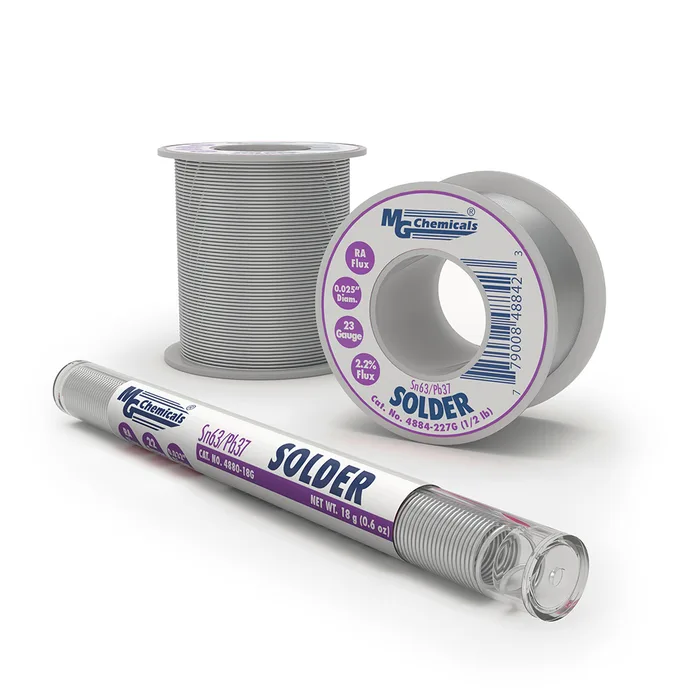
The same eutectic alloy and the same ROM1 rosin classification, with a data sheet that publishes real numbers and a pocket pack for small jobs.
Best for: Hobbyists and repair benches who want a fully specified leaded rosin wire without committing to a full pound of it.
- The data sheet gives the flux classification as ROM1 RA to J-STD-004B, activity moderate, acid number 150 to 160 mgKOH/g and halides 0.5 to 2.0 percent by weight.
- MG states the alloy is eutectic, exceeds J-STD-006C purity requirements and meets ASTM B 32, and lists a 10 year shelf life.
- It comes in an 18 g pocket pack plus 227 g and 454 g spools across .025 in, .032 in, .040 in, .050 in and .062 in.
- The technical data sheet does not publish the flux content as a percentage by weight, which the Kester tables do.
- There is nothing finer than .025 in, so very fine-pitch surface-mount rework needs a different spool.
- MG lists it as unavailable in the EU and UK, so buyers there need a different source.
- It carries a California Proposition 65 lead warning, and the residue still benefits from cleaning on high-reliability work.
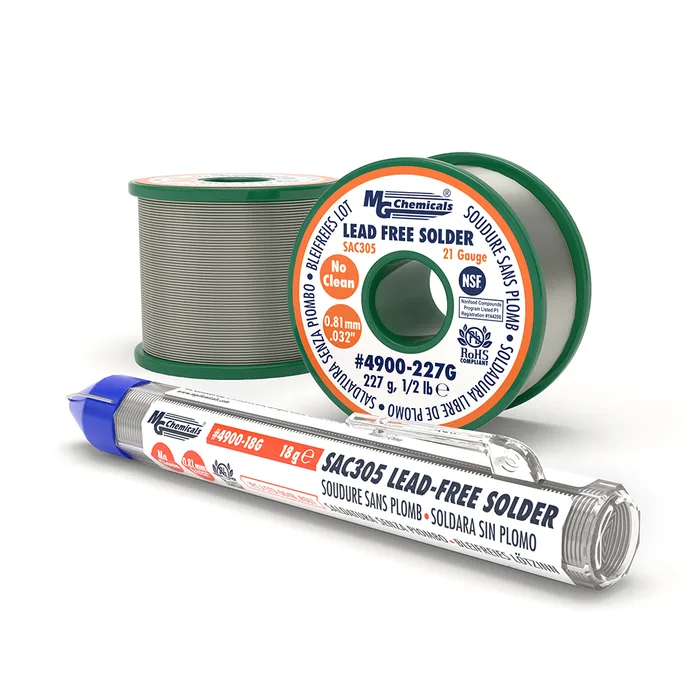
A genuinely well-documented lead-free no-clean wire that asks you to run a hotter iron and gives you exactly one diameter.
Best for: Anyone building equipment that has to comply with RoHS, or who has decided to keep lead off the bench entirely and will accept a hotter process.
- The flux is classified REL0 to J-STD-004B: resin base, low activity, and halide-free at under 0.05 percent by weight.
- MG publishes surface insulation resistance of 2.3 x 10^11 ohms and a pass on electrochemical migration to Bellcore GR-78-CORE 13.1.4.
- The flux core is stated as 2.2 percent, and MG notes the wire runs about 14 percent longer by weight than leaded wire.
- SAC305 melts across a 217 to 220 °C range rather than at one temperature, so the iron and the parts both see more heat.
- MG lists only one diameter, 0.81 mm or 0.032 in, which is awkward for fine surface-mount work.
- The residue softening point is 24 °C, so what it leaves behind stays soft at normal room temperature and can look and feel tacky.
- Low activity flux is less forgiving on oxidised or salvaged parts than a moderately activated rosin.
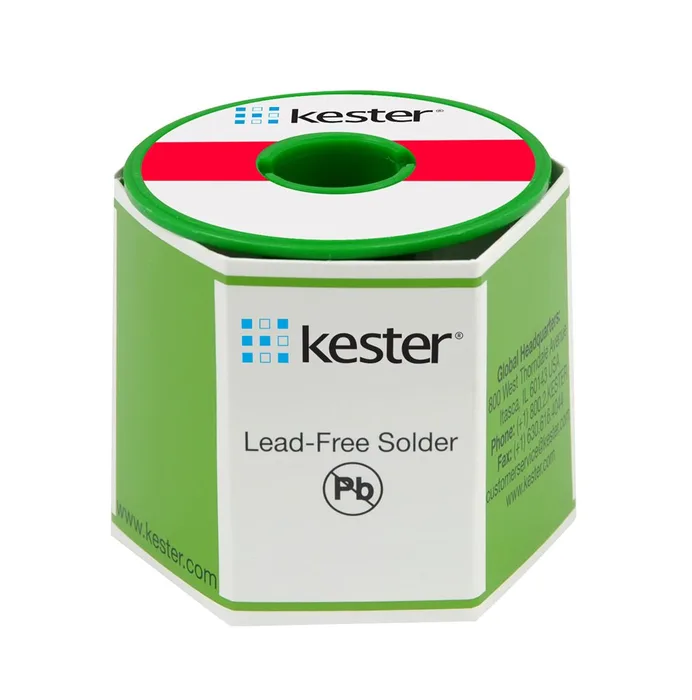
An excellent production wire and a genuinely bad idea on a bench with no way to wash the board afterwards.
Best for: Production and repair operations that already run an aqueous cleaning step and need a flux that cuts through heavy oxide.
- Kester classifies 331 as ORH1 under J-STD-004, an organic water-soluble flux that it says is more effective than rosin fluxes on difficult metals.
- Kester describes it as more heat stable than most organic fluxes, which it says results in minimal smoke and odour.
- It is offered across Sn63Pb37, Sn60Pb40, SAC305 and other alloys, in diameters from .010 in to .093 in.
- The residue is not optional to remove. Kester's own instruction is a heated water rinse, with deionised water suggested to avoid introducing unknown chemistries.
- The H in ORH1 is the high activity band, which under J-STD-004 carries more than 2.0 percent halides by weight when it is designated 1.
- A soldered board that never gets washed is a board with active flux sitting on it, and that is how water-soluble flux ruins hardware.
- Almost nobody working at a bench has the aqueous wash setup this chemistry assumes, which makes it the wrong default purchase.
| Criteria | 44 Flux-Cored Wire (Sn63Pb37) Top pick | 4880-4888 Sn63/Pb37 RA Solder Wire | 4900 SAC305 No-Clean Solder Wire | 331 Flux-Cored Wire (water-soluble) |
|---|---|---|---|---|
| Verdict | Buy it | Buy it | It depends | Skip it |
| Best for | Anyone repairing or building through-hole and mixed-technology boards by hand who wants one wire that handles almost every joint size. | Hobbyists and repair benches who want a fully specified leaded rosin wire without committing to a full pound of it. | Anyone building equipment that has to comply with RoHS, or who has decided to keep lead off the bench entirely and will accept a hotter process. | Production and repair operations that already run an aqueous cleaning step and need a flux that cuts through heavy oxide. |
| Price tier | $$ · mid-range | $ · budget | $$ · mid-range | $$ · mid-range |
| Alloy | Sn63Pb37 plus six other alloys | Sn63/Pb37 only | SAC305 (Sn96.5Ag3Cu0.5) | Sn63Pb37, Sn60Pb40, SAC305 and more |
| Melting behaviour | Eutectic, 183 °C | Eutectic, 183 °C | 217 to 220 °C range | Depends on alloy chosen |
| Flux code (J-STD-004) | ROM1 rosin | ROM1 RA rosin | REL0 resin | ORH1 organic |
| Flux activity | Moderate | Moderate | Low | High |
| Halide content | Listed as containing halogen | 0.5 to 2.0 percent by weight | Under 0.05 percent, halide-free | Above 0.05 percent, H1 band |
| Cleaning | Optional on most work, advisable on high-reliability boards | Optional on most work, advisable on high-reliability boards | None required | Mandatory heated water rinse |
| Diameters offered | .010 in to .125 in | .025 in to .062 in | .032 in only | .010 in to .093 in |
| Flux content by weight | 1.1, 2.2, 3.3 or 4.4 percent | Not published on the data sheet | 2.2 percent | Mostly 3.3 percent |
Which one is right for you?
- Anyone repairing or building through-hole and mixed-technology boards by hand who wants one wire that handles almost every joint size. Buy it Kester 44 Flux-Cored Wire (Sn63Pb37)
- Hobbyists and repair benches who want a fully specified leaded rosin wire without committing to a full pound of it. Buy it MG Chemicals 4880-4888 Sn63/Pb37 RA Solder Wire
- Anyone building equipment that has to comply with RoHS, or who has decided to keep lead off the bench entirely and will accept a hotter process. It depends MG Chemicals 4900 SAC305 No-Clean Solder Wire
- Production and repair operations that already run an aqueous cleaning step and need a flux that cuts through heavy oxide. Skip it Kester 331 Flux-Cored Wire (water-soluble)
How we judged the field
Five things separate a spool that makes soldering easy from one that fights you. First, the alloy and whether it is eutectic. A eutectic alloy such as Sn63Pb37 has a single melting and freezing temperature, 183 °C, so there is no window in which the joint is half-solid and a nudge can wreck it. Non-eutectic alloys have a plastic range, and MG Chemicals says plainly that its Sn60/Pb40 wires melt at slightly higher temperatures and over a wider range than 63/37. Second, working temperature, because lead-free SAC305 runs at 217 to 220 °C by AIM Solder’s alloy chart, and every degree of that has to come through the iron tip and through your components. Third, the flux classification under IPC J-STD-004, which tells you the flux base, its activity level and whether it carries halides. Fourth, whether the residue has to be cleaned, which is a process decision, not a preference. Fifth, whether the maker publishes a data sheet at all.
The field splits cleanly along two axes rather than one. On alloy, it is leaded eutectic against lead-free SAC305, and that decision is driven by whether you are placing equipment on a regulated market, not by which is objectively better at making a joint. On flux, it is rosin and resin fluxes that leave a benign residue against organic water-soluble fluxes that leave an active one. We picked two leaded rosin wires because that combination is what most hand soldering actually wants, one lead-free no-clean wire because plenty of people need or want it, and one water-soluble wire specifically to mark it as a trap. Every product here publishes a real specification. That was the entry requirement, and it eliminated a large amount of unbranded wire that lists nothing beyond a diameter and a ratio.
Kester 44 Flux-Cored Wire (Sn63Pb37)
Buy itKester 44 is the wire most people mean when they say rosin core solder. Kester classifies the 44 flux as ROM1 under J-STD-004, which decodes as a rosin base with moderate activity that contains halides. That moderate activity is why it wets so quickly on tarnished copper, oxidised component legs and salvaged parts, and it is a large part of why 44 has stayed the default on repair benches for decades. In Sn63Pb37 the alloy is eutectic, melting and freezing at 183 °C with no plastic range, so a joint that gets bumped while it cools still sets solid instead of going grainy. Kester lists that alloy in diameters from .010 in up to .125 in, and in four flux loadings by weight of 1.1, 2.2, 3.3 and 4.4 percent, which means you can match the wire to fine surface-mount work or to a chassis ground lug without changing chemistry. The trade-offs are honest ones: it contains lead, it contains halogen, and the residue is worth removing on work you care about. Best for anyone hand soldering through-hole and mixed boards.
MG Chemicals 4880-4888 Sn63/Pb37 RA Solder Wire
Buy itMG Chemicals 4880-4888 gives you the same two decisions as the Kester and documents them just as clearly. The data sheet lists the flux as ROM1 RA to J-STD-004B and MIL-F-14256F, a rosin base of moderate activity, with an acid number of 150 to 160 mgKOH/g, halides of 0.5 to 2.0 percent by weight, a residue softening point of 80 °C and a 10 year shelf life. The alloy is eutectic, exceeds J-STD-006C purity requirements and meets ASTM B 32. What makes it the value pick is the packaging rather than the chemistry. Alongside 227 g and 454 g spools in .025 in, .032 in, .040 in, .050 in and .062 in, there is an 18 g pocket pack, which is the right size for a repair kit or a first spool you are not sure you will finish. The gaps are that the data sheet never states flux content by weight, nothing finer than .025 in is offered, and MG lists the product as unavailable in the EU and UK. Best for hobbyists who want documented performance in a size they will actually use up.
MG Chemicals 4900 SAC305 No-Clean Solder Wire
It dependsMG Chemicals 4900 is the lead-free option that earns its place by publishing more than most. The flux is REL0 to J-STD-004B, a resin base of low activity that is halide-free at under 0.05 percent by weight, and MG backs that with a surface insulation resistance of 2.3 x 10^11 ohms, a copper mirror pass and an electrochemical migration pass to Bellcore GR-78-CORE 13.1.4. Flux content is stated as 2.2 percent. The alloy is SAC305, which AIM Solder’s chart puts at 217 to 220 °C, so it melts across a small range rather than at a single point and it needs meaningfully more heat than a leaded eutectic. That heat has to pass through your iron tip and through whatever you are soldering, which is the real cost for heat-sensitive parts. Two other things to weigh: MG offers exactly one diameter, 0.81 mm or 0.032 in, and the residue softening point is 24 °C, so what it leaves behind stays soft at room temperature. Best for anyone who needs RoHS compliance or has simply decided against lead.
Kester 331 Flux-Cored Wire (water-soluble)
Skip itKester 331 is a good product being recommended to the wrong people. Kester classifies it as ORH1 under J-STD-004: an organic water-soluble flux, high activity band, halide-bearing. Kester says it is more effective than rosin fluxes on difficult metals and that it is more heat stable than most organic fluxes, which keeps smoke and odour down. All true, and none of it is the point. The point is the sentence Kester puts on the same page: the residue can be completely removed with a simple heated water rinse, and deionised water is suggested to avoid introducing chemistry from unknown water sources. That is not a cleaning tip, it is a required process step, because organic fluxes generally do not deactivate until they reach high temperatures and their residues stay active. Leave that residue on a board and you have put a corrosive film across your traces and under your components. Unless you already run an aqueous wash, this is the spool to walk past. Best for production lines with a real cleaning stage.
Sources
Specs in this review come from these pages.
- Kester, 44 Flux-Cored Wire product page and offerings table (kester.com)
- Kester, 331 Flux-Cored Wire product page and offerings table (kester.com)
- MG Chemicals, 4880-4888 Sn63/Pb37 RA Solder Wire technical data sheet (mgchemicals.com)
- MG Chemicals, 4900 SAC305 No-Clean Solder Wire technical data sheet (mgchemicals.com)
- AIM Solder, Solder Flux Classification: How to Decode ROL0 and More (IPC J-STD-004) (aimsolder.com)
- UK legislation.gov.uk, RoHS Regulations 2012, Schedule A1, restricted substances and maximum concentration values (legislation.gov.uk)
Kester 44 Flux-Cored Wire (Sn63Pb37) vs MG Chemicals 4880-4888 Sn63/Pb37 RA Solder Wire: which should you buy?
Kester 44 and MG Chemicals 4880-4888 are, chemically, close relatives. Both are Sn63Pb37 eutectic alloy with a rosin flux that both makers classify as ROM1, moderate activity, halide-bearing. If you put a joint made with each under a loupe you would struggle to tell them apart, and neither is going to be the reason a board works or does not. So the choice comes down to sizes, quantity and where you are.
Buy the Kester if you need a diameter the MG does not offer, which mostly means anything below .025 in for fine surface-mount rework or anything above .062 in for heavy chassis work, or if you want to pick your flux percentage deliberately, since Kester publishes 1.1, 2.2, 3.3 and 4.4 percent options and MG does not state the figure at all. Buy the MG if you want a small quantity to start with, since the 18 g pocket pack is a genuinely useful size and a pound of solder is a lot of solder for a hobbyist, or if you value having acid number, halide range and residue softening point printed on a data sheet you can download in ten seconds. If you are in the EU or UK, note that MG lists 4880-4888 as unavailable there, which settles it.
What to look for
- Eutectic or not: Sn63Pb37 melts and freezes at a single temperature of 183 °C, while a non-eutectic alloy such as Sn60Pb40 has a plastic range in which the joint is neither liquid nor solid and movement leaves a disturbed joint.
- The J-STD-004 code: four characters tell you the flux base, its activity and its halide content, so ROM1 and REL0 and ORH1 are directly comparable in a way that marketing words like ‘rosin core’ are not.
- Whether cleaning is optional or mandatory: rosin and resin no-clean residues can stay on the board, but an organic water-soluble residue has to be washed off completely or it will corrode the board.
- Working temperature: lead-free SAC305 runs at 217 to 220 °C against 183 °C for a leaded eutectic, and that extra heat has to travel through your iron tip and into parts that may not want it.
- Diameter against your smallest joint: thin wire in the .015 in to .025 in range suits fine surface-mount pads, .031 in is the general-purpose through-hole size, and .040 in and up is for heavy connections.
- Flux percentage by weight: a wire with more flux gives you more activity per length of solder fed, which is why Kester publishes 1.1, 2.2, 3.3 and 4.4 percent options rather than a single figure.
Our final take
Buy Kester 44 in Sn63Pb37 at .031 in if you want one spool that will handle almost everything you point it at, and add a finer diameter later if you move to surface-mount work. Buy the MG Chemicals 4880-4888 pocket pack if you would rather test the idea before committing to a pound of wire. Take the lead-free MG 4900 only if RoHS or a personal preference makes it the right call, and go in knowing you are running a hotter iron for it. And leave Kester 331 on the shelf unless you can rinse boards in heated water afterwards, because water-soluble flux is the one choice in this category where getting it wrong does real damage rather than just producing an ugly joint.
Questions, answered
Is leaded solder banned? Am I allowed to buy Sn63Pb37?
Leaded solder is not banned and is sold openly by every major manufacturer. What RoHS does is restrict what can be in electrical and electronic equipment placed on the market. The UK version of the rules states that equipment placed on the market must not contain the listed substances above the maximum concentration tolerated, and for lead that figure is 0.1 percent by weight in any homogeneous material. That restriction attaches to the finished equipment a business places on the market, not to a reel of solder wire and not to you fixing your own amplifier or building a project for yourself. There are also long-standing exemptions for particular solder applications, and separate carve-outs for categories such as military and space equipment. So the honest summary is that leaded solder is restricted in commercial products, not prohibited to own or use.
What does a flux code like ROM1 or REL0 actually mean?
It is the IPC J-STD-004 four-character designator, and once you can read it you can compare any two spools instantly. The first two letters are the composition: RO for rosin, RE for resin, OR for organic, IN for inorganic. The third character is activity: L for low, M for moderate, H for high, judged on tests including copper mirror, surface insulation resistance and quantitative halide content. The fourth character is halide content, where 0 means below 0.05 percent by weight and 1 means above it. So ROM1 is a rosin flux of moderate activity that contains halides, and REL0 is a resin flux of low activity that is halide-free. Note that the thresholds shifted between the original J-STD-004 and the B and later revisions, so it is worth checking which revision a data sheet cites.
Do I have to clean no-clean flux off the board?
No, and if you are going to do a bad job of it you are better off leaving it. No-clean residues are formulated to be inert once they have been through the soldering process, and MG Chemicals publishes surface insulation resistance and electrochemical migration test results for its no-clean wires to back that up. The nuance worth knowing is about heat. Many no-clean fluxes need enough thermal exposure to fully decompose their activators, and AIM Solder notes that this is a real risk with liquid flux applied separately at a rework station, where the localised heat may not be enough. With cored wire the risk is lower, because the flux has to be heated to leave the wire in the first place. AIM also notes that partially cleaned no-clean residues have been measured with lower resistivity than untouched residue, so a half-hearted wipe with isopropyl alcohol can leave you worse off than doing nothing.
What wire diameter should I buy?
Match the wire to the smallest joint you do regularly, not the largest. Fine surface-mount work and small pads want something in the .015 in to .025 in range, because a thick wire dumps far more solder than the pad can hold and you spend your time wicking it back off. General through-hole work on standard boards is comfortable around .031 in, which is why that diameter is stocked by everyone. Anything chunky, such as chassis grounds, terminal blocks or heavy-gauge wire, wants .040 in or more so you are not feeding for ten seconds while the joint sits hot. If you can only justify one spool, .031 in or .025 in is the safest single choice. Kester lists Sn63Pb37 44 wire from .010 in to .125 in, which covers essentially the entire range.
What should I do about fumes and about the lead itself?
The fume you see is mostly flux breaking down, not vaporised metal. MG Chemicals' safety data sheet states that soft soldering temperatures below 450 °C are generally too low to generate significant metal vapour, but that metal oxide fume or dust and flux decomposition fumes can occur. Its recommendation for frequent or prolonged soldering is a local exhaust system: a fume cabinet, a hood on a flexible arm, or a tip-mounted extractor on the iron. That matters because the UK Health and Safety Executive lists rosin-based solder flux fume among substances that can cause occupational asthma. For the lead, the exposure route that matters at a bench is ingestion rather than inhalation, so the practical controls are simple: wash your hands with soap and water after handling solder, and do not eat, drink or smoke at the bench. OSHA sets a permissible exposure limit for lead of 50 micrograms per cubic metre over an eight-hour time-weighted average, with an action level of 30.
Deciding between the top two? See our head-to-head: Kester 44 Flux-Cored Wire (Sn63Pb37) vs MG Chemicals 4880-4888 Sn63/Pb37 RA Solder Wire.
More Tools & DIY reviews
 The Best Solder Fume Extractors: 4 Compared (and One to Skip)
  The Best Soldering Irons and Stations: 4 Compared (and One to Skip)
  The Best Splitting Axes and Mauls: 4 Compared (and One to Skip)
  The Best Step Ladders: 4 Compared (and One to Skip)
  The Best Stud Finders: 4 Compared (and One to Skip)
  The Best Table Saws: 4 Compared (and One to Skip)