

Tools & DIY
The Best Socket Sets: 4 Compared (and One to Skip)
Four socket sets compared on which standard the maker is willing to name, the difference six points make against twelve, and why piece count is the least useful number on the box.
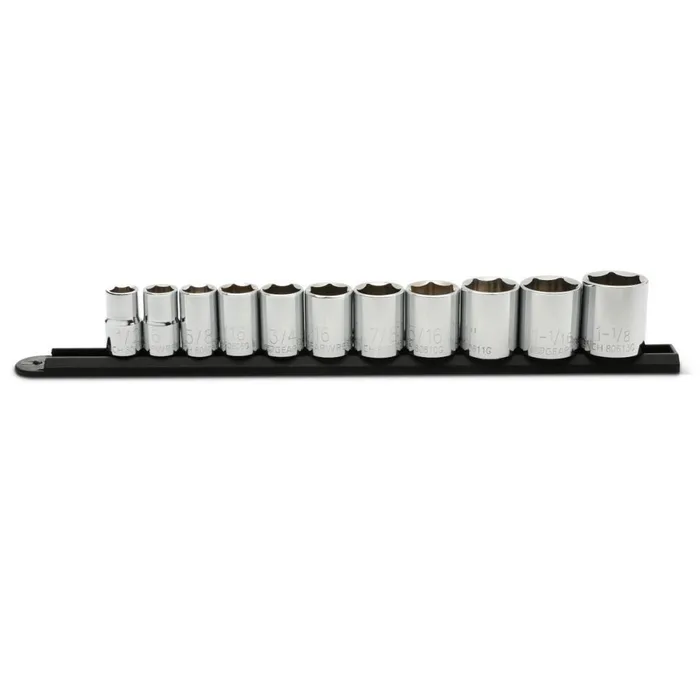
The short version
Buy the GEARWRENCH 80703, an 11-piece 1/2 inch drive 6-point SAE set. It is the only set here whose maker names the actual standard, ASME B107.1, rather than referring vaguely to a standards body, and its off-corner loading design deliberately moves force onto the flats of a fastener rather than the corners, which is what stops rounding. Buy the DEWALT DWMT73804 if you want breadth in the small drives: 34 pieces across 1/4 and 3/8 inch drive, 6-point sockets, and a 72-tooth ratchet giving a 5 degree swing arc for tight work, though DEWALT only says it exceeds ANSI specifications without naming one. The GEARWRENCH 80711 is the it-depends, the same set in 12-point geometry, which engages a fastener in half the rotation and is genuinely better in confined spaces at the cost of gripping corners instead of flats. Skip the CRAFTSMAN CMMT12024 if the 135-piece count is doing the persuading: it is a competent set that meets or exceeds ASME specifications without saying which, and most of the count is sockets in sizes you will never reach for. Best for: anyone choosing between a 135-piece set and an 11-piece one and unsure why the small one costs more.
Our picks at a glance
- GEARWRENCH 80703 11-Piece 1/2 in. Drive 6-Point Standard SAE Socket Set - Buy. The only set here whose maker names the standard rather than the standards body, with geometry designed specifically against rounding.
- DEWALT DWMT73804 34-Piece 1/4 in. and 3/8 in. Drive Socket Set - Buy. Covers the two drive sizes most work actually happens in, with a 72-tooth ratchet for places a coarse one cannot turn.
- GEARWRENCH 80711 11-Piece 1/2 in. Drive 12-Point Standard SAE Socket Set - It depends. The same set in twelve-point geometry, which halves the rotation needed to engage a fastener and gives up grip on the flats to do it.
- CRAFTSMAN CMMT12024 135-Piece SAE and Metric Mechanics Tool Set with Case - Skip. A big number on the box, three drive sizes, and a standards claim that never names a standard.
The verdict in 30 seconds
What mattered most
- Standard named
- Socket geometry
- Drive sizes
- Pieces
- Ratchet included
- Measurement system
Socket sets are sold on piece count, which is the number least connected to whether the tools work. What would tell you something is the standard: ASME B107 is the family that governs socket dimensions, strength and markings in the US, and a maker either cites the specific standard or gestures at the standards body. In this group one does the former and two do the latter, saying their tools meet or exceed ANSI or ASME specifications without naming which. The other decision that matters is geometry. Six-point sockets grip the flats of a fastener and twelve-point sockets grip the corners, which is faster to engage and more likely to round a tight bolt. Everything else on the box, the piece count included, is packaging.
The only set here whose maker names the standard rather than the standards body, with geometry designed specifically against rounding.
Best for: Anyone building a kit deliberately who wants the heavy drive done properly before filling in the small sizes.
- Stated to meet or exceed ASME B107.1, naming the specific standard rather than referring generally to ANSI or ASME.
- Off-corner loading design puts the driving force on the flats of the fastener instead of its corners, which is the mechanism that prevents rounding.
- Six-point geometry, giving the largest contact area with the fastener and the most resistance to slipping on a tight bolt.
- Chamfered socket openings that guide the socket onto the fastener, which matters when you are working by feel.
- Eleven pieces in a single drive size, so it is a component of a tool kit rather than a kit in itself.
- Half inch drive only, which is the wrong tool for small fasteners where 1/4 and 3/8 inch do the work.
- SAE only in this part number, so metric is a second purchase.
- No ratchet included in the set at this piece count.
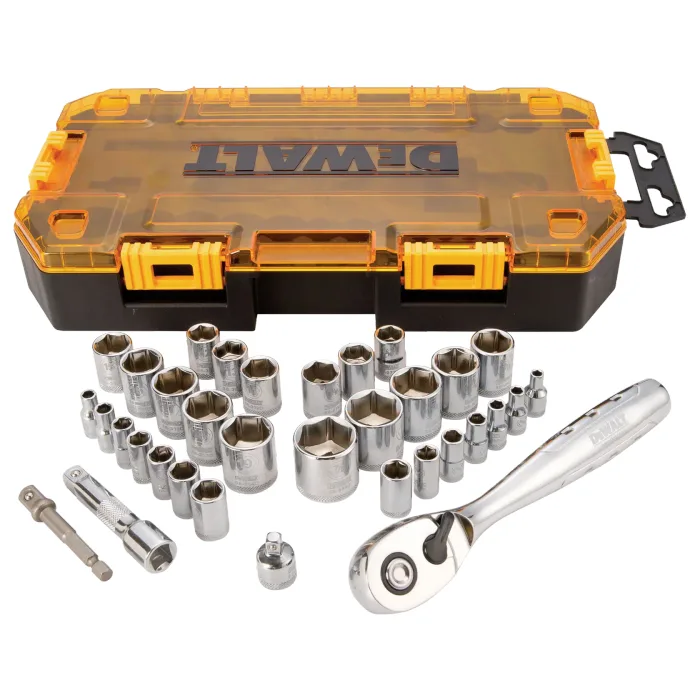
Covers the two drive sizes most work actually happens in, with a 72-tooth ratchet for places a coarse one cannot turn.
Best for: General maintenance and automotive work where most fasteners are small and access is tight.
- Covers 1/4 and 3/8 inch drive, which between them handle the large majority of fasteners most people meet.
- A 72-tooth ratchet, giving roughly a 5 degree swing arc, so it can be worked in confined spaces where a coarse ratchet jams.
- Six-point sockets, gripping the flats rather than the corners.
- Hard stamped size markings on the sockets, which stay legible long after printed markings wear off.
- DEWALT states only that it exceeds ANSI specifications, without naming a standard, and ANSI is the standards body rather than the standard itself.
- No 1/2 inch drive, so anything requiring real torque needs another set.
- Thirty-four pieces sounds broad but is thin once split across two drive sizes and both SAE and metric.
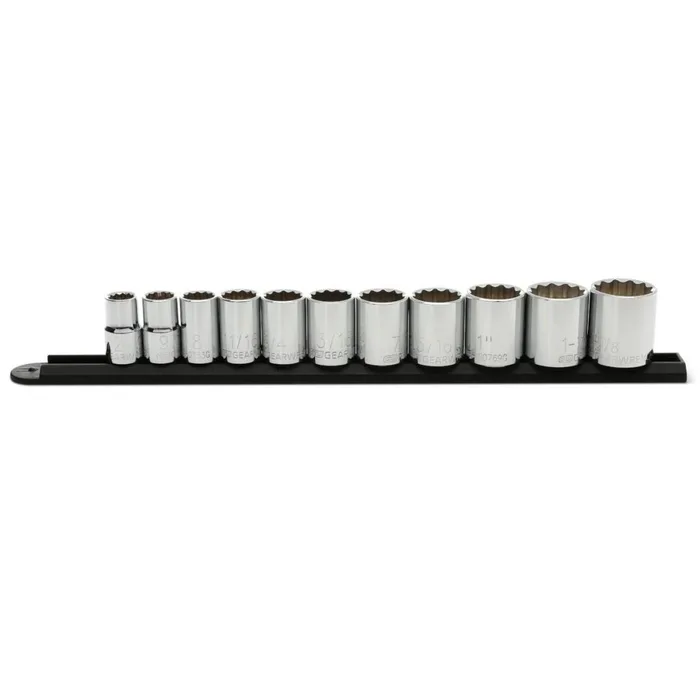
The same set in twelve-point geometry, which halves the rotation needed to engage a fastener and gives up grip on the flats to do it.
Best for: Confined engine bays and awkward access where the swing you can achieve limits the job more than the torque does.
- Also stated to meet or exceed ASME B107.1, so the disclosure is as good as its six-point sibling.
- Twelve points engage a fastener every 30 degrees rather than every 60, which is decisive when a wall or a hose limits how far you can swing.
- Easier to seat by feel on a fastener you cannot see, since there are twice as many positions where it will drop on.
- Identical build, finish and markings to the six-point set, so the choice is purely geometric.
- Twelve points load the corners of a fastener rather than the flats, which is where rounding starts on a tight or corroded bolt.
- The thinner walls between points make it the weaker geometry under high torque.
- Wrong default choice for anyone whose main problem is seized fasteners rather than access.
- Same limitations as the 80703 on drive size and SAE-only coverage.
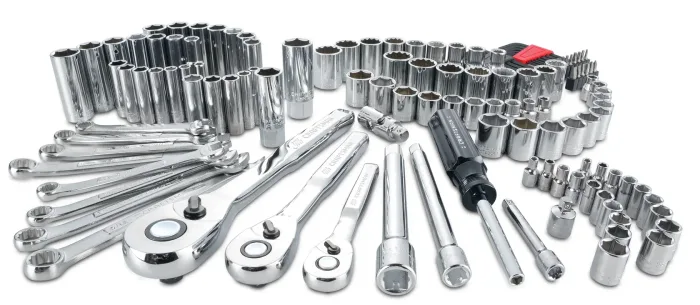
A big number on the box, three drive sizes, and a standards claim that never names a standard.
Best for: Someone with no tools at all who wants broad coverage in a single box and is not comparing standards claims.
- Covers three drive sizes with 72-tooth ratchets throughout, giving a 5 degree swing arc across the set.
- Six-point sockets in the smaller drives, though the maker's page lists the 1/2 inch drive sockets as 12-point.
- Full polish chrome finish for corrosion resistance, and a case that keeps the set together.
- Genuinely broad coverage in one purchase for someone starting from nothing.
- States that it meets or exceeds ASME specifications without naming which, so the claim cannot be checked against anything.
- The 135-piece count is inflated by sizes and adapters that most owners will never use, which is how piece count works in this category.
- Three drive sizes in one case means the case is large and the set is not really portable.
| Criteria | 80703 11-Piece 1/2 in. Drive 6-Point Standard SAE Socket Set Top pick | DWMT73804 34-Piece 1/4 in. and 3/8 in. Drive Socket Set | 80711 11-Piece 1/2 in. Drive 12-Point Standard SAE Socket Set | CMMT12024 135-Piece SAE and Metric Mechanics Tool Set with Case |
|---|---|---|---|---|
| Verdict | Buy it | Buy it | It depends | Skip it |
| Best for | Anyone building a kit deliberately who wants the heavy drive done properly before filling in the small sizes. | General maintenance and automotive work where most fasteners are small and access is tight. | Confined engine bays and awkward access where the swing you can achieve limits the job more than the torque does. | Someone with no tools at all who wants broad coverage in a single box and is not comparing standards claims. |
| Price tier | $$ · mid-range | $$ · mid-range | $$ · mid-range | $$ · mid-range |
| Standard named | ASME B107.1 | No, exceeds ANSI specifications | ASME B107.1 | No, meets or exceeds ASME specifications |
| Socket geometry | 6-point | 6-point | 12-point | 6-point (12-point in 1/2 in.) |
| Drive sizes | 1/2 in. | 1/4 and 3/8 in. | 1/2 in. | 1/4, 3/8 and 1/2 in. |
| Pieces | 11 | 34 | 11 | 135 |
| Ratchet included | No | Yes, 72-tooth | No | Yes, 72-tooth |
| Measurement system | SAE | SAE and metric | SAE | SAE and metric |
| Size markings | Stamped | Hard stamped | Stamped | Large markings |
Which one is right for you?
- Anyone building a kit deliberately who wants the heavy drive done properly before filling in the small sizes. Buy it GEARWRENCH 80703 11-Piece 1/2 in. Drive 6-Point Standard SAE Socket Set
- General maintenance and automotive work where most fasteners are small and access is tight. Buy it DEWALT DWMT73804 34-Piece 1/4 in. and 3/8 in. Drive Socket Set
- Confined engine bays and awkward access where the swing you can achieve limits the job more than the torque does. It depends GEARWRENCH 80711 11-Piece 1/2 in. Drive 12-Point Standard SAE Socket Set
- Someone with no tools at all who wants broad coverage in a single box and is not comparing standards claims. Skip it CRAFTSMAN CMMT12024 135-Piece SAE and Metric Mechanics Tool Set with Case
How we judged the field
Three questions, none of which is piece count. First, does the maker name the standard? ASME B107 is the family governing socket dimensions, strength and markings in the US, and there is a meaningful difference between citing B107.1 and saying a tool meets or exceeds ANSI specifications, because the second names an organisation rather than a document and cannot be checked against anything. Second, what geometry is it? Six points bear on the flats of a fastener and twelve bear on the corners, and that single choice does more to determine whether you round a bolt than any material claim. Third, which drive sizes are covered, since a set that omits the drive you need is not a set for you regardless of how many pieces it contains. Material names like chrome vanadium we largely discounted, because heat treatment and wall thickness decide strength and neither gets published.
GEARWRENCH 80703 11-Piece 1/2 in. Drive 6-Point Standard SAE Socket Set
Buy itThe GEARWRENCH 80703 is the pick on the strength of two things that are unusual in this category. It names its standard: ASME B107.1, a specific document rather than a wave at a standards body, which puts it alone among the four here. And its geometry is designed against the actual failure mode. GEARWRENCH’s off-corner loading moves the driving force onto the flats of the fastener rather than its corners, which is where rounding starts, and the chamfered socket opening helps the socket find the fastener when you are working by feel behind an engine. Six-point construction gives the largest contact area available. The obvious limitation is scope: eleven pieces, half inch drive, SAE only, and no ratchet in the set. This is a component bought deliberately rather than a kit, and it makes most sense to someone building up from the heavy end rather than someone with an empty toolbox.
DEWALT DWMT73804 34-Piece 1/4 in. and 3/8 in. Drive Socket Set
Buy itThe DEWALT DWMT73804 is the second buy because it covers the drives where most fastening actually happens. A 1/4 and 3/8 inch pair handles the large majority of fasteners a home or automotive user meets, and the 72-tooth ratchet gives roughly a 5 degree swing arc, which is the difference between turning a bolt behind a panel and going to find a wrench. The sockets are six-point and the size markings are hard stamped rather than printed, which matters because printed markings wear off exactly on the sockets you use most. Where it falls short is disclosure: DEWALT says it exceeds ANSI specifications, and ANSI is the body that accredits standards rather than the standard itself, so the claim cannot be checked. There is also no half inch drive, so anything genuinely tight needs a second set, and 34 pieces thins out quickly once divided between two drives and both measurement systems.
GEARWRENCH 80711 11-Piece 1/2 in. Drive 12-Point Standard SAE Socket Set
It dependsThe GEARWRENCH 80711 is the it-depends, and it is the same set as the pick with one thing changed. Twelve points engage a fastener every 30 degrees instead of every 60, so it seats in half the rotation and drops onto a bolt you cannot see far more readily. In a crowded engine bay, where the limit on the job is how far you can swing a handle before hitting something, that is not a convenience but the difference between possible and impossible. The cost is structural. Twelve points bear on the corners of the fastener, and the walls between the points are thinner, which makes it both more likely to round a tight bolt and weaker under high torque. Since it carries the same ASME B107.1 statement and the same build as the 80703, the decision is purely about which problem you have more often, access or seized fasteners.
CRAFTSMAN CMMT12024 135-Piece SAE and Metric Mechanics Tool Set with Case
Skip itThe CRAFTSMAN CMMT12024 is the skip, and specifically the 135-piece count is the thing to skip. The set itself is competent: six-point sockets in the smaller drives (the 1/2 inch sockets are listed as 12-point), 72-tooth ratchets across three drive sizes, full polish chrome, and a case that keeps everything together. For someone who owns nothing, that breadth in one purchase is a real argument. But the standards claim is that it meets or exceeds ASME specifications without ever saying which, which is the same non-statement as DEWALT’s and cannot be verified. And the piece count is doing persuasive work it has not earned, since reaching 135 means counting every size in every drive plus adapters and bits, most of which will sit unused for the life of the set. Three drives in one case also makes it bulky rather than portable. Buy it for coverage if you have nothing, but do not buy it because the number is bigger.
Sources
Specs in this review come from these pages.
- GEARWRENCH 80703, 11-piece 1/2 in. drive 6-point standard SAE socket set (gearwrench.com)
- GEARWRENCH 80711, 11-piece 1/2 in. drive 12-point standard SAE socket set (gearwrench.com)
- DEWALT DWMT73804 socket set, 1/4 in. and 3/8 in. drive (acmetools.com)
- CRAFTSMAN CMMT12024, standard SAE and metric mechanics tool set with case (craftsman.com)
- GEARWRENCH socket set listing citing ASME B107.1 compliance (hubbardsupply.com)
GEARWRENCH 80703 11-Piece 1/2 in. Drive 6-Point Standard SAE Socket Set vs DEWALT DWMT73804 34-Piece 1/4 in. and 3/8 in. Drive Socket Set: which should you buy?
The two GEARWRENCH sets are the most useful comparison here precisely because everything except the geometry is held constant: same maker, same ASME B107.1 statement, same finish and markings, same drive and size range. That isolates the one decision. Six points give you the largest bearing area on the flats of the fastener, which is where the metal is thickest and where force is least likely to round anything. Twelve points give you engagement every 30 degrees, which is what you want when a hose, a bracket or a bulkhead means you can only move the handle a short way. There is no general answer. If your recurring problem is bolts that are tight or corroded, take the six-point. If it is bolts you can barely reach, take the twelve-point and accept that it is the weaker geometry.
What to look for
- A named standard, not a named organisation: ASME B107.1 points at a document you can read, while meets or exceeds ANSI specifications points at a standards body and cannot be checked.
- Six-point geometry as the default: it bears on the flats of the fastener where the metal is thickest, and twelve-point should be a deliberate choice made for access.
- Which drive sizes are covered: 1/4 and 3/8 inch handle most fasteners, 1/2 inch handles the tight ones, and a set missing the one you need is not cheaper, it is incomplete.
- Ratchet tooth count: 72 teeth gives roughly a 5 degree swing arc, which decides whether confined fasteners can be turned at all.
- Hard stamped rather than printed markings: printed sizes wear off first on the sockets you reach for most, which is exactly when you need to read them.
- Whether individual pieces can be replaced: sets sold as components can be topped up, and sets sold as a sealed count usually cannot.
Our final take
Piece count is the number this category advertises and the least informative one available. Read the standards claim first, and notice whether it names a document or an organisation. Then choose six-point unless access is your recurring problem. A carefully chosen small set from a maker that will name its standard beats a large one that will not.
Questions, answered
Six-point or twelve-point sockets?
Six-point for anything tight, corroded or high-torque, because the socket bears on the flats of the fastener where the metal is thickest. Twelve-point for access, because it drops onto a fastener every 30 degrees instead of every 60, which matters when a hose or a wall limits your swing. The trade is real and physical: twelve points load the corners, and corners are where rounding begins. If you are buying one set, buy six-point and accept the occasional awkward reach.
What is ASME B107 and does it matter?
It is the family of American standards covering hand tools, including socket dimensions, strength requirements and markings, with B107.1 among the parts covering sockets and drives. It matters mostly as a disclosure test. A maker who names the specific standard is pointing at a document you could read; one who says its tools meet or exceed ANSI or ASME specifications is naming a standards body, which is not the same thing and cannot be checked. In this comparison GEARWRENCH names B107.1 and the other two do not name anything.
Does the piece count tell me anything?
Very little, and it is the number the category is sold on. A 135-piece set reaches that figure by counting every socket in every size across three drives, plus adapters and bits, many of which will never be used. An 11-piece set in one drive size can easily be the better tools. Count the sizes you actually reach for, check which drives are covered, and treat the headline number as packaging rather than specification.
What does a 72-tooth ratchet buy me?
A smaller swing arc. Seventy-two teeth means the mechanism catches every 5 degrees, so you can turn a fastener in a space where a 36-tooth ratchet needing 10 degrees would simply jam. That is the whole benefit and it is a real one in engine bays and behind panels. The trade-off is that finer teeth are individually smaller and, in cheap mechanisms, less durable under heavy torque, which is why the fine-tooth ratchets tend to appear on the smaller drive sizes.
Are chrome vanadium and alloy steel different things?
Chrome vanadium is a type of alloy steel, so the terms overlap and listings use them loosely. What actually determines a socket's strength is the heat treatment and wall thickness, neither of which is usually published. This is why the standards claim carries more weight than the material name: a named standard sets minimum strength and dimensional requirements, whereas chrome vanadium on its own describes the recipe and not the result.
Deciding between the top two? See our head-to-head: GEARWRENCH 80703 11-Piece 1/2 in. Drive 6-Point Standard SAE Socket Set vs DEWALT DWMT73804 34-Piece 1/4 in. and 3/8 in. Drive Socket Set.
More Tools & DIY reviews
 The Best Solder Wire for Electronics: 4 Compared (and One to Skip)
  The Best Solder Fume Extractors: 4 Compared (and One to Skip)
  The Best Soldering Irons and Stations: 4 Compared (and One to Skip)
  The Best Splitting Axes and Mauls: 4 Compared (and One to Skip)
  The Best Step Ladders: 4 Compared (and One to Skip)
  The Best Stud Finders: 4 Compared (and One to Skip)