Explained
Socket Sets, Explained
After reading, you'll know which standards claims can be checked, which geometry suits your work, and why piece count misleads.
In this guide
Socket sets are advertised on how many pieces are in the box. The two things that decide whether they work are the geometry of the socket and whether the maker will name a standard.
The 30-second version
- Naming a standard is the real test, because ASME B107.1 is a document you can read while meets or exceeds ANSI specifications names only the organisation.
- Six points bear on the flats, where the fastener metal is thickest, which is why six-point sockets round tight bolts far less often than twelve-point ones.
- Twelve points buy access, not strength, engaging every 30 degrees instead of every 60, which matters when a bracket or hose limits how far the handle can swing.
- Piece count is packaging, since large numbers are reached by counting every size across three drives plus adapters, most of which stay in the case.
- Tooth count sets the swing arc, as a 72-tooth ratchet catches every 5 degrees and can turn fasteners a coarse ratchet simply cannot reach.
The products this guide is about
Our verdict on each, with the full reasoning on the companion review.
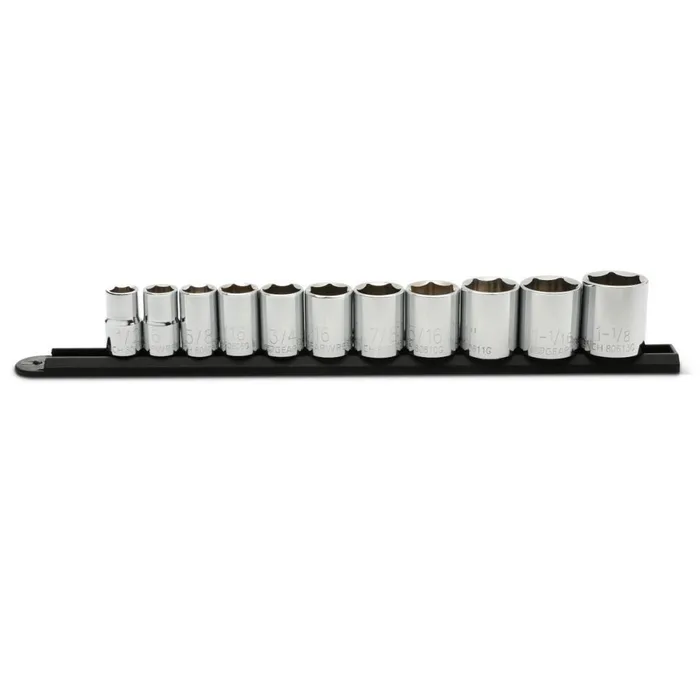
- Buy GEARWRENCH 80703 11-Piece 1/2 in. Drive 6-Point Standard SAE Socket Set The only set here whose maker names the standard rather than the standards body, with geometry designed specifically against rounding. Amazon
- Buy DEWALT DWMT73804 34-Piece 1/4 in. and 3/8 in. Drive Socket Set Covers the two drive sizes most work actually happens in, with a 72-tooth ratchet for places a coarse one cannot turn. Amazon
- It depends GEARWRENCH 80711 11-Piece 1/2 in. Drive 12-Point Standard SAE Socket Set The same set in twelve-point geometry, which halves the rotation needed to engage a fastener and gives up grip on the flats to do it. Amazon
- Skip CRAFTSMAN CMMT12024 135-Piece SAE and Metric Mechanics Tool Set with Case A big number on the box, three drive sizes, and a standards claim that never names a standard.
What actually matters
- The standards claim - ASME B107 is the family covering socket dimensions, strength and markings. A specific part number cited is a checkable claim; a reference to ANSI or ASME in general is not.
- Point count - six-point sockets contact the six flats of a hex fastener; twelve-point contact the corners. Six is stronger and safer on tight fasteners, twelve is faster to engage in confined spaces.
- Drive size - 1/4 inch for small fasteners and electronics, 3/8 inch for general work, 1/2 inch for anything needing real torque. Most sets are bought incomplete in this respect.
- Ratchet tooth count - the number of engagement positions. Seventy-two teeth means about 5 degrees of swing per click; thirty-six means about 10, which is often too much in an engine bay.
- Marking method - hard stamped size markings survive; printed or etched ones wear off, and they wear off first on the sockets used most.
- Deep versus standard sockets - deep sockets clear protruding studs and reach recessed fasteners; standard ones fit where clearance is short. A set with only one type will eventually stop you.
The specs, in plain English
Green flags vs red flags
Green flags
- A specific standard is cited, such as ASME B107.1, rather than a standards body.
- Point count is stated for every socket in the set rather than only in marketing copy.
- Drive sizes are listed explicitly and the ratchet tooth count is given.
- Size markings are described as hard stamped.
- Individual replacement pieces are available to buy separately.
Red flags
- Piece count leads the listing and the drive sizes are hard to find.
- Meets or exceeds ANSI or ASME specifications appears with no part number.
- Chrome vanadium is offered as the main quality claim with no standard alongside it.
- Professional grade or heavy duty appears with no torque or standard behind it.
- The point count of the sockets is not stated anywhere in the specification.
Who's who: the brands
- GEARWRENCH - Names ASME B107.1 on its chrome socket sets and builds off-corner loading geometry to resist rounding. The clearest disclosure in this comparison.
- DEWALT - Broad mechanics sets with fine-tooth ratchets and hard stamped markings, stating only that tools exceed ANSI specifications.
- CRAFTSMAN - Large mixed sets sold on piece count and coverage, with standards claims that name ASME without naming a part.
- TEKTON - A well-known tool brand worth checking if you want to extend a set later.
- Wera - German, best known for the Zyklop ratchet family and unconventional drive geometries, at a considerable price premium.
How to read a listing without getting fooled
Find the standards claim first and check whether it names a document or an organisation. Then find the point count, and treat six as the default unless you know access is your problem. Check which drive sizes are included against the work you do. Read the ratchet tooth count if a ratchet is included. Look at piece count last, and only to see how it was reached.
How much should you spend?
Budget buys a large mixed set with broad coverage and an unverifiable standards claim, which for someone starting from nothing is a reasonable trade. Mid-range buys either a named standard or better geometry, usually in a narrower set. Premium buys ratchet mechanisms and drive designs that solve access problems, and it is worth paying only once you know which fasteners you keep failing to reach.
Questions, answered
Will a twelve-point socket round my bolts?
It is likelier to than a six-point, and mostly on fasteners that are already tight, corroded or slightly worn. Twelve points bear on the corners of the hex, which are the thinnest part of the fastener and the first to deform. On a bolt that turns freely the difference rarely shows. On one that is seized, reach for six points every time.
Do I need both SAE and metric?
Almost certainly, unless you work exclusively on one type of machinery. The dangerous part is not that you lack a size but that near-size pairs exist across the two systems and will engage just enough to round a fastener. Sets that cover both, and mark them clearly, remove a whole class of expensive mistake.
Is a 135-piece set better value than an 11-piece one?
Per piece, obviously. Per useful tool, often not. Large counts are reached by including every size across several drive sizes plus adapters and bits, and a substantial fraction will never be used. An 11-piece set in the right drive with better geometry and a named standard can be the more useful purchase, which is why the small set is not necessarily the cheap one.
What actually makes one socket stronger than another?
Heat treatment and wall thickness, neither of which appears on the box. That is why the standards claim carries the weight it does: a named standard sets minimum strength and dimensional requirements that the tool has to meet, whereas a material name like chrome vanadium describes what it was made from and nothing about how well.
Or jump to the head-to-head: GEARWRENCH 80703 11-Piece 1/2 in. Drive 6-Point Standard SAE Socket Set vs DEWALT DWMT73804 34-Piece 1/4 in. and 3/8 in. Drive Socket Set.