

Tools & DIY
The Best Random Orbital Sanders: 4 Compared (and One to Skip)
Four random orbital sanders compared on the specification that decides what the tool is for: orbit diameter, which Makita states on its page and CRAFTSMAN does not.
The short version
Buy the Makita BO5041. It publishes a 2.8 mm sanding orbit, the largest figure here, and pairs it with the widest speed range at 4,000 to 12,000 orbits per minute from a 300 W motor. That bottom end matters: a sander that cannot slow down burns finish and rounds edges. Buy the Festool ETS 125 REQ if the work is finishing rather than shaping. Its 2 mm sanding stroke is the smallest here and produces the finest scratch pattern, its 6,000 to 14,000 OPM range is the fastest at the top, and the 250 W motor is the lowest rated here, which is exactly right for a tool meant to refine rather than remove. The DEWALT DWE6423 is the it-depends, a 3 amp sander whose page does not list an orbit diameter and whose 8,000 to 12,000 OPM range will not go slow, so it is happier on bare timber than on finish coats. Skip the CRAFTSMAN CMEW231 on disclosure: 3 amps and 12,000 OPM are published, and the orbit diameter, the number that decides what the sander is actually for, is not. Best for: anyone who read that they should choose between a 3 mm and a 5 mm orbit and then could not find either.
Our picks at a glance
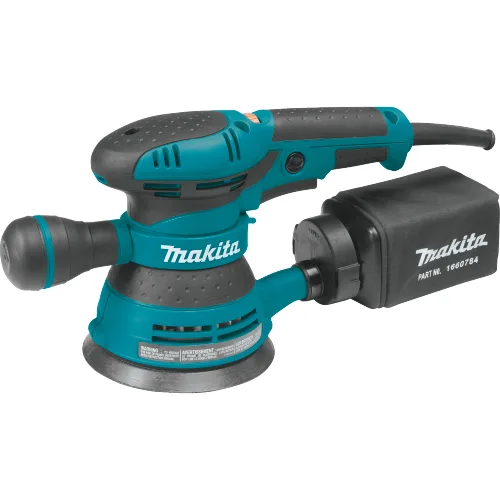
- Makita BO5041 5 in. Random Orbit Sander, variable speed - Buy. Publishes the largest orbit here at 2.8 mm and the widest speed range, including a genuinely slow 4,000 OPM setting.
- Festool ETS 125 REQ-Plus Random Orbital Sander - Buy. The smallest stroke here at 2 mm and the highest top speed, which is the correct combination for a tool that refines rather than removes.
- DEWALT DWE6423 5 in. Variable Speed Random Orbit Sander - It depends. A capable sander whose speed range will not go slow, which limits where it belongs.
- CRAFTSMAN CMEW231 5 in. Corded Random Orbit Sander, 3 amp - Skip. Publishes amps, speed and weight, and leaves out the orbit diameter that decides what kind of sander it is.
The verdict in 30 seconds
What mattered most
- Published orbit diameter
- Speed range
- Lowest usable speed
- Power
- Pad diameter
- Vibration published in m/s2
Every guide to random orbital sanders explains that a small orbit gives a fine finish and a large orbit removes material fast, usually contrasting a 3 mm orbit with a 5 mm one. Then you look at what is sold as a woodworking sander and these have nothing like a 5 mm orbit. The figures we found for the tools here are 2.0 and 2.8 mm, both firmly at the fine-finish end, and the aggressive 5 mm stroke belongs to a different category of machine sold mostly for automotive paint work. So the real decision is narrower and more interesting than the guides suggest: small differences in orbit, large differences in speed range, and whether the maker publishes the number at all.
Publishes the largest orbit here at 2.8 mm and the widest speed range, including a genuinely slow 4,000 OPM setting.
Best for: General woodworking that spans stock preparation and finish sanding, where one tool has to do both ends.
- Makita publishes a 2.8 mm sanding orbit diameter, the largest figure here.
- A 4,000 to 12,000 OPM range, meaning it will actually run slowly, which is what protects finish coats and edges.
- 300 W continuous input power, the highest figure here.
- A 123 mm pad, and Makita publishes pad diameter, orbit and a vibration figure.
- The 123 mm pad is slightly under the 125 mm standard, so pad and abrasive fit needs checking.
- 2.8 mm is still a fine-finish orbit, so this is not a material-removal tool despite being the most aggressive here.
- Makita's vibration figure of 3.5 m/s2 is for sanding a metal plate, so treat it as a guide rather than a wood sanding result.
- Corded, so the hose and cord management is on you.
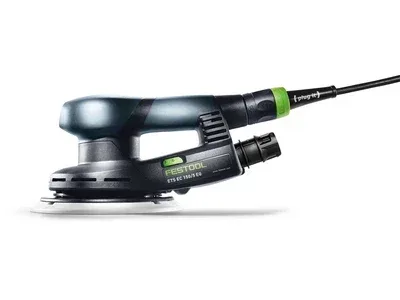
The smallest stroke here at 2 mm and the highest top speed, which is the correct combination for a tool that refines rather than removes.
Best for: Finish work and between-coat sanding where scratch pattern matters more than how fast material comes off.
- A 2 mm sanding stroke, the finest in this comparison, producing the smallest scratch pattern before finishing.
- 6,000 to 14,000 OPM, the highest top speed here, which suits the small stroke by putting more passes over the same area.
- 250 W is deliberately modest, since a finishing sander that pushes hard leaves marks rather than removing them.
- Interchangeable 125 mm sanding pad, so worn pads are replaced rather than making the tool disposable.
- By far the most expensive tool here, and the abrasives and accessories continue that pricing.
- A 2 mm stroke removes material slowly, so stock preparation is genuinely tedious with it.
- The 6,000 OPM floor is higher than the Makita's 4,000, so it is less gentle at the bottom than the stroke suggests.
- Best value depends on buying into the wider Festool dust extraction system, which is another purchase again.
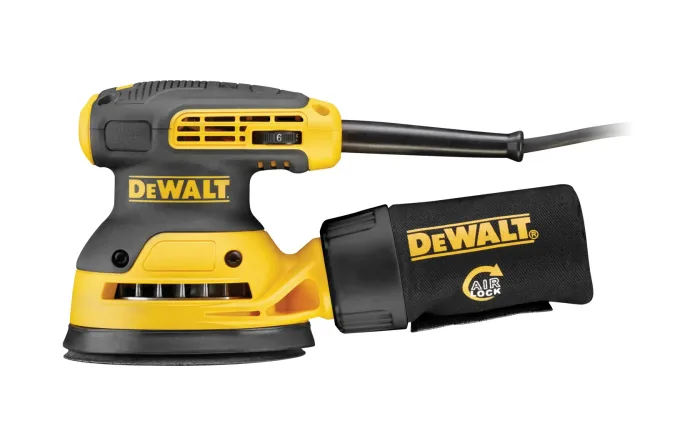
A capable sander whose speed range will not go slow, which limits where it belongs.
Best for: Bare timber and stock preparation where fast, uniform sanding matters more than a slow setting.
- Variable speed from 8,000 to 12,000 OPM and a 5 in. hook-and-loop pad, with a separate counterweight that DEWALT says reduces vibration.
- A 3 amp motor, level with the CRAFTSMAN.
- A standard 5 in. pad, so abrasives are easy to source.
- Priced in the same band as the Makita, making it an easy like-for-like comparison.
- The 8,000 to 12,000 OPM range has the highest floor here, so it cannot be dialled down for delicate work the way the Makita can.
- DEWALT's US product page does not list an orbit diameter, the specification that defines what the sander is for.
- No numeric vibration figure on the US page.
- Variable speed on a 4,000 OPM span is less useful than it sounds, since the whole range is fast.
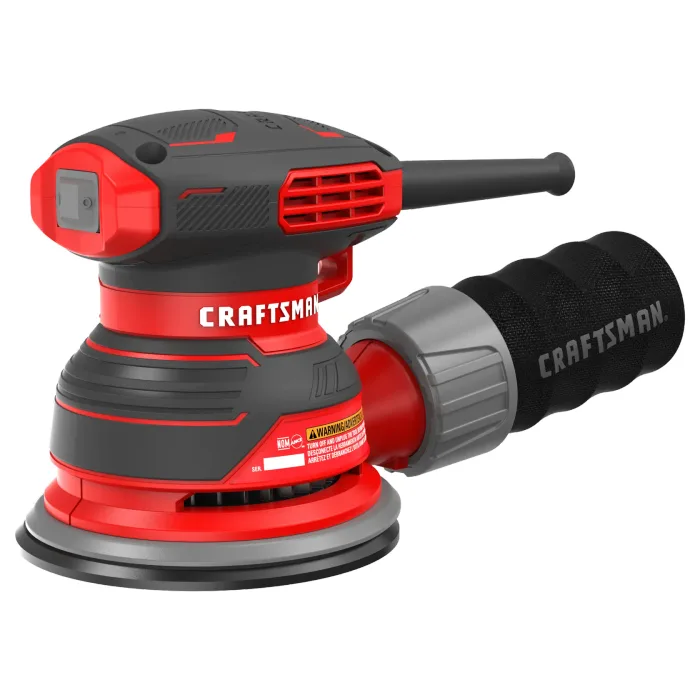
Publishes amps, speed and weight, and leaves out the orbit diameter that decides what kind of sander it is.
Best for: Occasional light sanding where the tool is bought on price and weight rather than on what it does to a surface.
- Straightforward single-speed design at a budget price.
- 12,000 OPM top speed, level with the Makita and DEWALT.
- On-board dust bag plus a 1-3/4 in. vacuum hose connection at a budget price.
- No sanding orbit diameter is published on the product page, so the single most defining specification of the tool is unknown before purchase.
- A single 12,000 OPM rating is given, so there is no slow setting for finish work.
- 3 amps is level with the DEWALT and a basic power rating.
- No vibration figure and no orbit, making it the thinnest specification of the four.
| Criteria | BO5041 5 in. Random Orbit Sander, variable speed Top pick | ETS 125 REQ-Plus Random Orbital Sander | DWE6423 5 in. Variable Speed Random Orbit Sander | CMEW231 5 in. Corded Random Orbit Sander, 3 amp |
|---|---|---|---|---|
| Verdict | Buy it | Buy it | It depends | Skip it |
| Best for | General woodworking that spans stock preparation and finish sanding, where one tool has to do both ends. | Finish work and between-coat sanding where scratch pattern matters more than how fast material comes off. | Bare timber and stock preparation where fast, uniform sanding matters more than a slow setting. | Occasional light sanding where the tool is bought on price and weight rather than on what it does to a surface. |
| Price tier | $$ · mid-range | $$$$ · flagship | $$ · mid-range | $ · budget |
| Published orbit diameter | 2.8 mm | 2.0 mm | Not listed on US page | Not published |
| Speed range | 4,000 to 12,000 OPM | 6,000 to 14,000 OPM | 8,000 to 12,000 OPM | 12,000 OPM |
| Lowest usable speed | 4,000 OPM | 6,000 OPM | 8,000 OPM | No slow setting |
| Power | 300 W | 250 W | 3 amps | 3 amps |
| Pad diameter | 123 mm | 125 mm | 5 in. | 5 in. |
| Vibration published in m/s2 | 3.5 m/s2 on a metal plate | No | No | No |
| Pad replaceable | Yes | Yes, interchangeable | Yes | Not stated |
Which one is right for you?
- General woodworking that spans stock preparation and finish sanding, where one tool has to do both ends. Buy it Makita BO5041 5 in. Random Orbit Sander, variable speed
- Finish work and between-coat sanding where scratch pattern matters more than how fast material comes off. Buy it Festool ETS 125 REQ-Plus Random Orbital Sander
- Bare timber and stock preparation where fast, uniform sanding matters more than a slow setting. It depends DEWALT DWE6423 5 in. Variable Speed Random Orbit Sander
- Occasional light sanding where the tool is bought on price and weight rather than on what it does to a surface. Skip it CRAFTSMAN CMEW231 5 in. Corded Random Orbit Sander, 3 amp
How we judged the field
Orbit diameter first, because it is the specification that decides what a random orbital sander is for, and because publishing it separates the tools that expect to be compared from the ones that do not. Then the speed range, and specifically its floor rather than its ceiling, since most sanders here reach 12,000 orbits per minute and the meaningful difference is whether it can also run slowly enough for finish work. Then power, read against the orbit rather than on its own, because a finishing sander with a small stroke has no use for a big motor. Then pad diameter and replaceability, which govern what abrasives fit and whether a worn pad ends the tool’s life. We also looked for hand-arm vibration figures in m/s2, and only Makita’s page gave one.
Makita BO5041 5 in. Random Orbit Sander, variable speed
Buy itThe Makita BO5041 is the pick because it publishes the most useful combination of numbers and then backs them with the widest operating range. Its 2.8 mm sanding orbit is the largest figure here, which within this fine-finish category suggests it is the quickest to level stock. More important is the speed range: 4,000 to 12,000 OPM, with a floor half that of the DEWALT’s 8,000. That low end is what lets one tool cover both bare timber and finish coats, because burning through a veneer or rounding an edge is a speed problem before it is an abrasive problem. The 300 W motor is the highest rated here. Two things to know before buying: the pad is 123 mm rather than the 125 mm standard, so abrasives should be bought to match rather than assumed, and its 3.5 m/s2 vibration figure was measured sanding a metal plate, so it is a guide rather than a wood result.
Festool ETS 125 REQ-Plus Random Orbital Sander
Buy itThe Festool ETS 125 REQ is the second buy and the only one here that is unambiguously a finishing tool. Its 2 mm sanding stroke is the smallest in the group and leaves the finest scratch pattern, and its 6,000 to 14,000 OPM range has the highest ceiling, which is the right pairing: a small stroke covers less ground per orbit, so more orbits per minute compensates. The 250 W motor being the weakest here is a design decision rather than a shortfall, since a finishing sander that can be pushed hard is a finishing sander that leaves marks. The pad is interchangeable at a standard 125 mm, so a worn pad is a consumable rather than the end of the tool. Against it: the price is in a different bracket from everything else here, the abrasives and the dust extraction system extend that, stock removal with a 2 mm stroke is genuinely slow, and its 6,000 OPM floor is higher than the Makita’s despite the finer stroke.
DEWALT DWE6423 5 in. Variable Speed Random Orbit Sander
It dependsThe DEWALT DWE6423 is the it-depends, and the reason is a range rather than a rating. DEWALT’s US page lists a 3 amp motor and a 5 inch hook-and-loop pad, but not an orbit diameter. The problem is that its speed range runs 8,000 to 12,000 OPM, the highest floor in this group, so its variable speed spans a narrow band of fast settings and it cannot be dialled down for delicate work at all. Without an orbit figure you cannot place it against the Makita’s 2.8 mm and the Festool’s 2.0 mm. What it does have is a standard 5 inch pad, which makes abrasives easy to source. As a dedicated stock-preparation sander for bare timber it is straightforward and good. As the one sander you own, the Makita covers more ground.
CRAFTSMAN CMEW231 5 in. Corded Random Orbit Sander, 3 amp
Skip itThe CRAFTSMAN CMEW231 is the skip, on a specific and checkable ground: it does not publish an orbit diameter. That is the number defining what a random orbital sander does to a surface, and without it you cannot know whether you are buying a finishing tool or a levelling one until you use it. What is published is 3 amps and 12,000 OPM. The page gives a single 12,000 OPM rating, so there is no slow setting for finish coats. It has an on-board dust bag and a 1-3/4 in. vacuum port at a budget price, and for occasional light sanding it will do the job. It just asks you to buy the least-specified tool in the category on trust.
Sources
Specs in this review come from these pages.
- Makita UK, BO5041 random orbit sander specifications (makitauk.com)
- DEWALT, DWE6423 5 in. variable speed random orbit sander (dewalt.com)
- Festool USA, ETS 125 REQ-Plus random orbital sander (festoolusa.com)
- CRAFTSMAN, CMEW231 corded 5 in. random orbit sander (craftsman.com)
- Rupes, random orbital sanders offered in 3 mm and 5 mm orbit versions (rupes.com)
Makita BO5041 5 in. Random Orbit Sander, variable speed vs Festool ETS 125 REQ-Plus Random Orbital Sander: which should you buy?
The Makita against the Festool is the clearest illustration of what orbit diameter buys. The Festool is rated at a 2 mm stroke, up to 14,000 OPM and 250 W: small bites, taken often, with modest force, which is the recipe for a fine scratch pattern and slow removal. The Makita runs a 2.8 mm stroke from 4,000 OPM with 300 W: bigger bites, a genuinely slow option, and more power behind them. Neither is better in the abstract. If your sanding is mostly the last stage before finish, the Festool’s stroke is doing work that the Makita cannot match, and the price is buying a narrower, better tool. If your sanding starts at rough timber and ends at a finish coat, the Makita’s 4,000 OPM floor and larger orbit cover the whole span, and the Festool would leave you waiting at the start of every job.
What to look for
- A published orbit or stroke diameter: the specification that decides whether the sander refines or removes, and its absence is the single biggest gap a listing can have.
- The bottom of the speed range, not the top: almost everything reaches 12,000 OPM, and only a low floor lets you work on finish coats and veneers without burning them.
- Power read against the orbit: a small-stroke finishing sander does not want a big motor, so a modest wattage on a 2 mm tool is a design choice.
- Actual pad diameter: 5 inch is nominal and pads vary, so check the millimetre figure before buying abrasives in bulk.
- Whether the pad is replaceable: hook-and-loop pads wear out, and a tool with a replaceable pad outlives one where the pad is the tool.
- Any hand-arm vibration figure in m/s2: not on most US product pages, and the only number that would tell you how long a session is reasonable.
Our final take
The standard advice to choose between a 3 mm and a 5 mm orbit does not survive contact with what is actually sold as a woodworking sander, where the figures we found run from 2 to 2.8 mm. Within that narrow band the decision is made by the speed floor rather than the stroke, and by whether the maker will tell you the stroke at all.
Questions, answered
What does orbit diameter actually change?
It sets how far the pad travels in each small circle, which decides the size of the scratch left behind and how fast material comes off. A 2 mm stroke leaves a very fine pattern and removes slowly, which is what you want between finish coats. A 5 mm stroke removes quickly and leaves marks you then have to sand out. The useful thing to know is that the woodworking sanders most people buy cluster between 2 and 3 mm, so the choice on offer is far narrower than the standard advice implies.
Where are the 5 mm orbit sanders everyone talks about?
Mostly in automotive paint and body work, sold by brands like Rupes and Mirka, often in pneumatic form and frequently with a choice of 3 mm or 5 mm versions of the same machine. General-purpose woodworking sanders from the mainstream power tool brands sit at the fine end. If you genuinely need fast material removal on wood, a belt sander or a coarser abrasive on one of these will get you there faster than hunting for a 5 mm random orbit.
Does a slower speed setting matter?
More than the top speed does. Running fast on a finish coat or a veneer generates heat and burns through edges, and the defence is dropping the speed rather than lifting the tool. The Makita here starts at 4,000 OPM, the DEWALT at 8,000, and the Craftsman page gives a single 12,000 OPM rating. A sander with a genuinely low floor can do delicate work that a fast-only tool cannot, regardless of how the orbit compares.
Why do so few pages publish a vibration figure?
Few US product pages carry one, although hand-arm vibration is the specification that would tell you how long a tool can be used comfortably in a day. Makita's page gives 3.5 m/s2 measured sanding a metal plate, and the other pages we read give no figure. If long sanding sessions are your reality, that absence is worth weighing.
Is a 123 mm pad a problem on a 125 mm sander?
It is a fitting question rather than a performance one. Abrasive discs are sold to nominal sizes, and a 123 mm pad with 125 mm discs leaves a small overhang that can catch and tear at edges. Makita sells pads and abrasives to match, so buying within the system avoids it. It is worth knowing before you buy a large pack of discs on the assumption that 5 inch means the same thing on every tool.
Deciding between the top two? See our head-to-head: Makita BO5041 5 in. Random Orbit Sander, variable speed vs Festool ETS 125 REQ-Plus Random Orbital Sander.
More Tools & DIY reviews
 The Best Reciprocating Saws: 4 Compared (and One to Skip)
  The Best Rotary Hammers: 4 Compared (and One to Skip)
  The Best Rotary Tools: 4 Compared (and One to Skip)
  The Best Safety Glasses: 4 Compared (and One to Skip)
  The Best Scroll Saws: 4 Compared (and One to Skip)
  The Best Snow Shovels: 4 Compared (and One to Skip)