Explained
Precision Screwdriver Sets, Explained
After reading, you'll understand which drive profiles you actually need, why a cross head screw rounds out, and which specification lines on a precision kit listing are worth anything.
In this guide
First time buyers almost always choose on bit count, because it is the only number on the box. It is close to meaningless: a sixty piece tray and a hundred and fifteen piece tray usually contain the same eight useful profiles plus filler. The two things that decide whether you round out a screw are whether the recess in front of you matches the point on your driver, and whether the tip is harder than the fastener. Neither is on the front of the box, and one of them is rarely published at all.
The 30-second version
- Count profiles, not pieces, because a kit is only as good as the specific drives it lists and most large trays are padded with sizes nobody uses.
- A cross head is not one shape, and a Phillips point in a Japanese JIS recess is the combination that rides out under load and chews the head.
- Few makers publish hardness, so a named steel grade like S2 is the strongest signal you will get and silence about the bit metal is itself a finding.
- Three Apple profiles cover almost everything, namely pentalobe P2, pentalobe P5 and tri-point Y000, and they cover the Apple jobs most people meet.
- The cap is the mechanism, since precision driving means holding a spinning cap under one fingertip while the other hand turns the barrel.
The products this guide is about
Our verdict on each, with the full reasoning on the companion review.
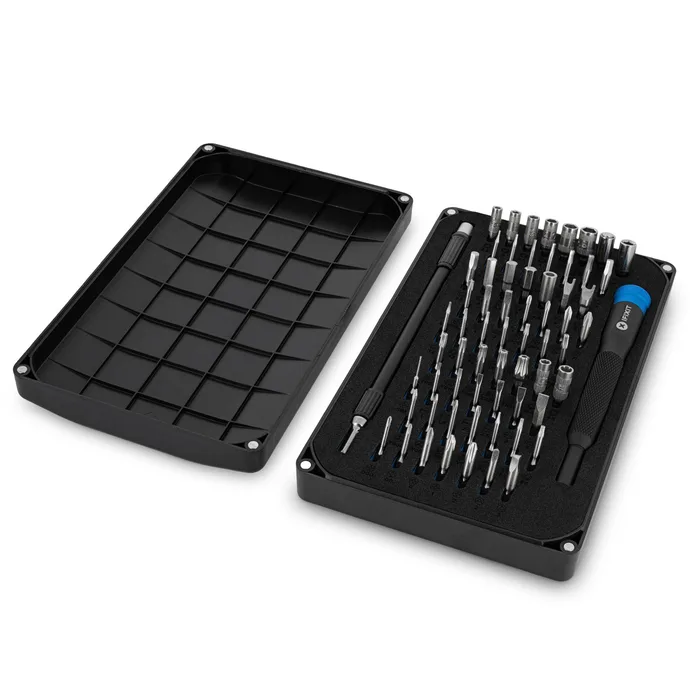
- Buy iFixit Mako Driver Kit, 64 Precision Bits The one kit here whose published bit list carries JIS cross point, pentalobe and tri-point together, in a case that names every slot. Amazon
- Buy Vessel TD-56S Precision Screwdriver Set Six fixed blade drivers whose cross points Vessel recommends for JIS and JCIS screws, which is the specific fix for cross heads that keep camming out. Amazon
- It depends Wera Kraftform Micro ESD Big Pack 1, 25 pieces The only set here that publishes an electrical surface resistance for its handles, which makes it a bench electronics tool rather than a device repair kit. Amazon
- Skip Xiaomi Electric Precision Screwdriver (MJDDLSD003QW) Xiaomi's own numbers give the motor 0.2 Nm at its higher setting against 3 Nm by hand, so the powered part cannot do the part of the job that is actually hard. Amazon
What actually matters
- Drive profile coverage - the list of specific drives a kit contains is the only capability statement that matters, and it should be read against the devices you own. Check for pentalobe, tri-point and JIS by name rather than trusting a total piece count.
- Bit steel and hardness - the bit is meant to be the harder of the two metals in the joint, and when it is not, it deforms and takes the screw head with it. Few makers in this category publish a Rockwell figure, so a named grade is the best available proxy.
- Recess geometry - Phillips, JIS, Pozidriv and Frearson all look like a cross and none of them are interchangeable under load. Matching the point to the recess is what stops cam out, and it is a geometry problem, not a technique problem.
- Handle and cap - a free running cap lets you apply straight axial pressure with a fingertip while turning with the other hand, which is how you keep a tiny point seated. A fixed cap forces you to grip and twist, which is exactly when the point walks out.
- Bit retention - a bit is held either by a magnet in the driver socket or by a spring detent, and the difference shows up when you tilt the tool over an open device. A bit that drops into a chassis is a worse afternoon than one that will not seat.
- Storage and labelling - a moulded or foam slot per bit with the size printed beside it is the difference between a complete kit and a bag of unidentifiable slivers two years in. A magnetic tray in the lid for removed fasteners is worth more than extra profiles.
- Published electrical properties - a kit sold for electronics work either publishes a handle surface resistance and names a standard, or it does not. This is one of the few places in the category where a real number is available, and most makers do not give one.
The specs, in plain English
Green flags vs red flags
Green flags
- JIS listed as its own profile alongside Phillips, rather than a claim that the Phillips bits fit Japanese screws.
- A named steel grade for the bits, and bonus marks if a hardness figure appears with the scale stated.
- Pentalobe P2 and P5 and tri-point Y000 all present, which covers current Apple hardware without buying singles later.
- A free running cap described on the handle, not just a rounded end.
- A moulded or foam slot per bit with the size printed next to it, plus somewhere to put the screws you have removed.
Red flags
- A headline piece count with no drive list, which usually means the useful profiles are a small subset of a padded tray.
- ESD safe stated as a phrase with no resistance value in ohms and no standard named.
- A specification table that names the handle and shank materials but says nothing at all about the bit metal.
- Cross head bits listed only as Phillips on a kit sold for cameras, consoles or Japanese built equipment.
- A powered driver whose published torque is far below what a hand delivers through the same body, which means the motor cannot do the difficult part.
Who's who: the brands
- iFixit - Builds kits around the profiles that turn up in device repair, and publishes the full drive list including JIS, pentalobe and tri-point sizes.
- Wera - German maker whose Kraftform Micro line is known for rotating caps and colour coding, and which publishes a handle surface resistance for its ESD tools.
- Wiha - German precision tool specialist with an electronics and ESD range. Check its current product pages for steel grade and handle resistance figures.
- Vessel - Japanese maker whose precision cross point drivers are recommended by the company itself for JIS and JCIS screws.
- Klein Tools - All in one precision kits sold through general hardware and electrical channels. Check the bit list for JIS by name.
How to read a listing without getting fooled
Ignore the piece count and find the drive list, which on a good listing is broken out by profile and size. Read it against your own hardware: an iPhone wants pentalobe P2 and tri-point Y000, a MacBook wants pentalobe P5, a console wants tamper resistant Torx and possibly a gamebit, and anything Japanese built wants a cross point that matches a JIS recess. Then look for the bit material line. If the table names the handle plastic and the shank steel but has nothing for the bits, that is a deliberate gap. Check the handle description for a rotating or swivel cap and for a magnetic socket, and check whether the case gives each bit its own labelled slot. Finally, if the kit is sold for electronics, look for a surface resistance in ohms with a standard cited; the phrase ESD safe on its own is not a specification.
How much should you spend?
Budget buys you a small fixed blade set of genuinely good drivers in a narrow range of sizes, which is excellent value if the sizes match your work and useless if they do not. Mid-range is where the broad bit kits sit, and it is the sensible first purchase for anyone opening consumer devices, because you get the awkward proprietary profiles in the same case as the ordinary ones. Premium buys German or Japanese fixed blade sets with better handles, published electrical properties and a driver per profile, which is worth it on a bench you use daily and largely wasted in a drawer. The powered options land in the middle and are priced against convenience rather than capability, so judge them on their published torque rather than their bit count. Spending more does not reliably buy you a hardness figure, because few makers publish one at any tier.
Questions, answered
Do I need a magnetiser, or are precision bits already magnetic?
It depends how the kit holds the screw. Some drivers have a rare earth magnet built into the bit socket, which keeps working indefinitely and magnetises whatever bit is fitted while it is in the tool. Other tools rely on the bit itself having been magnetised, and that induced field weakens with handling and knocks, which is why cheap magnetiser and demagnetiser blocks exist and why people report a tool that used to pick up screws and now does not. Check the product description: a magnet named as a component of the driver is a different thing from a bit described as magnetic tipped.
Can I use a precision driver on something that is plugged in?
No. Precision drivers are not insulated tools, and the sets we reviewed are not marked or documented as such. Insulated hand tools are a separate product class with their own standard, their own proof testing and their own markings, and a plastic handle on its own means nothing. Our [insulated hand tool comparison](/best-insulated-hand-tools) covers what the marking actually certifies. For device work, the rule is simpler: unplug it and, where the device allows, disconnect the battery before anything metal goes near the board.
Do I need a torque controlled precision driver?
Most people doing repairs do not. Torque control matters when a manufacturer publishes a value you are required to hit, which happens on optics, some bicycle and firearm components, and specified electrical terminations. For putting an eight screw laptop bottom back on, feel and a light hand are enough, and none of the kits here publish a torque figure or an accuracy claim anyway. If you do need a number you can trust, that is a different tool with a calibration certificate, covered in our [torque screwdriver comparison](/best-torque-screwdrivers).
What does ESD safe mean on a screwdriver handle?
It should mean the handle material conducts charge away slowly enough not to shock a component but fast enough not to hold a charge, and a maker that means it publishes a surface resistance in ohms and names IEC or DIN EN 61340-5-1. In practice many products use the phrase with no number attached. It is worth noting that the handle is only one part of the path: the mat, the wrist strap and the ground connection matter more, and in our [ESD mat comparison](/best-esd-mats) many makers did not publish a resistance figure.
Or jump to the head-to-head: iFixit Mako Driver Kit, 64 Precision Bits vs Vessel TD-56S Precision Screwdriver Set.