Explained
Reciprocating Saws, Explained
After reading, you'll be able to work out which saw actually cuts fastest and know which claims cannot be compared at all.
In this guide
Reciprocating saws are sold on strokes per minute. That is half the cutting rate, and the other half, how far the blade moves each time, is where they differ.
The 30-second version
- Stroke times speed is the cutting rate, and the saw quoting 3,000 strokes a minute on a 1 inch stroke cuts slower than one quoting 2,800 on a 1-1/4 inch stroke.
- A longer stroke saves blades, because it draws more teeth through the work each pass, spreading wear and clearing the kerf instead of packing it.
- Vibration claims are relative and uncomparable, since makers quote a percentage improvement over their own previous model rather than an absolute figure in m/s2.
- A four-position clamp changes what the tool can reach, letting the blade mount sideways or inverted for flush cuts along a wall and for overhead work.
- The shoe is a pivot, not a guard, so a saw held off the workpiece bounces, and most complaints about vibration are really the shoe not being loaded.
The products this guide is about
Our verdict on each, with the full reasoning on the companion review.
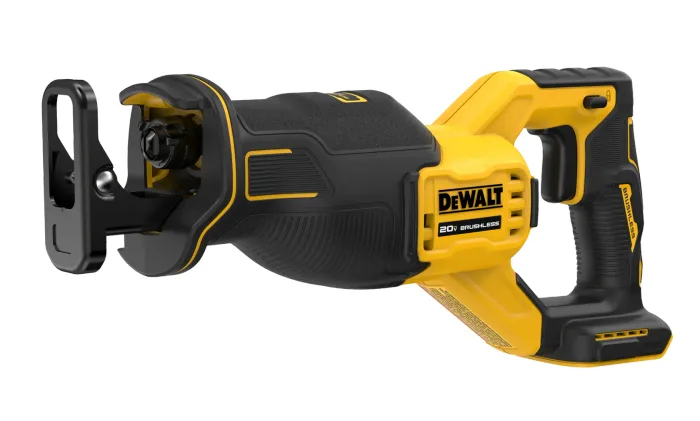
- Buy DEWALT DCS382B 20V MAX XR Brushless Reciprocating Saw The highest stroke-times-speed figure in this group, from the only brushless motor here. Amazon
- Buy Makita XRJ04Z 18V LXT Lithium-Ion Cordless Recipro Saw The longest stroke here at 1-1/4 inches, which uses more of the blade and clears the cut better than a faster short stroke does. Amazon
- It depends DEWALT DWE305 12 Amp Corded Reciprocating Saw A four-position blade clamp that solves flush and overhead cutting, on a corded motor that never runs out mid-demolition. Amazon
- Skip CRAFTSMAN CMCS300B V20 Cordless Reciprocating Saw Quotes a competitive 3,000 strokes per minute on the shortest stroke here, which nets out to the slowest cut of the four. Amazon
What actually matters
- Stroke length - how far the blade travels per stroke, typically 1 to 1-1/4 in. The half of the cutting-rate equation that actually varies, and the one that decides blade life.
- Strokes per minute - usually variable from zero. Meaningful only multiplied by stroke length, and the number most listings lead with.
- Blade clamp positions - a basic clamp holds the blade one way. A four-position clamp allows sideways and inverted mounting for flush and overhead cuts.
- Orbital action - an elliptical blade path that bites harder in wood and shortens blade life in metal. Frequently unstated, and unstated usually means absent.
- Motor type - brushless matters more here than on most tools, because this saw binds in the cut routinely and binding is what overheats brushes.
- Cutting capacity - some makers publish maximum cut in wood and pipe. Most do not, so a published figure is worth treating as a signal of confidence.
The specs, in plain English
Green flags vs red flags
Green flags
- Stroke length is published in inches alongside the speed range.
- Maximum cutting capacity in wood and pipe is stated.
- The blade clamp is described by how many positions it accepts.
- The presence or absence of orbital action is stated explicitly.
- Motor type is named as brushed or brushless.
Red flags
- Strokes per minute and amps lead the listing and no stroke length appears.
- Vibration is claimed as a percentage improvement with no baseline named.
- Demolition or heavy-duty appears with no capacity figure behind it.
- The blade clamp is described only as tool-less.
- A high SPM figure sits beside a 1 inch stroke without comment.
Who's who: the brands
- DEWALT - Publishes stroke and speed clearly across corded and cordless lines, and the corded models carry the four-position blade clamps.
- Makita - Longer strokes and published cutting capacities in wood and pipe, and unusually willing to state that a feature is absent.
- Milwaukee - The Sawzall name is theirs and the category is largely their invention. Strong on demolition-focused designs.
- CRAFTSMAN - Budget cordless saws with shorter strokes, competitive speed figures and thin published specification.
- Bosch - Strong in compact and one-handed recip saws, generally competing on control and balance rather than raw capacity.
How to read a listing without getting fooled
Find the stroke length and multiply it by the top speed before comparing anything, because that product reorders most listings. Then look for a published cutting capacity, which most makers omit. Check how many positions the blade clamp accepts if you ever cut flush to a surface. Treat any vibration claim expressed as a percentage as uncomparable, and read amps last.
How much should you spend?
Budget buys a short-stroke cordless saw that will prune and do light demolition, and whose blade costs will be higher than you expect. Mid-range buys a corded saw with a full stroke and often a four-position clamp, which is the best value in the category. Premium buys a brushless cordless tool with the longest strokes and the highest cutting rates, and the money goes on the motor and the battery platform rather than on capacity.
Questions, answered
Do I need orbital action?
Only if you cut a lot of wood. Orbital action swings the blade in a slight ellipse so it bites harder on the cutting stroke, which is noticeably faster in timber and much rougher. In metal it strips teeth quickly and gives a poor cut, so any saw with the setting should have it switched off for pipe and conduit.
Why do my blades keep snapping?
Usually the shoe is not held against the work, so the blade takes the bending load the shoe should be absorbing. The other common cause is plunge cutting, where the blade is levered rather than fed. Press the shoe firmly, start slow, and let the saw pull itself into the cut rather than pushing it.
Is a corded reciprocating saw still worth buying?
For sustained demolition, yes. This is continuous work that drains batteries fast, and a corded saw simply does not fade. Corded models are also where the four-position blade clamps tend to live, which is the feature that makes flush cutting possible. The argument against is that demolition often happens in buildings with the power already pulled.
How much does vibration actually matter?
Enough that it is regulated in some jurisdictions and enough that manufacturers advertise reducing it. The difficulty is that none of these saws publishes an absolute figure, and a claim of forty percent less than a previous model tells you nothing about how it compares with a different brand. Until absolute figures appear, take frequent breaks and hold the tool no tighter than you need to.
Or jump to the head-to-head: DEWALT DCS382B 20V MAX XR Brushless Reciprocating Saw vs Makita XRJ04Z 18V LXT Lithium-Ion Cordless Recipro Saw.