

Tech & Gadgets
The Best Non-Contact Voltage Testers: 4 Compared (and One to Skip)
We compared four testers on what the manufacturers actually publish: detection range, measurement category rating, which safety standards they are certified to, and whether the tool checks itself before you trust it.
The short version
The Klein Tools NCVT3P is the best non-contact pen here because it runs a self-test on every power-up, has two sensitivity modes so you can dial back false hits on high voltage, and is certified to both UL 61010-1 and 61010-2-030 by a recognised body. The Milwaukee 3202-20 is the value pick: same CAT IV 1000 V rating, a genuinely useful independent work light, and a simpler single 50 to 1000 V range. The Klein ET60 is the one that suits a different buyer, a two-probe contact tester with low input impedance that shrugs off ghost voltage and is the type of instrument NFPA 70E actually accepts for an absence of voltage test, within its CAT IV 600 V rating. We would skip the Fluke 2AC: it is always on with no self-test, only an optional battery check that Fluke itself says is not a substitute for a live-source check, and its published compliance list stops at 61010-1. Whichever you buy, no non-contact pen is permitted by NFPA 70E as the sole means of establishing an absent voltage condition at 1000 V or less. Best for: finding a live conductor fast, then proving it dead with something else.
Our picks at a glance
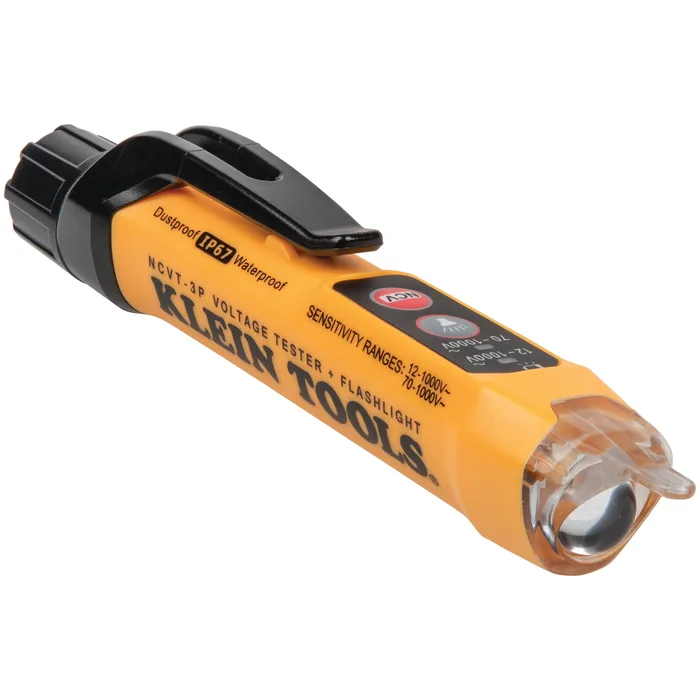
- Klein Tools NCVT3P Dual-Range Non-Contact Voltage Tester with Flashlight - Buy. The best documented pen in the category, with two sensitivity modes and a self-test that runs every time you switch it on.
- Milwaukee 3202-20 Voltage Detector with LED - Buy. A tough single-range pen with the same CAT IV 1000 V rating and a work light you can run on its own.
- Klein Tools ET60 Electronic AC/DC Voltage Tester, 12 to 600V - It depends. A two-probe contact tester with low input impedance, which is the kind of instrument NFPA 70E actually accepts for an absence of voltage test.
- Fluke 2AC VoltAlert Non-Contact Voltage Tester - Skip. A well-made always-on pen whose published specification gives you less to verify against than its own stablemates.
The verdict in 30 seconds
What mattered most
- Type
- Detection or measurement range
- Published safety rating
- Standards named by the maker
- Self-test
- Ingress and drop
A non-contact voltage tester is a pen you wave near a wire to see if it is live. It is the fastest tool in the bag and the most misunderstood, because the one thing it cannot reliably tell you is that a conductor is dead. Every manufacturer in this comparison prints the same warning in its own manual: if there is no indication, voltage could still be present. We picked four tools that let you see that limit clearly, including one contact tester for contrast.
The best documented pen in the category, with two sensitivity modes and a self-test that runs every time you switch it on.
Best for: Anyone who wants the most transparent published specification in the category and both a low-voltage and a line-voltage sensitivity setting.
- Klein states that all LEDs illuminate during a self-test at power-up, and the tip glows green when no voltage is detected, so a dark tester is visibly a dead tester.
- Two selectable ranges, 70 to 1000 V AC in Mode 1 and 12 to 1000 V AC in Mode 2, let you drop sensitivity when you expect line voltage and raise it for control and doorbell circuits.
- Published as CAT IV 1000 V AC, conforming to UL 61010-1 and 61010-2-030, certified to the matching CSA standards and independently tested by Intertek.
- Klein's own manual lists conditions where it WILL NOT detect voltage: a shielded wire, an operator who is not grounded or is isolated from earth ground, and DC.
- It MAY NOT detect voltage if you are wearing a glove, if the wire is partially buried or in grounded metal conduit, or if the field is blocked or dampened.
- Mode 2 is more sensitive to high voltage sources and electrically noisy environments, so Klein recommends switching back to Mode 1 above 70 V AC.
- Despite the IP67 marking, Klein specifies the operating environment as indoor and says not to expose it to moisture, rain or snow.
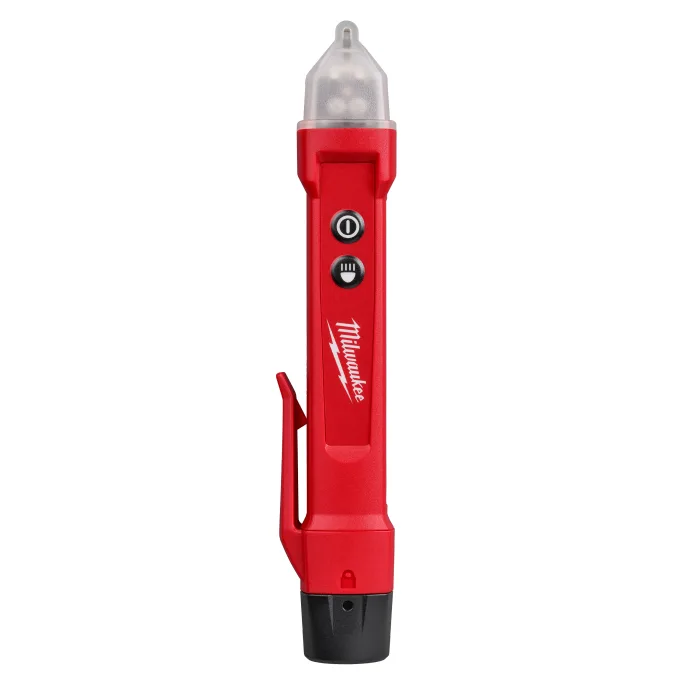
A tough single-range pen with the same CAT IV 1000 V rating and a work light you can run on its own.
Best for: A jobsite spare or a first tester where ruggedness and a good light matter more than a low-voltage range.
- Rated CAT IV 1000 V with a 50 to 1000 V AC detection range, which covers everything from a 120 V receptacle to a 480 V panel.
- The LED work light is independently operable, so you can light a dark panel without the tester being switched on.
- Published IP54 ingress protection, a reinforced tip and a quarter-turn cap for battery changes, on two AAA cells.
- Milwaukee publishes no self-test, no power-on integrity indicator and no battery-condition indicator for this model, so verifying it on a known live circuit is the only check you have.
- Single range only, with a 50 V floor, so it will not indicate on 24 V control, thermostat or doorbell wiring.
- Milwaukee's product page cites the CAT IV 1000 V rating but does not list the 61010 standard parts or a certification body behind it.
- It replaces the earlier 2202-20, whose published feature list included a green power-on indicator that the replacement's does not.
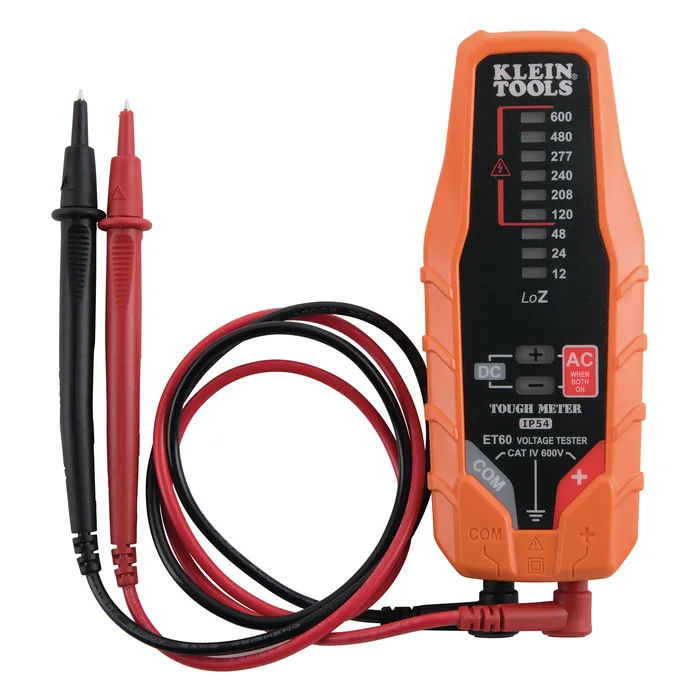
A two-probe contact tester with low input impedance, which is the kind of instrument NFPA 70E actually accepts for an absence of voltage test.
Best for: Anyone who needs to prove a circuit dead rather than just find it live, and who works within 600 V.
- Klein states that its inherent low input impedance reduces the possibility of falsely reading ghost or stray voltages on non-energised circuits.
- It needs no batteries, because it is powered by the applied voltage in the circuit being tested, removing the dead-battery failure mode entirely.
- Reads AC and DC from 12 to 600 V at nine LED levels aligned with common system voltages, and uses standard replaceable multimeter test leads.
- It is a contact tester, so you have to put probes on live parts, with the personal protective equipment and training that implies.
- CAT IV 600 V, which is a lower rating than the 1000 V pens here and rules it out of some higher-energy work.
- Nine discrete LED levels, not a numeric reading, so it tells you roughly which nominal voltage is present rather than an exact figure.
- Klein does not list a continuity function for it, and it is bulkier in a pocket than a pen.
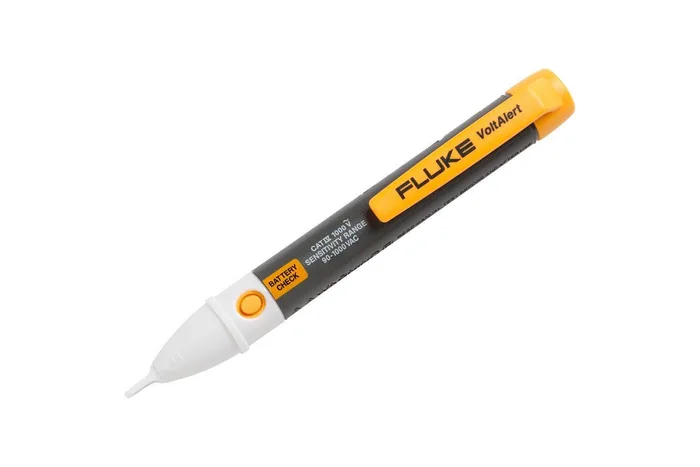
A well-made always-on pen whose published specification gives you less to verify against than its own stablemates.
Best for: Someone who specifically wants an always-on pen and is disciplined about the live-dead-live check every single time.
- CAT IV 1000 V rated, with a 90 to 1000 V AC detection range covering ordinary line and distribution work.
- Always on, with no button to press, so there is no way to leave it switched off and misread the result.
- Fluke states a typical battery life of greater than one year and backs it with a two-year warranty.
- No continuous self-test. Fluke's stated integrity feature is a Battery Check that its own footnote calls optional and for convenience only, and not a substitute for checking the unit on a known live source before and after use.
- Fluke's published safety compliance for this model lists IEC 61010-1, UL 61010-1 second edition and CAN/CSA-C22.2 No. 61010-1, without the 61010-2-030 particular standard that Fluke and Klein both cite for other testers in this comparison.
- No ingress protection rating and no drop rating are published for it, so there is nothing to compare against the IP54 and IP67 figures elsewhere here.
- The 90 V detection floor means it will give no indication on 12 to 70 V AC circuits, which reads exactly like a dead conductor.
| Criteria | NCVT3P Dual-Range Non-Contact Voltage Tester with Flashlight | 3202-20 Voltage Detector with LED | ET60 Electronic AC/DC Voltage Tester, 12 to 600V | 2AC VoltAlert Non-Contact Voltage Tester |
|---|---|---|---|---|
| Verdict | Buy it | Buy it | It depends | Skip it |
| Best for | Anyone who wants the most transparent published specification in the category and both a low-voltage and a line-voltage sensitivity setting. | A jobsite spare or a first tester where ruggedness and a good light matter more than a low-voltage range. | Anyone who needs to prove a circuit dead rather than just find it live, and who works within 600 V. | Someone who specifically wants an always-on pen and is disciplined about the live-dead-live check every single time. |
| Price tier | $$ · mid-range | $ · budget | $$ · mid-range | $$ · mid-range |
| Type | Non-contact pen, dual range | Non-contact pen, single range | Two-probe contact tester | Non-contact pen, always on |
| Detection or measurement range | 70 to 1000 V AC (Mode 1), 12 to 1000 V AC (Mode 2) | 50 to 1000 V AC | 12 to 600 V AC and DC, nine LED levels | 90 to 1000 V AC |
| Published safety rating | CAT IV 1000 V AC | CAT IV 1000 V | CAT IV 600 V | CAT IV 1000 V |
| Standards named by the maker | UL 61010-1 and 61010-2-030, CSA certified, Intertek tested | None named on the product page | CAT IV 600 V and CE stated, no 61010 parts named | IEC and UL 61010-1 and CAN/CSA 61010-1, no 61010-2-030 named |
| Self-test | All LEDs light during power-on self-test; low battery disables the flashlight | None published | No battery to fail; powered by the circuit under test | Optional Battery Check, which Fluke says is not a substitute for a live-source check |
| Ingress and drop | IP67, 2 m drop, specified for indoor use | IP54 | IP54, 3 m drop | Not published |
| Power | 2 x AAA alkaline | 2 x AAA | None, powered by the applied voltage | Battery, life stated as more than one year |
| Accepted by NFPA 70E as the sole absence of voltage test at 1000 V or less | No | No | Yes, within its CAT IV 600 V rating | No |
Which one is right for you?
- Anyone who wants the most transparent published specification in the category and both a low-voltage and a line-voltage sensitivity setting. Buy it Klein Tools NCVT3P Dual-Range Non-Contact Voltage Tester with Flashlight
- A jobsite spare or a first tester where ruggedness and a good light matter more than a low-voltage range. Buy it Milwaukee 3202-20 Voltage Detector with LED
- Anyone who needs to prove a circuit dead rather than just find it live, and who works within 600 V. It depends Klein Tools ET60 Electronic AC/DC Voltage Tester, 12 to 600V
- Someone who specifically wants an always-on pen and is disciplined about the live-dead-live check every single time. Skip it Fluke 2AC VoltAlert Non-Contact Voltage Tester
How we judged the field
Five things decide whether one of these tools is worth carrying. First, what it is certified to, not just what is printed on it: a CAT IV 1000 V marking backed by UL 61010-1, the 61010-2-030 particular standard for testing and measuring circuits, and a recognised certification body is a different claim from a bare number moulded into plastic. Second, whether it checks itself, because the defining failure of a non-contact pen is that a dead one and a dead conductor look identical. Third, the detection range and whether sensitivity can be changed, since a 50 V or 90 V floor gives no indication on live 24 V control wiring. Fourth, what the manufacturer admits it cannot do, which is where the manuals are far more honest than the packaging. Fifth, build: ingress protection, drop rating and battery access, because a tester that has been rattling in a pouch for two years is the one you will reach for in a hurry.
The field splits cleanly. Almost every pen on the market is a single-pole capacitive detector that senses the electrostatic field around an AC conductor, and they differ mainly in range, ruggedness and how much the maker publishes. A smaller group adds a second sensitivity mode or a signal-strength readout, which is the only real answer to false hits from induced and coupled voltage. Then there is a separate class of two-probe contact testers, which is what NFPA 70E actually accepts for an absence of voltage test, and which behaves completely differently around ghost voltage. We picked two pens that publish enough to be checked, one contact tester to show what the pens cannot do, and one pen we would pass on for reasons that come entirely from its own specification sheet.
Klein Tools NCVT3P Dual-Range Non-Contact Voltage Tester with Flashlight - buy
The Klein NCVT3P earns the top spot on paperwork as much as on feel. Klein publishes the full failure list, the exact conditions under which its thresholds hold, the standards it conforms to and the body that tested it, and that transparency is worth more in a life-safety tool than any feature. Practically, the two modes matter: Mode 1 covers 70 to 1000 V AC and Mode 2 drops the floor to 12 V for control, thermostat and irrigation wiring, and Klein tells you outright that Mode 2 is more sensitive to high voltage sources and electrically noisy environments, so you switch back above 70 V. Every power-up runs a self-test with all LEDs lit, the tip glows green when nothing is detected, and a low battery makes the unit power up with a blinking red LED while disabling the flashlight to protect the detection function. The IP67 and 2 m drop figures are the best here, though Klein still specifies indoor use. This is the pen for someone who wants to know what they are holding.
Milwaukee 3202-20 Voltage Detector with LED - buy
The Milwaukee 3202-20 is the straightforward one. Fifty to 1000 V AC, CAT IV 1000 V, IP54, a reinforced tip, a quarter-turn battery cap and a work light that runs independently of the detector, which is more useful than it sounds when you are trying to read breaker numbers in a dark closet. It replaced the older 2202-20 and is the current model in Milwaukee’s line. The gap is disclosure. Milwaukee does not publish a self-test, a power-on integrity indicator or a battery-condition indicator for it, and the product page cites the CAT IV 1000 V rating without naming the 61010 standard parts or the body that certified it. Milwaukee’s own answer to how you know it is working is to test it on a known live circuit before use, which is correct but puts the whole burden on your discipline. It is a good, rugged, inexpensive tester for someone who will do that check every time and does not need a low-voltage range.
Klein Tools ET60 Electronic AC/DC Voltage Tester, 12 to 600V - it depends
The Klein ET60 is here to show the pens what they are missing. It is a two-probe contact tester reading AC and DC from 12 to 600 V across nine LED levels that map onto real system voltages, and Klein states plainly that its inherent low input impedance reduces the possibility of falsely reading ghost or stray voltages on non-energised circuits. It takes no batteries at all, drawing its power from the circuit under test, which removes the failure mode that kills people with pens. Because it contacts the conductor, it can test phase-to-phase and phase-to-ground, which is what NFPA 70E requires for an absence of voltage test, and it takes ordinary replaceable multimeter leads. The trade-offs are real: CAT IV 600 V rather than 1000 V, no numeric reading, no continuity function listed, and it asks you to touch live parts with proper protective equipment. Buy it if your job is proving circuits dead rather than finding them live, and if you work at 600 V or below.
Fluke 2AC VoltAlert Non-Contact Voltage Tester - skip
The Fluke 2AC is a nicely built tester with a specification sheet that gives you less to hold onto than its siblings. It is CAT IV 1000 V, 90 to 1000 V AC, and always on, which removes one user error and introduces another: there is no power cycle, so the only integrity check Fluke offers is a Battery Check button, and Fluke’s own asterisk says use of that function is optional and for convenience only and is not intended as a substitute for checking the unit on a known live source before and after use. Fluke’s published safety compliance for this model names IEC 61010-1, UL 61010-1 second edition and CAN/CSA-C22.2 No. 61010-1, and does not name 61010-2-030, the particular standard for equipment with testing or measuring circuits that both Klein and Fluke cite for other testers here. No IP rating and no drop rating are published. Add the 90 V floor, which means silence on live low-voltage circuits, and there are better ways to spend the same money.
Klein Tools NCVT3P Dual-Range Non-Contact Voltage Tester with Flashlight vs Milwaukee 3202-20 Voltage Detector with LED: which should you buy?
Both buy picks are CAT IV 1000 V pens that will find a live conductor in a second, so choose on two things: range and disclosure. The Klein NCVT3P gives you a 12 V floor when you switch to Mode 2, which matters the moment you touch a thermostat, a doorbell transformer, low-voltage lighting or an irrigation valve. The Milwaukee 3202-20 stops at 50 V, so on those circuits it will sit there silent, and silence is exactly the reading you must never trust. If any part of your work goes below line voltage, that alone settles it.
The second difference is what each maker is willing to put in writing. Klein publishes the self-test behaviour, the standards, the certifying bodies and a blunt list of the conditions under which the tester will not work. Milwaukee publishes the rating and the ruggedness and leaves the rest to you. Neither approach changes what the tool physically does, but in a category where the failure mode is silent, the manufacturer that documents its limits is telling you how to survive them. Take the Milwaukee if you want a tough, cheap pen for line voltage and you are religious about live-dead-live. Take the Klein otherwise.
What to look for
- A category and a voltage together: CAT IV alone is not a rating, so look for the pair, as in CAT IV 1000 V, and match it to the highest energy point you will ever put the tool near.
- A named standard and a certification mark: the strongest sheets name UL or IEC 61010-1 and the 61010-2-030 particular standard, and state a body such as UL, CSA or Intertek behind them, rather than printing a category and leaving it there.
- Some form of self-test: a power-up lamp test, a battery-condition indicator or a continuous flashing heartbeat all answer the same question, which is whether a silent tester is silent because the circuit is dead or because the tester is.
- A detection floor that matches your work: a 50 V or 90 V floor gives no indication on 12 to 48 V control, thermostat and doorbell wiring, and a pen that cannot see those circuits looks identical to one held against a dead wire.
- A sensitivity mode or signal-strength readout: capacitive coupling from adjacent live conductors triggers false hits, and the only in-tool answer is being able to lower sensitivity or see how strong the field actually is.
- A contact tester alongside it: NFPA 70E 120.6(7) requires an adequately rated portable instrument tested phase-to-phase and phase-to-ground, verified on a known source before and after, and no non-contact pen can do that at 1000 V or less.
Our final take
Buy the Klein NCVT3P if you want one pen that documents its own limits, self-tests on every power-up and can be dialled down to 12 V when you need it. Buy the Milwaukee 3202-20 if you want a rugged CAT IV 1000 V pen for line-voltage work and nothing more. Buy the Klein ET60 if your actual job is proving circuits dead within 600 V, because contact and low impedance are what that job needs. Skip the Fluke 2AC on its published specification. And treat all of them the same way: a pen tells you a wire is probably live, never that it is safe. Prove dead with a contact tester, verified live before and after.
Questions, answered
Can I use a non-contact voltage tester to prove a circuit is dead?
No, not on its own, and this is the single most important thing to know about the category. NFPA 70E 120.6(7) requires you to use an adequately rated portable test instrument to test each phase conductor or circuit part both phase-to-phase and phase-to-ground, which a non-contact pen physically cannot do because it never touches a conductor. The standard then requires you to verify the instrument on a known voltage source before and after the test. The only place NFPA 70E permits a non-contact instrument for this is Exception No. 2, which allows noncontact capacitive test instruments on electrical systems over 1000 volts. Below that, use a contact tester or a meter, and verify it live, dead, live.
What makes a non-contact tester fail to indicate on a live wire?
The manufacturers publish the list themselves. Klein's NCVT3P manual says the tester WILL NOT detect voltage if the wire is shielded, if the operator is not grounded or is otherwise isolated from an effective earth ground, or if the voltage is DC. It says the tester MAY NOT detect voltage if you are not holding it, if you are insulated from it by a glove or other material, if the wire is partially buried or in grounded metal conduit, if you are too far from the source, if the field is blocked or dampened, or if the waveform is not a clean sine wave between 50 and 500 Hz. A flat or weak battery is the other obvious one, which is why a self-test and a live-source check matter. Klein also specifies its stated thresholds only under normal conditions, meaning the tip within about 6 mm of a source radiating unimpeded, your bare hand on the body, you standing on or connected to earth ground, roughly 50 percent humidity, and the tester held still.
What is ghost voltage and why do some testers have a sensitivity setting?
Ghost or phantom voltage appears when an unenergised conductor runs alongside live conductors, usually in the same conduit. The two wires and the insulation between them behave as a capacitor, so AC couples across onto the idle wire. Fluke's own guidance explains that this coupled voltage forms a voltage divider with the measuring instrument's input impedance, so a high impedance input on the order of 10 megohms displays a false reading while a low impedance input on the order of two kilohms causes the ghost voltage to collapse. A non-contact pen has no impedance to load anything down, so it sees the coupled field and beeps. Sensitivity settings exist to manage this: Klein's Mode 2 detects down to 12 V but is, in Klein's words, more sensitive to high voltage sources and electrically noisy environments, which is why Klein recommends Mode 1 whenever you expect more than 70 V.
Does a CAT IV marking mean anything if the tester is cheap?
A measurement category is only meaningful as a pair, the category and the working voltage, because CAT III 600 V and CAT IV 1000 V describe very different transient withstand. A number printed alone tells you nothing. The category also has to be backed by something. Klein's NCVT3P sheet names UL 61010-1 and 61010-2-030, says it is certified to the matching CSA standards, and states that the product was independently tested by Intertek. Southwire states that its 40116N is UL and cUL listed. A rating printed on a housing with no standard named and no recognised certification mark is a manufacturer's claim, not a verified one, and NFPA 70E 110.6(B) asks for test instruments that are rated for the circuits where they are used and approved for the purpose.
Have non-contact testers actually been recalled for failing to indicate voltage?
Yes. In June 2021 Klein Tools recalled the NCVT-1, NCVT-1SEN and the 69149 test kit. The Canadian recall notice describes the hazard precisely: when the on/off button is depressed and not released, the tool falsely indicates that it is ready to detect voltage, but it will not detect the presence of voltage until the button is released, posing an electric shock hazard to a consumer who believes there is no voltage present. More than a million units were involved across the United States and Canada. That is the exact failure mode this whole category has to be defended against, and it is why the power-on indication and the live-source check are not optional rituals. Register your tester so recall notices actually reach you.
More Tech & Gadgets reviews
 The Best Outdoor Security Cameras: Wide Coverage Without the Monthly Trap
  The Best Outlet Testers: 4 Compared (and One to Skip)
  The Best Ethernet Patch Panels: 4 Compared (and One to Skip)
  The Best PC Cases: 4 Compared (and One to Skip)
  The Best Portable Monitors of 2026: Honest Picks for Travel and Work
  The Power Banks Worth Buying (and the 'Mega-mAh' One to Skip)