

Tech & Gadgets
The Best Ethernet Patch Panels: 4 Compared (and One to Skip)
We compared four 24-port patch panels on how the cable actually attaches, whether you can replace one port or none, and whether the panel gives you a terminated permanent link or just another plug in the path.
The short version
The trueCABLE 24-port staggered blank keystone panel is our pick for a home lab, because an empty panel lets you mix Cat6A jacks, couplers, fibre and coax adapters in one 1U frame and swap a single dead port instead of the whole panel. The Monoprice 24-port Cat6 punch-down panel is the value choice if you know you have 24 ethernet drops and they are not going to change, since the ports come built in and there is nothing extra to buy. The Leviton Flat QuickPort panel is the depends pick: it is a well-made blank panel with a rear cable bar and silk-screened numbering, but it is built around Leviton's own QuickPort modules, so it makes most sense if your wall plates are already QuickPort. Skip the Cable Matters inline-keystone feed-through panel as permanent infrastructure, because a coupler panel never terminates the solid in-wall cable into the panel at all. In a small network a patch panel is an organisation and durability choice, not a speed upgrade, since every panel adds connection points. The reason it is worth it is that solid-core cable is built to be installed and left alone, not plugged and unplugged. Best for: anyone who has run more than about six permanent drops and wants them terminated once, labelled, and never touched again.
Our picks at a glance
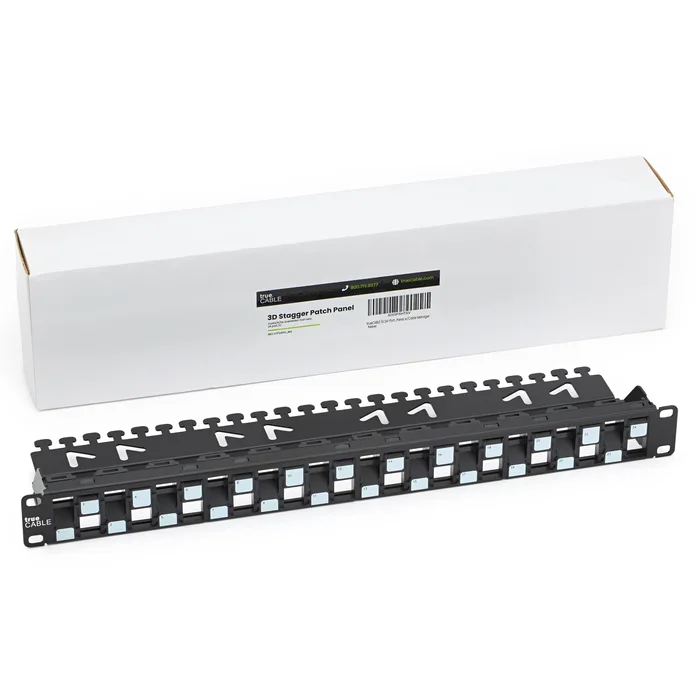
- trueCABLE Unshielded Patch Panel, 24 Port, 1U, Staggered Blank Modular - Buy. An empty 1U frame with 24 keystone bays, so you decide what each port becomes.
- Monoprice 24-port Cat6 Unshielded UL Listed Patch Panel, 1U, 110/Dual IDC, with Wire Support Bar - Buy. One part, 24 fixed Cat6 ports, dual IDC headers labelled for both wiring schemes, and nothing else to buy.
- Leviton Flat QuickPort Patch Panel, 24-Port, 1RU, Black (49255-H24) - It depends. A well-finished blank 1RU panel built around Leviton's own QuickPort module range rather than a generic bay.
- Cable Matters 1U 24-Port UTP Cat 6 Ethernet Patch Panel with Inline Keystone - Skip. A feed-through coupler panel that takes a patch lead on both sides, which is exactly why it should not be your permanent infrastructure.
The verdict in 30 seconds
What mattered most
- Panel type
- Jacks included
- How solid cable attaches
- Replace one bad port
- Mixed media in one frame
- Rear cable management bar
A patch panel is the piece of a home network that people buy last and think about least, which is backwards. It is the thing that decides whether your solid-core in-wall runs get terminated once and left alone, or get flexed every time you move a device. The field splits into three shapes: punch-down panels where the ports are fixed to the panel body, keystone panels that ship empty so you populate the bays yourself, and feed-through panels where both sides take a patch lead. We picked one of each plus a value punch-down, and tested the claims against what the manufacturers and the cabling standards actually say.
An empty 1U frame with 24 keystone bays, so you decide what each port becomes.
Best for: A home lab where the drop count, the media types, or the plan are all still moving.
- Blank bays take any standard snap-in keystone, so you can mix ethernet jacks, couplers and other media in one panel.
- A single damaged port is a jack swap rather than a panel replacement.
- The 3D staggered bay layout is what trueCABLE says defends against alien crosstalk at 10G without needing shielded hardware.
- Ships with no jacks, so 24 keystones are a separate purchase on top of the panel.
- Every jack is punched down individually, which is more handling than a monolithic panel.
- Listed at 19.75 by 4.75 by 2.75 inches, so it is worth measuring a shallow wall enclosure before you order.
- Unshielded, so a shielded install needs the shielded version of the panel instead.
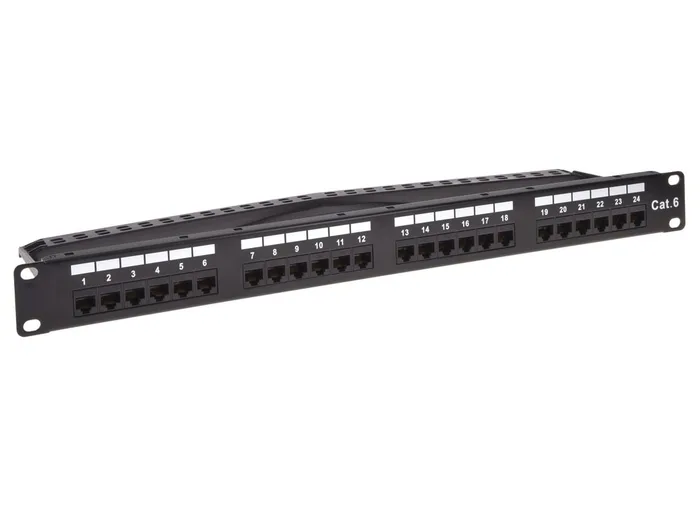
One part, 24 fixed Cat6 ports, dual IDC headers labelled for both wiring schemes, and nothing else to buy.
Best for: A settled 24-drop house or office run where every drop is ordinary copper ethernet and always will be.
- The ports are built into the panel, so there is no per-jack cost and no second shopping list.
- Dual IDC headers are marked for both the T568A and T568B wiring schemes, so you punch to whichever scheme your jacks already use.
- Includes a wire support bar on the rear, per the product name.
- Fixed RJ45 ports mean no fibre, coax or coupler modules in the same frame.
- A damaged port is a panel-level problem rather than a jack-level one.
- Unshielded only, so it is the wrong panel if you are running shielded cable that needs bonding.
- Cat6 rated, so it is not the panel to buy if you are planning a Cat6A 10G run later.
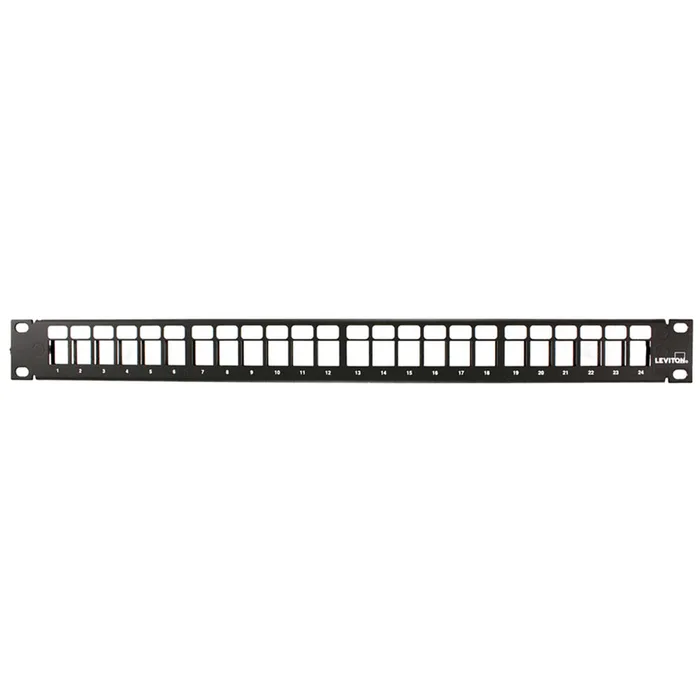
A well-finished blank 1RU panel built around Leviton's own QuickPort module range rather than a generic bay.
Best for: Someone already standardised on Leviton QuickPort wall plates who wants the rack end to use the same parts.
- Silk-screened port numbers plus white labels and write-on blocks, so labelling is designed in rather than improvised.
- A rear cable management bar is included, which is the part cheap panels tend to leave out.
- Takes any QuickPort connector, so one module family covers the panel and the matching wall plates.
- It is tied to the QuickPort module range, and Leviton's page does not state compatibility with third-party keystones, so we cannot promise generic jacks will fit.
- The panel itself is unshielded, so a shielded run needs a different Leviton part.
- No category rating applies to the empty panel, since performance comes from whichever module you fit.
- Panel plus branded modules is the most expensive route here for the same 24 ports.
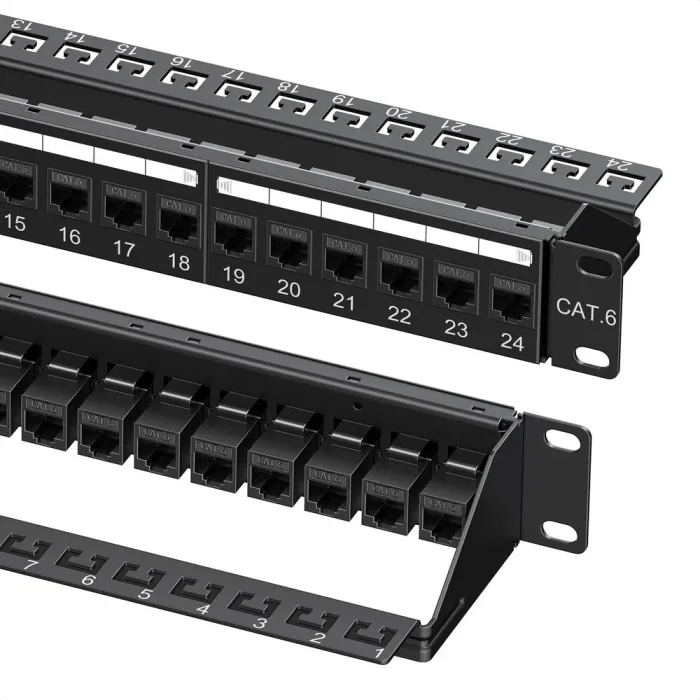
A feed-through coupler panel that takes a patch lead on both sides, which is exactly why it should not be your permanent infrastructure.
Best for: A rental, a temporary rack, or a lab bench you will tear down, where nothing is going inside a wall.
- No punch-down tool and no termination skill required, so it goes in fast.
- Arrives preloaded with couplers, so there is nothing to buy to get started.
- The couplers sit in standard keystone openings, so an individual coupler can be replaced.
- The solid in-wall cable is never terminated into the panel, so the run has to be plug-terminated and mated through a coupler instead of landing on a jack.
- That mated coupler is an extra connection pair in the middle of the link, and every mated connection spends part of your insertion loss budget.
- Because the horizontal cable ends in a plug rather than a jack, the run is not the jack-to-jack permanent link that structured cabling assumes.
- trueCABLE positions this panel type as suited to temporary installs, confined spaces, or installers not set up to terminate solid copper, which is a narrower job than the listings imply.
| Criteria | Unshielded Patch Panel, 24 Port, 1U, Staggered Blank Modular Top pick | 24-port Cat6 Unshielded UL Listed Patch Panel, 1U, 110/Dual IDC, with Wire Support Bar | Flat QuickPort Patch Panel, 24-Port, 1RU, Black (49255-H24) | 1U 24-Port UTP Cat 6 Ethernet Patch Panel with Inline Keystone |
|---|---|---|---|---|
| Verdict | Buy it | Buy it | It depends | Skip it |
| Best for | A home lab where the drop count, the media types, or the plan are all still moving. | A settled 24-drop house or office run where every drop is ordinary copper ethernet and always will be. | Someone already standardised on Leviton QuickPort wall plates who wants the rack end to use the same parts. | A rental, a temporary rack, or a lab bench you will tear down, where nothing is going inside a wall. |
| Price tier | $$ · mid-range | $ · budget | $$$ · premium | $$ · mid-range |
| Panel type | Keystone, 24 blank bays | Punch-down, fixed ports | Keystone, 24 QuickPort bays | Feed-through coupler |
| Jacks included | No, buy separately | Yes, built into panel | No, QuickPort modules separately | Yes, couplers preloaded |
| How solid cable attaches | Punched into each keystone | Punched into 110 dual IDC | Punched into each QuickPort module | Not terminated, plug into coupler |
| Replace one bad port | Yes, swap the jack | No, panel level | Yes, swap the module | Yes, swap the coupler |
| Mixed media in one frame | Yes, any standard keystone | No, fixed RJ45 only | Yes, any QuickPort module | No, RJ45 couplers only |
| Rear cable management bar | Not stated, 24 nylon cable ties included | Yes, wire support bar | Yes, included | Not verified |
| Shielding | Unshielded, shielded model sold separately | Unshielded | Unshielded | Unshielded |
| Category rating | Set by the keystones you fit | Cat6 | Set by the module you fit | Cat 6 |
Which one is right for you?
- A home lab where the drop count, the media types, or the plan are all still moving. Buy it trueCABLE Unshielded Patch Panel, 24 Port, 1U, Staggered Blank Modular
- A settled 24-drop house or office run where every drop is ordinary copper ethernet and always will be. Buy it Monoprice 24-port Cat6 Unshielded UL Listed Patch Panel, 1U, 110/Dual IDC, with Wire Support Bar
- Someone already standardised on Leviton QuickPort wall plates who wants the rack end to use the same parts. It depends Leviton Flat QuickPort Patch Panel, 24-Port, 1RU, Black (49255-H24)
- A rental, a temporary rack, or a lab bench you will tear down, where nothing is going inside a wall. Skip it Cable Matters 1U 24-Port UTP Cat 6 Ethernet Patch Panel with Inline Keystone
How we judged the field
Five things decide whether a patch panel is worth the rack unit it takes up. First, how the cable attaches: a panel that terminates your solid in-wall run onto an IDC contact is doing the job, and a panel that only accepts a patch lead on both sides is not. Second, whether the ports are fixed to the panel or modular, because that determines whether a damaged port costs you a jack or a panel, and whether you can put a fibre or coax module in bay 19 when the plan changes. Third, the rear cable management bar, which sounds like a throwaway feature and is actually what stops the weight of 24 cables hanging off your terminations. Fourth, shielding, which is only useful if you are running shielded cable and can bond the panel, and is dead weight otherwise. Fifth, physical fit: 19 inch rack width and 1U height are standard, but depth is not, and a shallow wall enclosure will happily refuse a panel that is fine in a rack.
The field splits three ways, and the split is more useful than any brand ranking. Punch-down panels put fixed ports on the front and 110-style IDC on the back, so it is one part and no per-jack cost, but you get exactly what the panel came as. Keystone panels ship as an empty steel frame, so you buy jacks separately and pay more per port, but you can mix categories, mix shielded and unshielded, drop in a coupler for the run you have not finished, and replace one dead jack instead of 24 live ones. Feed-through panels take a patch lead on both sides and terminate nothing. We picked the strongest keystone panel we could verify, the cheapest credible punch-down panel, one keystone panel built around a proprietary module family to show where that trade-off bites, and one feed-through panel to explain why the convenience is not free.
trueCABLE Unshielded Patch Panel, 24 Port, 1U, Staggered Blank Modular
Buy ittrueCABLE sells this one empty, and that is the whole point. You get a 1U frame with 24 keystone bays, 24 nylon cable ties, and nothing else, so you decide what goes in each bay: unshielded jacks for the drops, a coupler for the run you have not pulled yet, a coax or fibre adapter for the one port that is not ethernet. The bays use trueCABLE’s 3D staggered layout, which the company says is specifically engineered to defend against alien crosstalk, which shows up at 350 MHz and higher, without shielded hardware. It is listed as UL listed, TAA compliant and RoHS compliant, and its item details give 19.75 by 4.75 by 2.75 inches, so check the fit against a shallow wall enclosure before you commit. The trade-off is real: 24 jacks are a separate purchase and a separate punch each, and the whole thing costs more per port than a loaded panel. Best for a home lab you expect to keep changing.
Monoprice 24-port Cat6 Unshielded UL Listed Patch Panel, 1U, 110/Dual IDC, with Wire Support Bar
Buy itThe unglamorous right answer for a settled install. One part, 24 Cat6 unshielded ports, dual IDC headers on the back marked for both the T568A and T568B wiring schemes, and a 110 punch-down tool is all you need. It has the wire support bar on the rear, as the product name says. Because the ports are integral, there is no second shopping trip and no per-jack cost, which is why it lands a full tier below the keystone panels for the same 24 ports. What you give up is optionality. There is no way to put a fibre module or a coupler in one of these bays, no way to make port 12 shielded, and a physically damaged port is a panel-level problem rather than a jack you unclip. It is also Cat6 rather than Cat6A, so it is not the panel to buy if a 10G run is on your list. Best for someone who knows they have 24 copper ethernet drops and knows that number is not moving.
Leviton Flat QuickPort Patch Panel, 24-Port, 1RU, Black (49255-H24)
It dependsLeviton’s Flat QuickPort panel is the same idea as the trueCABLE blank, executed with more finish and less openness. It is a 24-port, 1RU, black, unshielded panel that accepts QuickPort connectors, and Leviton includes a rear cable management bar, silk-screened port numbers with white labels, and write-on blocks. Labelling being designed in rather than improvised is a genuine advantage when you are three years past the install and trying to find which drop feeds the office. The catch is the module family. Leviton describes the panel as compatible with QuickPort connectors, and its page does not state anything about third-party keystones, so we are not going to promise you generic jacks drop in. That matters because generic keystones are the cheap part of a keystone build. There is also no category rating on the empty panel itself, since that comes from whichever module you fit. Best for someone already running Leviton QuickPort wall plates who wants one parts system from the outlet to the rack.
Cable Matters 1U 24-Port UTP Cat 6 Ethernet Patch Panel with Inline Keystone
Skip itThis is the panel that looks like the easy answer and is the one to avoid for permanent work. It arrives loaded with RJ45 couplers so both the front and the back take a patch lead, No punch-down tool, no termination skill, done in an afternoon. The problem is what it does not do: it never terminates your solid in-wall cable into the panel. To use it you put a plug on the end of solid horizontal cable and mate it through a coupler, so the run ends in a plug instead of landing on a jack, and you have inserted an extra mated connection pair into the middle of the link where it spends part of your insertion loss budget. trueCABLE’s own guidance places feed-through panels with temporary installations, confined spaces, and installers not set up to terminate solid copper. For a bench, a rental, or a rack you will dismantle, that is a fair description of a useful product. As the permanent spine of a house, no.
Sources
Specs in this review come from these pages.
- trueCABLE Cable Academy: Punch Down, Feed-Through, and Toolless Keystone Ethernet Patch Panels Explained (truecable.com)
- trueCABLE Cable Academy: Cat6 Ethernet Cable Untwist Performance Compared, Fluke DSX-8000 Test Results (truecable.com)
- trueCABLE Cable Academy: T568A vs T568B, Which to Use (truecable.com)
- trueCABLE Cable Academy: Solid vs Stranded Ethernet Cable (truecable.com)
- trueCABLE Cable Academy: Shielded Wall-Mounted Patch Panel Overview and Installation Guide (truecable.com)
- Leviton 49255-H24 Flat QuickPort Patch Panel product page (leviton.com)
trueCABLE Unshielded Patch Panel, 24 Port, 1U, Staggered Blank Modular vs Monoprice 24-port Cat6 Unshielded UL Listed Patch Panel, 1U, 110/Dual IDC, with Wire Support Bar: which should you buy?
The choice between the trueCABLE blank keystone panel and the Monoprice punch-down panel is really a question about your future, not your network. The Monoprice panel is one part that does one thing: it terminates 24 unshielded Cat6 drops onto fixed ports and costs less than a blank panel plus 24 jacks. If your house has 24 ethernet drops, they are all copper, none of them are shielded, and you are not planning a 10G run, buying anything more flexible is buying flexibility you will never spend. It is a better panel than its price suggests, and the dual IDC header marked for both wiring schemes means it fits whatever your jacks already use.
The trueCABLE panel earns its extra cost the first time the plan changes. An empty bay takes an unshielded Cat6A jack, a shielded jack, a coupler, or a coax or fibre adapter, so one frame can carry a mixed install rather than forcing a second panel. It also changes what a failure costs: a jack that stops working is unclipped and replaced while the other 23 stay live. The staggered bay layout is trueCABLE’s answer to alien crosstalk at 10G, which is the case for buying it over a cheaper flat blank panel. Rule of thumb: if you can write down your final port list today and you believe it, buy the Monoprice. If you cannot, or if you are the sort of person who runs one more cable every spring, buy the trueCABLE and populate it as you go.
What to look for
- Fixed or modular: decide this first, because a punch-down panel is cheaper per port and a keystone panel lets you mix media and replace one jack instead of the whole panel.
- A real rear cable management bar: it takes the weight of the cable bundle off your terminations, and its absence is the most common corner cut on cheap panels.
- Termination discipline over brand: the ANSI/TIA 568 maximum pair untwist at a termination is 0.50 inches, and trueCABLE’s certifier testing showed 5/8 inch failing NEXT on Cat6, so a careful punch on a budget panel beats a sloppy one on an expensive panel.
- Shielded only if you are shielded: a shielded panel has to be bonded, to a rack bus bar or via a bonding adapter to a properly wired outlet, and an unbonded shielded panel gives you nothing an unshielded one would not.
- Depth, not just width and height: 19 inch and 1U are standard, but panel depth varies and can still refuse to close a shallow wall-mount enclosure.
- Port numbering and label space: silk-screened numbers plus write-on blocks are the difference between tracing a drop in thirty seconds and tracing it with a tone probe three years later.
Our final take
Buy the trueCABLE blank keystone panel if your network is still a work in progress, and the Monoprice punch-down panel if it genuinely is not. The Leviton is a nicer object and the right call inside a QuickPort house, but it locks you to one module family for no performance gain we could verify. Skip the feed-through coupler panel for anything going in a wall: it saves you the punch-down and charges you a mated connection pair and a link that is not terminated the way structured cabling assumes. And keep the goal straight. The panel is not making anything faster. It is making sure your solid-core runs get terminated once, labelled, and never flexed again, which is what they were built for.
Questions, answered
Do I actually need a patch panel in a house?
Not for speed. A panel adds connection points between your switch and your wall jacks, so on paper it costs you a little of the link budget rather than gaining you anything. The reason to fit one is mechanical and organisational. Solid-core cable is the right choice for permanent in-wall runs because of how it behaves over distance, but it is built to be installed and left alone rather than handled repeatedly, and stranded cable is what manufacturers point you at for the flexing connection between a jack and a device. A panel terminates each solid run once, then lets you do all the plugging and unplugging with stranded patch leads that are designed for it. If you have three drops, a few keystones in a wall plate is fine. Past six or so, the labelling alone earns the panel.
T568A or T568B, and does it matter?
Pick one and use it at both ends of every run. The two schemes swap the green and orange pairs, and both remain straight-through connections. trueCABLE tested the two against each other on 292 feet of Cat6A cable with a Fluke DSX-8000 certifier and described the performance result as a wash. T568B is the more common choice in North American commercial and residential work, but the standard itself is neutral unless a contract specifies one. What actually breaks things is mixing them: if one end is A and the other is B on the same cable, you have made a crossover, not a straight-through link. Most panels, including the Monoprice one here, print both colour codes on the IDC header so you can punch to either scheme.
Why do people say not to use a feed-through or coupler panel?
Because it does not terminate your permanent cabling. On a feed-through panel, both sides of every port take a patch lead, so your solid in-wall run has to end in a plug and mate through a coupler rather than landing on a punched-down jack. Structured cabling assumes the permanent part of the link is cable terminated to a jack at each end, one in the wall plate and one in the panel. A coupler panel replaces that with an extra mated connection pair sitting in the middle, and every mated connection eats into the insertion loss budget for the run. trueCABLE positions this panel style as suited to temporary installations, confined spaces, or installers who are not equipped to terminate solid copper. For a bench or a rental it is genuinely convenient. As the backbone of a house, you are paying convenience with headroom you cannot get back.
How much can I untwist the pairs when I terminate?
Half an inch, and less is better. trueCABLE cites the ANSI/TIA 568 maximum conductor pair untwist as 0.50 inches, and it applies across Cat5e through Cat8. They then went and tested it on Cat6 with a Fluke DSX-8000 certifier: a factory termination with about 3/16 inch of untwist passed with the best headroom, a hand termination at the full 0.50 inch passed but only just, 5/8 inch failed on NEXT, and 3/4 inch failed worse. That is one eighth of an inch over spec turning a pass into a fail. A failing link can still bring up a gigabit connection, which is why this problem hides: you get retransmissions and a network that feels slow on big transfers rather than an obvious dead port. Keep the last twist as close to the IDC contact as you can.
Do I need a shielded panel, and what does bonding mean?
Only if you are running shielded cable. A shielded panel is metal specifically so the cable shields have somewhere to drain electrostatic discharge and electromagnetic and radio frequency interference to. That path has to be completed: trueCABLE's guidance is that a rack-mounted shielded panel bonds to the rack bus bar with its stock bond wire, and a wall-mounted one with no rack bus bar needs a bonding adapter reaching a properly wired three-prong AC outlet within about six feet. A shielded panel that is not bonded is just a more expensive unshielded panel. trueCABLE also notes that without at least one shielded drop in the install, grounding the panel becomes optional. Most home installs are unshielded, and that is a perfectly reasonable place to be.
Deciding between the top two? See our head-to-head: trueCABLE Unshielded Patch Panel, 24 Port, 1U, Staggered Blank Modular vs Monoprice 24-port Cat6 Unshielded UL Listed Patch Panel, 1U, 110/Dual IDC, with Wire Support Bar.
More Tech & Gadgets reviews
 The Best PC Cases: 4 Compared (and One to Skip)
  The Best Photo and Film Scanners: 4 Compared (and One to Skip)
  The Best Pixel Art Displays: 4 Compared (and One to Skip)
  The Best Portable Monitors of 2026: Honest Picks for Travel and Work
  The Power Banks Worth Buying (and the 'Mega-mAh' One to Skip)
  The Best Portable Power Stations: 4 Compared (and One to Skip)