

Tech & Gadgets
The Best Outlet Testers: 4 Compared (and One to Skip)
We compared four currently sold plug-in outlet testers on what their own documentation says they cannot see: the quality of the ground, a reversed neutral and ground, and whether a GFCI test is even possible on the circuit in front of you.
The short version
The Klein Tools RT250 is the pick for most people because it puts numbers on a screen: line voltage, the name of the fault, and the seconds a GFCI took to trip. The IDEAL 61-502 is the value choice, a plain lamp tester with a GFCI button, certified to UL 1436 and CSA C22.2 No. 160, that does not pretend to do more than indicate wiring. The Extech CT70 is the depends pick and the only unit here that measures hot, neutral and ground impedance and percent voltage drop under a selectable 12, 15 or 20 A load, which is essential if you diagnose circuits for a living and pointless if you do not. Skip the Klein RT310: the AFCI button is what lifts it above the RT250, and UL 1436 itself classes that function as an arc-fault circuit-interrupter indicator rather than a tester, while Schneider Electric's published answer says the approved AFCI test is the breaker's own push-to-test button. One thing applies to all four: they trip a GFCI by deliberately creating a real ground fault through the equipment grounding conductor, so none of them can test a GFCI on a receptacle that has no equipment ground. Best for: homeowners and electricians who want a fast wiring check and want to know exactly what the lamps cannot tell them.
Our picks at a glance
- Klein Tools RT250 GFCI Receptacle Tester with LCD - Buy. The tester that shows you an actual voltage and an actual GFCI trip time instead of asking you to decode three lamps.
- IDEAL Electrical 61-502 120V AC GFCI Receptacle Tester - Buy. A plain lamp tester with a GFCI button, certified to the same wiring standard as the screens, and honest on its own product page about needing a real ground.
- Extech CT70 GFCI and AC Circuit Analyzer - It depends. The one unit here that measures the thing UL 1436 testers are explicitly not built to judge: conductor impedance, ground included.
- Klein Tools RT310 AFCI / GFCI Outlet Tester - Skip. A competent wiring tester whose headline feature, the AFCI button, is the part breaker makers tell you not to rely on.
The verdict in 30 seconds
What mattered most
- Type
- Wiring conditions indicated
- Voltage shown
- Fault current the tester injects
- GFCI trip time displayed
- Ground quality measured
An outlet tester is the cheapest diagnostic tool in electrical work and the easiest one to over-trust. The standard these devices are built to, UL 1436, says in its own scope that they are "not intended to be a comprehensive instrument or to determine the quality of the grounding circuit". That one sentence explains most of the surprises people run into, starting with three reassuring lamps above a ground that is jumpered to neutral behind the wall. We picked four testers that are on sale right now and judged them on how much real information each returns and how honestly each maker documents the gaps.
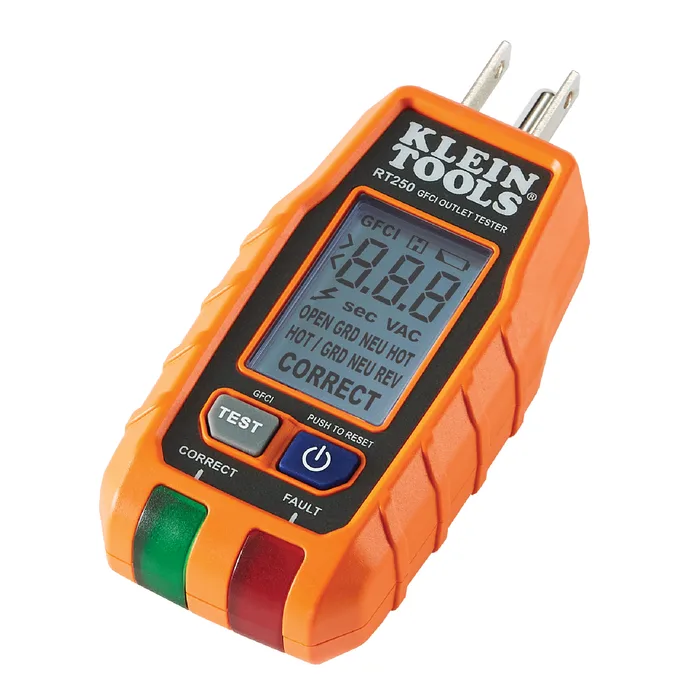
The tester that shows you an actual voltage and an actual GFCI trip time instead of asking you to decode three lamps.
Best for: Anyone who wants one plug-in tester and would rather read a voltage and a trip time than a pattern of lamps.
- The backlit LCD names the fault and displays line voltage, so a supply that is low or high shows up as a number you can act on.
- Reports the time a GFCI took to trip after the tester creates its 6 mA to 9 mA ground fault.
- Klein publishes a full instruction sheet that states outright which conditions the tester does not indicate, quality of ground among them.
- Conforms to UL 1436, so it cannot assess the grounding circuit however green the display reads.
- Klein's own note says it does not indicate reversal of neutral and ground conductors, multiple hot wires, or combinations of defects beyond a dual open neutral and ground.
- CAT II 135 V keeps it at the receptacle, not at the distribution side of the installation.
- For use on 3-wire outlets only, and Klein warns against attempting the GFCI test on a circuit the tester has already flagged as miswired.
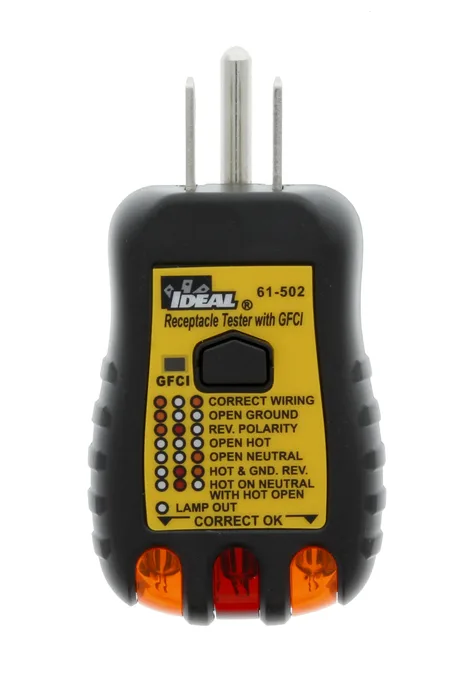
A plain lamp tester with a GFCI button, certified to the same wiring standard as the screens, and honest on its own product page about needing a real ground.
Best for: A second bag, a service van door pocket or a kitchen drawer, where a certified basic wiring check is all you actually need.
- Indicates correct wiring plus open ground, reverse polarity, open hot, open neutral, hot and ground reversed, and hot on neutral with hot open.
- cULus certified to UL 1436 and CSA C22.2 No. 160, the same indication standard the LCD models are built to.
- IDEAL states on the product page that the receptacle must be properly grounded for the GFCI test to work, which is the failure people usually blame on the tester.
- No display, so you get a lamp pattern and no voltage reading at all.
- No GFCI trip time, so you learn that a device tripped but not how quickly it did.
- Same UL 1436 blind spots as every lamp tester, ground quality included.
- The legend has to be read off the tester body every time, which is slower in a dim crawl space than a screen that spells out the fault.
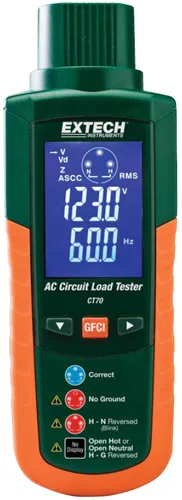
The one unit here that measures the thing UL 1436 testers are explicitly not built to judge: conductor impedance, ground included.
Best for: Electricians and inspectors chasing voltage drop, nuisance trips or a suspect ground, rather than confirming an outlet is wired the right way round.
- Measures hot, neutral and ground impedance and calculates available short circuit current from line voltage and line impedance.
- Applies a selectable 12, 15 or 20 A load and reports percent voltage drop, with the manual citing 5 percent as the National Electrical Code maximum for nominal efficiency.
- Reads ground-to-neutral voltage and turns the backlight red above 2 V AC, and runs both a 6 to 9 mA GFCI test and a 30 mA equipment protective device test with an elapsed trip time.
- Extech's own user guide says the meter cannot sense ground reversals and cannot sense two hot wires in a circuit.
- It displays one circuit issue at a time, and under a no-ground condition only the line voltage and voltage drop tests can be run.
- Impedance is specified from 0.00 to 3.00 ohms; above 3 ohms the accuracy is listed as unspecified.
- The ground impedance and short circuit current tests push current down the ground conductor and will trip a GFCI, and the manual asks for 20 seconds between load tests.
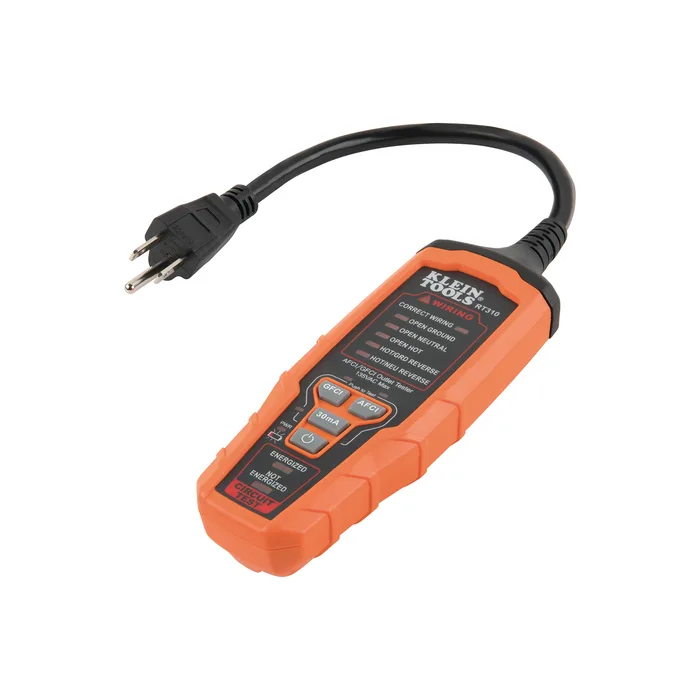
A competent wiring tester whose headline feature, the AFCI button, is the part breaker makers tell you not to rely on.
Best for: Someone who has already decided they want the 30 mA equipment protective device check and the long cord, and who treats the AFCI light as a hint rather than a verdict.
- Gives the same wiring indications as the RT250 and adds a 10 inch flexible cord that reaches recessed boxes and appliance receptacles.
- Includes a separate 30 mA ground fault button for equipment protective devices alongside the GFCI button.
- Rated CAT III 135 V and conforms to UL 61010-1, 61010-2-030 and 1436, with IP40 and 2 m drop protection.
- The AFCI function is what lifts it above the RT250, and UL 1436's scope covers devices like it as arc-fault circuit-interrupter indicators rather than testers.
- Schneider Electric's published answer on third party AFCI equipment says such devices are not UL listed for testing the function of an arc fault breaker, that Square D does not endorse them, and that the approved method is the breaker's push-to-test button.
- No voltage display, so you give up the numeric readout that makes the cheaper RT250 useful.
- Klein's instruction sheet repeats the same blind spots as the RT250, including quality of ground and reversal of neutral and ground conductors, so the extra money does not buy a better wiring diagnosis.
| Criteria | RT250 GFCI Receptacle Tester with LCD | 61-502 120V AC GFCI Receptacle Tester | CT70 GFCI and AC Circuit Analyzer | RT310 AFCI / GFCI Outlet Tester |
|---|---|---|---|---|
| Verdict | Buy it | Buy it | It depends | Skip it |
| Best for | Anyone who wants one plug-in tester and would rather read a voltage and a trip time than a pattern of lamps. | A second bag, a service van door pocket or a kitchen drawer, where a certified basic wiring check is all you actually need. | Electricians and inspectors chasing voltage drop, nuisance trips or a suspect ground, rather than confirming an outlet is wired the right way round. | Someone who has already decided they want the 30 mA equipment protective device check and the long cord, and who treats the AFCI light as a hint rather than a verdict. |
| Price tier | $$ · mid-range | $ · budget | $$$ · premium | $$ · mid-range |
| Type | Plug-in tester with backlit LCD | Plug-in lamp tester with GFCI button | Plug-in circuit analyzer with a load bank | Plug-in tester on a 10 in flexible cord |
| Wiring conditions indicated | Correct, open ground, open neutral, open hot, hot/ground reversed, hot/neutral reversed, dual open neutral and ground | Correct, open ground, reverse polarity, open hot, open neutral, hot and ground reversed, hot on neutral with hot open | Correct wiring, reverse polarity, no ground | Correct, open ground, open neutral, open hot, hot/ground reversed, hot/neutral reversed, dual open neutral and ground |
| Voltage shown | Line voltage on the LCD | None | Line, loaded, ground to neutral, peak, plus frequency | None |
| Fault current the tester injects | 6 mA to 9 mA ground fault | GFCI button, current not published | 6 to 9 mA GFCI, plus a 30 mA EPD test | GFCI, 30 mA and AFCI buttons, currents not published |
| GFCI trip time displayed | Yes, in seconds | No | Yes, elapsed time shown once the device is reset | No |
| Ground quality measured | No | No | Yes, hot, neutral and ground impedance | No |
| Standards named by the maker | UL 61010-1, 61010-2-030, 1436; CSA C22.2 61010-1, 61010-2-030, 160 | cULus to UL 1436 and CSA C22.2 No. 160 | CE and ETL; GFCI utility performed per UL 1436 | UL 61010-1, 61010-2-030, 1436; CSA C22.2 61010-1, 61010-2-030, 160 |
| Safety rating | CAT II 135 V | CAT II 150 V | CAT II 300 V | CAT III 135 V |
Which one is right for you?
- Anyone who wants one plug-in tester and would rather read a voltage and a trip time than a pattern of lamps. Buy it Klein Tools RT250 GFCI Receptacle Tester with LCD
- A second bag, a service van door pocket or a kitchen drawer, where a certified basic wiring check is all you actually need. Buy it IDEAL Electrical 61-502 120V AC GFCI Receptacle Tester
- Electricians and inspectors chasing voltage drop, nuisance trips or a suspect ground, rather than confirming an outlet is wired the right way round. It depends Extech CT70 GFCI and AC Circuit Analyzer
- Someone who has already decided they want the 30 mA equipment protective device check and the long cord, and who treats the AFCI light as a hint rather than a verdict. Skip it Klein Tools RT310 AFCI / GFCI Outlet Tester
How we judged the field
Five things separate a useful outlet tester from a reassuring one. First, what it can indicate, which for a UL 1436 device is a fixed short list of wiring conditions and nothing about the health of the conductors. Second, whether it reports a number, because “correct” tells you less than “118 V, correct” and a GFCI that takes four seconds to trip is a different finding from one that takes forty milliseconds. Third, how the maker documents the gaps, since the good instruction sheets in this category print the conditions the tool does not indicate right next to the ones it does. Fourth, the safety rating and standards actually named on the sheet, not implied by the packaging. Fifth, whether the tool measures anything at all, which is the line between an indicating device and an instrument.
The field splits cleanly on that last point. On one side sit the UL 1436 lamp and LCD testers, which infer a wiring pattern from voltage differences between three pins, and which the standard itself says are not intended to determine the quality of the grounding circuit. On the other sit the circuit analysers, which apply a real load and measure conductor impedance. That second group has shrunk: IDEAL’s SureTest 61-164 is discontinued, its 61-165 is described in IDEAL’s documentation as no longer available, and Amprobe’s INSP-3 now sits under legacy tools. So we took the best-documented indicating tester, the plainest certified one, the one surviving analyser we could confirm as current, and the model that charges for a function its own governing standard calls an indicator.
Klein Tools RT250 GFCI Receptacle Tester with LCD - buy
The RT250 is the tester we would hand to almost anyone, and the reason is the screen. Plug it in and you get line voltage and a named fault, not a lamp pattern to decode against a legend printed on the body. Press the GFCI button and the tester creates a 6 mA to 9 mA ground fault, then shows the seconds it took the device to trip, which is the single most useful number a receptacle tester can give you. It indicates correct wiring, open ground, open neutral, open hot, hot to ground reversed, hot to neutral reversed, and a dual open neutral and ground. The red LED also lights for a supply that is low, 30 to 85 V AC, or high, 135 to 150 V AC. Klein rates it CAT II 135 V, conforms it to UL 61010-1, 61010-2-030 and 1436, and prints the limits: quality of ground, multiple hot wires and a reversal of neutral and ground are all explicitly not indicated. That honesty is why it wins. It is for the person who wants one tester and wants to know what it is blind to.
IDEAL Electrical 61-502 120V AC GFCI Receptacle Tester - buy
The 61-502 is what an outlet tester was before screens, and there is nothing wrong with that. Three neon lamps, a legend on the yellow face, and a black GFCI button. It indicates correct wiring, open ground, reverse polarity, open hot, open neutral, hot and ground reversed, and hot on neutral with hot open, and the face carries a lamp-out position so a dead neon does not quietly become a fault. It is cULus certified to UL 1436 and CSA C22.2 No. 160, rated CAT II 150 V, and carries a limited two year warranty. What makes it worth recommending over the pile of identical looking testers is that IDEAL says on the product page what most brands leave you to discover in a crawl space: the receptacle has to be properly grounded for the GFCI test to work. You give up voltage and trip time, which is a real loss, but you keep the certified indication that is the entire point of the category. Buy it as the tester you are relaxed about leaving in a van.
Extech CT70 GFCI and AC Circuit Analyzer - it depends
The CT70 is a different class of tool and should be judged that way. It applies a selectable 12, 15 or 20 A load and reports percent voltage drop and loaded voltage, and Extech’s manual walks you through interpreting the result against the 5 percent figure it cites from the National Electrical Code. It measures hot, neutral and ground impedance, calculates available short circuit current, reads ground-to-neutral voltage and turns the backlight red above 2 V AC. The manual sets the targets plainly: ground impedance under 1 ohm for personal protection, preferably around 0.25 ohm for equipment. It runs a 6 to 9 mA GFCI test and a 30 mA equipment protective device test, stopping at 6.5 seconds with an overload indication. It is also frank about limits. It cannot sense ground reversals, cannot sense two hot wires, shows one issue at a time, and specifies impedance only from 0.00 to 3.00 ohms. This is the tool for someone diagnosing circuits, not confirming them.
Klein Tools RT310 AFCI / GFCI Outlet Tester - skip
The RT310 is the one to walk past, and not because it is a bad tester. Its wiring indication is the same as the RT250’s, it adds a genuinely handy 10 inch flexible cord and a separate 30 mA ground fault button, it is rated CAT III 135 V and it is IP40 with 2 m drop protection. The problem is what you are paying the premium for. The AFCI button is the headline, and UL 1436’s scope covers devices of this kind as arc-fault circuit-interrupter indicators rather than testers. Schneider Electric’s published answer on third party AFCI equipment goes further: not UL listed for testing the function of an arc fault breaker, not endorsed by Square D, subject to false negatives, with the approved test being the breaker’s own push-to-test button. Klein’s manual also disables the AFCI button on an incorrectly wired outlet and asks you to clear the circuit of powered equipment first. Meanwhile you lose the RT250’s voltage readout entirely. If you want the 30 mA check and the cord, take it knowingly.
Klein Tools RT250 GFCI Receptacle Tester with LCD vs IDEAL Electrical 61-502 120V AC GFCI Receptacle Tester: which should you buy?
The RT250 and the 61-502 do the same job under the same standard, and the whole choice is whether you want numbers. Both are UL 1436 devices that infer wiring conditions from the voltage pattern across three pins, both trip a GFCI by creating a real ground fault through the grounding conductor, and both share every blind spot that standard implies. The RT250 adds a backlit LCD that names the fault, reads out the line voltage, flags a supply outside roughly 85 to 135 V AC, and times the GFCI trip in seconds. The 61-502 gives you a lamp pattern and a legend, which is faster to read once you have memorised it and useless for telling a solid 122 V from a sagging 104 V.
Buy the RT250 if this will be your only tester, if you ever work on circuits where voltage drop or a slow GFCI is a live question, or if you would rather not memorise a legend. Buy the 61-502 if you already own something that measures voltage, if you want a second unit for a different bag, or if you simply want a certified basic check without batteries mattering to the reading. Neither one tells you whether the ground is real, and if that is the question you are actually asking, neither is the tool.
What to look for
- Read the standard, not the packaging: UL 1436 says in its own scope that these devices are not intended to be a comprehensive instrument or to determine the quality of the grounding circuit, which is the ceiling on every lamp tester ever sold.
- Look for the list of what it cannot indicate: the better instruction sheets print it, usually as quality of ground, multiple hot wires, reversal of neutral and ground conductors, and combinations of defects, and a maker that publishes that list is telling you something.
- A GFCI test needs a real equipment ground: the tester trips the device by creating a deliberate ground fault, so on an ungrounded receptacle nothing happens no matter how healthy the GFCI is, and the device’s own TEST button is the test to use.
- Prefer a numeric readout: a fault name plus a voltage plus a trip time in seconds is three pieces of evidence, where a lamp pattern is one, and the extra two are what let you tell a marginal circuit from a broken one.
- Treat an AFCI button as a bonus, never a verdict: UL 1436 classes these as indicators, and Schneider Electric’s published guidance says the approved test for an arc fault breaker is its own push-to-test button in an energised panel.
- Keep a voltage pen next to it: a reverse-polarity bootleg ground energises the ground pin while every lamp tester still reads correct, and a non-contact pen near the plate screw is the practical catch, as covered in our non-contact voltage tester comparison.
Our final take
Buy the RT250 if you want one tester that tells you a voltage, a fault and a trip time. Buy the IDEAL 61-502 if you want a certified basic check to leave in a second bag. Buy the Extech CT70 only if the question you keep asking is about ground impedance or voltage drop under load, because it measures rather than indicates and is now close to alone in doing so. Skip the RT310 unless you want its 30 mA button, since the AFCI function that justifies the step up is classed as an indicator by the very standard the tester conforms to. Whichever you buy, hold the result loosely: three green lights mean the pattern is right, not that the ground is.
Questions, answered
Will a plug-in outlet tester tell me whether my ground is any good?
No, and the standard says so before any manufacturer does. UL 1436, the standard for outlet circuit testers and similar indicating devices, states in its scope that these devices are not intended to be a comprehensive instrument or to determine the quality of the grounding circuit. A lamp tester only checks that a voltage difference exists between the pins in a particular pattern. It cannot tell a bonded, correctly sized grounding conductor from a high resistance splice or a scrap of wire clipped to a water pipe. If you need to know that the ground can actually carry fault current, you need an instrument that measures ground impedance, which is a different and much smaller category of tool.
My tester shows correct wiring. Can I trust that?
Trust it for what it covers, which is less than most people assume. Klein's instruction sheets for both testers here state that conditions not indicated include, but are not limited to, quality of ground, multiple hot wires, reversal of neutral and ground conductors, and combinations of defects other than a dual open neutral and ground. The one that catches people is the bootleg ground, where the equipment grounding conductor is jumpered to neutral at the receptacle. Every lamp tester reads that as correct. The dangerous variant, where hot and neutral are also swapped, energises the ground pin and the metal box while the lamps still say correct. A non-contact voltage pen held near the plate screw is the practical way to catch that one, which is why it is worth reading our [non-contact voltage tester comparison](/best-non-contact-voltage-testers) alongside this.
Why will my tester not trip the GFCI on an old two-wire outlet?
Because of how the test works. A plug-in tester trips a GFCI by deliberately creating a ground fault, passing a small current from hot to the equipment grounding conductor so the device sees an imbalance. Klein specifies 6 mA to 9 mA for the RT250, and Extech specifies the same 6 to 9 mA for the CT70. If there is no equipment grounding conductor at that receptacle, there is nowhere for that current to go and nothing trips, even when the GFCI is perfectly healthy. IDEAL says the same thing on the 61-502 page, that the receptacle must be properly grounded for the GFCI test to function, and Extech's manual tells you to use a three-to-two adaptor manually bonded to a ground such as a cold water pipe. On a receptacle marked "No Equipment Ground", the device's own TEST button is the test to use.
Is there still a plug-in tester that measures ground impedance?
Yes, but the field has thinned out badly. IDEAL's SureTest 61-164 has been discontinued and the 61-165 is described in IDEAL's own documentation as no longer available, and Amprobe now lists the INSP-3 wiring inspector under legacy tools. Extech still lists the CT70 as a current product, and it measures hot, neutral and ground impedance, calculates available short circuit current and reports percent voltage drop under a selectable load. If you specifically need ground impedance from a plug-in unit, that is the shortlist. Expect it to sit in the premium tier and expect the ground impedance test itself to trip any GFCI on the circuit, because it puts current into the grounding conductor to make the measurement.
Should I buy a tester with an AFCI button?
Probably not, and the reason comes from the breaker side rather than the tester side. UL 1436's scope covers these as arc-fault circuit-interrupter indicators, and Schneider Electric's published answer on third party AFCI equipment says such products are not UL listed for testing the function of an arc fault breaker, that Square D does not endorse or recommend them, and that they can give false negatives. The approved test is the push-to-test button on the breaker itself, in an energised panel. Arc signatures are proprietary and differ between makers, so an indicator that trips one brand may do nothing on another. If a tester's AFCI button is the only reason you are paying more, put the money into a model that shows you voltage instead.
More Tech & Gadgets reviews
 The Best Ethernet Patch Panels: 4 Compared (and One to Skip)
  The Best PC Cases: 4 Compared (and One to Skip)
  The Best Portable Monitors of 2026: Honest Picks for Travel and Work
  The Power Banks Worth Buying (and the 'Mega-mAh' One to Skip)
  The Best Portable Power Stations: 4 Compared (and One to Skip)
  The Best Portable Projectors: 4 Compared (and One to Skip)