

Tools & DIY
The Best Pocket Hole Jigs: 4 Compared (and One to Skip)
Four Kreg pocket hole jigs compared on what actually separates them, which is clamping and repeatability, because all four drill an identical hole.
The short version
Buy the Kreg 720PRO. Its Automaxx clamping sets the material thickness automatically as it clamps, in one motion, for stock from 1/2 to 1-1/2 inches, which removes the step people most often get wrong. The support wings hold longer workpieces steady and the jig has onboard accessory storage. Buy the 520PRO if you want most of that for less: it has three thickness presets and a built-in clamp, so setup is a deliberate choice rather than automatic. The Kreg 320 is the it-depends, the smallest full-size jig and the cheapest way into standard pocket holes, but it needs a separate clamp you must buy and hold, which is the difference between two hands on the work and one. Skip the Kreg 310 for anything repetitive: it drills a proper pocket hole, and you reposition the guide by hand for every single one, which is fine for a repair and painful for a cabinet. Best for: anyone who assumed the expensive jig makes a stronger joint.
Our picks at a glance
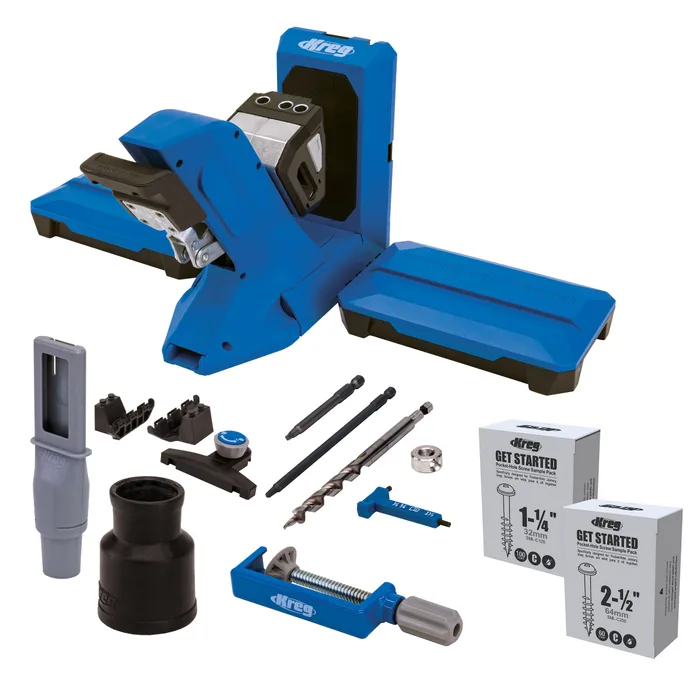
- Kreg Pocket-Hole Jig 720PRO - Buy. Sets the material thickness automatically as it clamps, which removes the one setup step that ruins pocket holes.
- Kreg Pocket-Hole Jig 520PRO - Buy. A built-in clamp and three thickness presets, which is most of the flagship's usefulness for considerably less money.
- Kreg Pocket-Hole Jig 320 - It depends. The cheapest route to a standard pocket hole, sold without the clamp it needs to be usable.
- Kreg Pocket-Hole Jig 310 - Skip. Drills a correct pocket hole one at a time, and asks you to reposition the guide by hand for every one of them.
The verdict in 30 seconds
What mattered most
- Clamping
- Thickness setting
- Holes without repositioning
- Material support
- Onboard storage
- Hole geometry
This comparison is four jigs from one maker, and that needs saying up front. Kreg is close enough to being the pocket hole category that a survey of four brands would mean comparing the market leader with three tools most people will never encounter, so the useful question is which Kreg rather than whether Kreg. The more important thing to understand before spending anything is that all four of these drill the same hole. The drill guide angle and the step-bit geometry are the same across the range, so joint strength is identical whichever you buy. What the money buys is clamping, thickness setting and repeatability, which is to say how quickly and how consistently you can produce that identical hole. And the specification that decides whether the joint actually holds, screw length and thread type, is not part of the jig at all.
Sets the material thickness automatically as it clamps, which removes the one setup step that ruins pocket holes.
Best for: Anyone building cabinets or face frames in volume, where setup time and consistency across dozens of holes is the whole job.
- Automaxx clamping sets the thickness and clamps in one motion for stock from 1/2 in. to 1-1/2 in., so the commonest setup mistake is designed out.
- Material support wings (the Docking Station) hold longer workpieces square to the guide instead of letting them tip.
- Onboard storage for Kreg accessories, so the parts you need are attached to the tool rather than in a drawer.
- Gripmaxx anti-slip material on the clamping faces, which keeps the workpiece from creeping under drill pressure.
- The most expensive jig in the range by a clear margin, and it drills exactly the same hole as the cheapest.
- Bulkier than the 520PRO, and it is a bench tool rather than something to carry to a repair.
- The automatic thickness setting still assumes you selected the right screw length for that thickness, which it cannot do for you.
- Overkill for anyone who builds a shelf twice a year.
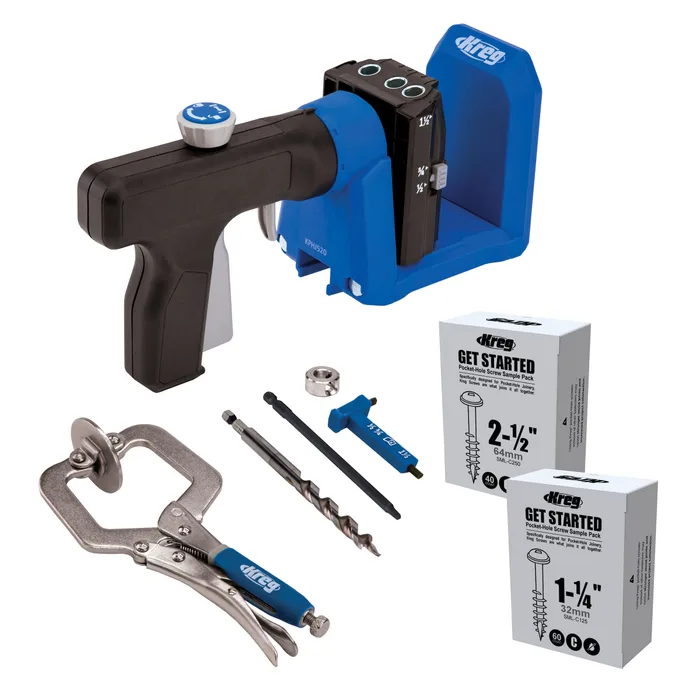
A built-in clamp and three thickness presets, which is most of the flagship's usefulness for considerably less money.
Best for: Most home shops, where the built-in clamp is the feature that matters and the automatic thickness setting is a luxury.
- A built-in clamp, so the jig holds the workpiece itself and both your hands stay on the drill and the stock.
- Three material thickness presets, which covers the common 1/2 in., 3/4 in. and 1-1/2 in. cases without measuring.
- Hardened-steel drill guides, with the thickness presets doing the setup work that would otherwise need measuring.
- Smaller than the 720PRO, so easier to take to the work.
- Presets rather than automatic setting, so thickness is still a decision you can make wrong.
- Three presets cover the common thicknesses and nothing in between, unlike the 720PRO's continuous range.
- No material support wings, so longer boards need supporting some other way.
- Less onboard storage than the flagship.
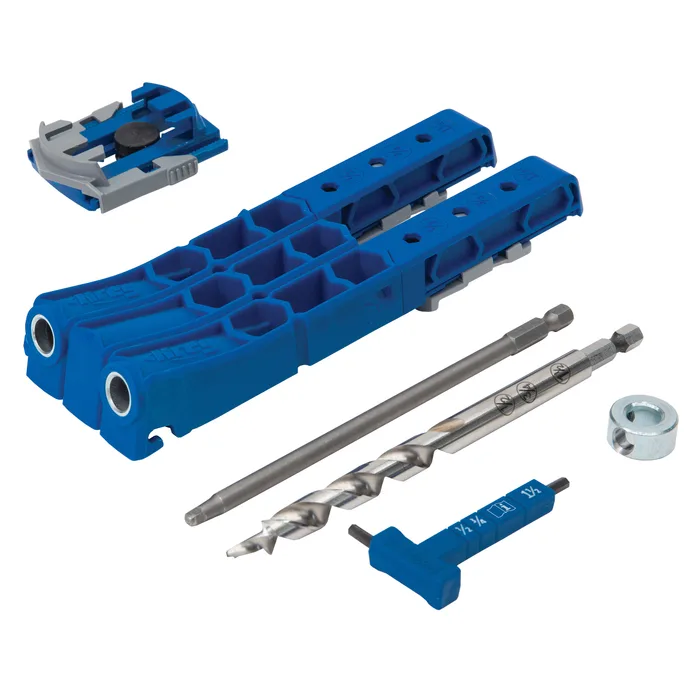
The cheapest route to a standard pocket hole, sold without the clamp it needs to be usable.
Best for: Occasional projects on a budget, for someone who already owns a face clamp or is willing to buy one.
- Drills the same standard pocket hole as the flagship, using ordinary washer-head pocket screws.
- Works with 1/2 in., 3/4 in. and 1-1/2 in. stock, covering the thicknesses most projects use.
- Small and light, and the two guide blocks can be separated and spaced for wider boards.
- The least expensive way into standard pocket hole joinery.
- No clamp included, so a face clamp is a separate purchase and a third hand you do not have.
- Clamping manually means the jig can shift under drill pressure, which is where misaligned holes come from.
- Thickness is set by hand each time, using stops, with no automatic mechanism.
- Two guide blocks to position and align adds a step the single-body jigs do not have.
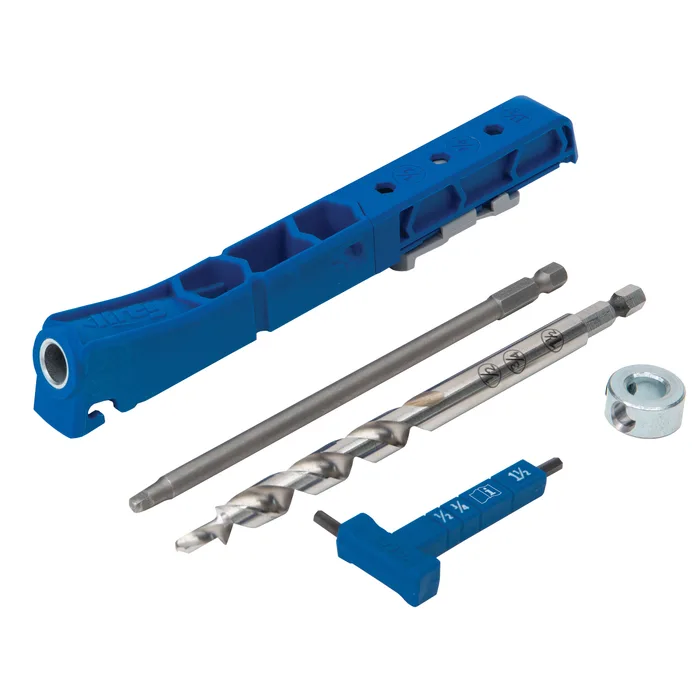
Drills a correct pocket hole one at a time, and asks you to reposition the guide by hand for every one of them.
Best for: Repairs and awkward in-place joints where a bench jig will not fit, as a second tool rather than a first one.
- Genuinely pocketable, so it goes in a toolbox for repairs rather than living on a bench.
- Drills the same standard pocket hole geometry as every other jig here.
- Cheapest entry into the system, and useful as a second jig for awkward in-place repairs.
- Works where a bench jig physically cannot reach, such as a joint already assembled in a corner.
- A single guide that must be repositioned and re-measured for each hole, which makes any repetitive work slow and inconsistent.
- Every reposition is another chance to set the spacing slightly differently, so hole alignment drifts across a workpiece.
- No clamping of its own, so holding the jig, the workpiece and the drill is a three-hand problem.
- Buying it for cabinet work means replacing it almost immediately.
| Criteria | Pocket-Hole Jig 720PRO Top pick Buy it Buy | Pocket-Hole Jig 520PRO Buy it Buy | Pocket-Hole Jig 320 It depends Buy | Pocket-Hole Jig 310 Skip it Buy |
|---|---|---|---|---|
| Best for | Anyone building cabinets or face frames in volume, where setup time and consistency across dozens of holes is the whole job. | Most home shops, where the built-in clamp is the feature that matters and the automatic thickness setting is a luxury. | Occasional projects on a budget, for someone who already owns a face clamp or is willing to buy one. | Repairs and awkward in-place joints where a bench jig will not fit, as a second tool rather than a first one. |
| Price tier | $$$ · premium | $$ · mid-range | $ · budget | $ · budget |
| Clamping | Automaxx, automatic in one motion | Built-in clamp | Anti-slip base and clamp adapter, clamp bought separately | None |
| Thickness setting | Automatic, 1/2 to 1-1/2 in. | Three presets | Stops, set by hand | Stops, set by hand |
| Holes without repositioning | Fixed guides | Fixed guides | Two, blocks positioned | One |
| Material support | Support wings (Docking Station) | None | None | None |
| Onboard storage | Onboard accessory storage | Limited | None | None |
| Hole geometry | Standard | Standard | Standard | Standard |
| Portability | Bench tool | Portable | Portable | Pocketable |
Which one is right for you?
- Anyone building cabinets or face frames in volume, where setup time and consistency across dozens of holes is the whole job. Buy it Kreg Pocket-Hole Jig 720PRO
- Most home shops, where the built-in clamp is the feature that matters and the automatic thickness setting is a luxury. Buy it Kreg Pocket-Hole Jig 520PRO
- Occasional projects on a budget, for someone who already owns a face clamp or is willing to buy one. It depends Kreg Pocket-Hole Jig 320
- Repairs and awkward in-place joints where a bench jig will not fit, as a second tool rather than a first one. Skip it Kreg Pocket-Hole Jig 310
How we judged the field
The first thing to establish is what does not vary. All four jigs here drill the same hole at the same angle with the same stepped bit, so the joint they produce is identical and joint strength is not a point of comparison at all. That leaves clamping, which is what stops the jig moving under drill pressure and which two of these four do not have; thickness setting, which positions the hole so the screw exits in the middle of the joining face and is the commonest thing people get wrong; repeatability, meaning how many holes you can drill before repositioning anything; and support, meaning whether long workpieces stay square to the guide. We also note throughout that the specification which actually decides whether the joint holds, screw length and thread type, is chosen by you and not by any of these tools.
Kreg Pocket-Hole Jig 720PRO
Buy itThe Kreg 720PRO is the pick because it removes the mistake rather than documenting it. Its Automaxx clamping sets the material thickness at the same time as it clamps, in one motion, anywhere from 1/2 to 1-1/2 inches, which means the step that produces most bad pocket holes cannot be skipped or misremembered. Everything else about it follows from being designed for volume: the material support wings hold a long rail square to the guide instead of letting it tip away, onboard storage keeps accessories with the tool, and Gripmaxx anti-slip faces stop the workpiece creeping while you lean on the drill. What you should be clear about is that none of this makes the joint stronger. It drills the same hole as the cheapest jig in the range. It is the most expensive tool here by a wide margin, it is a bench tool rather than something to carry, and the automatic thickness setting still assumes you picked the right screw length to go with it, which it cannot do for you.
Kreg Pocket-Hole Jig 520PRO
Buy itThe Kreg 520PRO is the second buy and the one most home shops should own. The built-in clamp is the feature that matters, because it means the jig holds the workpiece and both your hands are free for the drill and the stock, which is the difference between consistent holes and holes that wander when the jig shifts. Three thickness presets cover 1/2, 3/4 and 1-1/2 inch material, which is nearly everything most people build with, It is small enough to take to the work. What you give up against the flagship is the automatic thickness setting, so choosing the preset is still a decision you can get wrong, the presets do not cover thicknesses between them, and there are no support wings for long boards. For the price difference, most people should take that trade.
Kreg Pocket-Hole Jig 320
It dependsThe Kreg 320 is the it-depends, and the caveat is significant enough to change the price. It drills the same standard pocket hole as everything else here, works with the three common stock thicknesses, and its two guide blocks can be separated and spaced apart for wider boards. It is the cheapest way into standard pocket hole joinery. But it ships without a clamp, and a pocket hole jig without a clamp is not really a working tool: holding it against the stock by hand while drilling lets it shift under pressure, and a jig that shifts produces holes that do not line up. So the real price is the jig plus a face clamp, which narrows the gap to the 520PRO considerably. Add that setting thickness is by hand every time and that two guide blocks need positioning and aligning, and it is a tool that asks for more attention on every hole.
Kreg Pocket-Hole Jig 310
Skip itThe Kreg 310 is the skip for anything repetitive, and it is worth being precise about why, because the hole it drills is perfectly good. The problem is that there is one guide, so every single pocket hole means repositioning and re-measuring the jig by hand. For a cabinet side needing a dozen holes that is slow, and worse, it is inconsistent, because each reposition is another opportunity to set the spacing slightly differently and the alignment drifts across the workpiece. It also has no clamping of its own, so holding the jig, the workpiece and the drill at once is a three-hand problem. Where it genuinely earns its place is the job no bench jig can do: a repair on something already assembled, a joint in a corner, a hole where the workpiece cannot come to the tool. As a second jig in a toolbox it makes sense. As a first jig for someone planning to build furniture, it will be replaced almost immediately.
Sources
Specs in this review come from these pages.
- Kreg Tool, compare and select a pocket-hole jig (learn.kregtool.com)
- Kreg Tool, Pocket-Hole Jig 720PRO product page (kregtool.com)
- Popular Woodworking on the Kreg 720 and 520 pocket-hole jigs (popularwoodworking.com)
- Kreg Tool, pocket-hole screw selection by material and thickness (learn.kregtool.com)
- Comparison of Kreg jig models and their clamping mechanisms (woodshopdiaries.com)
Kreg Pocket-Hole Jig 720PRO vs Kreg Pocket-Hole Jig 520PRO: which should you buy?
The 720PRO against the 520PRO is the choice most buyers actually face, and it comes down to one question: is automatic thickness setting worth the difference. Both have built-in clamping, which is the feature that separates them from the cheaper pair. Both drill the same hole. The 720PRO sets thickness as it clamps, continuously across the 1/2 to 1-1/2 inch range, and adds support wings and onboard storage. The 520PRO asks you to select one of three presets, which takes a second and covers the thicknesses nearly everyone uses. If you are drilling a few dozen holes a year, that second is not worth the premium and the 520PRO is the better buy. If you are producing face frames and cabinet carcasses where the same setup error repeated across sixty holes ruins a day, the automatic setting is the whole point of the tool.
What to look for
- Whether the jig clamps the workpiece itself: a jig held by hand shifts under drill pressure, and the ones without clamps need a face clamp bought alongside them.
- How material thickness is set: automatic, preset or manual, and this is the setting that positions the screw’s exit point and is the commonest thing people get wrong.
- How many holes before repositioning: a fixed two-hole guide is a different tool from a single guide you move for every hole.
- Support for long workpieces: without it, a long rail tips away from the guide and the hole angle changes.
- The real price including the clamp: the cheapest jig in a range is often not the cheapest working setup.
- Screw length and thread type, which no jig sets: coarse for softwood, plywood and particle board, fine for hardwood, and length chosen by the thickness being drilled.
Our final take
Every jig here drills an identical hole, so nothing you spend improves the joint. What you are buying is the removal of setup steps and the ability to repeat a hole without thinking about it, which is worth a great deal in volume and almost nothing on a single shelf. Buy the clamping for the work you actually do, then spend the attention you saved on choosing the right screw, because that is the part that decides whether the joint holds.
Questions, answered
Does a more expensive jig make a stronger joint?
No. Every jig in this range drills the same hole at the same angle with the same stepped bit, so the joint that results is identical. What the money buys is clamping, thickness setting, support for long workpieces and the ability to produce that identical hole quickly and repeatably. Joint strength is set by the screw and the wood, not by which jig made the hole. If you are building one bookcase, the cheapest jig produces the same result more slowly.
What actually decides whether a pocket hole joint holds?
Screw length and thread type, neither of which is part of the jig. Length is chosen from the thickness of the piece being drilled, and getting it wrong either wastes holding power or pushes the screw through the far face. Thread type is chosen by material: coarse threads for softwood, plywood and particle board, where the thread needs to bite into loose fibre, and fine threads for hardwood, where a coarse thread would split it. The jig sets none of this, which is why a good jig with the wrong screws still makes a bad joint.
Why does the material thickness setting matter so much?
Because it positions the hole so the screw exits in the middle of the joining face. Set the jig for 3/4 inch stock and drill 1/2 inch stock and the screw comes out too close to a surface, which either blows out the face or leaves almost nothing holding. It is the single commonest pocket hole mistake and the reason the flagship jig sets thickness automatically as it clamps, rather than leaving it as a separate step people forget.
Do I need the dedicated clamp?
With the 320 and the 310, effectively yes, because holding the jig against the workpiece by hand while drilling lets it shift. The jigs with clamping built in solve this by design, which is most of what separates them from the cheaper ones. If you buy the 320, price a face clamp alongside it, because the jig on its own is not really a working tool.
Can I use pocket holes on plywood and MDF?
Plywood yes, with coarse-thread screws, and it is one of the things pocket holes do best because the joint does not rely on the edge grain the way a dowel or biscuit does. MDF is possible but weaker, since the material crushes rather than gripping, so use coarse threads, keep the screw well away from an edge and do not expect the joint to take much racking. In both cases the hole geometry is the same; only the screw changes.
Deciding between the top two? See our head-to-head: Kreg Pocket-Hole Jig 720PRO vs Kreg Pocket-Hole Jig 520PRO.
More in Tools & DIY
Pocket Hole Jigs, Explained Plain-English guide → Kreg Pocket-Hole Jig 720PRO vs Kreg Pocket-Hole Jig 520PRO Head-to-head →  The Best Precision Screwdriver Sets: 4 Compared (and One to Skip)
  The Best Random Orbital Sanders: 4 Compared (and One to Skip)
  The Best Reciprocating Saws: 4 Compared (and One to Skip)
  The Best Roof Rakes: 4 Compared (and One to Skip)