

Tools & DIY
The Best Pipe Wrenches: 4 Compared (and One to Skip)
We compared four pipe wrenches on the things a maker either publishes or does not: what the body is cast from, what the jaws weigh, and whether there is a catalog number for a new hook jaw when the teeth round over.
The short version
The RIDGID 31025, the 18 inch Heavy-Duty Straight, is the pick, because RIDGID publishes the most checkable detail: a ductile iron housing, a size chart running 6 inch to 60 inch, a maximum workpiece hardness of 325 BHN, and catalog numbers for the hook jaw, heel jaw, pin, spring and adjustment nut. The REED RW18 is the value choice and the interesting one, a high tensile ductile iron 18 inch whose hook jaw, heel jaw and pin, spring and nut are all separately catalogued, and which Reed states fits most heavy duty US brands including RIDGID from 18 inch to 48 inch. The Milwaukee 48-22-7318 CHEATER suits a service tech who wants 11 inch to 24 inch of handle in one 4.45 lb tool, and is the wrong answer if you ever need more than 2 1/2 inch pipe. Skip the Klein Tools 68228: Klein publishes cast iron where RIDGID and Reed publish ductile iron, its own spec block gives two different lengths for the same tool, and Klein's replacement parts catalog has no wrench or plumbing section, so there is no published jaw to buy. Best for: anyone who wants the wrench they buy this year to still be the wrench they own in twenty.
Our picks at a glance
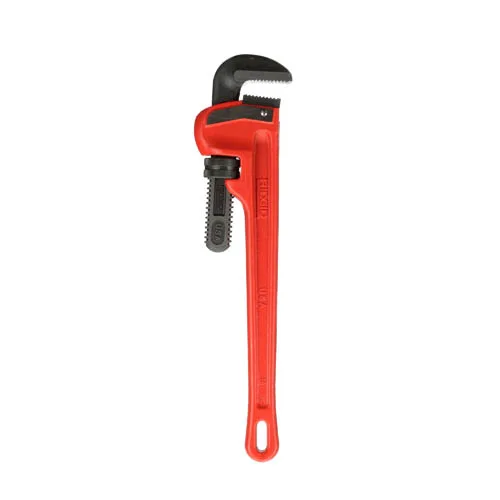
- RIDGID 31025 Model 18, 18 in. Heavy-Duty Straight Pipe Wrench - Buy. The reference tool, and the only one here whose maker publishes a use guide, a size chart and a part number for every wear item.
- REED Manufacturing RW18 Heavy Duty Straight Pipe Wrench, 18 in. - Buy. A high tensile ductile iron 18 inch whose wear parts are catalogued and, Reed states, fit the other big US brands too.
- Milwaukee Tool 48-22-7318 CHEATER Aluminum Adaptable Pipe Wrench - It depends. A pipe wrench with the handle extension engineered in, which is either the neatest idea here or a solution to a problem you do not have.
- Klein Tools 68228 Adjustable Cast Iron Pipe Wrench, 18-Inch - Skip. A perfectly normal looking 18 inch wrench that Klein's own pages will not tell you enough about to keep alive.
The verdict in 30 seconds
What mattered most
- Size and jaw capacity
- Published weight
- Body material the maker states
- Replacement hook and heel jaw catalogued
- Other wear parts catalogued
- What changing the heel jaw takes
A pipe wrench is about as simple as a hand tool gets, which makes it easy to assume they are all the same casting in different colours. They are not, and the differences are printed on the makers' own pages. One publishes a ten size chart, a workpiece hardness limit and a part number for every wear item down to the spring. One publishes a spec table that contradicts itself. The odd thing is that no American National Standard covers pipe wrenches at all, so what a maker chooses to print is the only thing you can check.
The reference tool, and the only one here whose maker publishes a use guide, a size chart and a part number for every wear item.
Best for: Anyone buying one pipe wrench to keep, who wants the wear parts to still be orderable in a decade.
- RIDGID publishes a ductile iron housing, an I-beam handle and a full floating forged hook jaw, with replaceable hook and heel jaws.
- The parts list gives a catalog number for the hook jaw (31670), heel jaw assembly (31675), pin (31690), spring assembly (31680), nut (31685) and handle assembly (31445).
- The Pipe Wrench Use Guide states a suggested pipe range and a maximum pipe size for every wrench from 6 inch to 60 inch, and a 325 BHN maximum workpiece hardness.
- At 5 1/2 lb it is 1 3/4 lb heavier than RIDGID's own 18 inch aluminium wrench of the same 2 1/2 inch capacity.
- RIDGID's page says the line complies with federal specification GGG-W-651 Type II, and that specification was cancelled without replacement in 1999.
- No maximum applied force or torque is published anywhere, so there is no number to work to.
- This is not an insulated tool and nothing on the page suggests otherwise.
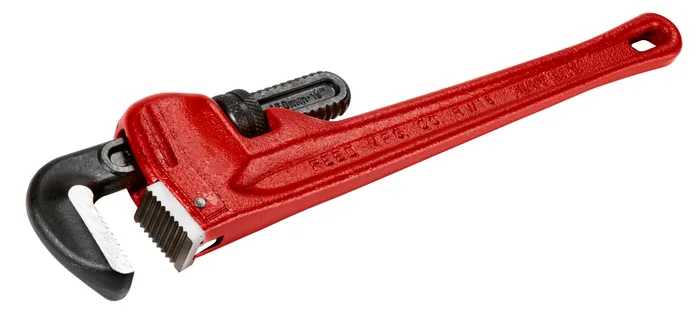
A high tensile ductile iron 18 inch whose wear parts are catalogued and, Reed states, fit the other big US brands too.
Best for: Someone who wants a US made ductile iron wrench and cares that the jaws are not locked to one brand.
- Reed publishes a high tensile ductile iron handle, hardened alloy steel parts and a solid steel pin in the heel jaw.
- Four wear parts carry their own catalog numbers: hook jaw RW18B, heel jaw and pin RW18C, coil and flat spring RW18E, nut RW18F.
- Reed states its heavy duty straight parts are interchangeable with most major heavy duty US brands including RIDGID, for straight, 45 degree offset and end wrenches from 18 inch to 48 inch.
- At 6.1 lb it is the heaviest tool here, and heavier than the RIDGID of the same nominal size and capacity.
- Reed's parts sheet states that parts for 14 inch and smaller wrenches were discontinued in June 2012, so the small Reeds are no longer repairable.
- Reed publishes capacity and weight but no suggested pipe size range and no separate use guide.
- Distribution is through pipe trade suppliers rather than general hardware, so it is harder to buy on a Saturday.
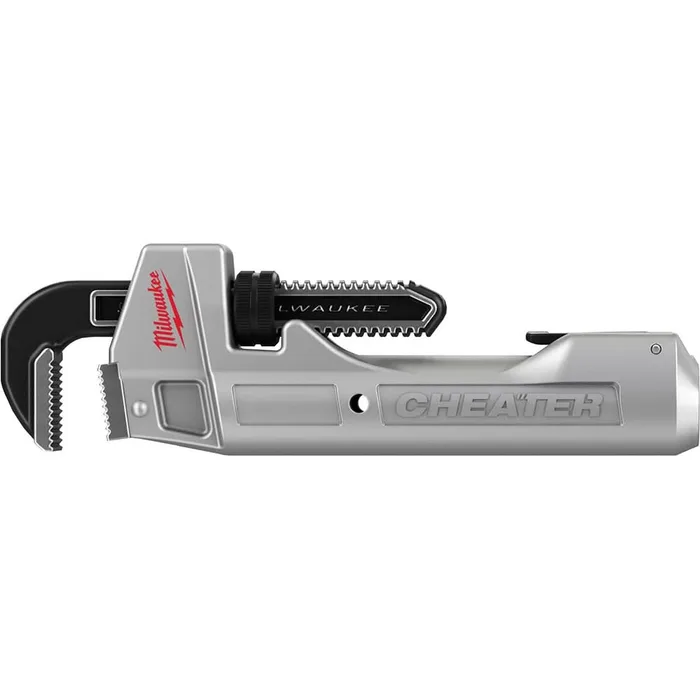
A pipe wrench with the handle extension engineered in, which is either the neatest idea here or a solution to a problem you do not have.
Best for: A service tech working mechanical rooms and ceilings who would rather carry one wrench than two and never touches pipe over 2 1/2 inch.
- Milwaukee publishes a quick slide handle that locks anywhere from 11 inch to 24 inch, so one tool covers tight access and general purpose leverage.
- Published weight is 4.45 lb and collapsed length is 17.13 in, with a 2 1/2 in jaw capacity and a Limited Lifetime Warranty.
- The service parts list carries the hook jaw with adjustment nut kit (43-90-0196), heel jaw kit (43-90-2001), spring and bracket kit (40-50-3232) and the handle assembly (43-62-0652).
- Jaw capacity stays 2 1/2 in even at the 24 inch setting, where a plain 24 inch wrench takes 3 in pipe.
- Milwaukee's own instruction on the parts list is that the head of the production rivet must be carefully ground off to fit a new heel jaw.
- The product name and copy say aluminum while the spec table lists material composition as steel, so the page does not settle what the body is.
- At 4.45 lb it gives up some of the weight saving that a plain 18 inch aluminium wrench offers at the same capacity.
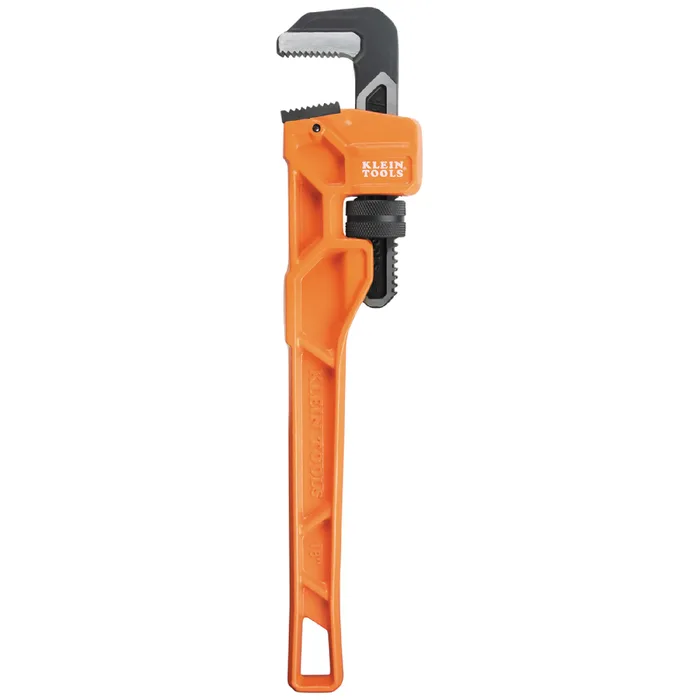
A perfectly normal looking 18 inch wrench that Klein's own pages will not tell you enough about to keep alive.
Best for: Someone who genuinely needs a pipe wrench once, for one fitting, and will not miss it when it is worn.
- Klein publishes a clear spec block: 2.5 in jaw capacity, 5.2 lb, I-beam handle, hang hole and a knurled twist knob.
- It is the cheapest tool here and the easiest of the four to walk into a general hardware aisle and find.
- Klein prints the safety point most makers leave out, that it should never be used on or near live electrical circuits.
- Klein publishes the material as cast iron, where RIDGID publishes ductile iron and Reed publishes high tensile ductile iron for the same class of tool.
- Klein's replacement parts catalog is organised into thirteen sections and none of them covers wrenches or plumbing, so there is no published hook jaw, heel jaw or pin to order.
- The same spec block gives overall length 15.9 in and handle length 18 in for one tool, which is not a spec sheet you can size from.
- It saves nothing in weight for the material choice: 5.2 lb against 5 1/2 lb for the ductile iron RIDGID of the same 2 1/2 in capacity.
| Criteria | 31025 Model 18, 18 in. Heavy-Duty Straight Pipe Wrench Top pick | RW18 Heavy Duty Straight Pipe Wrench, 18 in. | 48-22-7318 CHEATER Aluminum Adaptable Pipe Wrench | 68228 Adjustable Cast Iron Pipe Wrench, 18-Inch |
|---|---|---|---|---|
| Verdict | Buy it | Buy it | It depends | Skip it |
| Best for | Anyone buying one pipe wrench to keep, who wants the wear parts to still be orderable in a decade. | Someone who wants a US made ductile iron wrench and cares that the jaws are not locked to one brand. | A service tech working mechanical rooms and ceilings who would rather carry one wrench than two and never touches pipe over 2 1/2 inch. | Someone who genuinely needs a pipe wrench once, for one fitting, and will not miss it when it is worn. |
| Price tier | $$ · mid-range | $$ · mid-range | $$$ · premium | $ · budget |
| Size and jaw capacity | 18 in, 2 1/2 in nominal pipe | 18 in, 1/4 to 2 1/2 in nominal pipe | Handle 11 in to 24 in, 2 1/2 in jaw capacity | 18 in, 2 1/2 in jaw capacity |
| Published weight | 5 1/2 lb (2.6 kg) | 6.1 lb (2.8 kg) | 4.45 lb | 5.2 lb (2.4 kg) |
| Body material the maker states | Ductile iron housing, I-beam handle | High tensile ductile iron handle, hardened alloy steel parts | Named aluminum, spec table lists material composition as steel | Cast iron |
| Replacement hook and heel jaw catalogued | Yes, hook jaw 31670 and heel jaw assembly 31675 | Yes, hook jaw RW18B and heel jaw with pin RW18C | Yes, hook jaw kit 43-90-0196 and heel jaw kit 43-90-2001 | Not found in Klein's replacement parts catalog |
| Other wear parts catalogued | Pin 31690, spring assembly 31680, nut 31685, handle assembly 31445 | Coil and flat spring RW18E, nut RW18F | Spring and bracket kit 40-50-3232, handle assembly 43-62-0652 | None published |
| What changing the heel jaw takes | Drive out the pin, pin sold separately | Heel jaw supplied with its pin | Milwaukee says grind off the head of the production rivet first | Not published |
| Suggested pipe size range published | Yes, a chart for every size from 6 in to 60 in | Capacity only | Jaw capacity only | Jaw capacity only |
| Use and safety guidance published | Four page use guide in three languages, with a 325 BHN workpiece limit | Product page and parts sheet only | Service parts list only | Two warning lines on the product page |
Which one is right for you?
- Anyone buying one pipe wrench to keep, who wants the wear parts to still be orderable in a decade. Buy it RIDGID 31025 Model 18, 18 in. Heavy-Duty Straight Pipe Wrench
- Someone who wants a US made ductile iron wrench and cares that the jaws are not locked to one brand. Buy it REED Manufacturing RW18 Heavy Duty Straight Pipe Wrench, 18 in.
- A service tech working mechanical rooms and ceilings who would rather carry one wrench than two and never touches pipe over 2 1/2 inch. It depends Milwaukee Tool 48-22-7318 CHEATER Aluminum Adaptable Pipe Wrench
- Someone who genuinely needs a pipe wrench once, for one fitting, and will not miss it when it is worn. Skip it Klein Tools 68228 Adjustable Cast Iron Pipe Wrench, 18-Inch
How we judged the field
Five things decide whether a pipe wrench is worth owning, and four of them are printed. The first is what the body is cast from, because ductile iron and grey cast iron are not the same material under a shock load, and the makers do say which they used. The second is whether the hook jaw and heel jaw have catalog numbers, since the teeth are the only part that wears out and a wrench you cannot re-tooth is a consumable. The third is what it weighs at a given capacity, because that is the whole aluminium argument and every maker here publishes a figure. The fourth is what the maker tells you about use: a size chart, a workpiece hardness limit, an instruction about the gap behind the hook jaw. The fifth is fit to the pipe, which is on you rather than the tool, but a maker who publishes a suggested range makes it much harder to get wrong.
The field splits on documentation more than on price. RIDGID and Reed sit at one end, both casting in ductile iron and both selling the jaws, the pin, the spring and the nut as separate items, with Reed going further and stating that its parts from 18 inch to 48 inch fit the other major US brands. Milwaukee sits in the middle: it publishes a full service parts list, so the CHEATER is repairable, but the tool it is attached to answers a different question, which is how to carry one wrench instead of two. Klein sits at the other end, with a clean spec block, a cheaper casting and no published jaw. We picked those four because between them they cover every real decision here: iron or aluminium, one wrench or two, and rebuildable or disposable.
RIDGID 31025 Model 18, 18 in. Heavy-Duty Straight Pipe Wrench
Buy itThe RIDGID 31025 is the 18 inch in the heavy duty straight line, and RIDGID publishes more about it than the other three publish about anything. The housing is ductile iron, the handle is an I-beam, the hook jaw is a full floating forging, and the threads are described as extra large and self cleaning. What matters more is the paperwork behind it. The parts list gives you a catalog number for the hook jaw, the heel jaw assembly, the pin, the spring assembly, the nut and the handle assembly, for every size from the 6 inch to the 60 inch. The Pipe Wrench Use Guide adds a suggested pipe range and a hard maximum for each size, a 325 BHN limit on the material you are allowed to put it on, and the instruction that a gap must stay open behind the hook jaw shank or the hook can fail. At 5 1/2 lb with a 2 1/2 inch capacity it is not light, and RIDGID also makes aluminium versions of the same size at a lower weight. For a wrench you intend to keep, the documentation is the feature.
REED Manufacturing RW18 Heavy Duty Straight Pipe Wrench, 18 in.
Buy itThe REED RW18 is the same tool argued from a slightly different angle. Reed publishes a high tensile ductile iron handle, hardened alloy steel parts, and a solid steel pin through the heel jaw, and at 6.1 lb it is the heaviest thing in this comparison for a 1/4 to 2 1/2 inch capacity. The reason to want it is on the parts sheet. Hook jaw RW18B, heel jaw with pin RW18C, coil and flat spring RW18E and nut RW18F are all separately catalogued, and Reed states that its heavy duty straight parts interchange with most major heavy duty US brands including RIDGID, across straight, 45 degree offset and end wrenches from 18 inch to 48 inch. Its own 60 inch heel jaw is listed as replacing the RIDGID equivalent outright. The same sheet carries the warning that goes with that: parts for 14 inch and smaller Reed wrenches were discontinued in June 2012, so buy the 18 inch or larger if repairability is the point. For anyone who resents being locked to one brand for a jaw, this is the answer.
Milwaukee Tool 48-22-7318 CHEATER Aluminum Adaptable Pipe Wrench
It dependsThe Milwaukee CHEATER is the only tool here that treats the handle as adjustable rather than fixed. Milwaukee publishes a quick slide handle that locks anywhere between 11 inch and 24 inch, a collapsed length of 17.13 in, a weight of 4.45 lb, a 2 1/2 inch jaw capacity and a Limited Lifetime Warranty, and the service parts list carries the hook jaw kit, heel jaw kit, spring and bracket kit and the handle assembly. It answers a real problem, which is that a mechanical room needs an 11 inch tool to get in and a 24 inch tool to break the joint. The catch is that leverage grew and capacity did not: at full extension you have 24 inches of handle on a head that still stops at 2 1/2 inch pipe, where a plain 24 inch wrench takes 3 inch. Two further things are worth knowing: Milwaukee’s own parts note says the head of the production rivet must be ground off to fit a new heel jaw, and the spec table lists material composition as steel on a tool the name and the copy both call aluminum.
Klein Tools 68228 Adjustable Cast Iron Pipe Wrench, 18-Inch
Skip itThe Klein 68228 looks right in the photograph and is priced to be the easy choice, which is exactly why it is worth being specific about. Klein publishes a 2.5 in jaw capacity, 5.2 lb, an I-beam handle, a knurled twist knob and a hang hole, and the material as cast iron. RIDGID and Reed both publish ductile iron for the same class of tool, and that is not a marketing distinction, it is a different iron with different behaviour when something shocks the handle. Then there is the part you cannot buy: Klein’s replacement parts catalog is split into thirteen sections covering pliers, cutters, drivers, fish tapes, holemaking, strippers and more, and none of them is wrenches or plumbing, so when the teeth round over the whole wrench is the consumable. The spec block also gives overall length 15.9 in and handle length 18 in for the same tool, which is a small thing that tells you how closely the page was checked. It saves no weight over the RIDGID either.
Sources
Specs in this review come from these pages.
- Hand Tools Institute - American National Standards covering hand tools (ASME B107 series list) (standards.hti.org)
- Federal Specification GGG-W-651E Notice 1 - cancellation of the pipe wrench and basin wrench specification (everyspec.com)
- RIDGID - Pipe Wrench Use Guide (warnings, inspection, workpiece hardness limit, size chart) (cdn2.ridgid.com)
- RIDGID - Heavy-Duty Straight Pipe Wrenches (catalog numbers, capacities, weights) (ridgid.com)
- RIDGID - Straight Pipe Wrench Parts List (hook jaw, heel jaw, pin, spring, nut catalog numbers) (cdn2.ridgid.com)
- REED Manufacturing - Pipe Wrenches, Heavy Duty, Straight (specifications and interchangeability note) (reedmfgco.com)
- REED Manufacturing - Pipe Wrenches (Heavy Duty) Replacement Parts list (reedmfgco.com)
- Milwaukee Tool - Service Parts List 54-49-3155, Pipe Wrenches (documents.milwaukeetool.com)
- Klein Tools - 68228 Adjustable Cast Iron Pipe Wrench, 18-Inch (kleintools.com)
- Klein Tools - Replacement Parts catalog (section list) (kleintools.com)
RIDGID 31025 Model 18, 18 in. Heavy-Duty Straight Pipe Wrench vs REED Manufacturing RW18 Heavy Duty Straight Pipe Wrench, 18 in.: which should you buy?
Both buys are 18 inch ductile iron wrenches with a 2 1/2 inch capacity, so the choice is not about capability. The RIDGID is lighter on paper, 5 1/2 lb against the Reed’s 6.1 lb, and it is the only one of the four that publishes a use guide, meaning you get a size chart, a workpiece hardness limit, an inspection routine and the explanation of why a gap has to stay open behind the hook jaw shank. It also publishes parts all the way down to the 6 inch, so a RIDGID bought at any size stays serviceable. If you are buying one wrench and want the manufacturer to have thought about how you will use it, that is the RIDGID.
The Reed makes a narrower but sharper argument. Its parts are catalogued too, and Reed states they interchange with most major heavy duty US brands including RIDGID from 18 inch to 48 inch, which means a Reed jaw is a spare for both wrenches and you are not tied to one supply chain. The trade is weight and small sizes: it is the heaviest tool here, and Reed discontinued parts for its 14 inch and smaller wrenches in June 2012, so the small ones are not part of this argument. Pick the RIDGID if the documentation is what you are paying for, the Reed if cross compatible jaws and a US foundry are.
What to look for
- Ductile iron, not just iron: RIDGID publishes a ductile iron housing and Reed a high tensile ductile iron handle, while Klein publishes cast iron, and that word is doing real work in a tool people lean on.
- A catalog number for the hook jaw: teeth are the only part that wears out, so a maker who sells the hook jaw, heel jaw, pin, spring and nut separately is selling you a wrench you can re-tooth instead of replace.
- Weight at a stated capacity: aluminium versions of the same size and capacity weigh noticeably less than the iron ones, so check the published pounds on both before you choose.
- A published size range, not just a maximum: RIDGID’s chart suggests 1 to 2 inch pipe for an 18 inch wrench and caps it at 2 1/2 inch, which is the difference between a wrench that grips and one that is technically within spec.
- What the maker says about extensions: RIDGID states in writing that handle extensions may damage the wrench or cause it to slip, and that the fix for a stubborn joint is a larger wrench or a compound leverage wrench.
- How the heel jaw is retained: RIDGID and Reed use a pin you can drive out, while Milwaukee’s own parts note says the head of the production rivet has to be ground off first, which turns a five minute repair into a bench job.
Our final take
Pipe wrenches are the rare category where the buy it for life claim is literally true, provided the maker sells the jaws. Nothing else on the tool wears out in normal use, so a wrench with a catalogued hook jaw, heel jaw, pin, spring and nut is a wrench you will hand on, and one without them is a consumable that happens to last a while. That is the whole of our recommendation. Buy the RIDGID 31025 if you want the fullest documentation behind the casting, the REED RW18 if you would rather have jaws that fit more than one brand, and the Milwaukee CHEATER only if the 11 inch to 24 inch trick solves a problem you actually have. There is no standard here to hide behind, so what a maker prints is all you get to check.
Questions, answered
Is there an actual standard for pipe wrenches?
No current American National Standard covers them. The Hand Tools Institute publishes the list of ASME B107 standards covering hand tools, and there are ten: driving and spindle ends, gages and mandrels for wrench openings, body repair tools, flat wrenches, socket wrenches, hand torque tools and testers, striking tools, struck tools, pliers and shears, and screwdrivers. Pipe wrenches are on none of them. The one US specification that ever did cover them was Federal Specification GGG-W-651E, and the 1999 notice cancelled it without replacement. RIDGID still states that its heavy duty straight line complies with GGG-W-651 Type II, which is a reference to a dead document, so treat it as a design lineage rather than a live certification.
Can I use a pipe wrench on a hex nut in a pinch?
The makers say no, and they explain why. RIDGID's use guide states plainly that a pipe wrench should not be used on hard, square, hexagonal or other non round material, and that the jaw teeth penetrate the stock in order to grip. On a hex the teeth land on flats and corners rather than biting into a curve, so the wrench either slips or chips its own teeth, and the nut gets rounded either way. RIDGID also sets a workpiece limit of 325 BHN, above which the teeth will skate instead of digging in. The same guide warns that the teeth mar the pipe surface and can leave sharp edges, which is why finished or plated pipe wants a strap wrench instead.
Why do the makers forbid a cheater bar when everybody uses one?
RIDGID's use guide is explicit: do not use handle extensions, because they may damage the wrench or slip and cause serious injury. The same page bans come-a-longs, chain hoists, backhoes, threading machines and drill rigs, and states that pipe wrenches are hand tools designed to be used by hand. Its remedy when you need more turning force is a larger wrench or a compound leverage wrench, not a longer handle. The tell that a wrench has been overloaded is a bent or twisted handle, and RIDGID says a bent handle should never be straightened and the wrench should be removed from service. Note what we could not find: none of the maker pages we read gives a maximum applied force or torque figure, so there is no number to check yourself against.
Should I sharpen dull teeth or replace the jaw?
Replace it. RIDGID's inspection instruction is to clean the jaws with a wire brush, check that the teeth are clean and sharp, and replace the jaws if the teeth are worn. The same document lists modification of any kind, including grinding or welding, as a reason to take the wrench out of service, because modification can weaken it. It also warns against using the wrench near flame or high heat, since the hook or heel jaw teeth can soften and then chip or flatten. That is the whole argument against filing them up: a bench grinder does the heat damage and the metal removal at once. RIDGID, Reed and Milwaukee all sell the jaws, so the repair is a part number rather than a project.
How do I know I have picked the right size wrench?
RIDGID publishes a chart, and none of the other three maker pages we read does. It gives a suggested pipe range and a hard maximum for each size: a 14 inch is suggested for 1/2 to 1 1/2 inch pipe with a 2 inch maximum, an 18 inch for 1 to 2 inch with a 2 1/2 inch maximum, a 24 inch for 1 1/2 to 2 1/2 inch with a 3 inch maximum. The physical check on the pipe is simpler. A gap must stay open between the shank of the hook jaw and the pipe, so that the heel jaw teeth and hook jaw teeth are the only two contact points. If the shank touches the pipe, RIDGID says gripping action drops sharply, the wrench can slip, and the hook jaw itself can fail. A wrench that fits the pipe never closes that gap.
Deciding between the top two? See our head-to-head: RIDGID 31025 Model 18, 18 in. Heavy-Duty Straight Pipe Wrench vs REED Manufacturing RW18 Heavy Duty Straight Pipe Wrench, 18 in..
More Tools & DIY reviews
 The Best Pocket Hole Jigs: 4 Compared (and One to Skip)
  The Best Precision Screwdriver Sets: 4 Compared (and One to Skip)
  The Best Random Orbital Sanders: 4 Compared (and One to Skip)
  The Best Reciprocating Saws: 4 Compared (and One to Skip)
  The Best Rotary Hammers: 4 Compared (and One to Skip)
  The Best Rotary Tools: 4 Compared (and One to Skip)