Explained
Pipe Wrenches, Explained
After reading, you'll understand what every number on a pipe wrench listing means, why the tool only grips round stock, and how to tell a wrench you can repair from one you cannot.
In this guide
Pipe wrenches look interchangeable and mostly are not. The confusing part is that the number in the name is the handle length, not the pipe it fits, and the capacity figure is a nominal pipe size rather than a measurement you can take with a tape. On top of that, the tool grips by a mechanism most people never have explained to them, which is why it works brilliantly on pipe and destroys hex nuts. And unlike sockets or torque wrenches, there is no published standard to fall back on, so the maker's own pages are the only thing to read.
The 30-second version
- The number in the name is the handle, so an 18 inch wrench is 18 inches of handle and takes pipe up to about 2 1/2 inch nominal, not 18 inch pipe.
- The teeth grip by digging in, which is why the tool works on round pipe and rounds off anything with flats and corners.
- No standard covers pipe wrenches, so the ten ASME B107 hand tool standards are silent here and the old federal specification was cancelled in 1999.
- Jaws are the consumable, and a maker who publishes catalog numbers for the hook jaw, heel jaw and pin is selling a tool you can keep.
- Aluminium saves weight, at the same published capacity, which is worth a lot overhead and worth nothing in a truck bed.
The products this guide is about
Our verdict on each, with the full reasoning on the companion review.
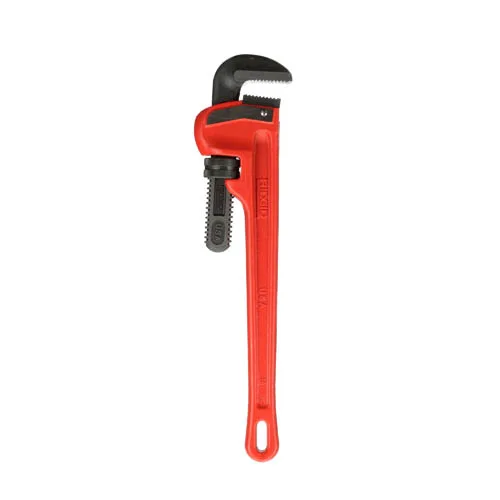
- Buy RIDGID 31025 Model 18, 18 in. Heavy-Duty Straight Pipe Wrench The reference tool, and the only one here whose maker publishes a use guide, a size chart and a part number for every wear item. Amazon
- Buy REED Manufacturing RW18 Heavy Duty Straight Pipe Wrench, 18 in. A high tensile ductile iron 18 inch whose wear parts are catalogued and, Reed states, fit the other big US brands too. Amazon
- It depends Milwaukee Tool 48-22-7318 CHEATER Aluminum Adaptable Pipe Wrench A pipe wrench with the handle extension engineered in, which is either the neatest idea here or a solution to a problem you do not have.
- Skip Klein Tools 68228 Adjustable Cast Iron Pipe Wrench, 18-Inch A perfectly normal looking 18 inch wrench that Klein's own pages will not tell you enough about to keep alive. Amazon
What actually matters
- Handle length - it sets both the leverage and, in practice, the pipe size the head is built for. Makers pair each handle length with a capacity, so choosing the length is choosing the capacity.
- Nominal pipe capacity - the largest nominal steel pipe the jaws will properly tighten. It is a pipe designation, not an outside diameter, which is why Reed publishes an actual outside diameter range alongside it.
- Body material - RIDGID publishes ductile iron and Reed high tensile ductile iron, while Klein publishes cast iron. Ductile iron deforms before it breaks, which matters in a tool people put their body weight on.
- Replaceable jaws - the hook jaw and heel jaw carry all the teeth and all the wear. If they have catalog numbers, a worn wrench is a small order. If they do not, it is scrap.
- The hook jaw gap - a gap has to stay open between the hook jaw shank and the pipe so that only the heel and hook teeth touch. Close that gap and grip drops sharply and the hook can fail.
- Weight - it decides whether the wrench comes up the ladder with you. The same maker's aluminium version of the same size usually holds the same capacity at at a lower weight.
- What the maker publishes - with no standard to point at, a size chart, a hardness limit and a parts list are the only checkable claims a pipe wrench maker can make.
The specs, in plain English
Green flags vs red flags
Green flags
- The maker publishes the body material by name, and that name is ductile iron rather than just iron.
- There is a parts list with catalog numbers for the hook jaw, heel jaw, pin, spring and adjusting nut.
- The listing pairs a suggested pipe size range with the maximum, rather than only quoting a maximum.
- There is a use guide, not just a spec block, covering inspection, wear and what the tool must not be used on.
- Weight is published in both pounds and kilograms alongside the capacity, so the aluminium comparison is actually checkable.
Red flags
- The spec table contradicts itself, for example giving two different lengths for one tool.
- The word cast iron appears with no further qualification in a heavy duty listing.
- No jaw, pin or spring appears anywhere in the maker's replacement parts catalog.
- Compliance is claimed against a specification number without a date, when the specification in question was cancelled.
- A torque or force figure is quoted for a pipe wrench, since we found none on the maker pages we read.
Who's who: the brands
- RIDGID - The reference in this category, publishing ductile iron and aluminium lines from 6 inch to 60 inch, a full parts breakdown for each, and the four page use guide with its inspection and safety wording.
- REED Manufacturing - An Erie, Pennsylvania pipe tool maker whose heavy duty straight and aluminium wrench parts it states are interchangeable with most major US brands including RIDGID from 18 inch to 48 inch.
- Milwaukee Tool - Steel and aluminium straight, offset and smooth jaw wrenches plus the extending CHEATER, all covered by one published service parts list with jaw, spring and handle kits.
- Klein Tools - Cast iron and cast aluminium pipe wrenches sold mainly through electrical and general hardware channels, with clear dimensional spec blocks but no wrench section in its replacement parts catalog.
- ROTHENBERGER - A German pipe tool maker with a US catalog, notable for selling replacement hook jaws and replacement chain wrench jaws as separate stocked items.
How to read a listing without getting fooled
Start at the two numbers that are not the same thing. The size in the name is handle length, and the capacity beside it is a nominal pipe size, so an 18 inch wrench is 18 inches of handle rated to about 2 1/2 inch nominal pipe. If the listing gives an actual outside diameter range as well, as Reed does, use that, because nominal sizes do not correspond to anything you can measure. Then look for the material word: ductile iron and cast iron are printed in the same font and mean different things. Next go looking for a parts list, which is the single most predictive item on any pipe wrench page, and check whether the hook jaw and heel jaw have their own numbers. Finally, note what is missing across the whole category. Nobody publishes a jaw hardness, nobody publishes a maximum torque, and nobody can point to a current standard, so the absence of those is normal rather than a red flag. What is not normal is a spec block that disagrees with itself.
How much should you spend?
Budget tier buys a working 18 inch wrench from a general hardware brand, and it will turn pipe, but expect a plainer casting and no published jaw to replace when the teeth go. Mid-range is where the ductile iron trade wrenches sit, and it is the tier worth paying for, because it is where the catalogued hook jaws, heel jaws, pins and springs start and where a wrench stops being a consumable. Premium here does not usually mean a better plain wrench. It means either aluminium, where you pay for roughly a third less weight at the same capacity, or a mechanism such as an extending handle or a compound leverage linkage. Two useful rules: an aluminium wrench costs more than the iron one it replaces and does the same work, and a spare hook jaw and heel jaw for a mid-range wrench cost a small fraction of a new tool, which is the whole argument for buying into a brand that sells them.
Questions, answered
What is the difference between straight, end and offset pipe wrenches?
RIDGID describes the straight wrench as suitable for all forms of pipe work, and it is the default. The end wrench angles the head so you can drop it onto pipe close to a wall or between closely spaced parallel runs, and RIDGID publishes it in the same sizes and near enough the same weights as the straight. The offset wrench angles the head the other way for easier entry into tight spots and awkward angles. If you are buying one wrench, buy the straight. The end and offset are second wrenches bought once you have met the specific problem they solve.
When is a chain or strap wrench the right answer?
A chain wrench is for work a fixed jaw cannot get around, and RIDGID's heavy duty models use a double jaw that gives ratchet-like action in either direction. Read both of its published capacities: the 14 inch heavy duty model is rated for 2 inch pipe but the chain will wrap up to 5 inch outside diameter, and those are not the same claim. A strap wrench is the tool for anything you must not mark, which RIDGID lists as plated, polished and plastic pipe. Its low profile also lets it work where a chain wrench or a large pipe wrench cannot swing through a full stroke.
Is an aluminium pipe wrench strong enough?
The makers publish the same nominal capacity for both materials at the same size, so on paper the aluminium tool does the same job. RIDGID's 18 inch aluminium and 18 inch ductile iron wrenches are both rated to 2 1/2 inch pipe, at 3 3/4 lb and 5 1/2 lb; Reed's ARW18 and RW18 are both 1/4 to 2 1/2 inch, at 3.5 lb and 6.1 lb. What none of them publishes is a comparative strength or abuse figure, so the honest position is that aluminium is a weight decision rather than a strength one. If the wrench lives overhead or on a ladder, take the weight saving. If it lives under other tools in a truck bed, the iron will take the neglect better.
Do pipe wrenches have a torque rating?
No. We found no maximum applied force or torque on the maker pages we read for a pipe wrench, and RIDGID's use guide points you to the product markings and the catalog instead. What it does publish is a suggested pipe size range per wrench size and an instruction to use a larger wrench or a compound leverage wrench rather than more force. If a job actually specifies a torque figure, a pipe wrench is the wrong tool for reading it and a torque wrench is the right one. The pipe wrench's own indicator of overload is cruder and comes too late: a bent or twisted handle, which RIDGID says should never be straightened and means the wrench comes out of service.
Or jump to the head-to-head: RIDGID 31025 Model 18, 18 in. Heavy-Duty Straight Pipe Wrench vs REED Manufacturing RW18 Heavy Duty Straight Pipe Wrench, 18 in..