Explained
Miter Saws, Explained
After reading, you'll be able to compare four capacity figures written in three different units and know which saw actually cuts your boards.
In this guide
Miter saw listings quote how big a board the saw will cut, and they do it in incompatible units. Converting them is most of the decision.
The 30-second version
- Capacity comes in three units, nominal lumber like 2x14, an actual measurement in inches, or a bare crosscut width, and only one of those can be checked with a tape.
- Blade diameter buys depth, which is why a 12 inch saw reaches 4x material and a 10 inch saw does not, regardless of how wide either one cuts.
- The slide buys width, because the rails pull the head through the board, and a saw without them is limited to the arc the blade sweeps.
- Nominal lumber flatters, since a board sold as a 2x14 measures about 1-1/2 by 13-1/4 inches, so the quoted figure reads larger than the saw cuts.
- Double bevel saves mistakes rather than time, letting both ends of long moulding be cut without flipping and re-marking the workpiece.
The products this guide is about
Our verdict on each, with the full reasoning on the companion review.
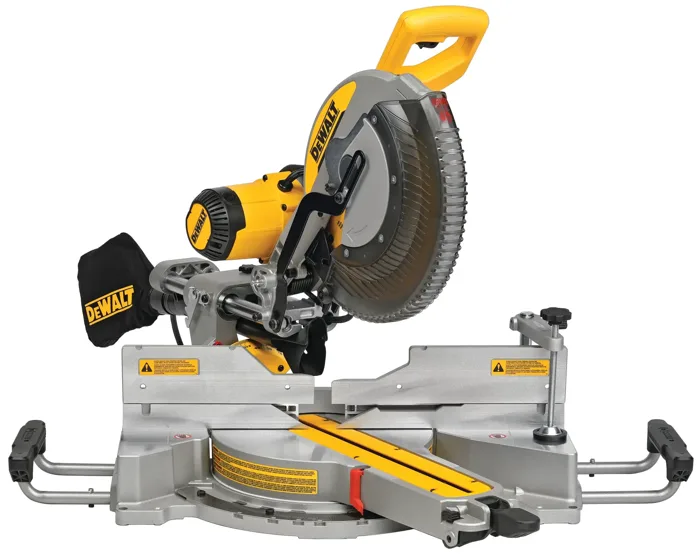
- Buy DEWALT DWS780 12 in. Double-Bevel Sliding Compound Miter Saw The largest crosscut capacity in this comparison, with a double bevel that stops you flipping every second cut. Amazon
- Buy Makita LS1019L 10 in. Dual-Bevel Sliding Compound Miter Saw with Laser The only saw here that publishes its capacity as a measurement you can check with a tape, on a rail design that sits against a wall. Amazon
- It depends DEWALT DWS715 12 in. Single-Bevel Compound Miter Saw A 12 inch blade with no slide, which buys depth and costs width, at a price the sliders cannot match. Amazon
- Skip CRAFTSMAN CMCS714M1 V20 7-1/4 in. Cordless Sliding Miter Saw Kit A slider whose 8 inch crosscut will not reach across a 2x10, which is the board most people buy a miter saw for. Amazon
What actually matters
- Crosscut capacity at 90 and 45 degrees - the two figures that decide what fits. Convert nominal lumber sizes to actual dimensions before comparing them with measured figures.
- Blade diameter - 7-1/4, 10 or 12 inches. Sets cutting depth, which determines whether 4x material is reachable. It does not set width on its own.
- Slide - rails that let the head travel through the board. The mechanism that sets crosscut width, and the main reason a slider costs more.
- Bevel type - single tilts one way, double or dual tilts both. Matters for long moulding and barely at all for framing.
- Nested crown capacity - the vertical height available for cutting crown against the fence at its installed angle, quoted separately because it is a different constraint.
- Rail clearance - most sliders need space behind them. Some designs avoid it, which decides whether the saw can live against a wall.
The specs, in plain English
Green flags vs red flags
Green flags
- Capacity is published as an actual measurement in inches, with depth and width.
- Both the 90 and 45 degree figures are given.
- Whether the saw slides is stated plainly rather than implied by the word compound.
- A separate nested crown capacity is published.
- Bevel is described as single, dual or double rather than just bevel.
Red flags
- Only a nominal lumber size is given, with no actual dimensions.
- A crosscut width appears with no depth figure attached.
- Blade diameter leads the listing and capacity is hard to find.
- Compound is used without saying whether the head slides.
- Only the 90 degree capacity is quoted, with nothing at 45.
Who's who: the brands
- DEWALT - Large capacities and double-bevel sliders, with capacity quoted as nominal lumber sizes that need converting before comparison.
- Makita - Publishes capacity as an actual measurement and builds compact rail designs that do not need clearance behind the saw. Premium prices.
- Bosch - Known for the axial-glide articulated arm that removes rails entirely, saving depth behind the saw at a price.
- CRAFTSMAN - Smaller cordless sliders aimed at trim and portability, with capacity quoted as a bare width.
- Metabo HPT - Long-standing value sliders, often undercutting the majors on price for comparable capacity.
How to read a listing without getting fooled
Convert every capacity figure into actual inches before you compare anything, because nominal lumber sizes read about three quarters of an inch larger than they measure. Then check whether the saw slides, which is what sets width, and read blade diameter as a depth specification. Look for the 45 degree figure as well as the 90, since that is usually the binding one. Read motor speed and amps last.
How much should you spend?
Budget buys a small cordless slider or a fixed-head saw that will handle trim and studs. Mid-range buys a 12 inch fixed-head saw with real depth and no width extension, which is the best value if you never cut wide boards. Premium buys rails and a second bevel direction, and flagship buys a compact rail design and a capacity figure published as a measurement rather than a lumber size.
Questions, answered
Will a 10 inch saw cut a 4x4?
Not usually in one pass. A 4x4 measures about 3-1/2 inches square and a 10 inch slider here gives 2-13/16 inches of depth, so it needs the board flipped and a second cut, which risks a visible step if the two passes do not align. A 12 inch saw clears it in one. This is the clearest case where blade diameter, not the slide, is the deciding specification.
What does the 31.6 degree detent do?
It is there for crown moulding cut flat on the table. Standard US crown sits at a 38 degree spring angle, and cutting it flat requires a compound setting of 31.62 degrees miter with a 33.86 degree bevel. Makers put a positive stop at that miter angle because it is otherwise fiddly to dial in accurately.
Are thin-kerf blades a good idea on a miter saw?
On a lower-powered or cordless saw, yes, because they remove less material and load the motor less. On a wide crosscut they deflect more than a full-kerf blade, which can leave a cut that is not quite square through the thickness. For fine trim on a corded saw, a full-kerf blade with a high tooth count gives the better result.
Does a laser or LED line help accuracy?
A shadow line from an LED tends to be more useful than a projected laser, because it shows the actual kerf rather than a line that has to be calibrated and can drift. Neither is a substitute for cutting on the waste side of your mark and checking the first cut. Treat them as a convenience rather than a precision feature.
Or jump to the head-to-head: DEWALT DWS780 12 in. Double-Bevel Sliding Compound Miter Saw vs Makita LS1019L 10 in. Dual-Bevel Sliding Compound Miter Saw with Laser.