Explained
Moisture Meters, Explained
After reading, you'll understand what a moisture meter is really measuring, why two meters disagree on the same board, and what number you should be aiming for.
In this guide
First-time buyers assume a moisture meter measures water the way a thermometer measures heat. It does not. It measures an electrical property and converts it using a calibration built around one reference wood, at one reference temperature, with one assumed pin type. Every one of those assumptions can be wrong for the piece in front of you, and the good meters are the ones that let you correct them.
The 30-second version
- A meter measures electricity, not water, and converts it using assumptions you should be able to see and change.
- Species is the biggest correction, because the same displayed reading can mean roughly 15.5% in one wood and 25% in another.
- Pins and pads answer different questions, one about a line through the wood, the other about a volume under a pad.
- Reference and relative scales are indexes, not percentages, and makers say so in their own documentation.
- A number without a target is noise, so look up what the job needs before you look at the screen.
The products this guide is about
Our verdict on each, with the full reasoning on the companion review.
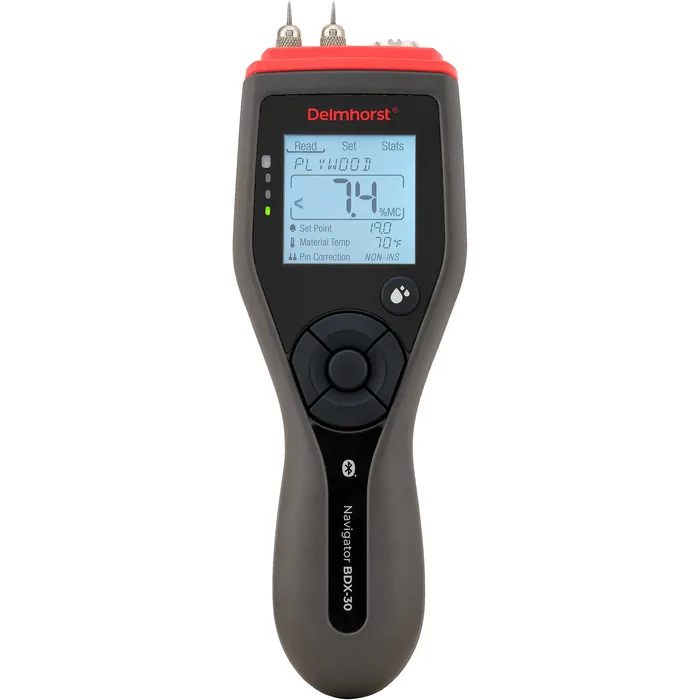
- Buy Delmhorst Navigator BDX-30 The one meter here that corrects for species, temperature and pin type, and lets you verify its own calibration before you trust a reading.
- Buy Lignomat mini-Ligno S/D A small pin meter that treats wood, gypsum and everything else as three different problems, with two pin depths in the box.
- It depends Wagner Meters Orion 950 Smart A pinless meter that leaves no holes and calibrates in the field, as long as you accept that anything other than solid wood comes back as an index. Amazon
- Skip General Tools MMD4E Pin-Type LCD Moisture Meter The default cheap pin meter, and the published spec sheet shows exactly what it leaves out. Amazon
What actually matters
- Species correction - Wood resistance varies enormously between species at the same moisture content, so a meter calibrated on one wood misreads others by several points. Look for named species settings in the meter, not a chart you have to apply by hand.
- Calibration species - Delmhorst states that its wood scale is calibrated on Douglas Fir, the USDA standard material. If a maker does not say what its scale is calibrated on, you cannot know what a reading means or how to correct it.
- Measurement depth - Pins report on the wood they touch and nothing deeper, which is why splitting a log and testing the fresh face matters. Pinless pads read a fixed depth, either side of which the reading degrades.
- Temperature - Delmhorst calibrates at 70 F and states that warmer wood reads higher and colder wood reads lower, with correction recommended outside roughly 50 to 90 F. Some pinless makers argue their sensors are largely immune.
- Fibre saturation - Above roughly 30% moisture content, meters lose usefulness. Wagner says its own wood range tops out at 32%.
- Scale honesty - Whether the meter gives you a true percentage for gypsum or only a relative index changes how you can use it. Both are legitimate; only one is a measurement.
- Calibration verification - An internal check with a published pass window, or a matched calibration block, is the only way to catch electronic drift before it costs you. Weak batteries are the usual first cause.
The specs, in plain English
Green flags vs red flags
Green flags
- The maker names the wood species its scale is calibrated on.
- Species corrections are selectable in the meter and applied automatically, not left to a printed table.
- Gypsum or drywall has its own published percentage range rather than being lumped into a generic building materials scale.
- The manual states a temperature correction range, or explains why the sensing method does not need one.
- A calibration check exists with a stated pass window, or a matched calibration block comes in the box.
Red flags
- A single scale claims to cover wood, drywall, concrete and plaster with one number.
- An accuracy figure is published but no species setting or calibration species appears anywhere on the spec sheet.
- A relative or reference number is presented on the packaging as though it were a moisture percentage.
- Pin length is not published, or is short enough that only the surface is being read.
- The listing quotes a top-of-range figure well above 30%, where every sensing method loses accuracy anyway.
Who's who: the brands
- Delmhorst - A US maker of conductance pin meters, known for publishing species and temperature correction tables and for building calibration checks into the meters.
- Wagner Meters - The pinless specialist, using an electromagnetic sensor pad, a specific gravity species setting and a paired calibration block that allows recalibration in the field.
- Lignomat - A Portland maker of compact pin meters with LED displays, separate wood and gypsum percentage scales and interchangeable pin depths.
- General Tools - A broad instrument maker whose budget pin meters are common in hardware stores, with basic specifications and no species correction.
- Extech - Now part of Teledyne FLIR, offering combination pin and pinless meters aimed at general building and HVAC work.
How to read a listing without getting fooled
Start at the bottom of the spec sheet, not the top. The headline is always a range and an accuracy figure, and neither means much on its own. Find the calibration species first: if the maker does not say, the percentage on the screen is an assumption. Then find the species correction, and note whether it is built into the meter or handed to you as a table. Then read the scales one at a time, because a maker who lists wood, gypsum and reference separately is telling you something a maker with one combined range is not. Check the pin length or the scan depth in inches and ask whether it reaches the part of the material you care about. Finally look for the words calibration check, and for a stated pass window or a supplied block. A meter that publishes all of that is telling you it expects to be questioned.
How much should you spend?
Budget meters are pin types with a fixed short pin, one wood scale and no species correction. They will separate soaking wet from dry and little else, which is enough if the only question is whether to keep stacking firewood. Mid-range buys you separate percentage scales for wood and gypsum, two or three species groups, and often a choice of pin depths, which is the point where the readings start supporting a decision rather than just an impression. Premium buys correction rather than features: named species corrections applied automatically, temperature correction with a published range, a pin type setting, a verifiable calibration check, and in the pinless world a matched calibration block. The jump from budget to mid-range changes what you can conclude. The jump from mid-range to premium mostly changes whether you can defend the conclusion to somebody else.
Questions, answered
Is a more expensive meter more accurate?
Not in the way people expect. The sensing electronics in a cheap pin meter and an expensive one work on the same principle. What you buy with money is correction and verification: a species setting, a temperature correction, a pin type setting and a way to check the meter has not drifted. Those close the gaps that create most real-world error, which is a different thing from the instrument being intrinsically more sensitive.
Where should I take the reading?
Somewhere representative of what you want to know, which is rarely the outside face. For firewood, split a piece and test the fresh inner face, because the outside of a split dries fastest and reads low. On lumber, take several readings along and across the board rather than one. Avoid nails, screws and metal framing entirely, since both sensing methods respond to metal and will read falsely high.
Can I use a wood moisture meter on concrete?
Only as an indicator. Neither sensing method has a percentage calibration for concrete, so you get a reference or relative number that is useful for comparing one area against another and nothing more. Concrete slab moisture is normally assessed by relative humidity probes placed in holes drilled into the slab, which is a different instrument and a different procedure.
How often should a moisture meter be calibrated?
Check it before any job whose outcome depends on the reading. Delmhorst's manual says to check the calibration before performing a job using either the internal Cal Check or an external calibration standard, and its first response to a failed check is to replace the batteries, because running a conductance meter on a weak battery can push it out of calibration. Recalibration itself usually means a return to the maker, unless the meter ships with a matched calibration block.
Or jump to the head-to-head: Delmhorst Navigator BDX-30 vs Lignomat mini-Ligno S/D.