

Tools & DIY
The Best Moisture Meters: 4 Compared (and One to Skip)
We compared four handheld moisture meters on the things that decide whether a reading means anything: how they sense moisture, whether they correct for wood species and temperature, what they actually publish for drywall, and whether you can check calibration in the field.
The short version
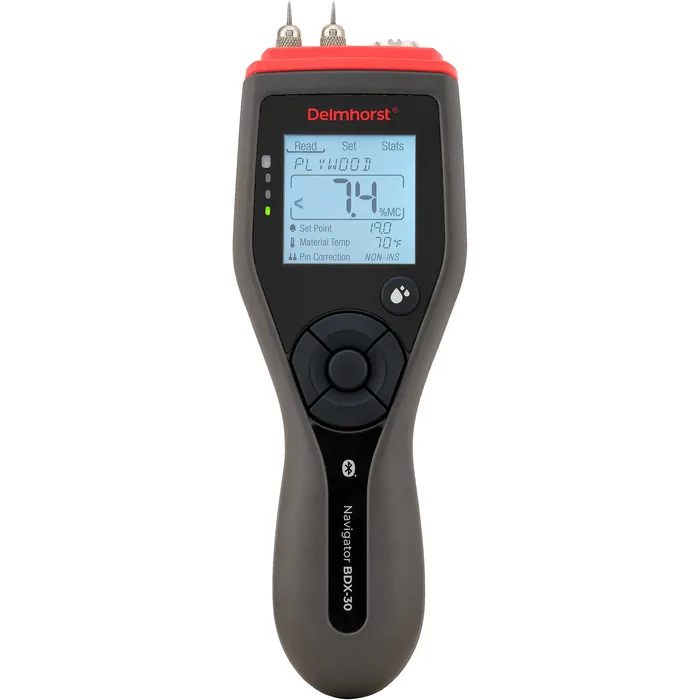
The Delmhorst BDX-30 is the pick if the number has to hold up: a wood scale from 6% to 60%, a genuine drywall scale from 0.1% to 6%, 37 species and material corrections loaded through the app, temperature correction across 0 to 255 F, and an internal calibration check that has to land between 11.8 and 12.2. The Lignomat mini-Ligno S/D is the value buy, with two wood group settings, three separate gypsum and wallboard settings and two pin lengths in the box. The Wagner Orion 950 is the depends pick, because a pinless sensor leaves no holes and Wagner says it is virtually unaffected by wood temperature, but everything that is not solid wood comes back on a 0 to 100 relative scale rather than a percentage. The General Tools MMD4E is the skip: it publishes an accuracy figure but no species setting and no calibration species, which is the one correction that moves readings most. Whatever you buy, learn the target before you read the number. Best for: anyone deciding whether wood is dry enough to burn, install, finish or leave alone.
Our picks at a glance
- Delmhorst Navigator BDX-30 - Buy. The one meter here that corrects for species, temperature and pin type, and lets you verify its own calibration before you trust a reading.
- Lignomat mini-Ligno S/D - Buy. A small pin meter that treats wood, gypsum and everything else as three different problems, with two pin depths in the box.
- Wagner Meters Orion 950 Smart - It depends. A pinless meter that leaves no holes and calibrates in the field, as long as you accept that anything other than solid wood comes back as an index.
- General Tools MMD4E Pin-Type LCD Moisture Meter - Skip. The default cheap pin meter, and the published spec sheet shows exactly what it leaves out.
The verdict in 30 seconds
What mattered most
- Sensing method
- Published wood range
- Species handling
- Drywall reading
- Non-wood reference scale
- Depth reached
A moisture meter does not measure water. It measures an electrical property and converts it, through a calibration built around one reference wood, into a percentage. That conversion is where meters differ, and it is why two meters can sit on the same board and disagree by several points. We picked four meters that are sold now, read every number off the maker's own spec sheet or manual, and paid most attention to what each one corrects for and what it quietly leaves to you.
The one meter here that corrects for species, temperature and pin type, and lets you verify its own calibration before you trust a reading.
Best for: Inspectors, restoration crews and anyone whose reading ends up in a report someone else will act on.
- Three real scales: wood from 6% to 60% on the Douglas Fir calibration, drywall from 0.1% to 6%, and a 1 to 100 reference scale for everything else.
- Thirty seven species and material corrections are available through the EDGE app, with twelve held in the meter at a time, and the meter applies the correction to each reading automatically.
- An internal Cal Check reports a number that has to fall between 11.8 and 12.2, so a drifting meter shows itself before it costs you a floor.
- Temperature correction only becomes available when a wood material is selected, so drywall and reference readings get none.
- The integral pins reach 5/16 in, and anything deeper needs one of the separate hammer or insulated electrodes.
- Species corrections beyond the twelve stored in the meter require a phone and the app, which is one more thing to have charged on a job.
- It is the most expensive way here to answer a simple question, and most homeowners will never use the statistics or the data export.
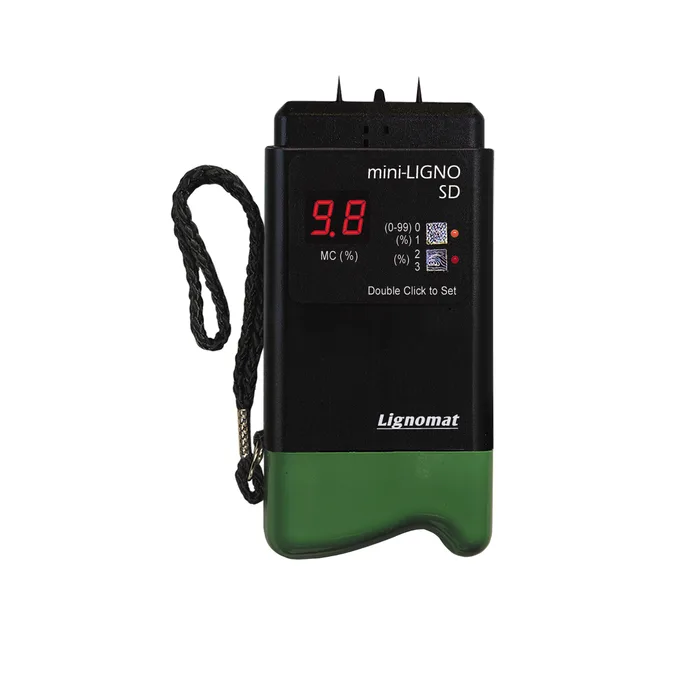
A small pin meter that treats wood, gypsum and everything else as three different problems, with two pin depths in the box.
Best for: Woodworkers, flooring installers and homeowners who need one meter that reads wood and drywall honestly without a subscription to anything.
- Separate percentage scales for wood and for gypsum, with two wood group settings and three settings for gypsum, drywall and various wall boards.
- Two pin sets are supplied, giving 3/16 in and 7/16 in measuring depths, so you can compare surface against core without buying an accessory.
- A 0 to 99 reference scale covers concrete, brick and plaster, kept clearly separate from the percentage scales.
- Two wood group settings is a coarse correction, and anything unusual sends you to the laminated species card that ships with it.
- The published range is 6% to 45% and varies by species, so very wet wood reads at the top of the scale rather than usefully.
- Temperature correction is a table in the manual rather than something the meter applies for you.
- The LED display steps in 1% increments above 10%, so the resolution you get is coarsest exactly where flooring decisions get made.
Amazon had no buyable listing for this when we last checked. The link still works if it returns.
Check price on Amazon Read our detailed assessment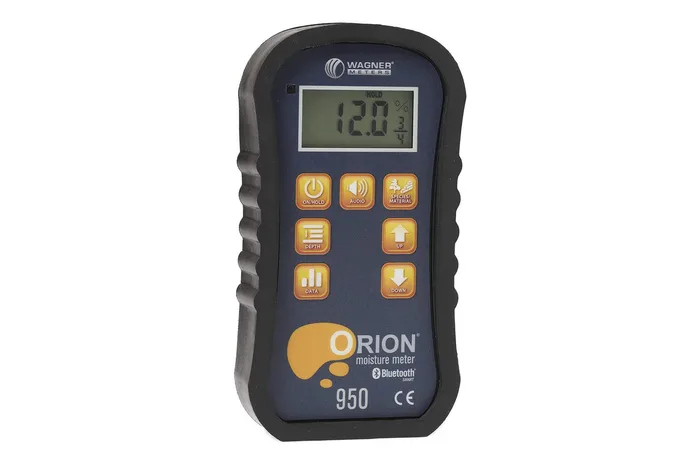
A pinless meter that leaves no holes and calibrates in the field, as long as you accept that anything other than solid wood comes back as an index.
Best for: Flooring installers and woodworkers checking finished or valuable stock, where a pinhole is the problem and drywall is not.
- Scans a 2.0 in by 2.5 in area at a selectable 0.25 in or 0.75 in depth, so a finished surface stays unmarked.
- Ships with an On-Demand Calibrator paired to the meter by serial number, which is a genuine field calibration rather than a battery test.
- Built-in temperature and humidity sensing feeds an equilibrium moisture content calculation, and Wagner says the meter is virtually unaffected by wood temperature.
- Non-wood materials including drywall, plywood, OSB and MDF read only on a 0 to 100 relative scale, which is not a percentage.
- Species correction is entered as a specific gravity value from 0.20 to 1.0, so you have to know or look up the density of what you are holding.
- Wagner states that wood thinner than 0.75 in read in the deep mode will underestimate the actual moisture content.
- The calibrator has to be used on a non-metallic surface, which is a fair warning about how the sensor responds to metal generally.
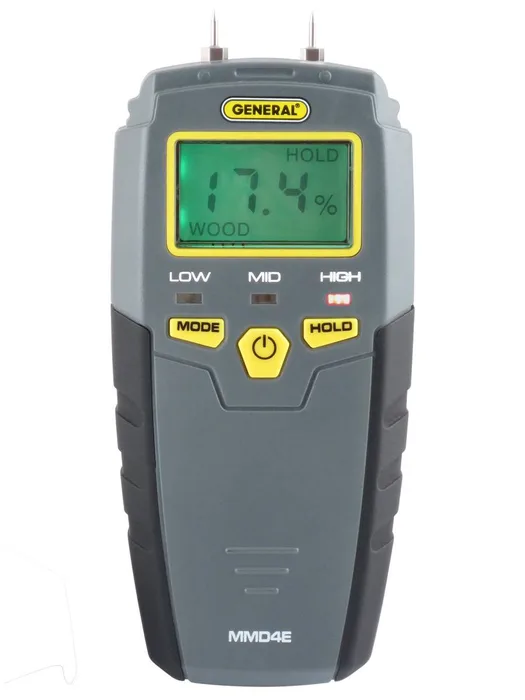
The default cheap pin meter, and the published spec sheet shows exactly what it leaves out.
Best for: Almost nobody, though it will still tell you that soaking wet is not the same as dry if that is genuinely all you need.
- Reads wood from 5% to 50% and building materials from 1.5% to 33%, which covers the range most people care about.
- General publishes an accuracy and resolution figure of plus or minus 2% and 0.1%, which many meters at this level do not.
- Light at 3 oz with a backlit display and colour tone bands, so it is easy to carry and easy to read one-handed.
- The spec sheet lists a wood and building material switch and nothing else. There is no species setting, and no calibration species is named, so the number rests on an assumption you cannot see or change.
- The pins reach 0.3 in, which tells you about the outer few millimetres of a split log or a joist and nothing about the core.
- No temperature correction is published, and the only field calibration aid is the pin cap that doubles as a checker.
- The wood scale is labelled WME, wood moisture equivalent, which is the convention for reading non-wood materials as if they were wood.
| Criteria | Navigator BDX-30 Top pick | mini-Ligno S/D | Orion 950 Smart | MMD4E Pin-Type LCD Moisture Meter |
|---|---|---|---|---|
| Verdict | Buy it | Buy it | It depends | Skip it |
| Best for | Inspectors, restoration crews and anyone whose reading ends up in a report someone else will act on. | Woodworkers, flooring installers and homeowners who need one meter that reads wood and drywall honestly without a subscription to anything. | Flooring installers and woodworkers checking finished or valuable stock, where a pinhole is the problem and drywall is not. | Almost nobody, though it will still tell you that soaking wet is not the same as dry if that is genuinely all you need. |
| Price tier | $$$ · premium | $$ · mid-range | $$$ · premium | $ · budget |
| Sensing method | Pin, electrical resistance | Pin, electrical resistance | Pinless, electromagnetic field | Pin, electrical resistance |
| Published wood range | 6% to 60% on Douglas Fir | 6% to 45%, varies by species | 4.0% to 32.0%, varies by setting | 5% to 50% WME |
| Species handling | 37 corrections via app, 12 stored | 2 wood group settings plus species card | Specific gravity 0.20 to 1.0 | None published |
| Drywall reading | Drywall scale 0.1% to 6% | 3 gypsum and wallboard settings | Relative scale only, not a percentage | Building materials 1.5% to 33% |
| Non-wood reference scale | Reference 1 to 100 | Reference 0 to 99 | Relative 0 to 100 | None published |
| Depth reached | 5/16 in pins, more via electrodes | 3/16 in and 7/16 in pin sets | 0.25 in or 0.75 in scan | 0.3 in pins |
| Temperature correction | Yes, 0 to 255 F, wood only | Table in the manual | Maker says virtually unaffected | Not published |
| Field calibration check | Internal check, must read 11.8 to 12.2 | Built-in check plus optional check block | Paired On-Demand Calibrator | Pin cap doubles as a checker |
Which one is right for you?
- Inspectors, restoration crews and anyone whose reading ends up in a report someone else will act on. Buy it Delmhorst Navigator BDX-30
- Woodworkers, flooring installers and homeowners who need one meter that reads wood and drywall honestly without a subscription to anything. Buy it Lignomat mini-Ligno S/D
- Flooring installers and woodworkers checking finished or valuable stock, where a pinhole is the problem and drywall is not. It depends Wagner Meters Orion 950 Smart
- Almost nobody, though it will still tell you that soaking wet is not the same as dry if that is genuinely all you need. Skip it General Tools MMD4E Pin-Type LCD Moisture Meter
How we judged the field
Five things separate a moisture meter that helps from one that misleads. First, sensing method, because pins read the resistance between two points at a known depth and a pinless pad reads the capacitance of a volume, and those are not interchangeable answers. Second, species correction, because resistance varies enormously between species at the same moisture content: Delmhorst calibrates on Douglas Fir and publishes a table where a single displayed reading of 20 maps to anything from about 15.5% to about 25% depending on the wood. Third, temperature, because Delmhorst calibrates at 70 F and states that a higher wood temperature raises the indicated moisture content while a lower one drops it. Fourth, what the meter publishes for non-wood materials, since a reference or relative scale is an index and not a percentage. Fifth, whether you can check calibration without posting the meter back.
The field splits cleanly. Pin meters dominate building inspection because they can be driven deep, they can find a wet pocket, and two makers publish a true percentage scale for gypsum. Pinless meters dominate flooring and woodworking because they leave no holes and cover a board in seconds, but every maker we read treats non-wood materials as a relative reading. We took one meter from each corner and one from the middle. The Delmhorst BDX-30 is the fully corrected pin meter. The Lignomat mini-Ligno S/D is the same idea, smaller and cheaper. The Wagner Orion 950 is the best argued case for going pinless. The General Tools MMD4E is the meter most people actually pick up, and reading its spec sheet next to the other three is the fastest way to see what you give up.
Delmhorst Navigator BDX-30
Buy itThe BDX-30 is the only meter in this group that closes all three gaps at once. It corrects for species, with 37 corrections loaded through Delmhorst’s app and twelve held in the meter, applied automatically to each reading. It corrects for wood temperature across a 0 to 255 F range, which matters because Delmhorst calibrates at 70 F and says readings drift up in warm wood and down in cold. It corrects for pin type, since insulated pins report the moisture only where the tips sit, and it lets you tell the meter which you are using. It carries three separate scales rather than one pretending to cover everything: wood from 6% to 60%, drywall from 0.1% to 6%, and a 1 to 100 reference for the rest. The internal Cal Check has to return 11.8 to 12.2 or the meter is out. That is the difference between a reading and evidence. It is the priciest thing here, and if the reading is only ever for you that is real money spent on rigour. For anyone writing it down for a client, it is the right tool.
Lignomat mini-Ligno S/D
Buy itThe mini-Ligno S/D is the sensible middle. Lignomat gives you two wood group settings covering softwoods, hardwoods and panel products on a percentage scale, three separate settings for gypsum, drywall and other wall boards also on a percentage scale, and a 0 to 99 reference scale for concrete, brick and plaster. Keeping those apart is the whole point, because a meter that reports one number for every material is asking you to guess which assumption it used. The box holds two pin sets, at 3/16 in and 7/16 in measuring depths, so you can take a surface reading and a deeper one on the same board and see the gradient rather than infer it. The published range is 6% to 45% and varies by species. The compromises are real: two wood groups is coarse next to 37 named corrections, the display steps in whole percent above 10%, and the temperature correction is a table in the manual rather than something the meter applies for you. For a woodworker or a homeowner chasing a damp patch, that is a fair trade.
Wagner Meters Orion 950 Smart
It dependsThe Orion 950 is the strongest argument for pinless, and it is still only right for some people. The sensor scans a 2.0 in by 2.5 in area at either 0.25 in or 0.75 in, so a finished floor or a piece of figured stock comes away unmarked, and Wagner says the meter is virtually unaffected by wood temperature, which removes a correction you would otherwise have to apply. Every Orion ships with an On-Demand Calibrator paired to it by serial number, so you can recalibrate on site rather than post the meter away. The catch is what pinless cannot do. Species correction is entered as a specific gravity value between 0.20 and 1.0, so you need to know the density of the wood in your hand. Wagner states that stock thinner than 0.75 in read in deep mode will read low. And drywall, plywood, OSB and MDF come back only on a 0 to 100 relative scale, which Wagner itself describes as a go or no go value. Buy it for wood. Do not buy it to investigate a wall.
General Tools MMD4E Pin-Type LCD Moisture Meter
Skip itThe MMD4E is the meter most people own, and its own spec sheet makes the case against it. General publishes a wood range of 5% to 50% WME, a building materials range of 1.5% to 33%, and accuracy of plus or minus 2%. What the sheet does not list is any species setting, or any statement of which wood the scale is calibrated against. That single omission is the biggest source of error in the category: Delmhorst’s published table shows a reading of 20 on a Douglas Fir calibration corresponding to roughly 15.5% in one species and 25% in another. A published accuracy figure cannot survive an uncorrected species assumption. The pins reach 0.3 in, so on a split log or a joist you are measuring the outer few millimetres, which is the part that dries first and reads lowest. No temperature correction is published, and the only calibration aid is a pin cap that doubles as a checker. It is genuinely useful for one thing, telling wet from dry in a rough way, and it is a poor basis for any decision that costs money.
Sources
Specs in this review come from these pages.
- Delmhorst Instrument Co., BDX-20 and BDX-30 Owner's Manual (delmhorst.com)
- Delmhorst Instrument Co., BDX-30 product specifications (delmhorst.com)
- Wagner Meters, Orion 950 specifications and species settings (shop.wagnermeters.com)
- Lignomat, mini-Ligno S/D specifications (lignomatusa.com)
- ASTM D7438, Field Calibration and Application of Hand-Held Moisture Meters (astm.org)
- US EPA Burn Wise, Best Wood-Burning Practices (epa.gov)
Delmhorst Navigator BDX-30 vs Lignomat mini-Ligno S/D: which should you buy?
The BDX-30 and the mini-Ligno S/D are both pin meters that take the same three jobs seriously: wood as a percentage, gypsum as a percentage, and everything else as an admitted index. The difference is how much of the correction each one does for you. Delmhorst loads 37 species and material corrections and applies them automatically, adds a wood temperature correction across 0 to 255 F, adds a pin type correction, and gives you a calibration check with a pass window of 11.8 to 12.2. Lignomat gives you two wood groups, three gypsum settings, a species card printed on laminate and two pin depths in the box, and asks you to do the rest yourself.
Choose by who reads the number. If a reading of yours will end up in an inspection report, a warranty claim or an insurance file, the Delmhorst is worth it, because every correction it applies is one fewer thing an opposing expert can pick apart, and the Cal Check gives you something to say about the instrument itself. If the reading is for you, deciding whether to lay a floor, glue a panel or light a fire, the Lignomat gets you to the same decision for a fraction of the outlay, and the two pin depths let you see a moisture gradient that a single fixed pin length hides. Neither is a mistake. One is documentation, the other is a decision.
What to look for
- Species setting, not species chart: a meter that names the wood and applies the correction itself beats one that hands you a laminated card you will lose, and a meter with no correction at all is reporting an assumption.
- Which wood the scale is calibrated on: Delmhorst states Douglas Fir, the USDA standard, on the face of its spec. A maker that does not say has not told you what the number means.
- A real percentage scale for gypsum, or an honest index: Delmhorst publishes 0.1% to 6% for drywall and Lignomat publishes three gypsum settings. A 0 to 100 relative reading is fine, but only if the maker calls it what it is.
- Depth, stated in inches: 0.3 in pins tell you about the surface, 7/16 in pins reach further, a hammer electrode reaches further still, and a pinless pad reads a fixed 0.25 in or 0.75 in. Match the depth to what you are trying to find.
- Temperature correction, or a maker who explains why it is not needed: Delmhorst calibrates at 70 F and publishes a correction range, and Lignomat lists a table in its manual. Wagner argues its pinless sensor is virtually unaffected. Silence on the subject is the answer you should worry about.
- A field calibration check: an internal check with a stated pass window, or a physical calibration block, is the only way to know the electronics have not drifted. Delmhorst’s window is 11.8 to 12.2 and its first move on a failure is fresh batteries.
Our final take
Buy the Delmhorst BDX-30 if your readings matter to someone other than you, because it is the only meter here that corrects for species, temperature and pin type and then lets you prove it is still in calibration. Buy the Lignomat mini-Ligno S/D if you just need to make good decisions about your own wood and your own walls, because it keeps wood, gypsum and reference readings honestly separate and gives you two pin depths to see a gradient. Take the Wagner Orion 950 if leaving no holes matters more than reading drywall. Skip the General Tools MMD4E, not because it is badly made, but because its spec sheet quietly omits the one correction that moves the number most.
Questions, answered
Do I need a pin meter or a pinless one?
They answer different questions. A pin meter passes current between two points and reports the resistance between them, so it tells you about the wood along the pins and nothing else. A pinless meter builds an electromagnetic field under a sensor pad and reports on the volume inside that field, which on the Orion 950 is a 2.0 in by 2.5 in area at either 0.25 in or 0.75 in deep. Pins leave holes but can go deep with a hammer electrode and can find a wet pocket. Pinless leaves no marks and covers ground fast, but it needs a flat surface, it is sensitive to density, and Wagner warns that stock thinner than 0.75 in read in deep mode will read low. If you only buy one, buy pins.
Why does the same board read differently on two meters?
Because both are converting an electrical measurement using an assumption about the wood. Delmhorst calibrates its wood scale on Douglas Fir, the USDA standard, and publishes a correction table showing how far other species land from it. On that table a meter reading of 20 corresponds to about 15.5% in Philippine mahogany and about 25% in spruce, pine and fir. That is nearly ten points of spread from one displayed number. ASTM D7438 makes the same point in standard language, noting that meters using different technologies may not give equivalent readings under the same conditions. Neither meter is broken. They are answering with different assumptions.
What moisture content am I actually aiming for?
It depends entirely on the job, which is why a bare percentage is useless. For firewood, the EPA says wood burns best below 20% moisture content, and University of Tennessee Extension puts green wood normally above 60% and sometimes as high as 120%. For wood flooring, the trade guidelines allow no more than 4% difference in moisture content between properly acclimated flooring and the subfloor, with the building held between 30% and 50% relative humidity. For a wet wall, Delmhorst's default warning thresholds on its gypsum scale are green up to 0.4%, amber from 0.5% to 0.9% and red at 1% and above. Look up the target first, then take the reading.
What does the relative or reference scale actually mean?
It is an index, not a measurement. Delmhorst says plainly that the numbers on a reference scale are not indicative of a specific percentage of moisture content, so a 12 on a 0 to 100 reference scale does not mean 12% moisture. Wagner is equally direct about its relative mode, describing it as a go or no go value, useful for deciding whether one area holds more moisture than another, not for absolute accuracy. The ranges are not standardised between makers either. Used properly you take a reading on a known dry patch of the same material first and compare everything else against that baseline.
Can I check whether my meter is still accurate?
Sometimes, and it is worth buying a meter that lets you. The Delmhorst BDX-30 has an internal Cal Check that must return a value between 11.8 and 12.2, and Delmhorst's first instruction if it fails is to change the batteries, since running a conductance meter on a low battery can push it out of calibration. Wagner ships every Orion with an On-Demand Calibrator matched to that meter by serial number, which lets you recalibrate rather than only verify. The General Tools MMD4E offers only a pin cap that doubles as a checker. The reference method behind all of this is the oven-dry test, which ASTM D4444 uses to standardise handheld meters in the first place.
Deciding between the top two? See our head-to-head: Delmhorst Navigator BDX-30 vs Lignomat mini-Ligno S/D.
More Tools & DIY reviews
 The Best Digital Multimeters: 4 Compared (and One to Skip)
  The Best Non-Contact Voltage Testers: 4 Compared (and One to Skip)
  The Best Oscillating Multi-Tools: 4 Compared (and One to Skip)
  The Best Outlet Testers: 4 Compared (and One to Skip)
  The Best Pipe Wrenches: 4 Compared (and One to Skip)
  The Best Pocket Hole Jigs: 4 Compared (and One to Skip)